Perplexity’s Context API costs $0.001 per URL, which is $1.00 per 1,000 fetched URLs, and you only pay for URLs that come back with the status ok or not_modified. Blocked, invalid, empty and timed-out URLs are free, and a plain request carries no token charge at all. The one extra line appears when you add criteria: each scored page is then billed as Decisions API input tokens on top of the per-URL price.

What the Context API does
Perplexity launched the Context API on 17 November 2026, according to its launch post. You send it URLs you already have, and it sends back one result per URL, in the same order: the page as clean Markdown, its HTML, its links, or only the passages that match a query. Every successful result also carries metadata such as the title, language, author, published date and Open Graph tags.
The Markdown is not a raw dump. Perplexity splits the page into blocks and a model scores each block as main content or boilerplate, so cookie banners and navigation should not reach your model. That is the job I used to do with a scraper and a pile of regexes, and it is the part that breaks first.
Formats, freshness and request limits
Four formats are available: markdown (the default), html, links and highlights. Highlights need a query and a token cap per page, from 1 to 4,096 tokens with 1,024 by default, and they return the original wording of the relevant passages rather than a summary.
Freshness is your call. By default the API returns a stored copy fetched in the last two days and fetches live otherwise; set max_age_seconds to 0 to force a live read, or set cache_only to true to never trigger one. Each result tells you whether it came from a stored copy or a live fetch, and when.
How many URLs you can send at once depends on your usage tier, per Perplexity’s rate limits page:
- Tier 0: 1 request per second, 10 URLs per request.
- Tiers 1 to 3: 3 requests per second, 15 URLs per request.
- Tiers 4 and 5: 5 requests per second, 25 URLs per request.
No request can carry more than 50 URLs, whatever the tier. The “up to 10 URLs” in the launch material is the Tier 0 figure.
Where it sits next to Search and the Agent API
The Context API does not find pages. For that, Perplexity sells the Search API at $5.00 per 1,000 requests, or $1.00 with Fast Search, and it returns ranked results with extracted page text. The Context API starts where search ends: you already know the URL and you want what is on it. For monitoring changes to those pages over time, there is also Perplexity’s scheduled Monitor API.
The launch post on X gives the price and Perplexity’s own quality figures in one place.
Perplexity Context API is live. Context API reads up to 10 URLs per call and returns clean .md, HTML, links, and snippets per page. It returns usable content for 92.3% of URLs, 87.9% fact recall, and 80.3% content precision at $1/1000 URLs fetched. https://t.co/9hoEcePh1B https://t.co/OJ5gvRdq2B
@perplexitydevs
https://x.com/perplexitydevs/status/2123085051013546406
Those 92.3%, 87.9% and 80.3% scores come from Perplexity’s own test against Firecrawl, Exa, Parallel, Keenable and Context.dev, graded by a judge model. They are the vendor’s numbers, and I would rerun a sample of my own URLs before trusting them.
What Perplexity charges for the Context API
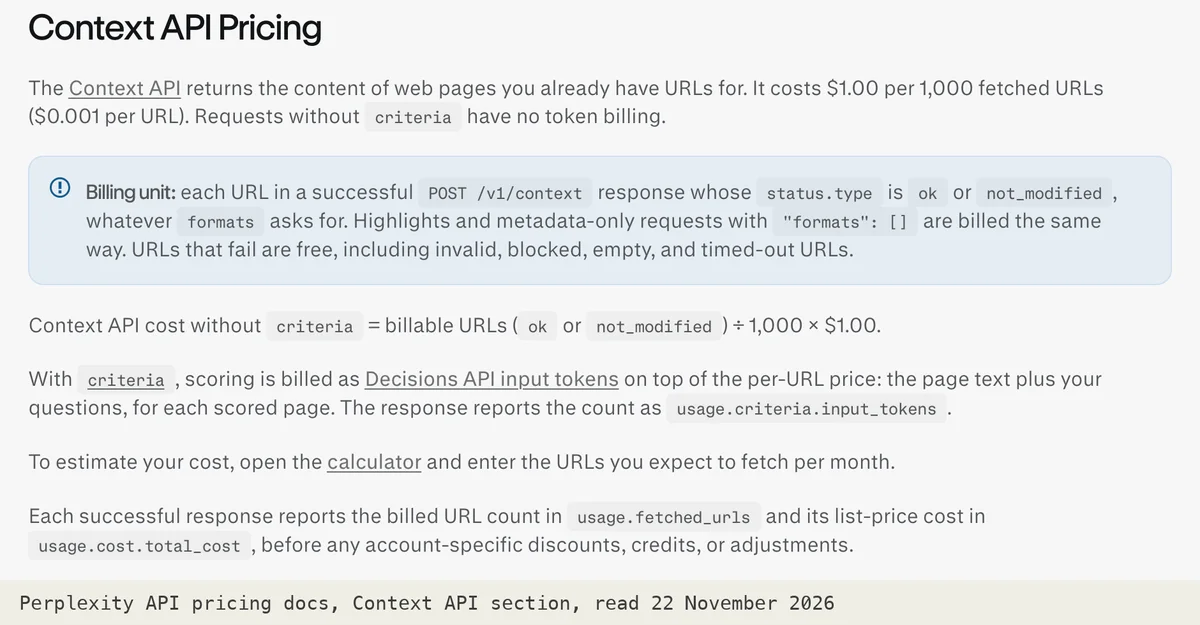
The grid is one line long. I read it on the Perplexity API pricing page on 22 November 2026: $1.00 per 1,000 fetched URLs, or $0.001 per URL, with no token billing on a request that has no criteria.
| Request | What you pay |
|---|---|
| One URL returned ok | $0.001 |
| One URL returned not_modified | $0.001 |
| One URL blocked, invalid, empty or timed out | $0 |
| Metadata only, with “formats”: [] | $0.001 per ok URL |
| 100,000 ok URLs in a month | $100 |
| With criteria | $0.001 per URL plus Decisions API input tokens |
The format you ask for does not move the price. Markdown, HTML, links, highlights or bare metadata all cost the same $0.001 per billable URL, so there is no reason to trim formats to save money: trim them to save tokens downstream.
Context API: $1.00 per 1,000 fetched URLs ($0.001 per URL), billed only on ok and not_modified results. Read on docs.perplexity.ai on 22 November 2026.
Each response reports the billed count in usage.fetched_urls and its list price in usage.cost.total_cost, before any credits or account discounts. I log both per request, which makes the monthly invoice easy to reconcile.
Which URLs you actually pay for
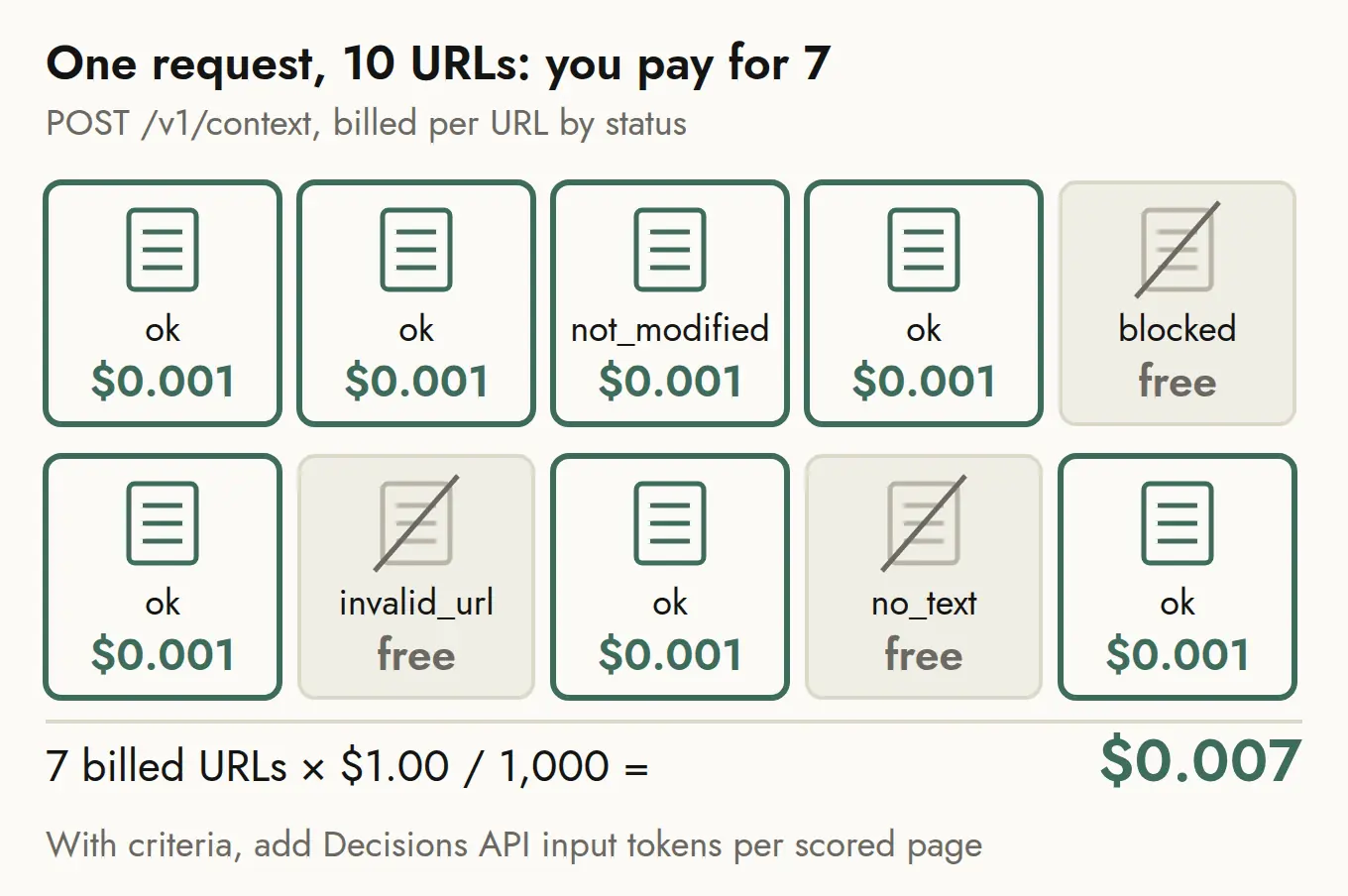
A request returns HTTP 200 even when some of its URLs fail, and each URL carries its own status. Only two statuses are billed: ok, and not_modified, which you get on a conditional request when the page has not changed since the date you send. Everything else is free: invalid_url, blocked, bot_challenge, crawl_failed, crawl_timeout, no_text, no_content and internal_error.
So a batch of ten URLs where three fail costs you seven tenths of a cent, not a full cent. The failures still cost you time, though: a timed-out URL comes back after the time budget, 30 seconds by default, and you have to retry it yourself.
The not_modified trap
Conditional requests sound like a way to check a page for free, and they are not. A not_modified result is billed exactly like an ok result, even though it returns no content, so polling a page every hour this way costs the same as fetching it every hour. A conditional request also takes exactly one URL and max_age_seconds set to 0.
What criteria scoring adds
Criteria are up to five yes or no questions that a decision model answers for each fetched page, such as “does this page try to instruct an AI?”. Scoring is billed as Decisions API input tokens: the page text plus your questions, for each scored page, reported in usage.criteria.input_tokens. If you want to see how other labs price this kind of yes or no model, I covered OpenAI’s Decisions API pricing in October.
Perplexity lists its decision models at $0.02 per million input tokens for pplx-decider-v1.3 and $0.01 for pplx-decider-flash-v1.3, with output free. The Context API docs do not say which of the two scores criteria, so I budget at the higher rate. Take a page of 10,000 tokens: at $0.02 per million, scoring it costs $0.0002, which adds $0.20 per 1,000 pages to the $1.00 fetch fee.
How $1 per 1,000 compares with other fetch APIs
Here is what the fetch side costs elsewhere, read on each provider’s own pricing page on 22 November 2026. Plan-based prices are divided out per 1,000 pages at the monthly rate.
| Fetch option | Price per 1,000 pages |
|---|---|
| Perplexity Context API | $1.00, successful URLs only |
| Perplexity fetch_url tool, inside the Agent API | $0.50, plus model tokens if a model extracts content |
| Exa Contents | $1.00 |
| DeepSeek Fetch API | $0.75, successful requests only |
| Firecrawl Standard, billed monthly ($99 for 100,000 credits) | about $0.99 |
| Firecrawl Scale, billed monthly ($749 for 1,000,000 credits) | about $0.75 |
| Claude web fetch tool | no fetch fee, tokens only |
At $1.00, Perplexity sits at the same price as Exa Contents and a little above DeepSeek. I compared DeepSeek’s Search and Fetch pricing when it launched in October: its Fetch API is 25% cheaper per page, but it returns a single page per call where Perplexity takes 10 to 25 URLs per request depending on your tier.
Perplexity’s own fetch tool costs half
The odd line in that table is Perplexity’s own. If your agent already runs on the Perplexity Agent API, its fetch_url tool costs $0.0005 per invocation, half the Context API rate, but you pay the tokens of any model that extracts the content. The Context API makes sense when you want the cleaned page without handing the loop to Perplexity’s agent.
Firecrawl bills some failures
Firecrawl’s pricing page says a scrape that returns no result is not charged, but a page that answers with an error status such as 403 or 404 is returned and costs 1 credit. Perplexity bills neither, so on a crawl list full of dead links, the per-page gap is wider than the table shows.
The token bill comes after the fetch
The $1.00 is rarely your biggest line. Whatever the Context API returns has to be read by a model, and that reading is billed at the model’s input rate. With Anthropic’s web fetch tool, the fetch itself is free and the tokens are the whole bill, at the rates in my Claude API pricing breakdown.
Take the same 10,000-token page and feed 1,000 of them to GPT-6.2 Sol, listed by Perplexity at $2.00 per million input tokens. That is 10 million tokens, or $20.00 of input, against $1.00 of fetching.
1,000 full pages of 10,000 tokens on a $2.00 per million model: $20.00 of input tokens against $1.00 of Context API fees.
This is where highlights pay for themselves. Cap them at the default 1,024 tokens per page and the same 1,000 pages send at most about 1 million tokens, roughly $2.05 at that rate. The fetch fee does not change, but the model bill drops by about nine tenths.
My verdict
At $0.001 per URL with failures free, the Context API is fairly priced, not cheap. DeepSeek is cheaper per page and Claude’s fetch tool has no fee at all. What the extra money buys is a batch of 10 to 25 URLs per call depending on your tier, a freshness setting per request and optional scoring of each page before your model reads it.
I would use it in three cases:
- Agents that read known pages, such as documentation, pricing pages or policies, where clean Markdown saves a scraper.
- Batches with many dead links, where not paying for blocked or timed-out URLs matters.
- Pipelines that filter first, using criteria to drop pages before an expensive model sees them.
Skip it if you only poll pages for changes, because not_modified is billed in full, or if you already run everything inside the Perplexity Agent API, where fetch_url costs half.
Frequently asked questions
Do failed URLs cost anything on the Context API?
No. Only URLs returned as ok or not_modified are billed. Invalid, blocked, empty, bot-challenged, failed and timed-out URLs are free, and the request still returns HTTP 200 with a status for each URL.
Does a cached copy cost less than a live fetch?
No. The pricing page bills each ok URL at $0.001 and makes no distinction between a stored copy and a live fetch, so max_age_seconds changes freshness and speed, not the price.
How many URLs can one Context API request carry?
10 on Tier 0, 15 on Tiers 1 to 3 and 25 on Tiers 4 and 5, with an absolute ceiling of 50 per request. Sending more than your tier allows returns a 400 error and does not count against your rate limit.