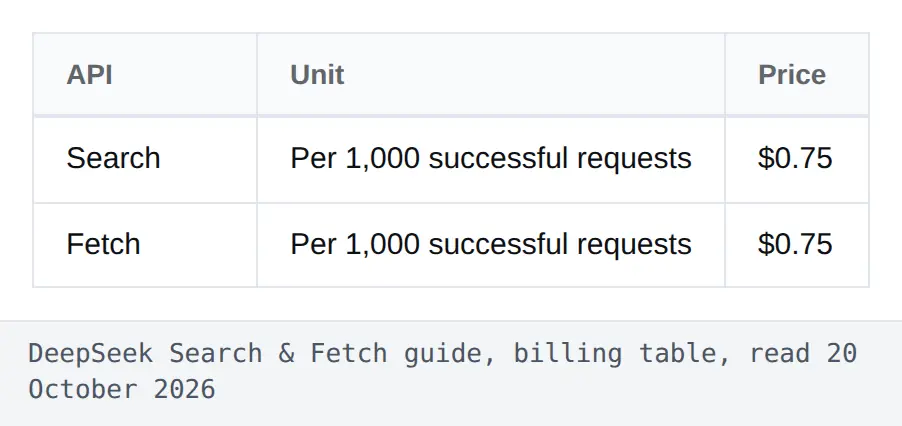
DeepSeek charges $0.75 per 1,000 successful requests for its Search API and the same $0.75 for its Fetch API, billed per call and not per token or per result. Failed calls, empty search results and timeouts are not billed. Calls made through DeepSeek Harness, Claude Code or Codex stayed free until 00:00 Beijing time on 1 November 2026, which is 16:00 UTC on 31 October, and have been billed at the same rate since. At that price, a DeepSeek search costs about a thirteenth of the $10 per 1,000 searches that Anthropic and OpenAI charge for their web search tools.

What DeepSeek charges for Search and Fetch
DeepSeek opened both APIs to every account on 17 October 2026, according to its API change log. Search returns structured web results from DeepSeek’s in-house search engine, and Fetch returns a single page as Markdown. Both are plain JSON endpoints that use your normal DeepSeek API key.
The price grid
The grid is short, and as of 20 October 2026 it reads the same on the Search and Fetch guide and on the models and pricing page.
| API | Price per 1,000 successful requests |
|---|---|
| Search (POST /v1/tools/search) | $0.75 |
| Fetch (POST /v1/tools/fetch) | $0.75 |
There is no peak and off-peak split on these two APIs, unlike the token prices. The guide lists no free allowance for direct calls: the free period below only covered calls routed through agent tools.
DeepSeek’s own launch post carries the same figure, $0.75 per 1,000 calls for each endpoint.
🔍 Search & Fetch APIs are now open to everyone! Powered by our in-house search engine, serving hundreds of millions of requests daily worldwide. 💰 Each endpoint: $0.75 per 1,000 calls. 📖 Docs: https://t.co/jnihMCWbyg 📌 Search & Fetch calls via server-side tools in DeepSeek
@deepseek_ai
https://x.com/deepseek_ai/status/2111375650414309859
What counts as a billable request
This is the part of the grid I like most. A request is billable only when it returns HTTP 200 and actually produces a result, so you never pay for a dead end.
- Search is billed only when the results array is not empty. A query that matches nothing is free.
- Fetch is billed only when it returns page content. A blocked URL or a page with no extractable Markdown comes back as a 404 and costs nothing.
- Errors and timeouts (400, 429, 5xx, 504) are not billed.
- The count parameter does not change the price: asking for 50 results costs the same as asking for 1.
The last point matters for agents. If your loop runs three narrow searches of five results, ask once for fifteen instead and you pay a third of the fee.
The free window ended on 31 October at 16:00 UTC
When you run the DeepSeek API behind DeepSeek Harness, Claude Code or Codex, the server-side search and fetch tools already call these two APIs. Those calls were free until the cut-off below; since 1 November they are billed at the same $0.75 per 1,000.
Per-request billing started at 00:00 Beijing time on 1 November 2026, which is 16:00 UTC on 31 October 2026 and noon in New York.
If you run a coding agent on DeepSeek, check your logs. The number of searches your agent fires per task is the number you now pay for.
Search and Fetch next to DeepSeek token prices
The $0.75 is only the entry fee. Whatever Search or Fetch returns has to be read by a model, and that reading is billed as input tokens at the model’s own rate.
Reading search results costs tokens too
Each search result carries a summary that DeepSeek sizes at 600 to 800 characters, written to be read by a model. Ten results therefore add roughly 7,000 characters to your context, or about 1,750 tokens with the usual four characters per token.
On deepseek-flash, served by DeepSeek-V4.1-Flash-1017, a cache miss costs $0.30 per million input tokens at peak. A thousand ten-result searches read in full would add about 1.75 million tokens, or roughly $0.53, so the reading costs about as much as the search fee itself. On deepseek-v4-pro at $1.32 per million, the same reading comes to about $2.31, three times the search fee.
| DeepSeek price (peak, per 1M tokens) | deepseek-flash / deepseek-v4-pro |
|---|---|
| Input, cache miss | $0.30 / $1.32 |
| Input, cache hit | $0.006 / $0.044 |
| Output | $1.20 / $3.96 |
Off-peak token rates are half of these. Peak hours are 01:00 to 04:00 and 06:00 to 10:00 UTC, Monday to Friday, outside Chinese public holidays, and the Search and Fetch fee does not change with the hour.
Fetch is where token costs take over
Fetch returns a whole page as Markdown, and pages are long. Take a page of 10,000 tokens: a thousand fetches feed 10 million tokens to the model, about $3.00 on deepseek-flash at peak and about $13.20 on deepseek-v4-pro. Against that, the $0.75 fee is the small line on the bill.
The same logic applies to Search with need_content set to true, which adds the page content to each result. My rule is simple: keep need_content off, read the summaries, and fetch only the two or three pages that deserve it.
How DeepSeek compares with Claude and OpenAI web search
The comparison that matters is with the search tools you would otherwise call from your model provider. Both Anthropic and OpenAI charge per search and bill the retrieved content as tokens on top.
| Web search tool | Price per 1,000 searches |
|---|---|
| DeepSeek Search API | $0.75 |
| Claude API web search | $10.00 |
| OpenAI web search (all models) | $10.00 |
| OpenAI web search preview, non-reasoning models | $25.00 |
Search at a thirteenth of the price
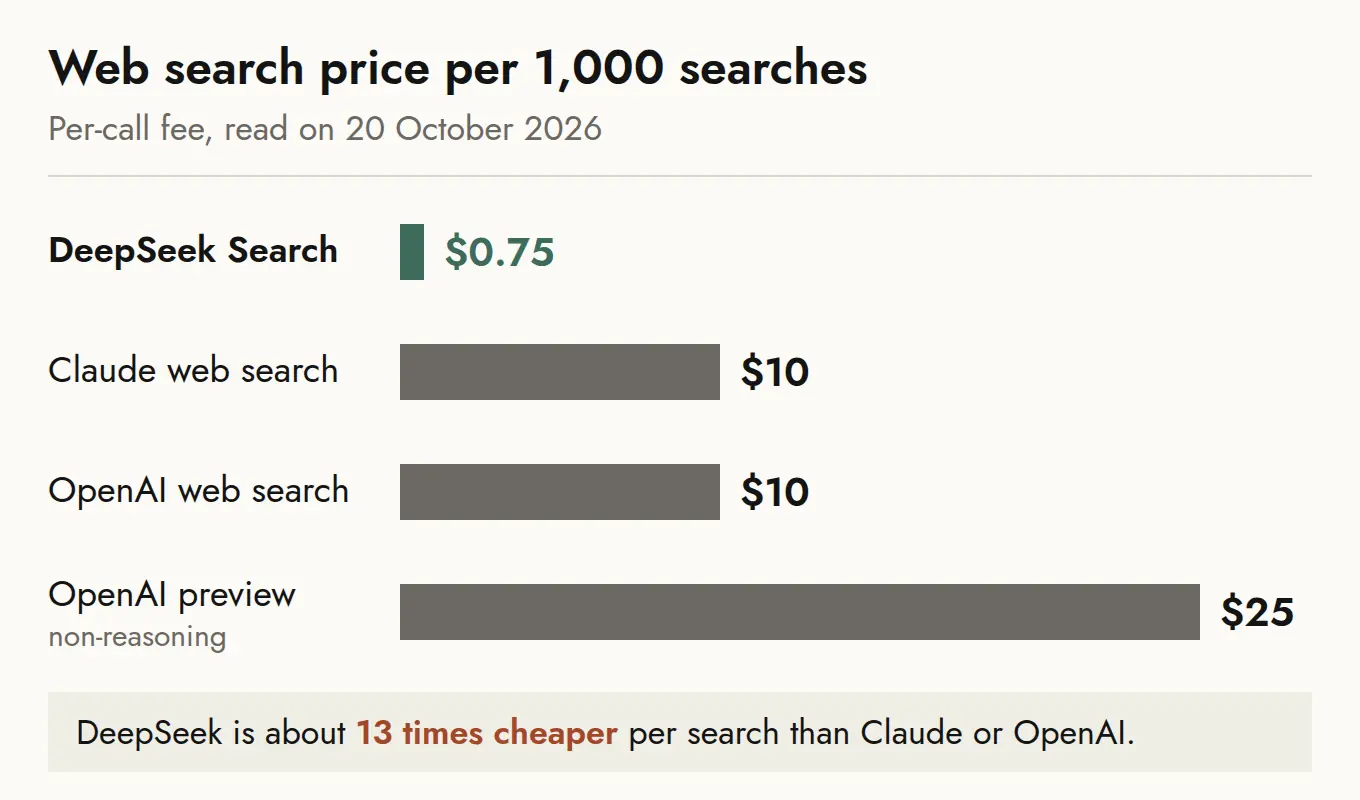
$10 divided by $0.75 is about 13. Anthropic’s pricing documentation lists web search at $10 per 1,000 searches plus token costs, and OpenAI’s pricing page lists $10 per 1,000 calls plus search content tokens. The only OpenAI line that includes the content tokens is the web search preview for non-reasoning models, at $25 per 1,000 calls.
The DeepSeek API is not tied to a DeepSeek model, either. It is a raw endpoint, so you can call it from an agent running any model and pass the results into the context yourself. That makes it a candidate for anyone building on the cheapest LLM APIs available today, not only DeepSeek users.
Fetch is the one place DeepSeek is not cheapest
Anthropic’s web fetch tool has no per-call charge: you pay only the tokens of the fetched content. DeepSeek’s Fetch adds $0.75 per 1,000 pages on top of tokens. If you already run Claude and only need to read known URLs, the Claude fetch tool is cheaper per call, and the token side dominates both bills anyway.
Rate limits and request limits
The limits are set per account, whatever API key you use, and separately from the model concurrency limits. Requests above them get an HTTP 429, which is not billed but stalls your agent.
- Search: 100 requests per second per account.
- Fetch: 25 requests per second per account, plus a per-domain limit that DeepSeek does not quantify.
- Search queries: 1 to 128 characters, with operators such as site:, -site:, lang:, after: and before:.
- Results per search: 1 to 50, ten by default.
- Fetch URLs: up to 8,192 characters, HTTP or HTTPS, without credentials.
The 128-character query cap is the one that bites agents. Models like to send whole sentences, so trim the query and pass the full question in the optional ori_question field instead.
My verdict
For search, this price sits far below what Anthropic and OpenAI charge, and the billing rules are fair: no charge for empty or failed calls, no charge for extra results. If your agent searches a lot, the fee drops from a real line item to a rounding error, and what is left is the token bill.
That is the trap to keep in mind. The search fee is now smaller than the cost of reading what comes back, especially with Fetch and full page content, and that is where your budget should go next. If you are still working out what DeepSeek actually costs you on tokens, start there before you count searches.