For a conversation that has to survive weeks rather than one evening, start with Nomi: it is the only app of the five that builds its whole pitch on a tiered memory store rather than on a bigger window.

Character.AI is the one to try if you want to find out cheaply whether paid memory is enough for you, because it is the only one publishing a price you can read before signing up, $9.99 a month, and the only one that shows memory on screen as a metered resource.
Replika, Kindroid and Candy AI describe memory in prose and publish no capacity figure at all. Below: what each app actually publishes, why every long conversation eventually breaks, and the three-week recall test that settles it for your own use.
Which app to pick for a conversation that lasts
Four of these apps are general purpose companions and one, Candy AI, is built for the romantic case, but on memory they all face the same physics. Here is the shortlist, reasoning from what each company publishes rather than from a test nobody has finished.
- If week-three recall is the whole point: Nomi, whose own description is built on short, medium and long term memory rather than on window size.
- If you want to test paid memory cheaply: Character.AI, $9.99 for a single month, the only readable price of the five and the only app that shows you a memory gauge.
- If you want the warmest first evening: any of them. That is the one thing every companion app does well, and it tells you nothing about month two.
- What none of them will tell you: a context window size or a stored fact count. Not one of the five publishes either.
If your question is which app to pick overall rather than which one remembers best, we rank the five on published prices and store ratings in our comparison of the best AI girlfriend apps.

The only app of the five that builds its pitch on a tiered memory store
$9.99 a month, and the only one that shows memory on screen as a metered resource
What each app publishes about memory
These are the apps people shortlist, whether they search for a companion app or an AI girlfriend app. We went to their public pages and read what they publish. The result is thinner than the review industry would suggest.
| App | What it published, read 15 and 16 August 2026 |
|---|---|
| Character.AI | “Better memory” is a checked Plus row on the c.ai+ table, dashed for Free, at $9.99 a month or $94.99 a year. Its App Store screens show a Memory screen with a usage gauge reading 65 percent left and four categories. |
| Nomi | “Short, medium, and long term memory” and a “Human-Level Memory” claim on the home page. No price published, /pricing returned 404. |
| Replika | A section headed “Always remembers what matters” on the home page. No price published. |
| Kindroid | “Your AI friend who listens, remembers, and grows with you everyday” on the home page. No specification, no price, /pricing returned 404. |
| Candy AI | Claims “advanced personality modeling and memory retention” in its own copy. Prices are public, at 3.99 euros a month on a twelve-month plan, but nothing is published about what is retained. |
Character.AI is the only one that puts a number on screen
The c.ai+ comparison table lists “Better memory” as a row where the Free column carries a dash and the Plus column a check, alongside access to the newest models, no slow mode and unlimited voice calls. The subscription was priced at $9.99 per month, or $94.99 per year shown against a struck-through $119.88.

The page never says what better means. Its App Store screens do rather more: memory appears as a screen of its own, with a usage bar reading 65 percent left and four labelled compartments, story memories and participant facts, chat history, persona, character information. That is not a capacity in tokens, and a marketing capture is not documentation, but it is the only place in this comparison where a company shows memory as something that fills up.
Nomi and Replika describe memory in prose
Nomi’s home page promises “short, medium, and long term memory” and markets the feature as “Human-Level Memory”. Its own App Store screens illustrate the outcome rather than the mechanism, with a companion returning to a subject from an earlier day. Replika’s home page runs a section headed “Always remembers what matters”.

Both are claims about a feeling rather than a specification, and neither page carries a number a reader could check, or a price. What Nomi’s framing does tell you is architectural: short, medium and long term is the vocabulary of a tiered store, which is the design that survives week three.
Kindroid and Candy AI publish nothing you can check
Kindroid promises a companion that “listens, remembers, and grows with you everyday” and publishes no specification behind it. Both nomi.ai/pricing and kindroid.ai/pricing returned a 404 on 15 August 2026. Candy AI is the opposite case on price, publishing its full grid without an account, and the same case on memory: retention is claimed in the copy and never described.

Whatever these apps retain, you find out after you sign up. We will not quote a figure we could not read at the source, and you should treat any article that does with suspicion unless it dates the reading.
Why a long conversation breaks
Every companion app is a language model wearing a persona. At each turn the app assembles a prompt: the persona description, some slice of your history, whatever notes it keeps about you, and your new message.
The model sees that prompt and nothing else. It holds no standing knowledge of you between turns. So the question “does it remember me” is really two questions, and they have different answers.
The context window is a queue, not a memory
The context window is the maximum size of that assembled prompt. It behaves like a queue: when the transcript grows past the limit, the oldest turns fall out to make room. Nothing is deleted from your account, but the model stops seeing it.
This is why a companion can be word-perfect on Tuesday about something you said on Monday and blank about the same thing a month later. The window did not shrink. Your history outgrew it.
The calculator above puts numbers on that. A daily habit of thirty medium-length messages with typical replies produces roughly 4,455 tokens a day. A 32,000 token window is full in about a week, a 128,000 token window gets you to around week five, and even a million token window runs out around week 33.
Every companion relationship crosses that line eventually. The only variable is when.
A memory store is a separate system, and it is the one that matters
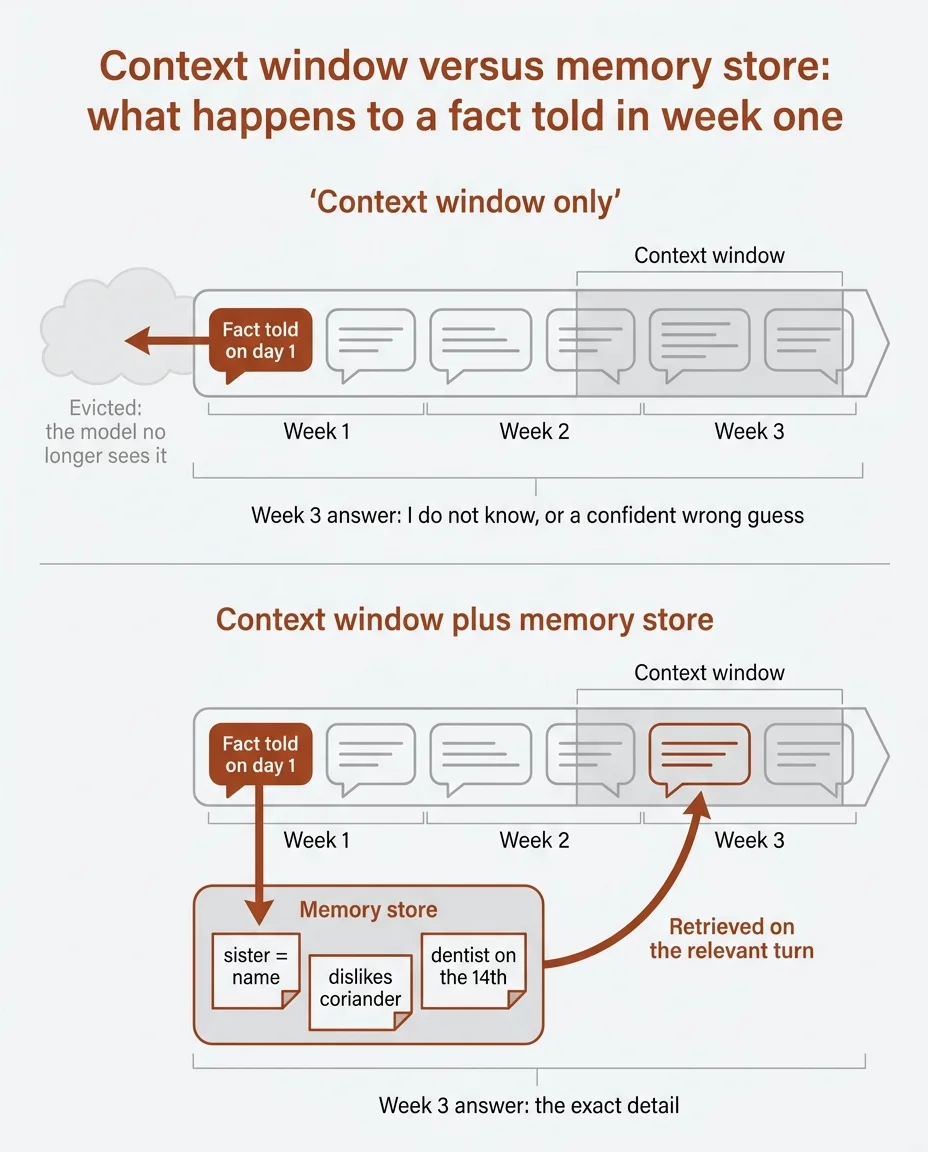
What happens after the line is crossed is a design decision, not a property of the model. An app can do nothing and simply forget. It can summarize the evicted turns into a paragraph and carry the paragraph forward, which preserves the gist and destroys the detail.
Or it can extract discrete facts, store them outside the conversation, and retrieve the relevant ones on every turn. Only the third approach survives week three with precision intact, and it is expensive to build and expensive to run, because retrieved notes are extra tokens on every single message.
Our comparison of what those tokens cost at API prices shows why an app has a financial reason to truncate rather than remember, and why the spread of cheap cached input tokens changed the economics of carrying a long history at all.
Memory is the feature the subscription is really selling, and it is the one feature none of these companies will put a number on.
Context budget calculator
The week your history stops fitting
Raw history overflows the window
during week 1
Set your numbers and press Calculate.
Assumes 1.35 tokens per English word and one reply per message you send. Persona text, system instructions and images are on top of this, so treat the overflow week as an optimistic ceiling, not a floor.
The three-week recall test
Almost every companion app review is written after a few hours of use. That measures personality, tone, and how fast the app matches the register you write in. It measures nothing about memory, because at hour three the whole conversation still fits inside the window and every app looks perfect.
Here is a protocol that measures the thing you actually care about. It costs three weeks of ordinary use and about twenty minutes of scoring.
Plant eight facts in week one
On day one, work eight items into normal conversation, once each, never repeated. Vary the type deliberately, because apps fail differently on each.
- A hard proper noun: your sister’s name.
- A preference: you cannot stand coriander.
- A dated plan: a dentist appointment on the fourteenth.
- An emotional context: you were anxious about a review at work.
- A correction: you mentioned one city earlier and have since moved.
- A constraint: never use a nickname for you.
- A running thread: a story you are writing together.
- A number: you run six kilometers.
Write the eight down somewhere the app cannot see. Then use it normally for three weeks without raising any of them again.
Probe them cold in week three
On day twenty-one, ask about each item directly and without hints. Not “do you remember what I said about my sister” but “what is my sister called”.
A leading question lets the model reconstruct an answer out of your own phrasing rather than out of memory, which is exactly the failure you are trying to detect. One probe per fact, in a single session, in no particular order.
Score recalled, distorted, gone
Three outcomes, not two. Recalled means the answer is right. Gone means the app says it does not know, which is the honest failure and the easy one to spot.

Distorted is the interesting result: a confident, plausible, wrong answer. Your sister acquires a different name. The dentist becomes a doctor.
Distortion is the signature of summarization, because the detail was compressed into a gist and the model filled the gap with something that fits. An app scoring six recalled and two gone is more usable than one scoring six recalled and two distorted, since you can trust the first one’s silences.
Reading the calculator above
The calculator turns your habit into tokens and returns the week your raw transcript stops fitting. It assumes 1.35 tokens per English word and one reply per message you send, and it ignores the persona text and system instructions that ride along on every turn, so the week it reports is an optimistic ceiling rather than a floor.
If your overflow week falls after the horizon you care about, the recall failures you are seeing are not a capacity problem: the history still fits, and the app is assembling its prompt badly. If your overflow week falls before your horizon, which it will for most daily users, then everything the app appears to remember from the early weeks is arriving through summarization or a retrieval store, and that machinery is the product you are paying for.
Frequently asked questions
Which AI girlfriend app has the best memory?
Nomi is the one to start with: it is the only app of the five whose own description is built on a tiered memory store rather than a bigger context window. No company in this set publishes a capacity figure, so treat that as an architecture argument, not a measurement.
Why does my companion forget things it knew last week?
Because the context window is a queue. Once your transcript grows past its limit the oldest turns fall out, and anything the app still appears to remember is arriving through a summary or a retrieval store instead.
How do I test an app’s memory myself?
Plant eight facts on day one, never repeat them, and probe them cold on day twenty-one. Score each answer as recalled, gone or distorted. The protocol is written out in full above.
Is a confident wrong answer worse than no answer?
For memory, yes. A distorted answer is the signature of summarisation, and an app that scores six recalled and two gone is more usable than one scoring six recalled and two distorted, because you can trust the first one’s silences.
What we verified and what we did not
Verified at the source: the c.ai+ feature table and its two prices, the memory copy on the Nomi, Replika and Kindroid home pages, Candy AI’s public price grid, the screens each company publishes on its App Store listing, and the two 404s, all read on 15 and 16 August 2026.
Not verified, and we will not pretend otherwise: the subscription prices for Nomi, Kindroid and Replika, which we could not read without creating an account; any context window figure for any of the five, because none of them publishes one; what Character.AI’s 65 percent gauge is a percentage of; and the three-week test itself, which we designed for this page and have not yet completed across all five apps.
A ranking that claims to have measured week-three recall on five apps inside a week of work is claiming something it did not do. We will publish our own scores when the clock has actually run, and we will date them. Whichever app you pick, plant the facts on day one. If the probes come back distorted on day twenty-one, it is not going to get better at remembering you in month two, and you will have found that out for the cost of a single subscription cycle.