
Output tokens, not input, drive almost every API bill you will ever receive. The spread between the cheapest and the most expensive frontier model is over a hundredfold: on 14 August 2026, DeepSeek V4-Flash charged $0.28 per million output tokens while OpenAI gpt-5.6-cyber charged $75.00 for the same million. The comparator above ranks every model against the volume you actually run, and each price on this page carries the date we read it from the provider’s own pricing page.
What your workload costs, model by model
Enter the volume you expect to run in a month. Every price below was read from the provider's own pricing page on 14 August 2026, per million tokens, standard tier.
Cache pricing applies to input you send again, typically a system prompt or a document you keep in context. It reorders the ranking as soon as your workload repeats itself. Long context, batch and priority tiers are billed differently and are not covered here.
What a million tokens costs, provider by provider
All figures below are standard-tier prices per million tokens, read on 14 August 2026. To see how this compares with specific providers, you can review what Mistral charges per million tokens. We archive a screenshot of each provider’s page on the day we check it, so a price here can always be traced back to what the provider was publishing that day.
| Provider | Model | Input | Output | Cached input |
|---|---|---|---|---|
| OpenAI | gpt-5.6-cyber | $12.50 | $75.00 | $1.25 |
| OpenAI | gpt-5.6-sol | $5.00 | $30.00 | $0.50 |
| OpenAI | gpt-5.6-terra | $2.00 | $12.00 | $0.20 |
| OpenAI | gpt-5.6-luna | $0.20 | $1.20 | $0.02 |
| Anthropic | Claude Fable 5 | $10.00 | $50.00 | $1.00 |
| Anthropic | Claude Opus 5 | $5.00 | $25.00 | $0.50 |
| Anthropic | Claude Sonnet 5 | $2.00 | $10.00 | $0.20 |
| xAI | grok-4.6 | $2.00 | $6.00 | not offered |
| DeepSeek | V4-Flash | $0.14 | $0.28 | $0.0028 |
| DeepSeek | V4-Pro | $0.435 | $0.87 | $0.003625 |
| Mistral | Mistral Large 3 | $0.50 | $1.50 | not offered |
| Mistral | GLM 5.2 | $1.40 | $4.40 | $0.14 |
The frontier tier, and why its output price is the one that matters
Frontier models are priced on a simple logic: input is cheap because the provider reads it once, output is expensive because the model has to generate it token by token. Every provider applies a multiplier between the two, and that multiplier is remarkably consistent. OpenAI charges six times more for output than input across its gpt-5.6 line. Anthropic charges five times more on Claude Opus 5 and Sonnet 5. xAI charges three times more on grok-4.6, which is the tightest ratio of the group.

The practical consequence is that your bill is governed by how verbose your application is, not by how much context you feed it. A retrieval system that reads fifty pages and answers in three sentences costs almost nothing in output. A drafting assistant that produces long documents from a short prompt inverts that entirely, and it is where the frontier tier becomes painful.
The cheap tier, and what you give up
DeepSeek V4-Flash at $0.14 in and $0.28 out is roughly two hundred and fifty times cheaper on output than gpt-5.6-cyber. That gap is not a rounding error in positioning, it is a different category of product. What you give up is not always quality on a single answer, which is often closer than the price suggests, but consistency across many runs, tool-calling reliability, and the behaviour of the model when a task goes wrong.
The honest way to use the cheap tier is to route to it deliberately. Classification, extraction, summarisation of short documents and first-pass drafts run well on it. Anything where a wrong answer is expensive, or where the model has to chain several tool calls without supervision, is where the frontier price starts to justify itself.

Cache pricing, the discount that reorders the whole table
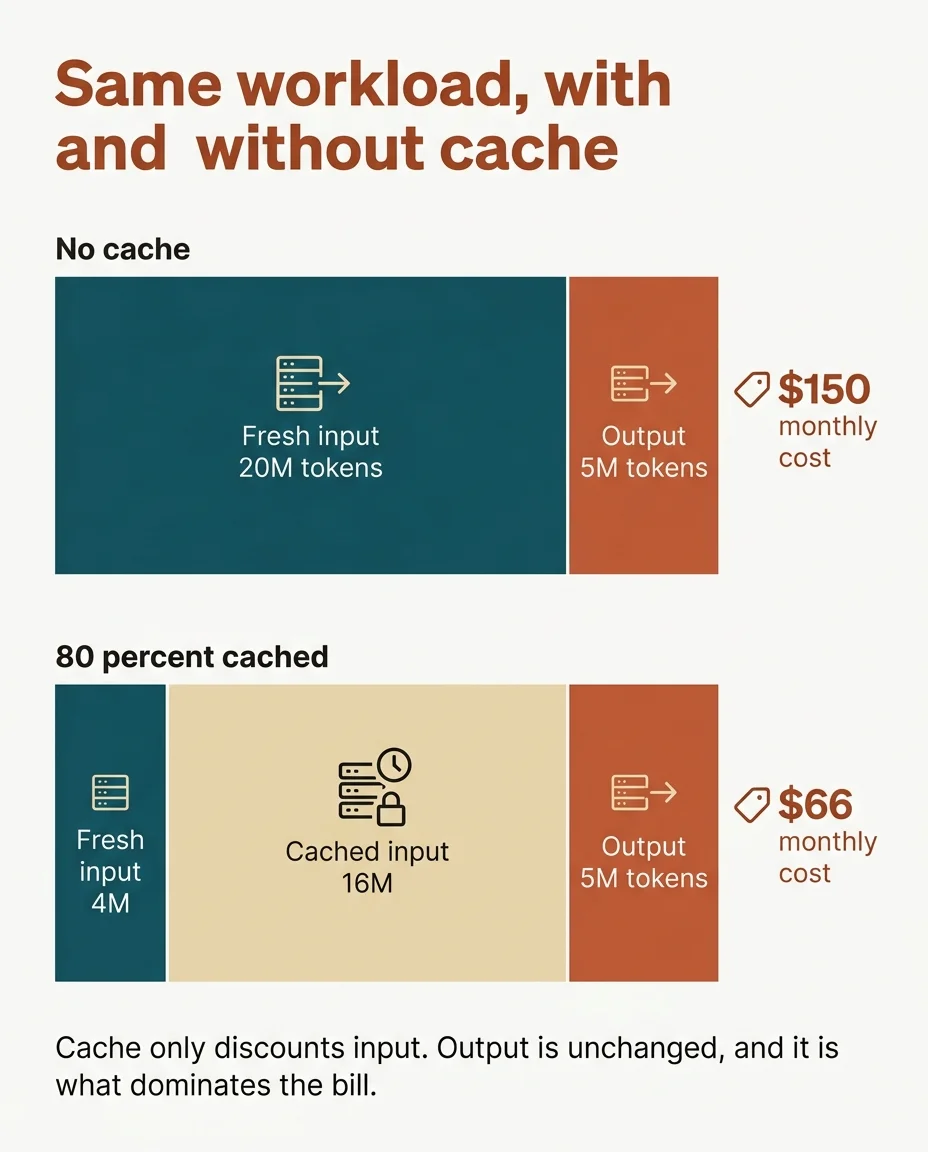
Cached input is the most underrated line in every pricing grid. When you send the same content again, a system prompt, a knowledge base, a long document you keep in context, providers bill it at a fraction of the normal rate. Anthropic reads cached input at $0.50 per million on Claude Opus 5 against $5.00 for fresh input, a tenfold discount. DeepSeek goes further with a cache hit at $0.0028 against $0.14, a fiftyfold discount.
This matters because most production workloads repeat themselves far more than their designers expect. Set the cache share in the comparator above to eighty percent and the ranking changes: models with aggressive cache pricing climb, and models that offer no cache discount at all, like grok-4.6 and Mistral Large 3 at the time of writing, fall behind despite competitive headline rates.

How we check these prices
What we read, and how often
We read the provider’s own pricing page, not a third-party aggregator, and we capture a screenshot of the grid on the day we read it. That screenshot is the record: if a price on this page is ever disputed, we can show what the provider was publishing when we checked. The date of the last check appears next to every figure, and we re-check the full table when a provider announces a new model or changes a tier.
What we do when a provider changes its grid
We update the number and we say what moved, rather than silently editing the page. A comparison whose history is invisible is a comparison you cannot trust, because you have no way of knowing whether it was refreshed last week or last year. When a change is large enough to alter the verdict of this page, it gets a line of its own.
What the price per million tokens leaves out
Long context is billed at a different rate
Several providers charge a premium once your request passes a context threshold. OpenAI publishes a separate long-context column: gpt-5.6-sol moves from $5.00 to $10.00 on input and from $30.00 to $45.00 on output once the request crosses into that tier. If your application routinely sends large documents, the headline price on this page understates your real cost, sometimes by half.
Batch, off-peak and priority tiers
Work that does not need an immediate answer is cheaper almost everywhere. Batch processing typically halves the rate. DeepSeek publishes explicit off-peak pricing, roughly half the standard rate during defined hours, which is unusual and worth designing around if your workload can wait. Conversely, priority and fast tiers cost more than the figures above.
Reasoning tokens you pay for but never read
Reasoning models generate tokens internally before producing the answer you see, and those tokens are billed as output. This is the single most common surprise on a first invoice: you measure the length of the answers your users receive, you multiply by the output price, and the real bill comes in several times higher. When you estimate a reasoning-model workload in the comparator above, raise your output figure well beyond the visible length of your answers.
Which model fits your workload?
High-volume chat and customer support
Short answers, huge volume, a system prompt repeated on every call. This is the profile where cache pricing dominates everything else. Claude Sonnet 5 at $2.00 in and $10.00 out, with cached input at $0.20, and gpt-5.6-terra at $2.00 and $12.00 with cached input at $0.20 both sit in a comfortable zone. If quality tolerance allows it, DeepSeek V4-Flash makes the same workload cost an order of magnitude less.
Long documents and retrieval
Heavy input, light output. Here the input price and the context window matter more than anything, and the long-context surcharge is the number to watch. DeepSeek V4-Flash and V4-Pro both advertise a one-million-token context, and grok-4.6 offers 500k, which changes what you can put in a single request rather than merely what it costs.
Batch classification and extraction
Predictable, repetitive, no latency constraint. Take the cheapest model that passes your accuracy bar, run it in batch, and check the off-peak windows. This is the workload where the frontier tier is hardest to justify, and where a hundredfold price gap translates directly into a hundredfold difference on the invoice.
Model choice sets the token price, but what you actually pay also depends on the gateway you route them through: we price the self-hosted and managed LiteLLM alternatives in a separate comparison.
Frequently asked questions
Why is output so much more expensive than input?
Reading your prompt is a single pass over the text, while generating an answer requires the model to run once per token produced. The compute cost genuinely differs, and every provider prices accordingly, with a multiplier between three and six times depending on the model.
Is the cheapest model always the right choice?
No. The right question is the cost of a wrong answer in your application. When a mistake is cheap to catch, the cheap tier wins easily. When a mistake propagates unsupervised through several tool calls, the frontier price buys reliability that is difficult to replicate.
How much does caching really save?
Between five and fifty times on the cached portion of your input, depending on the provider. The saving only materialises if your requests genuinely repeat content, and it does nothing for output, which is where most of your bill sits.
Do these prices include taxes?
No. Every figure on this page is the provider’s published rate excluding tax, and several providers apply a regional uplift on top for data residency endpoints.
How often is this page updated?
Whenever a provider changes a grid or ships a model that belongs in the table. Each price carries the date it was last verified, so you can judge for yourself how fresh the comparison is rather than trusting a generic update stamp.