On 15 August 2026, Bedrock did not mark up the models it carries at parity: Mistral Large 3 costs $0.50 per million input tokens and $1.50 output on Bedrock and the identical rate on mistral.ai, and Grok 4.3 costs $1.25 and $2.50 on both. What Bedrock charges for is the calendar.

Its Anthropic row is Claude 3.5 Sonnet under Public Extended Access at $6.00 and $30.00, against Claude Sonnet 5 at $2.00 and $10.00 direct, and its DeepSeek row is v3.2 at $0.62 and $1.85 while DeepSeek itself no longer sells that generation at all, its cheap tier now being V4.1-Flash at $0.30 and $1.20. On top of the tokens sit per-request platform fees that no direct API charges, from guardrails to knowledge base retrieval.

Bedrock or the provider direct: what one month costs on each side
Every rate below was read on 15 August 2026 from the AWS Bedrock pricing page and from each provider's own pricing page. On-demand tier, US regions, per million tokens.
Bedrock platform fees, added to the Bedrock column
| Model on each side | Bedrock | Direct | Difference |
|---|
The rows where Bedrock charges exactly what the provider charges
Start with the good news, because it is the part most Bedrock cost guides get wrong. On the models where AWS and the provider both publish a current rate, the rates match to the cent.
| Model | Bedrock, per 1M in / out | Provider direct, per 1M in / out | Delta |
|---|---|---|---|
| Mistral Large 3 | $0.50 / $1.50 | $0.50 / $1.50 (mistral.ai) | none |
| Grok 4.3 | $1.25 / $2.50, cached input $0.20 | $1.25 / $2.50, cached input $0.20 (docs.x.ai) | none |
The Bedrock grid, priced by AWS rather than by the model provider
Run 50 million input tokens and 10 million output tokens through Mistral Large 3 and the token bill is $40 a month whichever door you walk through. Grok 4.3 comes to $87.50 on both sides. There is no reseller margin baked into the per-token rate, and anyone claiming Bedrock adds a flat percentage on top of every model is describing a platform that does not exist.
So where does the money go? Two places: the generation of model you are allowed to buy, and the per-request fees that sit beside the tokens.
The rows where you pay for last year’s model
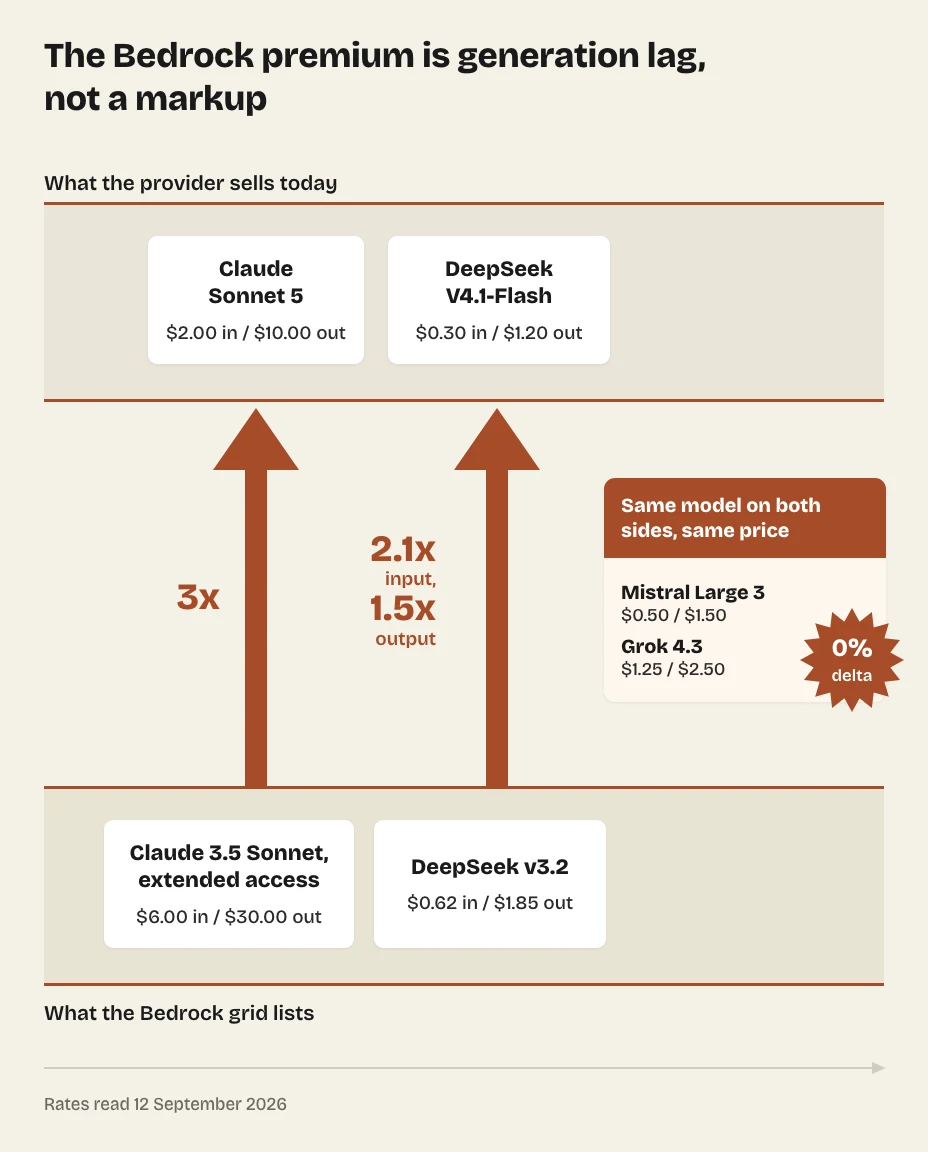
The Anthropic row AWS publishes is the clearest case. On 15 August 2026 the Bedrock pricing page listed Claude 3.5 Sonnet and Claude 3.5 Sonnet v2 under Public Extended Access, effective 1 December 2025, at $6.00 per million input tokens and $30.00 per million output. Batch is half of that, $3.00 and $15.00. Cache writes cost $7.50 and cache reads $0.60, which is 1.25 times and 0.1 times the base input rate, the same multipliers Anthropic applies on its own API.
Anthropic’s current grid, read the same day, prices Claude Sonnet 5 at $2.00 in and $10.00 out, Claude Opus 5 at $5.00 and $25.00, and Claude Haiku 4.5 at $1.00 and $5.00. The extended-access 3.5 row therefore costs three times the current Sonnet on both sides of the meter, a 200% premium. On 50 million input and 10 million output tokens that is $600 a month against $200.

The same shape shows up on DeepSeek. Bedrock lists DeepSeek v3.2 at $0.62 in and $1.85 out in US regions, $0.74 and $2.22 international, and v3.1 in Sydney at $0.5974 and $1.7304. DeepSeek’s own pricing page, read on 12 September 2026, lists two models and neither is v3.2: V4.1-Flash at $0.30 in and $1.20 out, V4-Pro at $1.32 and $3.96. The Bedrock row is not a marked-up version of what DeepSeek sells, it is a model DeepSeek has stopped selling, priced roughly twice the current cheap tier on input and half again on output. That gap was four and a half times on input and six and a half on output in August, and DeepSeek’s own price rise, not a Bedrock cut, is what closed it.
Anthropic’s documentation, read on 15 August 2026, makes the pattern explicit rather than accidental. Claude Opus 4.1 at $15 and $75, Claude Sonnet 4 at $3 and $15, and Claude Haiku 3.5 at $0.80 and $4 are all marked retired, except on Bedrock and Google Cloud. The clouds are where deprecated models go to keep billing, and older frontier models carry older frontier prices. If your workload is pinned to a model ID because a prompt was tuned against it, that pin has a monthly cost you can now put a number on.
The fees the direct API does not have
The second half of the wrapper is billed per request, not per token, so it never shows up in a per-million comparison. Read on the same page, the same day:
- Guardrails content filters, $0.15 per 1,000 text units, and $0.00075 per image
- Guardrails denied topics, $0.15 per 1,000 text units
- Guardrails sensitive information filters and contextual grounding checks, $0.10 per 1,000 text units each
- Guardrails automated reasoning checks, $0.17 per 1,000 text units
- Knowledge Bases index storage, $5.00 per GB per month
- Knowledge Bases standard retrieval, $1.00 per 1,000 API calls, and agentic retrieval at $4.00 per 1,000 calls plus $1.00 per 1,000 underlying retrieve calls
- Intelligent Prompt Routing, $1 per 1,000 requests
- Simple Prompt Optimizer, $0.03 per 1,000 tokens
Take a retrieval chatbot doing two million requests a month with one guardrail evaluation and one knowledge base lookup per turn. That is $300 of content filtering and $2,000 of retrieval before a single token is priced, and it scales with traffic rather than with prompt length. The comparator above lets you switch those lines on so they land in the Bedrock column where they belong. Our per-million-token comparison of every major model deliberately excludes them, because they are platform fees rather than model prices, which is exactly why they surprise people at the end of the first quarter.
Two AWS doors to Claude, and only one of them is Bedrock
Anthropic now sells a second route on AWS, Claude Platform on AWS, and it prices differently from Bedrock. Its terms, read on 15 August 2026, bill through AWS Marketplace in Claude Consumption Units at a fixed $0.01 per CCU, with token usage rated in dollars at Anthropic’s standard per-model rates and then converted, so one hundred CCUs is one dollar of Anthropic pricing. Metering is hourly, invoicing is monthly and in arrears, and the AWS bill shows a single CCU line item.
The practical consequence is that the same company can sit on AWS paperwork at Anthropic prices or at Bedrock prices depending on which service page it signed up through. Two further multipliers, both read the same day, are worth knowing before you model a budget. On Bedrock, regional endpoints carry a 10% premium over global endpoints for Claude Sonnet 4.5, Haiku 4.5, Opus 4.5 and every model after them. On Anthropic’s first-party API, pinning inference to the United States with the inference_geo parameter applies a 1.1x multiplier to input, output, cache writes and cache reads alike. Data residency is not free anywhere, it is simply priced in different places.
What we could read on the AWS page, and what we could not
The Bedrock pricing page renders most of its grid through tabbed JavaScript, and a fair amount of it does not survive as plain text. Being straight about that is more useful than filling the gaps with plausible numbers.
What came through cleanly: the Anthropic extended-access rows, Mistral (Mistral Large 3, Magistral Small 1.2 at $0.50 and $1.50, Devstral 2 123B at $0.40 and $2.00, the three Ministral sizes, Voxtral Mini at $0.04 and $0.04), DeepSeek v3.1 and v3.2, Grok 4.3, the Gemma 3 and Gemma 4 family, Qwen3, NVIDIA Nemotron, MiniMax M2, Moonshot Kimi K2.5 at $0.60 and $3.00, Z AI GLM 5 at $1.00 and $3.20, Writer Palmyra, Cohere, AI21, Titan, the Stability image rates, and every platform fee listed above.
What did not: the Meta Llama grid beyond two legacy rows, Llama 2 Chat 13B at $0.75 and $1.00 and Llama 2 Chat 70B at $1.95 and $2.56. Sections exist for Llama 3.1, 3.2, 3.3 and Llama 4, but no readable per-token figures sit under them, so this article states no Bedrock-versus-direct delta for Llama at all. The Amazon Nova rates and the current Claude 4.x and Claude 5 rows on Bedrock were equally unreadable, which is why the Claude comparison above is framed as extended access against the current Anthropic model rather than as a same-model markup. If you need those two grids to the cent, open the page in a browser, expand the tab for your region, and screenshot it with the date visible.
When the wrapper earns its price
Paying more per token is not automatically a mistake. Bedrock buys you IAM rather than a second key vault, VPC endpoints and PrivateLink rather than egress to a third party, one invoice that counts toward an existing AWS commitment, provisioned throughput when you need guaranteed capacity, and a guardrail layer your compliance team can point at during an audit. For a regulated workload that already lives in AWS, a legacy Claude row at three times the current rate can still be cheaper than the vendor review needed to add one more direct API to the estate.
The mistake is paying that premium without knowing it. Two habits fix it: check whether the model you pinned is still the current generation at the provider, and read the per-request lines beside the token lines. If your workload is cache-heavy the ordering can shift again once cache reads enter the arithmetic, which is the case we work through in Claude API pricing with cache included.
Frequently asked questions
Is Bedrock more expensive than calling the provider directly?
Not on the models where both sides publish a current rate. Mistral Large 3 and Grok 4.3 were priced identically on 15 August 2026. The premium appears when the Bedrock catalogue is a generation behind, as with the Claude 3.5 Sonnet extended-access row at $6.00 and $30.00 against Sonnet 5 at $2.00 and $10.00, and on the per-request platform fees that the direct APIs do not charge.
Does Bedrock charge extra for prompt caching?
Not on the row we could verify. Cache writes on the Claude 3.5 Sonnet row cost $7.50 and cache reads $0.60 against a $6.00 base input rate, the same 1.25x write and 0.1x read structure Anthropic publishes for its own API. The cache discount is proportional, so it never closes a gap that comes from the base rate.
Do batch discounts work the same way?
On the row we could verify, yes. Bedrock lists batch pricing at $3.00 and $15.00 against $6.00 and $30.00 on-demand, a flat 50% off, matching Anthropic’s own Batch API discount of 50% on input and output.
Which Bedrock models are genuinely cheap?
The small open-weight rows, all read on 15 August 2026. Gemma 3 4B and Gemma 4 E2B at $0.04 and $0.08, Voxtral Mini at $0.04 and $0.04, Nemotron Nano 2 at $0.06 and $0.23, GPT OSS Safeguard 20B at $0.07 and $0.20, and GLM 4.7 Flash at $0.07 and $0.40. At those rates the platform fees, not the tokens, will dominate the bill.
About the author
Owen Marsh tracks API pricing pages for a living and rebuilds the comparison grids on this site every time a provider moves a number. The prices in this article were read on 15 August 2026 from aws.amazon.com/bedrock/pricing, platform.claude.com, docs.x.ai, mistral.ai and api-docs.deepseek.com. Providers change rates without notice, so the date on each figure is there to tell you how stale it has become.