gpt-5-mini costs $0.25 per million input tokens and $2.00 per million output tokens, and gpt-5-nano costs $0.05 and $0.40, on the OpenAI grid we read on 14 August 2026. Both are still served, but they are on the way out. OpenAI’s deprecation page, read on 10 September 2026, gives gpt-5-mini-2025-08-07 and gpt-5-nano-2025-08-07 a shutdown date of 11 December 2026, with gpt-5.6-terra and gpt-5.6-luna named as the recommended replacements. Build on them today and you are booking a migration for December. The small tier of the current 5.6 family is gpt-5.6-luna at $0.20 input, $0.02 cached input and $1.20 output, which undercuts gpt-5-mini on both columns anyway.

Luna is exactly one tenth of gpt-5.6-terra on every column of the price list. Against gpt-5.6-sol the ratio is no longer flat: one twentieth on input and on cached input, one sixteen and two thirds on output, since OpenAI cut sol to $4.00 and $20.00 and left the rest of the family alone. The price question is therefore settled before you start, and the only one left is where the quality stops holding, so this page prices the same task on all three 5.6 tiers and marks the failure rate at which the cheap tier stops paying.
Where gpt-5-mini and nano sit on the current grid
Both models are still on the price list, so if you came here for a number, the number above is it. What changed is that they are no longer the cheap end of the lineup, because the 5.6 family that arrived after them starts below gpt-5-mini on both columns.
What mini and nano cost next to luna
gpt-5-mini and gpt-5-nano were the small models of the GPT-5 generation, sized by suffix in the way OpenAI had labeled its lineup for years. The 5.6 family dropped that convention and gave each tier a name instead: luna at the bottom, then terra, then sol, then cyber. Luna occupies the mini slot, and it is cheaper than the model it succeeds.

| Model | Input | Output |
|---|---|---|
| gpt-5-nano | $0.05 | $0.40 |
| gpt-5.6-luna | $0.20 | $1.20 |
| gpt-5-mini | $0.25 | $2.00 |
The cheap tier of the GPT line, per million tokens
Read that ordering carefully, because it settles the question most people arrive with. Luna undercuts gpt-5-mini by twenty percent on input and by forty percent on output, so there is no price argument left for staying on mini.
gpt-5-nano is the cheapest OpenAI row on the page, at a quarter of luna on input and a third of it on output. We did not benchmark it, so read that as a price fact and not as a recommendation: the rest of this page works through the 5.6 tiers, where the columns scale cleanly and the routing arithmetic has one answer.
Why the search term still matters
Naming churn is not cosmetic when you are budgeting. A team that sized its infrastructure against gpt-5-mini a year ago now has a cost model pinned to a previous-generation row that a current model beats on both columns, and nothing on the invoice will point that out. The safer habit is to budget the slot rather than the name: cheapest tier, mid tier, frontier tier, then re-read the grid whenever the labels move.
The 5.6 family also spans further than the old suffixes did. Cyber, the top tier, is priced at $12.50 input and $75.00 output, which is 62.5 times luna’s output rate and a wider internal spread than most providers publish. The cross-provider view, every major model side by side on the same reading date, is in our LLM API pricing comparison.
What the small tier costs next to terra and sol
Here is the standard tier grid for the three models a buying decision usually comes down to, in dollars per million tokens, as read on 14 August 2026. Cyber is omitted because nobody comparing against the cheap tier is also considering it.
| Model | Input | Cached input | Output | Long ctx in | Long ctx out |
|---|---|---|---|---|---|
| gpt-5.6-luna | $0.20 | $0.02 | $1.20 | $0.40 | $1.80 |
| gpt-5.6-terra | $2.00 | $0.20 | $12.00 | $4.00 | $18.00 |
| gpt-5.6-sol | $4.00 | $0.40 | $20.00 | $8.00 | $30.00 |

The long context columns double the small tier
Past the context ceiling, luna is billed at $0.40 input and $1.80 output. Input doubles, output goes up by half. The same multipliers apply to terra and to sol, which means the tier ratio survives the switch: luna is still one tenth of terra in the long context columns, and stands to sol there exactly as it does on the short grid, one twentieth on input and one sixteen and two thirds on output. A very long prompt does not change which tier is cheapest. It only changes how much the choice is worth to you in absolute dollars, and it makes prompt trimming pay twice.
Cached input keeps the same ratio
Cached input is priced at one tenth of fresh input on all three tiers: $0.02 against $0.20 for luna, $0.20 against $2.00 for terra, $0.40 against $4.00 for sol. A uniform discount cannot reorder a table, so caching never changes which model is cheapest. What it does change is the shape of your invoice. Shrink the input side by ninety percent and output goes from a minority of the bill to the overwhelming majority of it, which pushes the whole decision onto the output column, where the gap between luna and sol is sixteen and two thirds to one.
The same task priced on three tiers
Three realistic shapes, priced straight off the grid above. Nobody buys a million tokens, so the only figure worth arguing about is the cost of one completed unit of work and the monthly total it rolls up to.
A support reply
A ticket reply with a cached system prompt: 1,500 input tokens of which 1,000 come from cache, 300 output tokens. That is $0.00048 on luna, $0.0048 on terra and $0.0084 on sol. At 100,000 replies a month the invoice is $48.00, $480.00 and $840.00 respectively. The absolute numbers are small enough that the tier choice looks irrelevant, which is exactly the trap this article is about.
A document summary
A forty page document summarized cold: 40,000 input tokens with no cache hit, 800 output tokens. Luna comes in at $0.00896, terra at $0.0896, sol at $0.176. Over 10,000 documents that is $89.60, $896.00 and $1,760.00. Here the input side dominates, output is only eleven percent of the luna bill, and the cache discount is worth nothing because there is nothing to reuse between documents.
An agent run
A tool-using agent loop: 30,000 fresh input tokens, 90,000 cached input tokens, 12,000 output tokens. Luna costs $0.0222 per run, terra $0.222, sol $0.396. At a thousand runs a day that is $666.00, $6,660.00 and $11,880.00 a month. Output is 12,000 of 132,000 tokens on this shape, nine percent of the volume, and sixty-five percent of the luna bill.
Notice what does and does not change between the three examples. Terra always costs ten luna, whatever the mix of fresh input, cached input and output, because OpenAI applied the same multiplier to every column of that tier. Sol behaved the same way at twenty-five times until OpenAI cut it, and it no longer does: it lands at seventeen and a half times luna on the reply shape, a shade under twenty on the document and just under eighteen on the agent loop. So the routing question still has one answer for your whole workload against terra, while sol has to be priced on your own mix.
Where luna stops being enough
What we can check and what we cannot
We read the price list and did the arithmetic, and both are auditable: the screenshot is above and every figure can be recomputed from it. We did not run a quality benchmark across the three tiers for this article, we have no privileged eval harness, and we are not going to relay a leaderboard score we did not reproduce. So this section does not tell you that luna is good enough for your task. It tells you something the grid alone can settle, which is how often luna is allowed to be wrong before the cheap tier stops saving you money.
The retries you never see
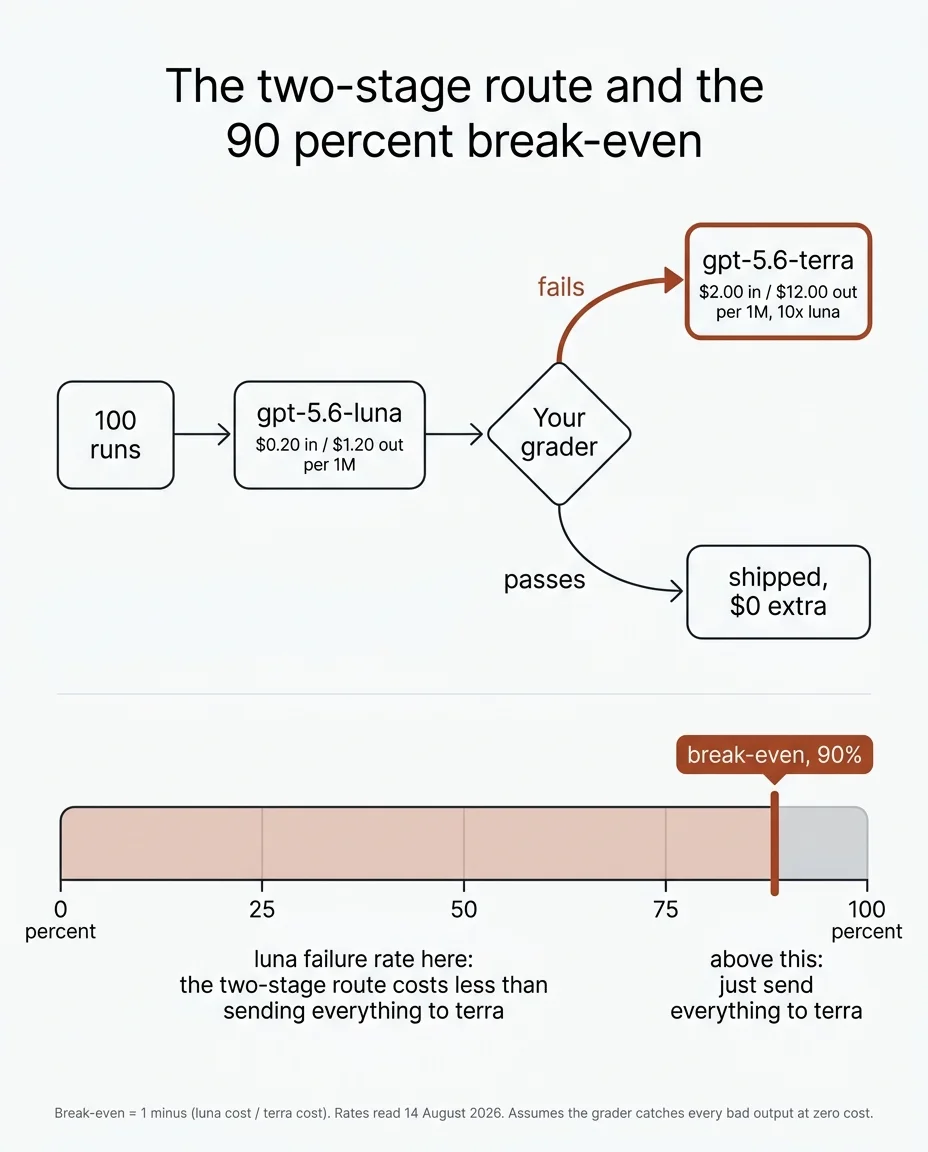
Take the obvious routing pattern: send every run to luna, detect the bad outputs, resend those to terra. Cost per run is the luna price plus the failure rate multiplied by the terra price. Set that equal to the terra price and the break-even failure rate is one minus the ratio of the two, which on this grid is one minus a tenth. Luna can fail ninety percent of the time and the two-stage route still costs less than sending everything to terra. Against sol the tolerance is no longer a single number since the cut: it runs between ninety-four and ninety-five percent depending on the shape of the run.
Those numbers are so permissive that the failure rate turns out to be the wrong thing to worry about. The arithmetic assumes a grader that catches every bad output at zero cost, and that assumption is doing all the work. A failure your grader misses is not a retry, it is a wrong answer delivered to a user, and it never appears anywhere on the invoice. The practical question is not whether luna fails, it is whether your pipeline can tell.
On todays episode of benchmarks. Turns out GPT 5.6 Luna on max effort fares worst of anything tested thus far. Worse even then itself on xhigh.
@itsnoahd
https://x.com/itsnoahd/status/2086562855587831977
Private benchmark harnesses are worth reading and worth distrusting in equal measure, because each one measures the workflow of the person who wrote it. That is a feature rather than a flaw when the workflow resembles yours, and it is the reason the only escalation rate you can safely act on is the one you measure on your own traffic.
When a human touches the failure
Put a person in the loop and the ninety percent tolerance evaporates. On the support reply above, terra costs $0.00432 more per reply than luna. A support agent at $25 an hour costs roughly $0.42 a minute, so a four minute cleanup on a bad answer costs about $1.67. Divide one by the other: a single extra human handoff for every 386 replies wipes out the entire saving from running luna instead of terra. Against sol the same arithmetic gives one handoff in 211.
That is the real threshold, and it has almost nothing to do with model quality in the abstract. It is about whether your failures are cheap to detect and cheap to absorb. Batch classification where a bad label is caught by a downstream check is a perfect fit for the cheap tier. A customer-facing reply where a bad answer costs you a human, a refund or a second contact is not, and no amount of token arithmetic will make it one.
How to route to luna without guessing
The break-even formula
For any two tiers, the tolerable failure rate is one minus the cost of the cheap run divided by the cost of the expensive run, computed on your own token shape. On the 5.6 family the answer is a constant because the columns scale uniformly, so luna against terra gives ninety percent for every workload you can construct. That uniformity is not a law of nature. Our read of GPT-5.2 pricing and what the tier actually buys you, taken from the same grid on 14 August 2026, gives $1.75 input and $14.00 output, which is neither a clean tenth nor a clean quarter of anything in the 5.6 family, so a luna-to-gpt-5.2 escalation has a break-even that genuinely moves with your input-to-output mix. Run the formula per shape whenever the ratio is not flat.
The eval you build once
Pull two hundred real requests out of your logs, write the grader you would trust a junior colleague to apply, and run the set on luna and on terra. What comes back is an escalation rate that belongs to your traffic rather than to a leaderboard, and at luna prices the whole exercise costs a couple of dollars. Compare it to the ninety percent line, then compare it again to the human-handoff line from the previous section, which is the one that will actually bind. If your task turns out to be well scoped and your grader cheap, it is worth pricing the same set against what DeepSeek actually costs, though V4.1-Flash no longer undercuts luna since DeepSeek raised its grid: $0.30 input and $1.20 output on the 12 September read, which ties luna on output and stays above it on input, against luna at $0.20 and $1.20.
Frequently asked questions
Is gpt-5-nano still available?
Yes. On the grid we read on 14 August 2026, gpt-5-nano is listed at $0.05 per million input tokens and $0.40 per million output tokens, which makes it the cheapest OpenAI row on the page, below gpt-5.6-luna on both columns. It sits in the previous generation rather than the 5.6 family, and we did not call the API or benchmark it. Treat this as read off the price list rather than probed at the endpoint.
How much cheaper is luna than terra, exactly?
Ten times, on every column: $0.20 against $2.00 on input, $0.02 against $0.20 on cached input, $1.20 against $12.00 on output, and the same factor of ten in the long context columns. Against sol it is twenty times on input and on cached input but sixteen and two thirds on output, in the long context columns as well as the short ones.
Does the cache discount change the ranking?
No. Cached input costs a tenth of fresh input on all three tiers, so caching scales every bill by the same factor and cannot reorder them. It does raise the share of your invoice that comes from output tokens, which is where the gap between tiers is widest, so heavy caching makes the tier choice matter more rather than less.
What did we not verify?
Quality, first of all: no benchmark was run for this page. We also did not test rate limits, latency or batch tier availability, and we did not check enterprise or committed-use discounts, which are negotiated privately and never appear on the public grid. Every number above was read from the OpenAI pricing page on 14 August 2026. The 5.6 short and long context columns are archived in the screenshot above; the gpt-5-mini, gpt-5-nano and cyber rates come from the same read but fall outside the crop of that screenshot. Everything else is arithmetic you can redo yourself from that grid.