The weights are free, the inference is not. Meta publishes Llama under a community license you can download and run without paying a license fee, but every path from those weights to an actual API response carries a bill: a GPU rented by the hour, a host charging by the token, or a router sitting between the two.

On 15 August 2026, the identical Llama 3.3 70B Instruct cost $0.10 per million input tokens on DeepInfra and $1.04 on Together, while one H100 80GB rented for $1.99 an hour on Runpod’s community tier. Which of those three routes is cheapest flips completely with volume.

What free covers, and what it does not
Three separate things get bundled under the phrase free Llama, and only one of them actually is. The model weights are free: you download them, and nothing meters that download. The commercial right is also free for almost everyone, since the threshold clause in Meta’s license is aimed at companies serving hundreds of millions of monthly users.
What is never free is compute. A 70B model has to be loaded into GPU memory and kept there, and that memory belongs to somebody who charges rent, whether that somebody is Runpod, DeepInfra, or the power company billing the machine under your desk.
So the question is really two questions wearing one coat. Is the model free? Yes.
Is there a free endpoint serving it at production volume? No. The hosts advertising a free Llama tier are running a rate-limited sampler measured in a few requests a minute, which is a demo, not a route to production.
Open weights change who you pay and how much, never whether you pay. It is the same answer we reached when we asked whether DeepSeek is actually free, and for the same structural reason.
Route one: renting a GPU and running the weights yourself
This is the route people mean when they say they will just self-host. It is real, it is sometimes the right call, and it is priced in hours rather than tokens, which changes the shape of the bill completely.
What each model size needs before it answers anything
Memory requirement drives the whole decision. Llama 3.1 8B in bf16 needs roughly 16 GB for weights plus headroom for the KV cache, so it fits on a 24 GB card: an RTX 4090 was $0.34 an hour on Runpod’s community tier and $0.74 on secure, read 15 August 2026.
Llama 3.3 70B in bf16 needs around 140 GB, meaning two 80 GB cards, or one if you quantize to 8 bits and accept the quality trade. An H100 80GB PCIe was $1.99 an hour community, $2.89 secure, the same day.

Llama 4 Maverick is a mixture of experts with 17B active parameters but a very large total, and it needs a full eight-card node just to hold. Eight H100s at $1.99 is $15.92 an hour before it serves a single token.
The hours you pay for with no traffic
The number that catches teams out is 730, the hours in an average month. A rented GPU bills all of them unless you build the plumbing to shut it down and cold start it again. One H100 at community rates is therefore $1,452.70 a month, flat: unchanged by your first request and unchanged by your millionth.
Scale-to-zero exists, but a 70B checkpoint takes minutes to load into VRAM, so the first request after every idle gap pays for the saving in latency. Most teams that try it end up leaving the box warm, which means paying for all 730 hours regardless. That flat line is the thing to understand about self-hosting: it is a subscription, not a usage fee.
Route two: a host that bills you per token
The second route hands the GPU problem to somebody else and charges you per million tokens, exactly the way a closed provider does. The difference is that dozens of hosts serve the same open checkpoint, so there is no single Llama price. Below is what eleven providers charged for Llama 3.3 70B Instruct, all read on 15 August 2026 from the public endpoint listings on OpenRouter. The Groq row is now historical: on 6 October 2026 Groq’s own documentation lists llama-3.3-70b-versatile as an enterprise model priced through a sales contact, with no public rate.
| Host | Input, per 1M | Output, per 1M |
|---|---|---|
| DeepInfra | $0.10 | $0.32 |
| Nebius | $0.13 | $0.40 |
| Novita | $0.135 | $0.40 |
| Parasail | $0.22 | $0.50 |
| Crusoe | $0.25 | $0.75 |
| Cloudflare Workers AI | $0.293 | $2.253 |
| SambaNova | $0.45 | $0.90 |
| Groq | $0.59 | $0.79 |
| CoreWeave | $0.71 | $0.71 |
| Google Vertex | $0.72 | $0.72 |
| Together | $1.04 | $1.04 |
The same weights, a tenfold spread
Read the first and last rows again. Together charged 10.4 times DeepInfra’s input rate for a checkpoint that is byte-identical on both platforms. Cloudflare’s output rate of $2.253 is seven times DeepInfra’s, on the same model.
Nothing about the model explains that gap: it is batching strategy, hardware, context window served, and how badly each host wants the volume. Novita’s $0.135 input, for instance, came with a 12,288 token context on that listing while DeepInfra served the full 131,072, so the cheapest row is not always the comparable one.
The practical consequence is that picking Llama does not set your price, picking the host does. A team that defaults to the best-known name can pay an order of magnitude more than a team that spent ten minutes reading endpoint listings. If you want the same exercise across the closed models, our reference grid on LLM API pricing compared tracks every major provider per million tokens on the same basis.
Route three: a router or a cloud wrapper
The third route puts a layer between you and the host: a router that shops across providers, or a hyperscaler that resells the model inside its own platform. These behave very differently on price.
On 15 August 2026, OpenRouter’s default listing for Llama 3.3 70B was $0.10 input and $0.32 output, identical to DeepInfra’s direct rate, so on the token line the router added nothing. Routers take their cut elsewhere, typically on credit top-ups, so read the funding terms rather than assuming the per-token number is the whole story. Which router suits which stack is a comparison of its own, and we ran it across five of them in the routers worth switching to.
Cloud wrappers are the opposite case. Google Vertex at $0.72 flat and Cloudflare Workers AI at $2.253 output are not routing you to the cheapest host, they are selling you the model inside a platform you are already buying, with its own network, IAM and compliance story attached. That can be worth several times the token price for a regulated team. It is rarely worth it for a side project.
Where the three routes cross over
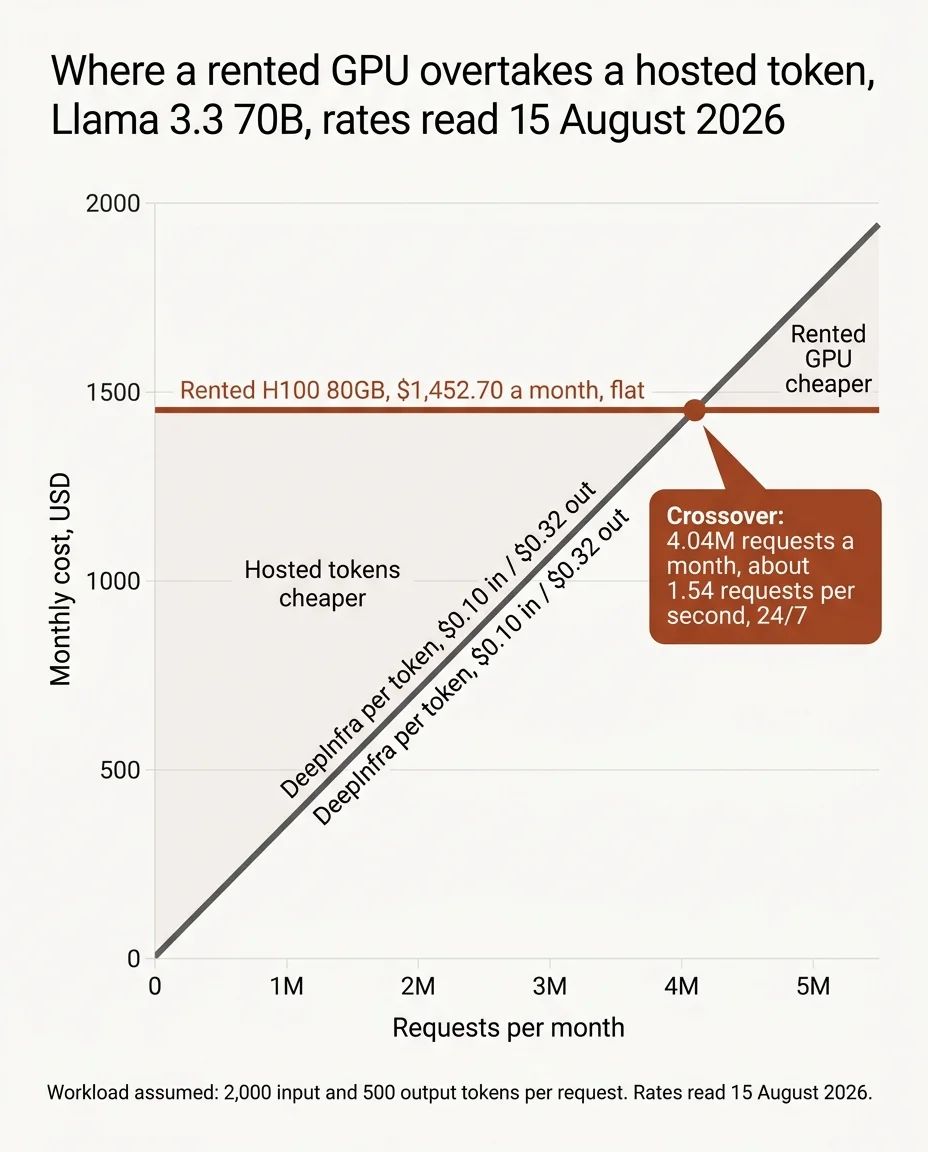
Take a realistic workload: 2,000 input and 500 output tokens per request, Llama 3.3 70B. At DeepInfra’s rates that is $0.00036 per request. One always-on H100 at community rates is $1,452.70 a month.
Divide, and the GPU stops being the expensive option at about 4,035,000 requests a month, which is roughly 1.54 requests per second sustained, every second, for thirty days. Below that line the hosted token wins, and it is not close: at 500,000 requests a month the hosted route costs $180 against $1,452.70 for the rented card.
Two caveats push that crossover further out. The first is that the calculation prices the rental, not the throughput: a single H100 running a quantized 70B may not sustain 1.54 requests per second at your context length, and if you need two cards the crossover doubles. The second is that the crossover assumes you have already built the serving stack, the autoscaling, the monitoring and the on-call rotation, none of which the hourly rate includes.
Self-hosting wins on privacy, on control, and on very high sustained volume. It rarely wins on a spreadsheet at startup scale.
What we checked, and what we could not
Every token rate on this page was read on 15 August 2026 from the public provider endpoint listings on OpenRouter, which publishes each host’s own rate for a given checkpoint rather than an average. Every GPU rate was read the same day from Runpod’s public on-demand pricing, community and secure tiers.
One thing we could not verify: Meta’s own first-party rate card. On 15 August 2026 the old developer domain redirected to a new one, the documented pricing path returned a 404, the product page listed models without any per-token figures, and the API host answered with an authentication error rather than a public grid.
We are not going to quote a Meta first-party price we could not read, so this page prices the routes that do publish. If Meta’s own endpoint matters to your decision, check it against a key of your own before you budget on it.
Frequently asked questions
Is Meta’s own Llama API free?
We could not confirm a public rate card for it on 15 August 2026, so we cannot say it is free and we will not say it costs a specific amount. What we found instead was a redirected domain, a 404 on the documented pricing path and an endpoint that answered with an authentication error, which is not a grid anyone can budget against.
For a decision you have to make this week, that makes the question moot: the three routes priced above are the ones publishing numbers you can check. Treat a Meta first-party rate as unavailable until you have read it on a key of your own.
Can I use Llama commercially without paying Meta?
Yes for the overwhelming majority of users. The Llama community license permits commercial use, with an additional-terms threshold aimed at very large consumer platforms. You still pay for compute, you just do not pay Meta for the right to run the model.
Is there a free tier on any Llama host?
Several hosts offer trial credits or a rate-limited free endpoint. They are useful for prototyping and useless for production: the limits are counted in requests per minute, and they can be withdrawn without notice. Budget as if they do not exist.
Does self-hosting ever actually win?
Yes, in three cases. When your data cannot leave your infrastructure, when you run a fine-tune nobody hosts, and when your sustained volume is high enough to keep the card busy around the clock. On the numbers above, that third case starts somewhere north of four million requests a month on a 70B model, and only if one card can genuinely keep up.