Perplexity’s Monitor API costs $1 per 1,000 runs: $0.001 for each succeeded Search run, or $0.001 for each fetched URL counted in a succeeded Page run. Failed and skipped runs are free, and a Search run is billed once even when it finds nothing. One Search monitor checked every hour costs about $0.72 over a 30-day month, and a ten-URL Page monitor on the same schedule about $7.20.

What Perplexity charges for the Monitor API
Perplexity launched the Monitor API on 16 November 2026: a scheduled web watch that either searches a topic or rereads pages you already know, then tells you what changed. The price sits in its own table on the Perplexity API pricing page, which I read on 22 November 2026.
Two meters, one price
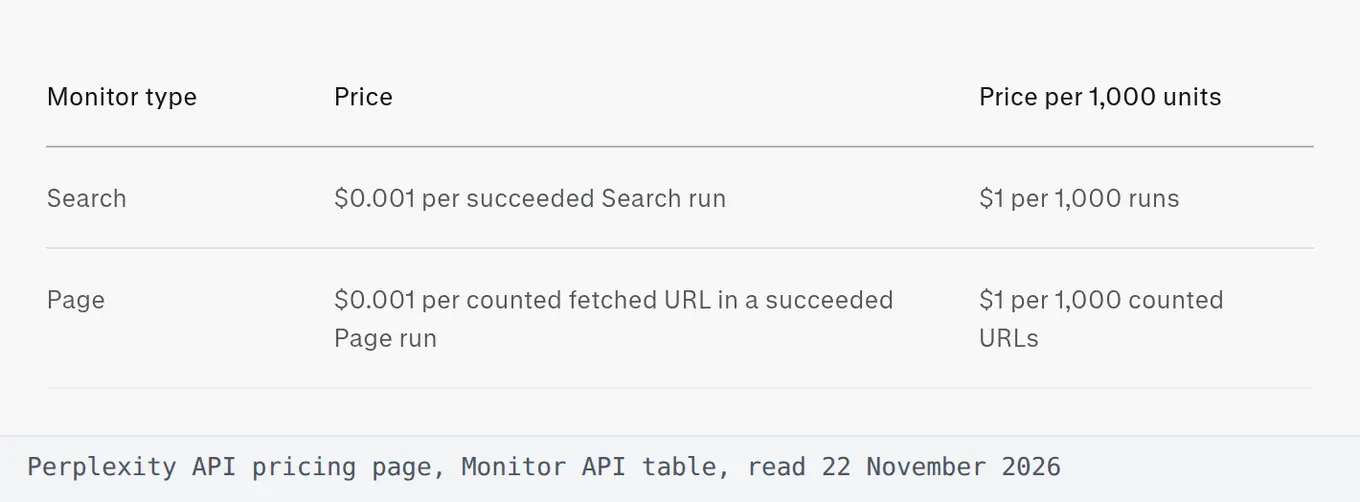
There are two monitor types, and each has its own unit. The rate is the same for both, so the only thing that changes your bill is what gets counted.
| Monitor type | Price |
|---|---|
| Search | $0.001 per succeeded Search run ($1 per 1,000 runs) |
| Page | $0.001 per counted fetched URL in a succeeded Page run ($1 per 1,000 counted URLs) |
There is no per-monitor fee and no token line, and run history is kept for 90 days at no charge.
What you are not billed for
The free cases are narrower than they look. Here is what the pricing and run documentation say costs nothing, and what still costs a tenth of a cent:
- Failed runs: free. A Page run fails only when every one of its pages fails to load.
- Skipped runs: free, for example a queued run cancelled because you paused the monitor.
- Page targets that error inside a succeeded run: not counted. Billing follows usage.fetched_urls, not the number of URLs you configured.
- A Search run with zero findings: billed. A succeeded run costs $0.001 whether it keeps three results or none.
- The baseline run of a Page monitor: billed. Perplexity’s own example shows a three-URL baseline at $0.003, even though a baseline never reports a change.
usage.cost is a list price, not your invoice
Each run returns a usage block with a cost in USD. Perplexity states it is the list-price cost, not the amount charged: use it for trends, and reconcile against billing in the API Console.
What a daily or hourly watch costs per month
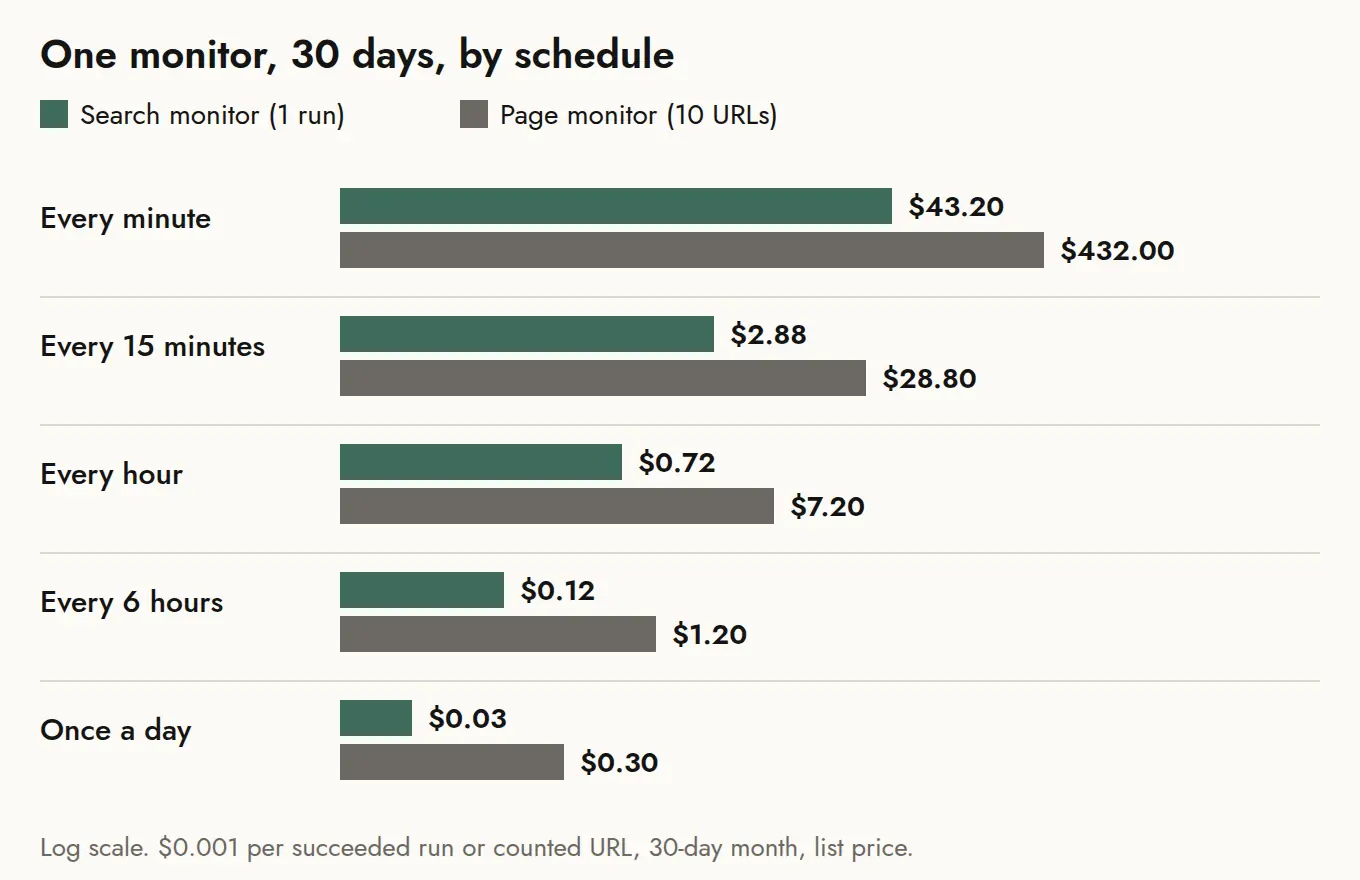
The figures below assume a 30-day month and that every run succeeds.
Search monitors by schedule
A Search monitor holds exactly one query, so its cost is the run count. Once a day is 30 runs, every hour is 720, every 15 minutes is 2,880 and every minute, the shortest interval allowed, is 43,200.
An hourly Search monitor costs $0.72 a month at list price. Even polled every minute, one topic stays under $45.
Page monitors scale with URLs
A Page monitor takes 1 to 10 URLs, and each one that loads counts as a unit on every run. Ten URLs checked hourly are 7,200 counted URLs a month, so ten times the Search monitor on the same clock.
| Watch (30 days) | List cost |
|---|---|
| Search monitor, once a day | $0.03 |
| Search monitor, every hour | $0.72 |
| Search monitor, every 15 minutes | $2.88 |
| Search monitor, every minute | $43.20 |
| Page monitor, 10 URLs, once a day | $0.30 |
| Page monitor, 10 URLs, every hour | $7.20 |
| 100 Search monitors, every hour | $72.00 |
The active monitor ceiling
The real cap is not money but monitor count. Perplexity’s rate limits page sets the number of active monitors by usage tier, shared by Search and Page monitors and by every key in the organization:
- Tier 0 and Tier 1: 100 active monitors.
- Tier 2: 200. Tier 3: 300. Tier 4: 400. Tier 5: 500.
- Paused monitors do not count, and creating one past the limit returns a 409 quota_exceeded.
So a new account can run at most 100 hourly topic watches, for about $72 a month.
What the Monitor API does for that dollar
Perplexity’s developer account announced the product on 16 November with the same unit price as the docs:
Today we’re introducing the Perplexity Monitor API.
Monitor API tracks new developments on a topic or changes to specific pages on a schedule, then sends relevant updates to your application through webhooks.
Available now at $1/1k runs or URLs fetched.@perplexitydevs
https://x.com/perplexitydevs/status/2122408441042149853
Search monitors return new URLs
A Search target takes one query of up to 1,000 characters, checks up to 20 results per run (the default), and accepts up to 20 domains to include or exclude. The monitor remembers what it already returned, so each run reports only results that are new in its time window. An optional goal tells Perplexity’s judge which findings matter, and each kept result carries a confidence score from 0 to 1.
Page monitors return diffs
A Page monitor fetches public URLs, saves a baseline on the first successful read, then compares text on later runs. A kept change arrives as a unified diff, capped at 24 KiB, with line counts and both fetch timestamps.
Schedules, jitter and webhooks
Schedules run from 1 minute to 31 days, or as a five-field cron expression in UTC unless you set a timezone. The Monitor API overview adds jitter of up to 10% of the interval, or up to 10 minutes after a cron time, so the monthly counts above are close, not exact. The first run is due as soon as you create the monitor, and it is billed like any other.
Webhooks are signed and retried seven times over about 17.6 hours. A monitor pauses itself when its webhook keeps failing, when a credit check fails, or when more than one run fails to read its sources. Organizations on zero data retention cannot run monitors at all.
Monitor against polling Perplexity yourself
The fair comparison is a cron job of your own calling Perplexity’s other APIs on the same schedule. On price alone, the Monitor API never costs more.
Search API and Context API on the same schedule
Run once an hour for 30 days, that is 720 calls. Here is what each route costs at the list prices on the same pricing page:
- Search API, standard: $5.00 per 1,000 requests, so $3.60 a month, five times the Search monitor.
- Search API with Fast Search: $1.00 per 1,000 requests, so $0.72, the same as the monitor, but with no deduplication, no judging and no webhook.
- Context API on 10 URLs: $1.00 per 1,000 fetched URLs, so $7.20, the same as a ten-URL Page monitor, but you store and diff the pages yourself.
One detail favors polling: a Search API request can carry up to five queries and still bills once. If you already dedupe on your side, five topics in one Fast Search call beat five monitors. For the fetch side, the Perplexity Context API pricing breakdown covers which URL statuses count.
Parallel’s Monitor API at $3 to $10 per 1,000 checks
Parallel sells the closest equivalent. Its pricing documentation lists Monitor at $3 to $10 per 1,000 checks depending on the processor, each execution counting as one check. The same hourly topic watch therefore costs $2.16 to $7.20 a month there, against $0.72 at Perplexity.
Parallel does give every account a recurring $5 free monthly allowance; Perplexity’s pricing page shows none for monitors.
Hourly, one topic: $0.72 a month on Perplexity Monitor, $2.16 to $7.20 on Parallel Monitor, $3.60 on Perplexity's standard Search API.
My verdict
For watching topics, Perplexity Monitor is the cheapest managed option I can price today, and the scheduling, deduplication and webhooks come free on top of what a Fast Search cron job costs. The monitor cap, not the bill, is what you will hit first. Before you wire it in, check three things:
- Interval: going from hourly to every minute multiplies the bill by 60.
- Page monitors: every URL counts on every run, baseline included, so trim the list.
- Reconciliation: track usage.cost for trends, but bill from the console.
Perplexity now prices its whole web stack per unit, from fetch to Orchestrator per-token model rates. DeepSeek also bills search per call, as the DeepSeek Search and Fetch pricing shows, but you schedule and diff everything yourself.
Frequently asked questions
Is a Search run that finds nothing billed?
Yes. A succeeded Search run costs $0.001 once, even if it performs several searches or returns no findings. Only failed and skipped runs are free.
How much does an hourly Perplexity monitor cost per month?
About $0.72 for one Search monitor over 30 days (720 runs), and about $7.20 for a Page monitor watching 10 URLs, at list price.
Does a Page target that errors cost anything?
No. Billing follows the URLs counted in usage.fetched_urls of a succeeded run, so a page that returns an error is not counted. If every page fails, the run fails and costs nothing.