The OpenAI Decisions API costs $0.10 per million input tokens on gpt-6-luna, and that is the only line on the bill: no output tokens, no reasoning tokens, no cache reads and no cache writes, per OpenAI’s Decisions guide read on 12 October 2026. The same model called through the Responses API costs $0.10 in and $0.50 out, so Decisions wins whenever the model would otherwise think or write before answering. It loses when a long shared prompt could be cached at $0.01, or when the job can wait for Batch.

What the Decisions API costs per million tokens
The Decisions API is a dedicated endpoint, POST /v1/decisions, that returns typed answers instead of text: a probability for a yes-or-no predicate, one value from a fixed list of choices, or a score against ordered levels. It runs on gpt-6-luna only, and it is in public beta since 6 October 2026.
The one billable line
The pricing paragraph sits at the bottom of the OpenAI Decisions guide, not on the main pricing page, which has no Decisions row at all on 12 October 2026. Look there, under “Pricing and availability”, if you need to show the rate to finance.
With gpt-6-luna, input costs $0.10 per 1M tokens. You pay only for input tokens: there are no cache-read, cache-write, or output-token charges.
What that sentence leaves out matters as much as what it says. These are the lines you would normally see on a gpt-6-luna invoice, and their status on /v1/decisions:
- Output tokens: not billed. The answer object, its probabilities and its confidence field cost nothing.
- Reasoning tokens: no output line exists, so whatever the model spends deciding does not reach your bill.
- Cache writes: not billed, where the Responses API charges 1.25x the input rate.
- Cached input: there is no cached-input line either, so the guide gives a repeated prefix no lower rate. Plan as if every input token bills at $0.10.
- Images: they count as input. Images must be inline base64 data URLs; hosted URLs and file IDs are refused.
Regional and long-context multipliers
The guide adds that “regional processing premiums and long-context input pricing multipliers apply”, without restating the figures. They come from the gpt-6-luna model page, which sets regional processing at a 10% premium and doubles the input rate for the whole request once a prompt passes 272K input tokens.
Applied to the Decisions rate, the arithmetic gives the grid below. It is my reading of the two pages together: OpenAI has not printed these three derived values anywhere.
| Decisions API case | Input per 1M tokens |
|---|---|
| Standard, prompt up to 272K tokens | $0.10 |
| Regional processing (US or EEA residency) | $0.11 |
| Prompt above 272K input tokens | $0.20 |
| Regional and above 272K | $0.22 |
| Output, reasoning, cache | Not billed |
The long-context case is rare for a classifier, but gpt-6-luna has a 1,050,000-token context window, so a whole contract or a long ticket thread fits in one call. Above 272K tokens, every token of that request bills at the doubled rate, not just the excess.
Decisions against gpt-6-luna on the Responses API
Same model, two endpoints, two billing logics. Before Decisions, the standard way to run a classifier on gpt-6-luna was the Responses API with Structured Outputs, and that path bills like any chat call. I covered the full rate card in my GPT-6 Sol and Luna pricing breakdown; here is the part that matters for a decision.
The Responses rate card for the same model
On the gpt-6-luna model page, read on 12 October 2026, the Standard tier lines up as follows, per million tokens:
| gpt-6-luna on Responses | Rate |
|---|---|
| Input | $0.10 |
| Cached input | $0.01 |
| Cache writes | $0.125 |
| Output, reasoning tokens included | $0.50 |
| Batch and Flex | 50% of Standard |
| Above 272K input tokens | 2x input and cache, 1.5x output |
The input price is identical. The difference lives entirely in the lines that Decisions drops, and in the two discounts (cache and Batch) that it does not offer.
Where the output line disappears
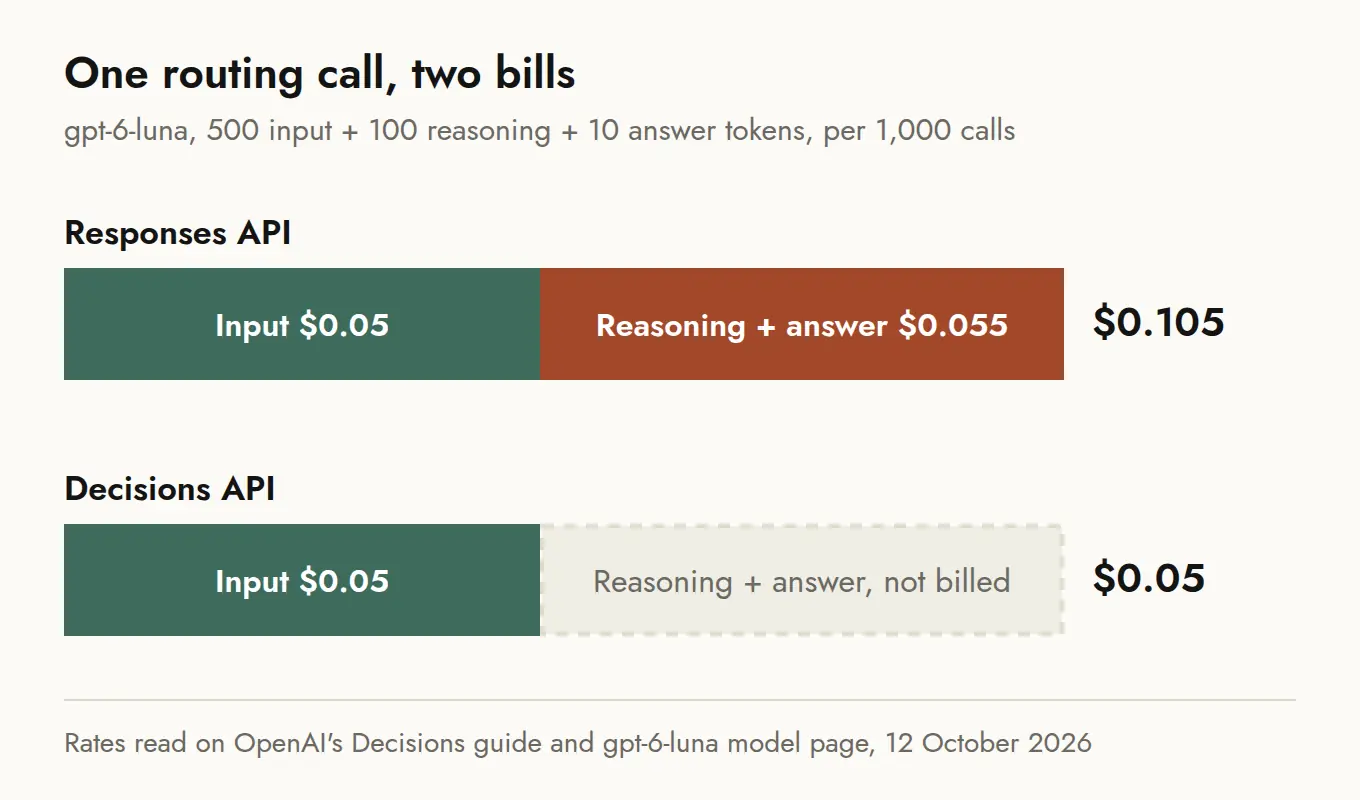
OpenAI’s reasoning guide states that reasoning tokens are invisible but “billed as output tokens”, and gpt-6-luna defaults to medium reasoning effort. A classifier that never sets reasoning.effort pays for thinking it never sees, at five times the input rate.
Take one routing call with 500 input tokens and a 10-token answer. On Decisions, it costs $0.05 per thousand calls. On Responses with reasoning off, it costs $0.055 per thousand; if the model also spends 100 reasoning tokens, it climbs to $0.105 per thousand, more than twice the Decisions price for the same input.
Same 500-token routing call on gpt-6-luna: $0.05 per thousand on Decisions, $0.105 per thousand on Responses once the model spends 100 reasoning tokens.
The bigger gain is predictability. Input is known before you send the request, so a Decisions bill is fixed in advance; on Responses, the output side moves with reasoning effort and answer length. If you already budget OpenAI calls line by line, my OpenAI cost breakdown by line shows how far reasoning drifts on other workloads.
Where Responses still wins
Decisions is not cheaper in every shape. Two cases flip the verdict, and both come from discounts the guide does not extend to /v1/decisions:
- A long shared prompt. Put a 4,000-token policy in front of a 300-token ticket on Responses: once the policy is cached, with a 10-token answer and no reasoning, that is $0.075 per thousand calls. The same 4,300 tokens on Decisions cost $0.43 per thousand, nearly six times more.
- Work that can wait. Batch halves every gpt-6-luna rate on Responses, so the 500-token call with reasoning off falls to $0.0275 per thousand. The Decisions guide mentions no Batch or Flex option.
So the rule is simple. Short, varied inputs that need an answer now go to Decisions; long rubrics repeated on every call, or overnight backlogs, stay on Responses with caching or Batch.
Where the Decisions API is a bargain
The sweet spot is a high-volume, latency-sensitive yes, no or pick-one question on short evidence. OpenAI claims answers come back “about 10x faster than the Responses API”, a figure its guide does not back with a published benchmark. Unlike Google’s Gemini Decision 1 pricing, these are the workloads where the pricing works for you, the same kind of job as page scoring in Perplexity’s Context API:
- Ticket and request routing: a short message, a list of departments, a fallback “other” value.
- Moderation and gating: a predicate on each user post or upload, with a threshold you set from labeled data.
- Image checks: damage, defects or document type on a cropped photo, where the image is the input and the answer is a probability.
- Agent next-step selection: one choice among a few tools or actions, asked many times per session.
One builder shows the image case end to end on a sorting line: each egg crop goes to the Decisions API and comes back as clean, dirty or cracked. The post gives the measured token count per image, which is the number you need to price this kind of job.
openai just released Decisions API, Jev-like “system 1” multi-modal model based on GPT6 Luna!
Each egg gets cropped and sent to OpenAI (~270ms latency) and returns P(clean, dirty, cracked).
One image crop consumes ~280 input tokens (~$0.03/1K imgs). @roboflow RF-DETR for@erik_kokalj
https://x.com/erik_kokalj/status/2107902595532824856
The arithmetic holds: 280 tokens a crop is 280,000 tokens per thousand images, or $0.028 at $0.10 per million. For a broader view of the floor across providers, my list of the cheapest LLM APIs right now already puts gpt-6-luna at the bottom of the metered grid; Decisions removes its output side on top.
Beta caveats before you route production traffic
OpenAI announced the public beta on 6 October 2026, and its developer account framed it as a speed product rather than a price cut:
Let your app choose the right model, tool, or action in near real-time with Decisions API, now available to all developers in public beta.
The Decisions API makes decisions up to 10x faster than GPT-6 Luna through the Responses API.@OpenAIDevs
https://x.com/OpenAIDevs/status/2107573382229188645
The guide says OpenAI expects general availability “in the coming weeks”. Until then, these limits are worth knowing before you move a production queue:
- The price is a beta price. It lives in a guide, not on the pricing page, and OpenAI has not said whether it carries over to general availability.
- One model. gpt-6-luna is the only model supported; you cannot move a hard question to a bigger model on the same endpoint.
- Typed answers only. For extracted fields or a written explanation, OpenAI points you back to Structured Outputs on the Responses API.
- Inline images only. Base64 data URLs are accepted; hosted image URLs and file_id inputs are not.
- Recent SDKs. The examples need Python 3.26.0, JavaScript 7.30.0, Go 3.73.0, Ruby 0.101.0 or Java 4.78.0 and later.
On compliance, the beta already supports Zero Data Retention and HIPAA use for eligible customers, with data residency in the United States and Europe (EEA and Switzerland). Residency is exactly where the 10% regional premium applies, so an EU deployment pays $0.11 per million input tokens, not $0.10.
My verdict: move short, real-time classification to Decisions now, test thresholds on your own labeled data, and keep any cached-rubric or overnight workload on Responses until OpenAI publishes the general availability terms.