Gemini Decision 1 costs $0.10 per 1M input tokens on the paid tier of the Gemini API, and output is not billed at all. Google charges the shared input once per request, however many of the up to 1,000 questions you ask about it, and AI Studio offers a free tier for prototyping. On a 20-question request with 2,800 input tokens, that works out to $0.28 per 1,000 requests, against $1.34 for Gemini 3.5 Flash-Lite answering the same questions in one call.

What Gemini Decision 1 is and what it is not
Gemini Decision 1 (model id gemini-decision-1) is a Gemini model that never writes text. Google launched it on 11 November 2026 with a dedicated endpoint, the Decisions API, available through the Gemini API in Google AI Studio.
According to Google’s launch post, the model scores your candidate options in a single forward pass instead of decoding an answer token by token. That is why there is no output line to bill, and why Google quotes 150 to 250 ms end to end, with median model compute of 50 to 100 ms.
Three question types in one pass
Every request can mix three kinds of questions against the same input, each answer with a confidence score between 0 and 1:
- Yes or no (type noul): the probability that a condition holds, with optional true and false criteria.
- Multiple choice (type choice): one winner among 2 to 255 options, plus normalized probabilities for every candidate.
- Rubric score (type score): a continuous weighted score across ordered levels starting at 0, with the probability of each level.
The input can be text, images, audio, video or PDF, combined in one shared block of up to 256K tokens.
Limits to know before you build
This is a classifier, not a chat model. Here is what I would check before moving a production queue onto it:
- No Batch API. The pricing page states plainly that Batch is not supported, so there is no 50% overnight discount.
- No context caching line. The grid lists caching as not available on both tiers.
- Not on Google Cloud yet. Google says support in Gemini in Google Cloud is coming soon, without a date.
- Benchmarks are Google’s. The lowest calibration error claim comes from Google’s own suite, not an independent test.
What teams are building with it
One day after launch, the concrete uses on record come mostly from Google itself. Each shows the workload the pricing targets: many short, bounded calls where latency matters more than prose.
Routing, design and emoji inside Google
Google lists four internal products already running on the Decisions API:
- Gemini Notebook uses it as a real-time router that picks the model tier and thinking level for each query, serving everyday queries with up to 40% lower latency.
- Stitch uses it to build playable wireframes of a product flow in seconds.
- CC, from Google Labs, picks an emoji reaction from a palette of more than 200 options in a fraction of a second.
- Google Search uses it as a safety layer for MCP tools, detecting adversarial behavior within its latency budget.
Google’s launch thread shows the photo-checking case end to end: a checklist of yes, no, choice and rating questions run over a batch of 100 delivery photos.
So how do your questions turn into a decision? Instead of asking a model to describe a photo, you give it a checklist of yes/no, multiple-choice, and rating questions so it knows what to check and what action to take. Here, Gemini Decision 1 scans 100 delivery photos in 4.5
Demo apps and day-one integrations
Google published three demo apps (Doorstep Parcels, Speed Sketch and Find the Zoo Keeper) and integrations rolling out across OpenRouter, LangChain, Vercel, LiteLLM, Pydantic AI, Pipecat, LiveKit and OpenCode. OpenRouter listed the model on launch day at the same rate.
Google’s very first decision model is here, and it’s on OpenRouter from day one. Gemini Decision 1 answers yes/no, multiple choice, and score questions with a probability, for $0.10/M input and free output.
@OpenRouter
https://x.com/OpenRouter/status/2120583084005605816
The Gemini Decision 1 rate card
On 12 November 2026, the Gemini Developer API pricing page lists gemini-decision-1 near the bottom, under the Lyria music models and above Gemini Embedding 2. It has a single Standard tab, and this is the whole grid, per 1M tokens on the paid tier:
| gemini-decision-1 | Paid tier |
|---|---|
| Input (text, image, video, audio, PDF) | $0.10 |
| Output | Not applicable, 0 output tokens |
| Context caching | Not available |
| Batch API | Not supported |
| Free tier | Free of charge, data used to improve Google products |
One billable line
Every modality bills at the same $0.10, which is unusual on Google’s grid: Gemini 3.5 Flash-Lite, for comparison, charges $0.30 for any input and $2.50 for output, thinking included. There are no thinking tokens to budget, and no separate audio transcription or OCR costs.
The rule that changes the math is how questions are counted. Google bills the shared input once per request, and each question only adds the tokens of its own instructions, criteria and formatting.
A 2,800-token request asking 20 questions costs $0.00028. That is $0.000014 per decision, or 1.4 cents per 1,000 decisions.
Google’s official announcement on X carries the same rate alongside the latency figure:
Most models are built to generate text, creative content, or reason step-by-step. But not every task needs a written answer. When a workflow or agent just needs to make a quick call, the Decisions API returns calibrated confidence scores (150-250 ms end-to-end) at $0.10 per 1M
The free tier trade-off
The free tier is enough to calibrate thresholds on your own labeled data. The catch sits on the last line of the grid: on the free tier, Google uses your content to improve its products, and on the paid tier it does not.
So prototype on free with synthetic or public samples, and switch to paid before you send customer photos, call recordings or claims PDFs. For the rest of Google’s grid translated per request, see my Gemini token cost breakdown.
What one decision really costs against Flash-Lite
Google says Decision 1 on the Decisions API is nearly 5x cheaper than Gemini 3.5 Flash-Lite on the Interactions API across its benchmark suite. My arithmetic on common workloads lands on both sides of that figure. Each scenario below assumes 1,000 requests at the paid Standard rates read on 12 November 2026.
A single routing question
One 500-token ticket, one multiple-choice question: $0.05 per 1,000 calls on Decision 1.
On Flash-Lite with a 10-token answer, the same call costs $0.175 per 1,000: $0.15 of input plus $0.025 of output. If the model spends 100 thinking tokens before answering, it climbs to $0.425, which makes Decision 1 about 8.5 times cheaper.
Twenty questions on one shared input
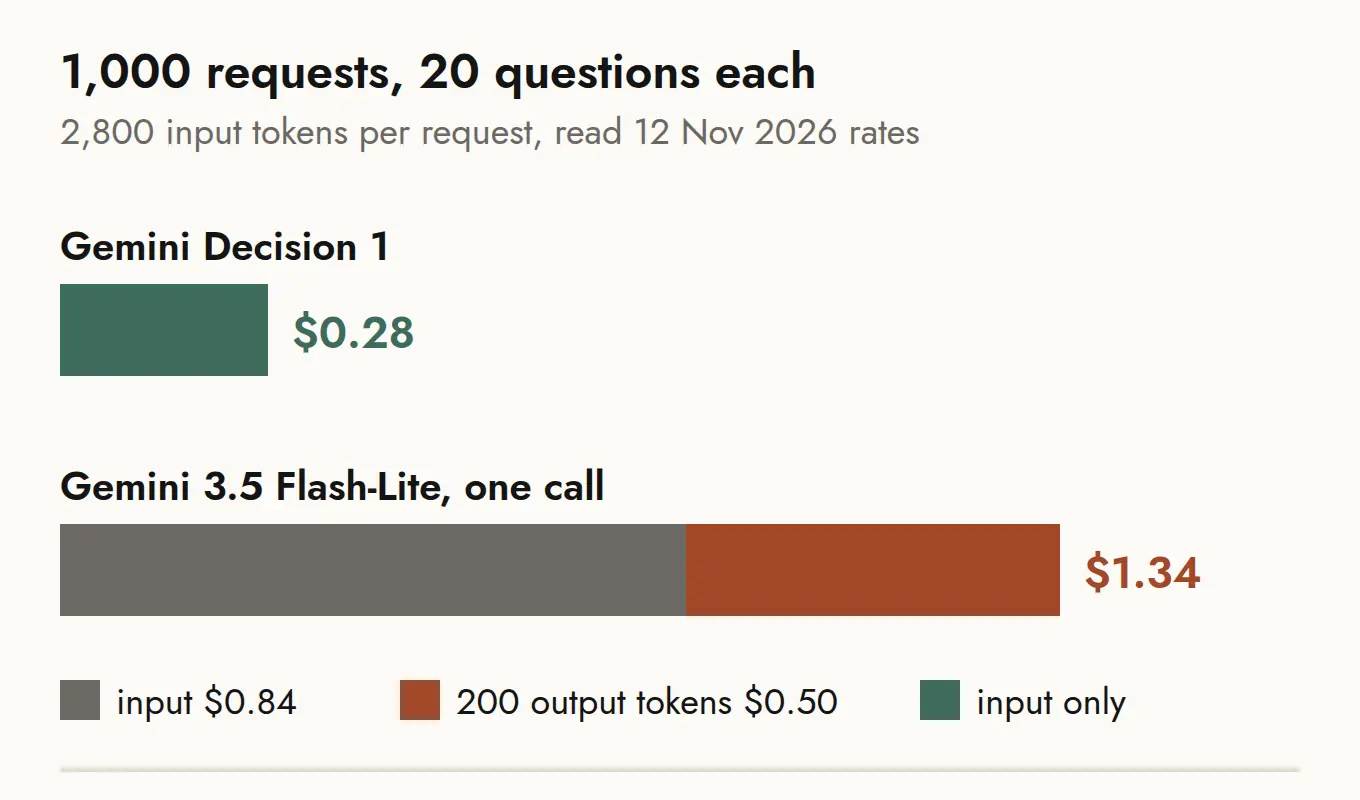
This is the case the Decisions API is built for. Picture a 2,000-token claim (form plus notes) checked against 20 questions of about 40 tokens each, so 2,800 input tokens per request.
Decision 1 bills $0.28 per 1,000 requests. Flash-Lite answering all 20 in one structured call, with about 200 output tokens, bills $0.84 of input and $0.50 of output, $1.34 in total, or 4.8 times more.
Ask Flash-Lite one question per call instead and the shared 2,000 tokens are billed 20 times over, which is the habit Decision 1 punishes most.
| Workload, per 1,000 requests | Decision 1 against the alternative |
|---|---|
| 500 tokens, 1 question | $0.05 against $0.175 on Flash-Lite ($0.425 with 100 thinking tokens) |
| 2,800 tokens, 20 questions | $0.28 against $1.34 on Flash-Lite in one call |
| 4,000-token cached policy plus 300-token ticket, 1 question | $0.43 against $0.07 on the OpenAI Decisions API with a cache hit |
Where Flash-Lite still makes sense
Flash-Lite keeps two advantages. It writes, so it can return extracted fields or a reason with the label, and it has the discounts Decision 1 lacks: context caching at $0.03 per million and Batch.
Decision 1 has no caching and no Batch. A long rubric resent on every call is billed in full at $0.10 per million, every time.
Gemini Decision 1 against the OpenAI Decisions API
OpenAI got there first: its Decisions API on gpt-6-luna launched as a public beta, and the OpenAI Decisions guide now says it is generally available. Same $0.10 input price, but the grids part ways on caching and on what one request carries.
Two grids side by side
Here is how the two compare:
- Input: $0.10 per million on both. OpenAI adds a 10% regional processing premium and doubles the input rate above 272K tokens.
- Output: not charged on either.
- Caching: OpenAI added prompt caching at general availability, at standard gpt-6-luna rates ($0.01 per million for cache reads, $0.125 for cache writes). Google lists none.
- Questions per request: up to 400 on OpenAI, up to 1,000 on Google.
- Inputs: text, images and JSON on OpenAI; text, images, audio, video and PDF on Google.
- Free tier: Google has one in AI Studio; the OpenAI guide mentions none.
The caching gap decides long-prefix jobs. A 4,000-token policy followed by a 300-token ticket costs $0.43 per 1,000 calls on Decision 1, and $0.07 on OpenAI once the policy is a cache hit ($0.04 of cached reads plus $0.03 of fresh input). My earlier OpenAI Decisions API pricing breakdown covers the gpt-6-luna side in detail.
Which one to pick
My verdict: Gemini Decision 1 wins whenever many questions hit the same input, and whenever that input is audio, video or a PDF that OpenAI’s endpoint does not take. OpenAI’s Decisions API wins when a long, identical rubric precedes short, changing inputs, because its cache reads cost a tenth of the input rate.
For anything that has to write an answer, neither endpoint helps, and the cheapest metered models are still in my list of the cheapest LLM APIs right now.