GPT-6.1 Sol costs $2.00 per million input tokens, $0.10 per million cached input tokens, $2.50 for cache writes and $10.00 per million output tokens on prompts up to 272K tokens, read on the OpenAI pricing page on 20 October 2026. Only one line moved from GPT-6 Sol: cached input, cut from $0.20 to $0.10. On an agent loop that re-reads a long prefix every turn, that trims about 14 percent off each call, and it makes GPT-6.1 Sol exactly half the price of Claude Opus 5.5 on short prompts. It no longer has the cheapest cache at its level, though: Claude Sonnet 5.5 has charged the same $0.10 since 7 October and stays cheaper past 272K tokens.

What GPT-6.1 Sol costs per million tokens
OpenAI bills gpt-6.1-sol on four lines, not three. The cache-write line matters as much as the cache-read line once you run agents, because every new chunk of conversation gets written before it can be read back cheaply.
The standard rate card
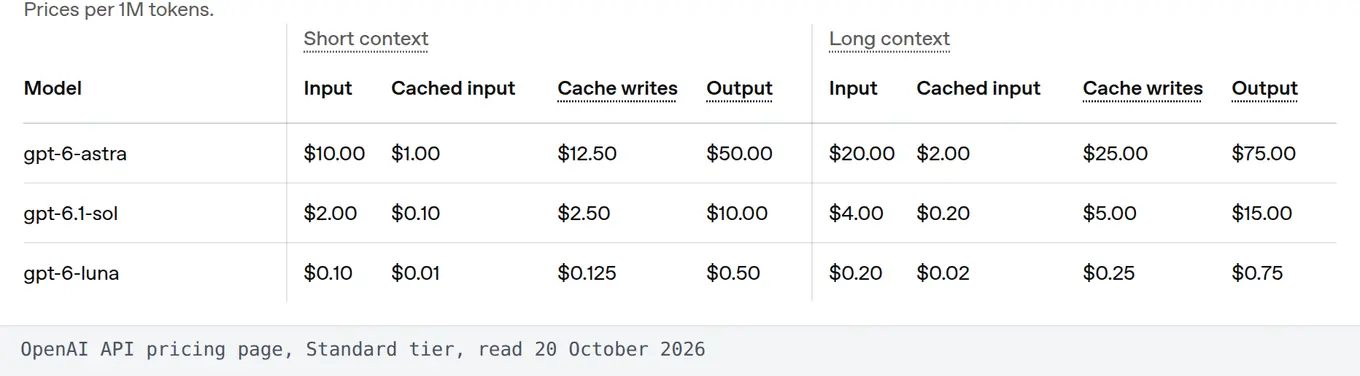
These are the Standard-tier rates from the OpenAI API pricing page, with the long-context rate in brackets.
| Line (per 1M tokens) | Short context (long context) |
|---|---|
| Input | $2.00 ($4.00) |
| Cached input | $0.10 ($0.20) |
| Cache writes | $2.50 ($5.00) |
| Output | $10.00 ($15.00) |
The gpt-6.1-sol model page gives the ratios behind those numbers. Cached input is 5 percent of the uncached rate, where GPT-6 Sol charges 10 percent, and cache writes cost 1.25 times the input rate on both models.
Cached input on GPT-6.1 Sol: $0.10 per million tokens, 5% of the $2.00 input rate. GPT-6 Sol still charges $0.20, or 10%.
Batch, Flex, Fast and Ultrafast
The same model sells at four other prices depending on the service tier. They are plain multipliers of the Standard card, which the model page states outright.
- Batch and Flex: half price, so $1.00 input, $0.05 cached, $1.25 cache writes and $5.00 output.
- Fast (the tier OpenAI called Priority until 30 July 2026): twice Standard, $4.00, $0.20, $5.00 and $20.00.
- Ultrafast: six times Standard, $12.00 input and $60.00 output, covered in detail in my page on GPT-6.1 Sol Ultrafast pricing.
- Regional processing: a 10 percent uplift on top of whichever tier you pick.
A batchable job with a large shared prefix therefore reads cached tokens at $0.05 per million, a twentieth of the $1.00 Batch input rate, similar to how GPT-6.1 Terra at half price restructures token economics.
The 272K line
Prompts with more than 272K input tokens are billed at twice the input and cache rates and 1.5 times the output rate, for the whole request. A 280K-token prompt does not pay the premium on the last 8K tokens only: every token in it moves to the long-context card.
The cache cut survives that switch, since long-context cached input is $0.20 against $0.40 on GPT-6 Sol. But the 272K line is where GPT-6.1 Sol stops competing with Anthropic, as the comparison below shows.
What the halved cache rate changes
A cache discount only pays on tokens you actually resend. Two shapes of workload resend a lot: agents, which replay their system prompt, tool definitions and history on every turn, and assistants built on a long fixed system prompt. I priced one of each.
Against GPT-6 Sol on an agent turn
Take one agent turn with a 100,000-token prompt: 90,000 tokens of cached prefix, 10,000 new tokens written to the cache, and 2,000 output tokens. On GPT-6.1 Sol that turn costs $0.009 in cache reads, $0.025 in cache writes and $0.020 in output, so $0.054.
The same turn costs $0.063 on GPT-6 Sol. The $0.009 difference is the whole effect of the price cut, about 14 percent per turn, and it grows with the share of the prompt that is cached.
Long system prompts
The second case is a support or extraction assistant with a 20,000-token system prompt, cached, plus 500 tokens of user input and 500 tokens of answer. Per 1,000 requests, GPT-6.1 Sol costs $8.00 and GPT-6 Sol costs $10.00.
Here the cut is worth 20 percent, because output is short and the cached prompt is a bigger share of the bill. The longer your fixed instructions and the shorter your answers, the more the new rate helps.
What it does not change
Three things stay where they were, and they can eat the saving if you switch model IDs without checking.
- Cache writes remain $2.50 per million, so a prompt that changes on every call (a timestamp at the top of the system prompt, for instance) pays more than an uncached one.
- Output remains $10.00 per million, and reasoning tokens are billed as output.
- The reasoning floor moved up: the model page says the none and minimal reasoning efforts are not supported on gpt-6.1-sol, so low is the cheapest setting. A classifier that ran GPT-6 Sol with no reasoning will now bill some reasoning output on every call.
For the full GPT-6 Sol card and the Luna tier below it, see my page on GPT-6 Sol and Luna pricing.
GPT-6.1 Sol against Sonnet 5.5, Grok 4.7 and Opus 5.5
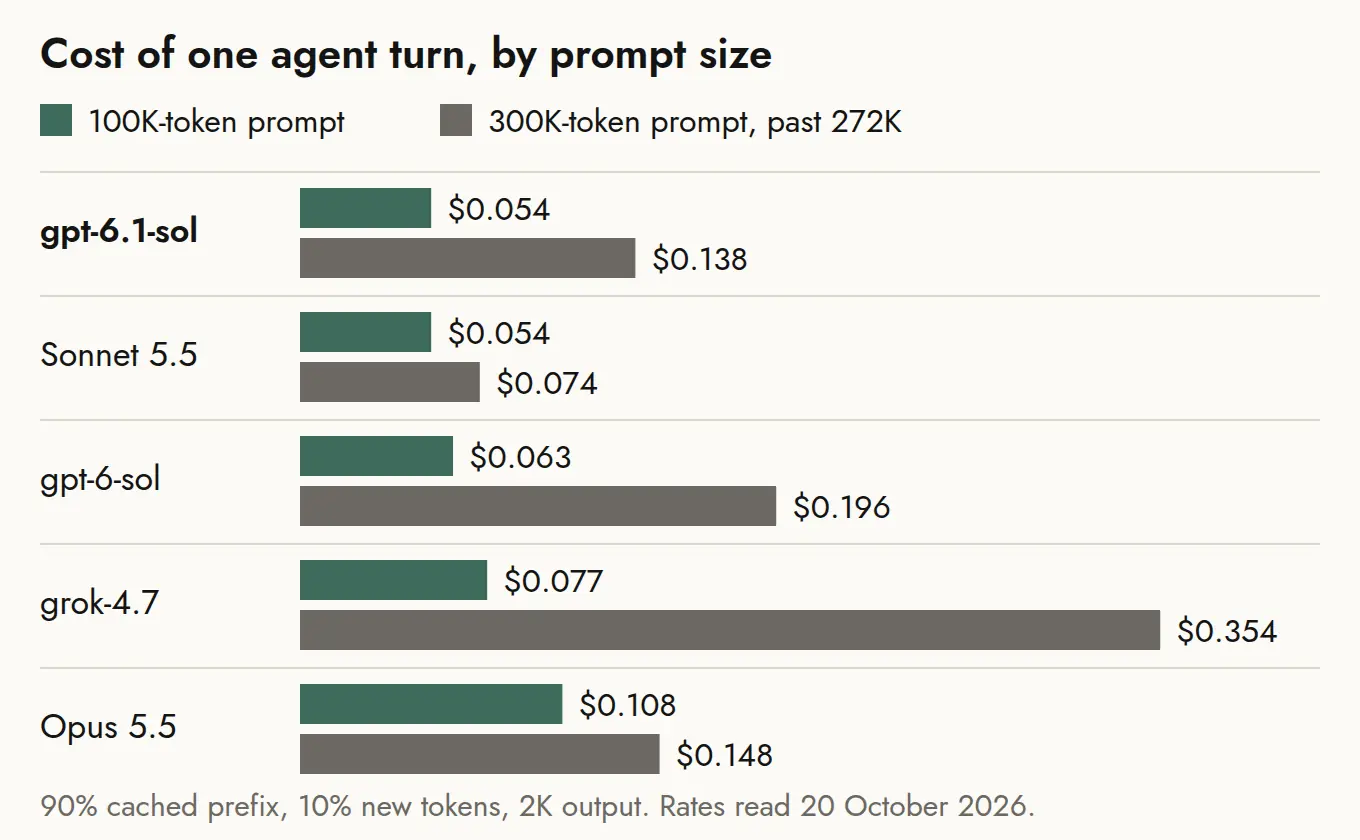
The same 100,000-token agent turn, priced on each provider’s own grid, gives the ranking below. For grok-4.7, xAI’s pricing table has no cache-write line, so the 10,000 new tokens are counted at its $2.00 input rate.
| Model | Cost of one 100K-token agent turn |
|---|---|
| gpt-6.1-sol | $0.054 |
| Claude Sonnet 5.5 | $0.054 |
| gpt-6-sol | $0.063 |
| grok-4.7 | $0.077 |
| Claude Opus 5.5 | $0.108 |
Sonnet 5.5 now charges the same short-context rates
On the Anthropic pricing page, Claude Sonnet 5.5 pricing shows $2 input, $10 output, $2.50 for a five-minute cache write and $0.10 for a cache read. Anthropic’s release notes date that last figure to 7 October 2026, when Sonnet 5.5 cache reads dropped from $0.20 to $0.10.
So on any prompt under 272K tokens, GPT-6.1 Sol and Sonnet 5.5 bill identically, line for line. Past that line they split: Anthropic charges Claude 4.6 and later models (except Haiku 5.5) the same rate across the full 1M context, while OpenAI doubles input and cache and raises output by half.
At 300K tokens, one agent turn costs $0.138 on GPT-6.1 Sol and $0.074 on Claude Sonnet 5.5, two models priced identically below 272K.
That 300K turn keeps the same shape as before: 290,000 cached tokens, 10,000 written, 2,000 output. GPT-6 Sol would charge $0.196 for it and grok-4.7, which moves to its long-context card past 200K, $0.354.
Grok 4.7 has cheaper output and a dearer cache
xAI’s pricing documentation lists grok-4.7 at $2.00 input, $0.50 cached and $6.00 output under 200K tokens, then $4.00, $1.00 and $12.00 above. Its output is 40 percent cheaper than GPT-6.1 Sol’s, but its cached input costs five times more.
That makes the comparison a question of shape. Grok 4.7 wins on output-heavy jobs with little repeated context, such as long generations from short prompts. On anything that replays a big prefix, the $0.50 cache line outweighs the output saving, as the agent turn above shows. Calls sent to xAI’s US regional endpoint cost 10 percent more.
When it beats Opus 5.5
On price, always. Below 272K tokens every GPT-6.1 Sol line is exactly half of Claude Opus 5.5’s: $2 against $4 input, $0.10 against $0.20 cached, $2.50 against $5 for writes, $10 against $20 output.
Past 272K, OpenAI’s surcharge brings input, cached input and cache writes up to Opus 5.5’s flat rates ($4, $0.20 and $5), but output stays at $15 against $20. GPT-6.1 Sol is therefore never the dearer of the two per request; on the 300K turn it costs $0.138 against $0.148. The gap that is left is narrow enough that the choice past 272K comes down to which model does the task better, not to the rate card. My Claude Opus 5.5 pricing page has its batch and fast-mode rates.
Which model to run a cached workload on
Here is how I would pick, on rates alone, for a workload where most of the prompt repeats from call to call.
- Prompts under 272K, already on OpenAI: move from gpt-6-sol to gpt-6.1-sol, after checking that the low reasoning floor does not inflate your output.
- Prompts that cross 272K: Claude Sonnet 5.5 costs the same below the line and about half above it on the turn priced here.
- Output-heavy jobs with little repeated context: grok-4.7, whose $6.00 output beats both.
- Work that needs Opus-level quality: compare GPT-6.1 Sol on your own tasks first, since it costs half as much on short prompts.
OpenAI announced the new cache rate in its launch thread on 29 September 2026. The post puts cached input at $0.10 per million tokens, 95 percent less than standard input pricing and 50 percent less than on GPT-6 Sol.
GPT-6.1 Sol makes frontier intelligence more affordable, so you can use it for more of the work that matters and developers can build and run applications at scale. Cached input costs just $0.10 per million tokens.
@OpenAI
https://x.com/OpenAI/status/2104986131238695200
All rates on this page were read on 20 October 2026 from each provider’s own pricing documentation, Standard tier, global endpoints.