GPT-6.1 Terra costs $1.00 per million input tokens, $0.05 per million cached tokens and $5.00 per million output tokens on OpenAI’s standard tier. That is exactly half of GPT-6.1 Sol on every column and ten times GPT-6 Luna on input and output. Batch and Flex cut it in half again, Fast mode doubles it, and prompts above 272K input tokens pay a long-context multiplier. On a month of 10 million input and 2 million output tokens, 90 percent cached, Terra bills $11.45.

The GPT-6.1 Terra price grid
OpenAI released gpt-6.1-terra on 26 October 2026, in ChatGPT Work, Codex and the API at the same time. The model takes text and images in, writes text out, and keeps the 1,050,000-token context window and 128,000-token output ceiling of the Terra line. Its knowledge cutoff is 1 June 2026.
Standard rates per million tokens
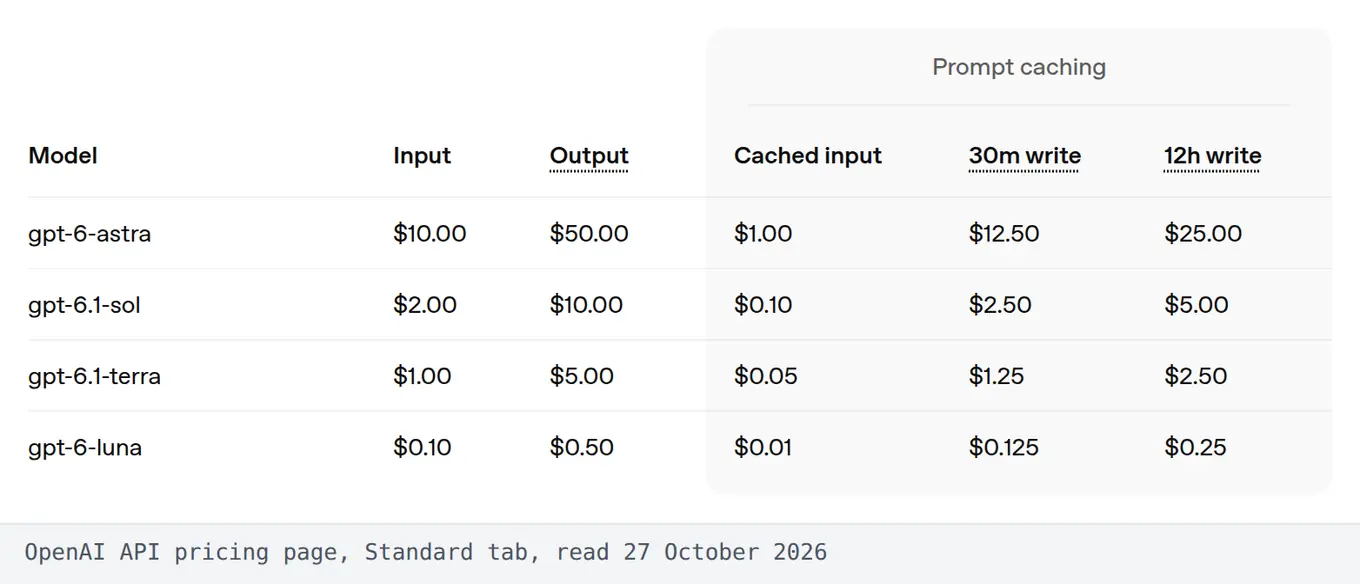
As of 27 October 2026, the GPT-6.1 Terra model page and the Standard tab of the OpenAI API pricing page agree on four numbers. Every other price on this page derives from them.
| Line (Standard, short context) | Price per million tokens |
|---|---|
| Input | $1.00 |
| Cached input | $0.05 |
| Cache write, 30-minute retention | $1.25 |
| Cache write, 12-hour retention | $2.50 |
| Output | $5.00 |
Output is five times input, the same ratio as every current gpt-6.x model. The cached rate is 5 percent of input, which puts Terra with GPT-6.1 Sol in the 0.05x cache club rather than with Luna, whose cache is 10 percent of its input.
Cache writes and the 12-hour option
Writing a prompt prefix into the cache is not free. A 30-minute write costs 1.25 times the input rate, and the 12-hour retention costs 2.5 times. The 12-hour write only pays off when the same prefix is read many times across a working day.
My rule of thumb on Terra is simple:
- A system prompt reused within minutes, as in a chat or an agent loop, belongs in the 30-minute cache.
- A large shared document queried all day by many users justifies the 12-hour write at $2.50.
- A prefix used only once should not be cached at all, since the write costs 25 percent more than a plain input token.
Batch, Flex, Fast mode and regional processing
The model page lists four adjustments to the standard grid, and the pricing page prints each one as its own table. Here is what each does to the $1 / $5 headline:
- Batch and Flex, 50 percent lower: $0.50 input, $0.025 cached, $2.50 output.
- Fast mode, 2x standard: $2.00 input, $0.10 cached, $10.00 output.
- Long context, above 272K input tokens: 2x input and cache, 1.5x output, applied to the full request.
- Regional processing (data residency), a 10 percent premium where available.
The pricing page has no Ultrafast row for Terra. That tier stays reserved for gpt-6-astra and gpt-6.1-sol.
Where Terra sits between Luna and Sol
OpenAI’s current flagship table now has four rows: gpt-6-astra, gpt-6.1-sol, gpt-6.1-terra and gpt-6-luna. Terra fills the gap that opened when GPT-6 Sol and Luna replaced the 5.6 line, and its price is set by simple ratios to its neighbours.
Exactly half of GPT-6.1 Sol
Every Terra price is half the matching GPT-6.1 Sol price: $1 against $2 on input, $0.05 against $0.10 cached, $1.25 against $2.50 for a 30-minute write, $5 against $10 on output. The ratio holds in the Batch and Fast tables too. There is no line where Terra is anything other than a 50 percent discount on Sol.
GPT-6.1 Terra is half of GPT-6.1 Sol on every line of the grid, and one tenth of gpt-6-astra ($10 in, $50 out).
Ten times GPT-6 Luna
Against GPT-6 Luna at $0.10 and $0.50, Terra costs ten times more on input, output and cache writes. The cache is the exception: $0.05 against $0.01, only five times more. On a workload that is mostly cache hits, the gap between Luna and Terra narrows a little, but Luna remains the cheapest row of OpenAI’s current flagship table.
Fast mode Terra costs what standard Sol costs
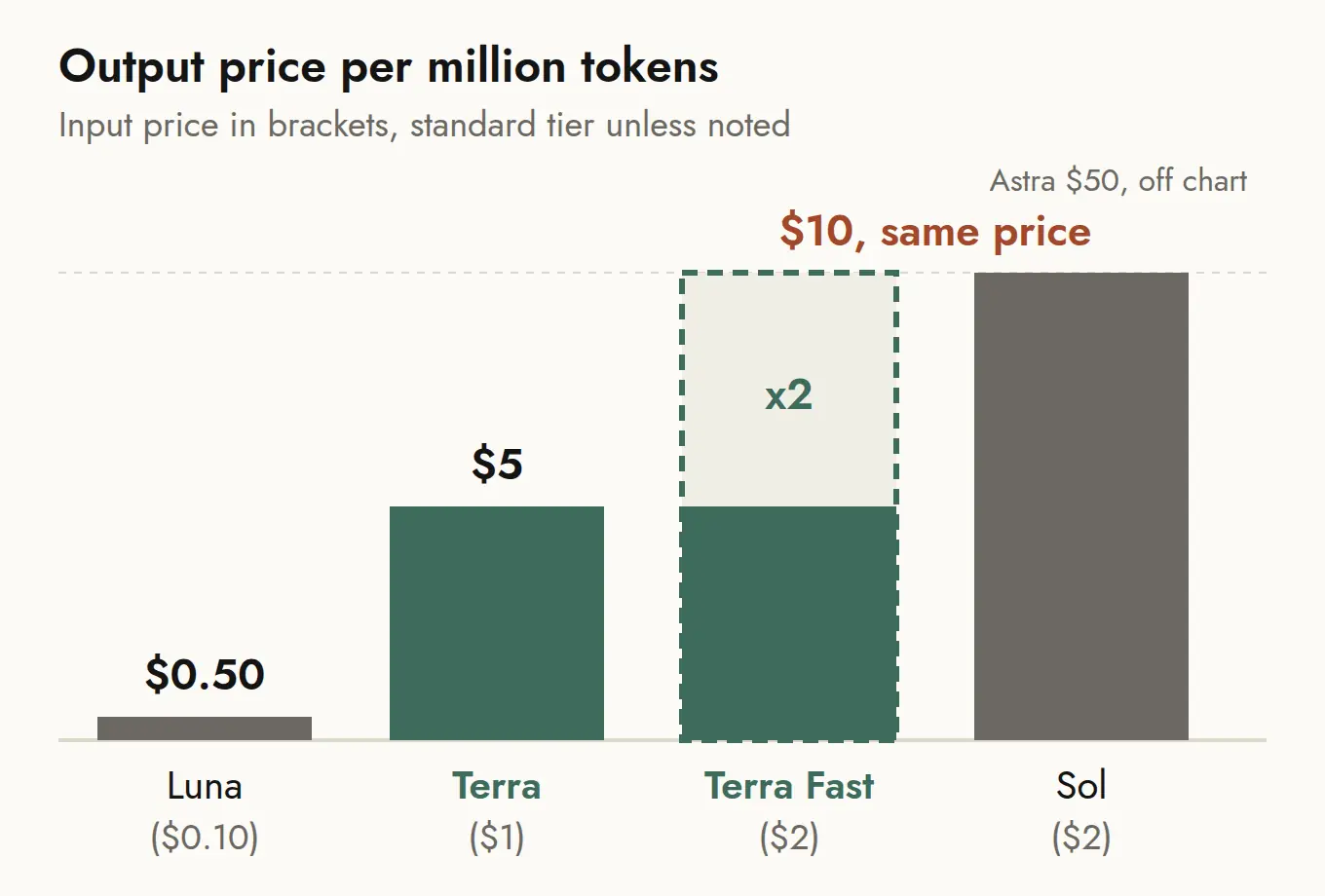
Doubling Terra lands precisely on Sol: Fast mode Terra is $2 / $0.10 / $10, the same as standard GPT-6.1 Sol. You pay the same per token either way, so the choice is purely speed against capability. OpenAI pitches Terra for computer use, screen reading and visual matching, where response time matters more than the deepest reasoning.
What a month of Terra costs
I price every OpenAI model on this site against the same month, so the numbers line up across pages. The workload is 10 million input tokens and 2 million output tokens, with 90 percent of the input served from cache and cache writes left out.
The reference workload
On Terra that month breaks down as 1 million uncached input tokens at $1.00, 9 million cached tokens at $0.05 and 2 million output tokens at $5.00. The total is $1.00 + $0.45 + $10.00, so $11.45. Output makes up 87 percent of the bill, which is normal for a model whose output costs five times its input.
| Model and mode | A month at that volume |
|---|---|
| gpt-6-luna, standard | $1.19 |
| gpt-6.1-terra, Batch or Flex | $5.73 |
| gpt-6.1-terra, standard | $11.45 |
| gpt-6.1-terra, regional processing | $12.60 |
| gpt-6.1-terra, every prompt above 272K | $17.90 |
| gpt-6.1-terra, Fast mode | $22.90 |
| gpt-6.1-sol, standard | $22.90 |
| gpt-5.6-terra, standard | $27.80 |
Without any caching, the same 10 million input and 2 million output tokens cost $20 on Terra, $40 on Sol and $2 on Luna. Caching takes almost 43 percent off the Terra bill here, less than on Sol, because Terra’s input was already cheap.
Long prompts past 272K tokens
The long-context rule applies to the whole request, not only to the tokens beyond the threshold. One prompt of 300K input tokens is billed at $2.00 input, $0.10 cached and $7.50 output for every token it contains. In my reference month, if every request crossed that line, the bill would rise from $11.45 to $17.90.
Above 272K input tokens, Terra bills 2x input and cache and 1.5x output on the full request: $2.00 / $0.10 / $7.50 per million.
For retrieval pipelines, the practical move is to cap context below 272K tokens. Staying under the line is worth more than any caching trick.
GPT-6.1 Terra against GPT-5.6 Terra
The previous Terra, gpt-5.6-terra at $2 in and $12 out, is still on its own model page with a $0.20 cached rate. The new model undercuts it on every line, and the cut is not uniform:
- Input falls by half, from $2.00 to $1.00.
- Cached input falls by three quarters, from $0.20 to $0.05.
- Output falls by 58 percent, from $12.00 to $5.00.
- The reference month falls by 59 percent, from $27.80 to $11.45.
OpenAI’s launch thread states the headline cut in plain terms, against the previous Terra:
GPT-6.1 Terra continues to advance the cost-intelligence frontier across our model families. It’s a significant step up over GPT-5.6 Terra, with 50% lower standard API prices. In ChatGPT Work and Codex, your usage allowance goes further with GPT-6.1 Terra than with GPT-5.6 https://t.co/k52sUAZrTr
@OpenAI
https://x.com/OpenAI/status/2114780715086754261
Artificial Analysis, which benchmarks models independently, published its index chart for the launch with the same $1 / $5 grid:
OpenAI has released GPT-6.1 Terra, pushing the cost efficiency frontier. It is the first Terra-class model since GPT-5.6, and is more intelligent for less than a third of the cost Pricing per token is half or less that of GPT-5.6 Terra – at $1/$5 per million input/output tokens https://t.co/b8EkKGqyk7
@ArtificialAnlys
https://x.com/ArtificialAnlys/status/2114781865811063259
“Half or less” is the accurate phrasing: only input is cut by exactly half. On output-heavy work, the saving is closer to three fifths.
Who should switch to Terra
My verdict is that gpt-5.6-terra has no reason to stay in production. Same context window, same output ceiling, a later knowledge cutoff, and a bill cut by more than half. The real decisions are elsewhere on the grid:
- Coming from gpt-5.6-terra: switch now, the month above drops from $27.80 to $11.45.
- Running GPT-6.1 Sol on screen-reading or form-filling agents: test Terra first, since it halves the bill and OpenAI built it for computer use.
- Running GPT-6 Luna on classification or extraction: stay on Luna unless quality fails, because Terra is ten times the price.
- Running offline jobs: send them through Batch, where Terra falls to $0.50 / $2.50.
One limit to plan for: the Free usage tier is not supported on gpt-6.1-terra. The Build tier starts at 5,000 requests and 1,000,000 tokens per minute, so a prototype needs a paid account from day one.