GPT-6.1 Sol Ultrafast costs $12.00 per million input tokens, $0.60 cached and $60.00 output on short prompts, read on the OpenAI pricing page on 10 October 2026. That is exactly six times the Standard rate of $2.00, $0.10 and $10.00, and past 272K input tokens it rises to $24.00, $1.20 and $90.00. OpenAI sells it as up to 8x faster token generation than Sol Standard, so you pay six times more per token for speed, never for a smarter model.

What GPT-6.1 Sol Ultrafast costs per million tokens
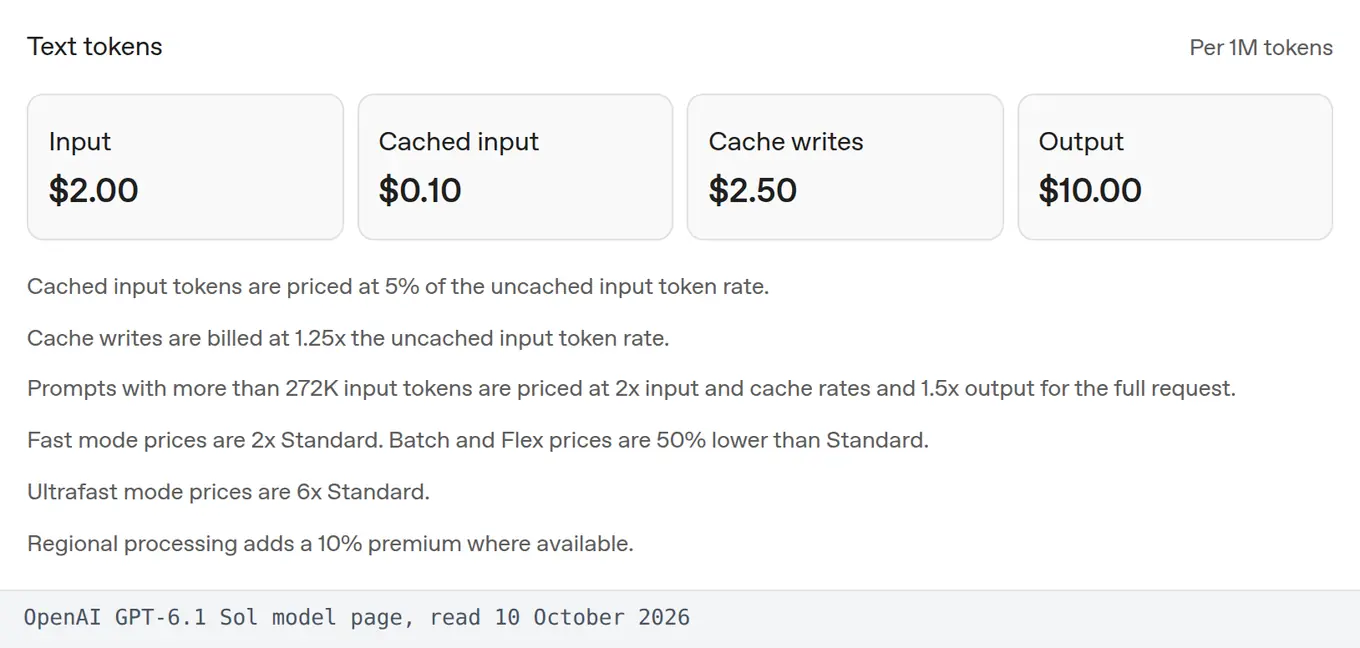
The OpenAI API pricing page now carries five tabs above its flagship table: Standard, Batch, Flex, Fast and Ultrafast. I read every tab cell by cell, then checked the mapping against the GPT-6.1 Sol model page, which states it in plain words: “Ultrafast mode prices are 6x Standard.” The table that reads $12.00 and $60.00 is the Ultrafast one, and every line in it is the Standard line multiplied by six.
Short context rates
Most requests stay under 272K input tokens, so this is the grid you will actually pay. I kept the four billing lines OpenAI publishes, because the cache write line is the one people forget when they budget an agent.
| GPT-6.1 Sol Ultrafast, per 1M tokens | Short context price |
|---|---|
| Input | $12.00 |
| Cached input | $0.60 |
| Cache writes | $15.00 |
| Output | $60.00 |
Output still costs five times input, the same ratio as every current gpt-6.x model. On a reasoning model that matters more than the input line, because the reasoning tokens you never see bill at the output rate.
Long context past 272K input tokens
The long context rule does not change with the tier. Once a prompt goes past 272K input tokens, the model page says the whole request is “priced at 2x input and cache rates and 1.5x output”, not just the tokens above the line.
On Ultrafast, that turns into the following long context grid:
- Input at $24.00 per million tokens
- Cached input at $1.20
- Cache writes at $30.00
- Output at $90.00
A 300K-token prompt on Ultrafast therefore costs $7.20 of fresh input before the model writes a single word. On Standard, the same prompt costs $1.20.
Cache reads and cache writes
The cache discount keeps the same shape on every tier: a cached input token costs 5% of the fresh rate, and a cache write costs 1.25x. What changes is the dollar value of a cache hit.
On Ultrafast, every million input tokens served from cache saves $11.40. On Standard, the same hit saves $1.90.
That makes a stable prompt prefix six times more valuable on Ultrafast. If your system prompt carries a timestamp or a request ID at the top, fix that before you switch the tier, or you will pay $12.00 on tokens that could have cost $0.60.
Ultrafast against Standard, Fast, Flex and Batch
GPT-6.1 Sol is one model sold at four price levels. The model page sums up the ratios: Fast is 2x Standard, Batch and Flex are 50% lower, and Ultrafast is 6x, a significant jump compared to GPT-6.2 Ultrafast at 3x Standard.
The tiers side by side
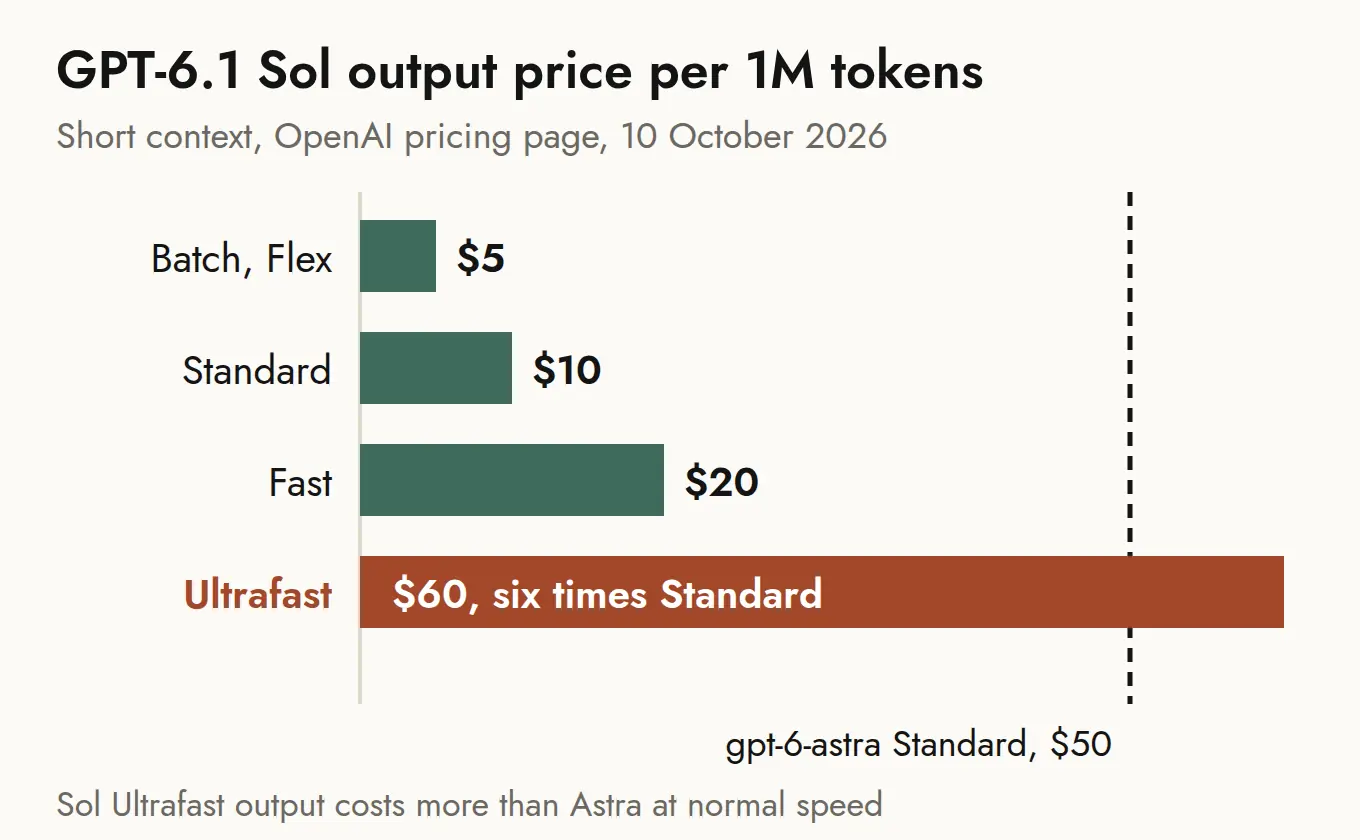
Here is the short context grid for every tier, read from the same pricing page on 10 October 2026, in input, cached input and output order.
| Tier | Input / cached / output per 1M tokens |
|---|---|
| Batch | $1.00 / $0.05 / $5.00 |
| Flex | $1.00 / $0.05 / $5.00 |
| Standard | $2.00 / $0.10 / $10.00 |
| Fast | $4.00 / $0.20 / $20.00 |
| Ultrafast | $12.00 / $0.60 / $60.00 |
The step that hurts is the last one. Ultrafast costs three times Fast, and twelve times Flex. Neither the pricing page nor the model page gives a speed figure for Fast, so there is no official way to say how much of the Ultrafast gain Fast already buys you: measure it on your own traffic before you pay the triple.
To make it concrete, take one agent turn with 50K input tokens, 40K of them cached, and 2K output tokens. It costs $0.022 on Flex, $0.044 on Standard, $0.088 on Fast and $0.264 on Ultrafast.
Sol Ultrafast against Astra Standard
This is the comparison nobody on page one makes. gpt-6-astra on its standard tier costs $10.00 input, $1.00 cached and $50.00 output, so Sol Ultrafast is more expensive than OpenAI’s top model at normal speed on fresh input and output.
The same 50K-token agent turn costs $0.24 on Astra Standard, against $0.264 on Sol Ultrafast. Sol Ultrafast only wins on cached input, at $0.60 against $1.00.
Sol Ultrafast undercuts Astra Standard only when a request carries more than 25 cached tokens per output token, plus 5 more per fresh input token.
So the choice is not about price. You pick Sol Ultrafast when you need Sol answers quickly, and Astra Standard when you need Astra answers and can wait. For the top of the grid, Astra Ultrafast costs $60.00 input and $300.00 output, five times the Sol Ultrafast rates.
What the 8x speed claim actually covers
The “8x” in the headline comes from OpenAI’s rollout post for GPT-6.1 Sol, which promised “near-Astra intelligence at up to 8x faster speeds than Sol Standard”. OpenAI has not published a tokens-per-second figure for Sol Ultrafast, on its pricing page, its model page or its Ultrafast mode guide.
Vaibhav Srivastav’s post below quotes that rollout announcement and puts the speed claim next to the API prices, which match the pricing table.
GPT-6.1 Sol Ultrafast is rolling out! Up to 8x faster token generation than Sol Standard, at $12 / 1M input tokens and $60 / 1M output tokens on the API.
@reach_vb
https://x.com/reach_vb/status/2108264743744020833
Codex speed and API speed are different promises
When OpenAI introduced the Ultrafast tier for GPT-6 Astra on 29 September 2026, it split the claim by product. The official post below gives up to 8x faster generation, or 300 tokens per second, in Codex, and up to 6x in the API.
This is Ultrafast. Our premium speed tier, Ultrafast offers up to 8x faster token generation (300 tokens per second) in Codex and up to 6x in the API.
@OpenAI
https://x.com/OpenAI/status/2104993966043320759
The Sol announcement does not repeat that split, and that is my main reservation. If the Astra pattern holds for Sol, an API caller pays 6x for up to 6x the speed, which is linear, not a bargain. “Up to” also means a ceiling: time to first token, tool calls and network round trips are not part of it.
Rate limits and data residency
Ultrafast runs on its own rate limits, separate from Standard and Fast. The guide lists default limits for GPT-6.1 Sol and recommends WebSockets for agents that chain tool calls, since HTTP overhead eats part of the gain.
These are the default Ultrafast token limits OpenAI lists for GPT-6.1 Sol:
- Build tier, 1,000,000 tokens per minute
- Launch tier, 4,000,000 tokens per minute
- Grow tier, 40,000,000 tokens per minute
Sol Ultrafast supports US and EU data residency, while Astra Ultrafast supports US residency only. Regional processing adds a 10% uplift, which puts EU or US resident Sol Ultrafast at $13.20 input, $0.66 cached and $66.00 output.
When paying six times more makes sense
My rule after years of running backends: speed is worth paying for only when a human or a deadline is waiting on the tokens. Everything else belongs on a cheaper tier.
Where Ultrafast earns its premium
These are the cases where I would switch a request to service_tier: "ultrafast":
- Live incident debugging, where an engineer reads every token as it streams
- Computer use agents running long chains of short steps, where the latency of each step stacks up
- Interactive coding loops in an editor, where a 20-second wait breaks the flow
- Short outputs on a big cached prefix, where the $0.60 cache rate keeps the bill sane
The tier is set per request, so you can keep one model ID and send only the user-facing turns to Ultrafast. My guide to reading an OpenAI invoice breaks down which lines move when you do that.
Where it burns money
Anything without a person waiting belongs on Batch or Flex at half the Standard price. Nightly extraction, evaluations, embeddings preparation and report generation gain nothing from faster tokens.
Long context jobs are the worst case: a 400K-token prompt with 10K output tokens costs $10.50 on Ultrafast against $1.75 on Standard. If you are still deciding between Sol and Luna for that work, my GPT-6 Sol and Luna pricing breakdown is the better starting point.
Frequently asked questions
Is GPT-6.1 Sol Ultrafast available to every API user?
Yes. OpenAI’s Ultrafast guide says Ultrafast mode for GPT-6 Astra and GPT-6.1 Sol is available to all API users, with separate rate limits. You enable it with model: "gpt-6.1-sol" and service_tier: "ultrafast" in the Responses API.
Does Ultrafast make GPT-6.1 Sol smarter?
No. You call the same model ID, and OpenAI describes Ultrafast as a service tier, the fastest one in its API. You pay for generation speed, not for a different model.
Does GPT-6 Luna have an Ultrafast tier?
No. The Ultrafast table on the pricing page lists only gpt-6-astra and gpt-6.1-sol, and the guide names only those two models. Luna stops at Fast, at $0.20 input and $1.00 output.