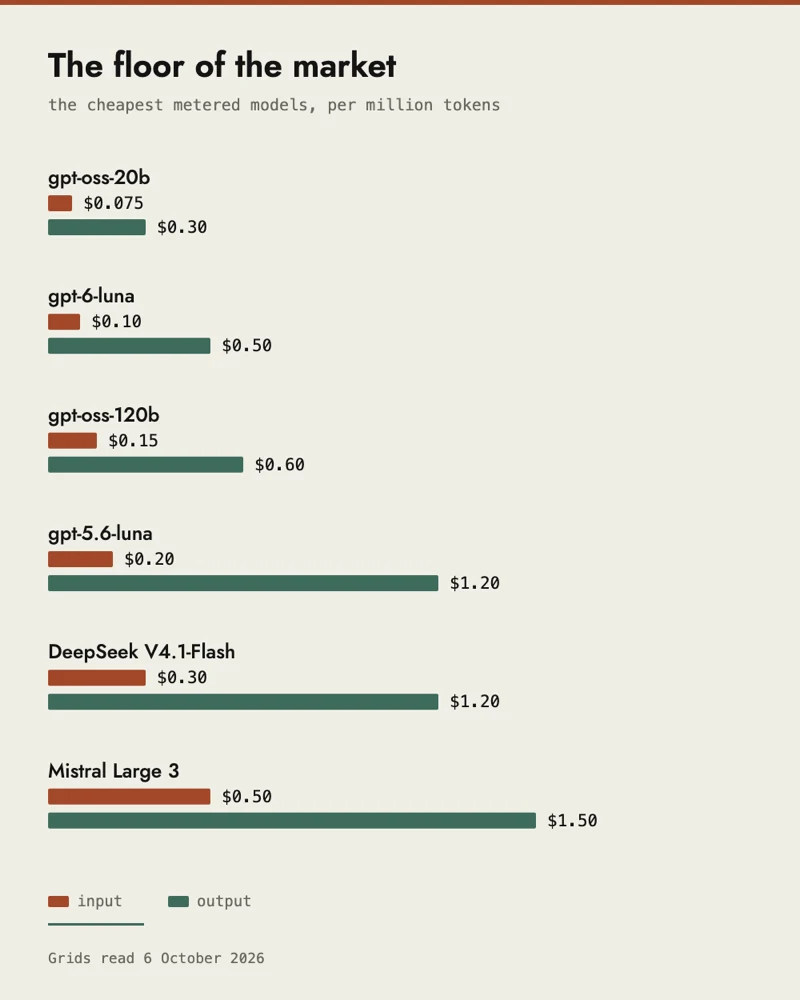
Among the models with broad general capability that this page tracks, the cheapest metered LLM API is now OpenAI’s gpt-6-luna, at $0.10 per million input tokens and $0.50 per million output, re-read on 6 October 2026. It halves gpt-5.6-luna on input and cuts its output by more than half, gpt-5.6-luna being at $0.20 and $1.20, level with DeepSeek V4.1-Flash on output, DeepSeek V4.1-Flash being at $0.30 and $1.20, then Mistral Large 3 at $0.50 and $1.50, with DeepSeek V4-Pro further up at $1.32 and $3.96, all re-read at the source on 6 October 2026. OpenAI’s gpt-5-nano is lower still at $0.05 and $0.40, but OpenAI marks it deprecated. On the open-weight rung, Groq’s gpt-oss-20b costs $0.075 and $0.30; the Groq Llama model that used to open this page, llama-3.1-8b-instant at $0.05 and $0.08 in our 15 August 2026 reading, no longer has a public price, since Groq now sells it through a sales contact.

The broad-capability group, from $0.50 to $1.50 on output, sits between about thirteen and a hundred and fifty times below the frontier tier, at $20.00 to $75.00, which is the side of the bill that actually moves. But cheapest is only a real answer once you have said what a wrong answer costs you, so filter the comparator by capability tier first, then read the price.
The cheapest API for the tier you can actually use
Pick a capability tier first, so you are not putting a small open-weight model next to a frontier one, then read the list from the top. Rows are ranked by output price, cheapest first, because output is what drives the bill. Rates are per million tokens, standard tier, read from each provider's own pricing page on 14 August 2026, except the Groq rows, read from Groq's own model documentation on 15 August 2026, and the OpenAI and DeepSeek rows, re-read on 12 September 2026. Cache rates were re-read from provider documentation on 29 September 2026. On 6 October 2026 gpt-6-luna was added, the Groq, OpenAI, DeepSeek and Mistral rows were re-read, and the two Groq Llama rows were removed, Groq now pricing them through a sales contact.
Tiers are our own reading of where each model sits on capability, not a vendor label. Open weight rows are small models served on someone else's hardware: they are the cheapest rung on the ladder and also the narrowest, so compare them against each other rather than against a frontier model. Every row here publishes a cached-input rate; on Groq it covers only the gpt-oss models. The grok-4.6 cache rate applies below 200,000 prompt tokens. Long context, batch and priority tiers are billed on separate grids and are not covered here.
The cheapest grids on the table
Three providers occupy the bottom of the closed-model price list, and they got there by different routes. One prices aggressively on purpose, one ships a deliberately small model under a flagship brand, and one sells a mid-size European model at a rate the US labs do not match. The figures that follow are standard-tier, per million tokens, read from each provider’s own pricing page or model documentation, first on 14 August and 12 September 2026, and all re-read on 6 October 2026.
What the bottom of the table looks like
OpenAI gpt-6-luna is the floor at $0.10 in and $0.50 out, and gpt-5.6-luna, which held that place until gpt-6-luna was released on 22 September 2026, follows at $0.20 in and $1.20 out. DeepSeek V4.1-Flash matches gpt-5.6-luna on output at $1.20 and sits above it on input at $0.30, and Mistral Large 3 at $0.50 and $1.50 closes the budget group. V4-Pro, the same DeepSeek family one step up, costs 4.4 times V4.1-Flash on input and 3.3 times on output, at $1.32 and $3.96, which puts it above the band rather than inside it. The next model up, grok-4.6, charges $2.00 and $6.00.

Two of those are worth a second look beyond the headline rate. DeepSeek bills a cache hit at $0.006 on V4.1-Flash, fifty times below its own input price, and it is also the only provider in the group with no consumer subscription at all, which we take apart in our read of what DeepSeek actually costs. Mistral Large 3 bills a cached token at ten percent of its input rate, $0.05 per million, a line published in Mistral’s API documentation rather than on its pricing page, and we go through that trade-off in detail in our read of the Mistral grid against the US models.
The open-weight rung, cheaper still
Alongside those sits a different kind of offer. Groq serves open-weight models on its own hardware: gpt-oss-20b at $0.075 input and $0.30 output, and gpt-oss-120b at $0.15 and $0.60, re-read from Groq’s own model documentation on 6 October 2026. gpt-oss-20b is still under every closed model in the comparator on both lines, four times below DeepSeek V4.1-Flash on output; gpt-oss-120b no longer is, since gpt-6-luna undercuts it on input and output. The Llama models that used to hold the very bottom of this rung, llama-3.1-8b-instant at $0.05 and $0.08 in our 15 August 2026 reading, are now listed by Groq as enterprise models priced through a sales contact, so there is no public rate left to compare and they have left the comparator.
It is a real floor rather than a footnote, but it is a floor for a narrower job. These are small open-weight models, and the comparison only holds where a 20B model can do the work: classification, routing, extraction, short rewrites. Set one against a frontier model and you are comparing model classes, not vendors. The speed side of that offer is the part Groq actually sells, and we price it separately in our read of Groq Cloud pricing.
Why you sort on output, not on input
Input is read once. Output is generated token by token, and every provider prices that difference in with a multiplier of three to six. OpenAI runs at six on gpt-5.6-terra and gpt-5.6-luna and at five on gpt-5.6-sol and gpt-6-luna, Anthropic at five on Claude Opus 5 and Sonnet 5, xAI at three on grok-4.6. DeepSeek used to be the outlier at two, and its September grids moved it to four on V4.1-Flash and three on V4-Pro, so verbose workloads no longer favour it the way they did.
The practical effect is that your bill tracks how much your application writes, not how much you feed it. A retrieval system that reads fifty pages and answers in two sentences barely notices the frontier tier. A drafting assistant that turns a short prompt into a long document inverts that completely, and it is where a hundredfold gap on output becomes a hundredfold gap on the invoice. That is why the comparator above ranks on output first, and why the full per-million-token table is worth reading the same way.
Cheapest is a trap until you price a wrong answer
The token price is only half of what a call costs you. The other half is what happens when the answer is wrong, and almost nobody puts a number on it before choosing a model. Do that and the decision stops being a matter of taste.
The variable that actually decides it
Take a support reply: 2,000 tokens of input, 400 tokens of answer. On DeepSeek V4.1-Flash at the 12 September 2026 rates, that call costs $0.0011. On Claude Sonnet 5 at $2.00 and $10.00, the identical call costs $0.008. The cheap model saves you $0.0069 per reply, and it is roughly seven times cheaper.
Now add the second term. Suppose the cheap model is wrong two times in a hundred more often than the expensive one, which is a plausible gap on a well-scoped task. Those two extra points only cost you what a wrong answer costs to absorb. If a bad reply just makes the user rephrase, call it two cents, and the extra errors cost $0.0004 per reply. The cheap tier wins by a mile. If a bad reply escalates to a human at two dollars a ticket, the same two points cost $0.04 per reply, five times the entire price gap. The cheap tier loses, and no amount of token arithmetic rescues it.
Where the arithmetic flips
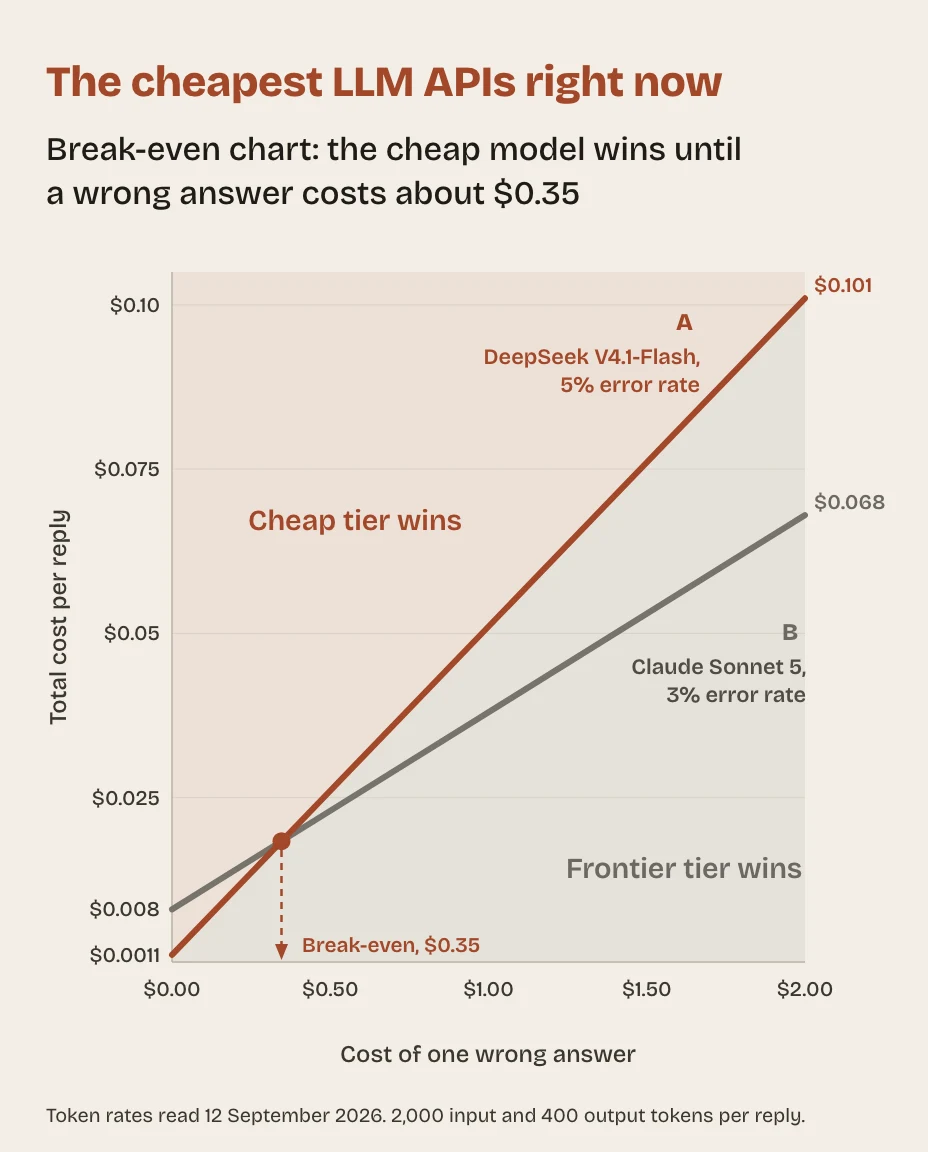
Set the two expressions equal and the crossover lands at about $0.35. Below that, when a wrong answer costs less than roughly thirty-five cents to catch or absorb, the cheap model is the correct choice at a two-point accuracy gap. Above it, the frontier price buys itself back. Halve the accuracy gap to one point and the crossover doubles to about $0.69. Double the gap and it halves.
The number itself is not the point, because your accuracy gap is not ours. The point is that it exists, that it is easy to compute from your own retry logs, and that it is the only comparison that survives contact with a real invoice. A team that has measured its error rate on a hundred sampled outputs knows which tier to buy. A team that has not is guessing with a price list.
Where the cheap tier genuinely wins
There is a whole class of work where the cost of a wrong answer is close to zero, either because a human checks the output anyway or because the task is verifiable. This is where the budget models are not a compromise.
Classification, extraction and routing
Labeling a ticket, pulling five fields out of an invoice, deciding which of four queues a message belongs in. The output is short, the format is constrained, and a mistake is visible downstream within minutes. On V4.1-Flash a million of these calls costs less than most teams spend on log storage, especially compared to options like OpenAI Decisions API pricing or Kimi K3.1 Pro API pricing, and the accuracy gap against a frontier model on a well-specified schema is usually small enough to disappear into your validation layer.
High-volume chat with a repeated preamble
A support assistant sends the same system prompt on every call. With an 80 percent cache hit rate, V4.1-Flash bills most of that input at $0.006 instead of $0.30, and the input side of the bill effectively vanishes. Caching never touches output, so the ranking on the generation side is unchanged, but a workload dominated by a repeated preamble is exactly where the cheap tier stretches its lead rather than losing it.
First drafts a human was going to read anyway
If the output goes to a person who edits it before anyone else sees it, the cost of a wrong answer is a few seconds of that person’s attention. Paying frontier rates for a draft that gets rewritten is the most common way teams overspend on inference. Route drafts to the budget tier, route the final pass to whatever you trust.
Where cheap stops being cheap
The failure modes are specific rather than general, and knowing them is worth more than a benchmark table.
Long unsupervised tool chains
An agent that makes eight decisions in a row without a human in the loop compounds its per-step error rate. At 97 percent per step you finish correctly 78 percent of the time. At 99 percent you finish correctly 92 percent of the time. That two-point difference per step is worth an enormous amount of money once each failed run has to be diagnosed by a person, which is why understanding cost efficiency becomes critical, as demonstrated by options like DeepSeek Search and Fetch pricing, and it remains the single clearest case for the frontier tier.
Verbosity, retries and reasoning tokens you never see
Reasoning models bill their internal deliberation as output, so a model whose answers look short can generate several times the tokens you measure. A cheap model that needs two attempts to produce something usable has doubled its real price, and a cheap model that pads every answer has quietly closed part of the gap. Price the tokens you actually send and receive over a week of real traffic, not the tokens you expect.
A missing cache line
Every row in the comparator now publishes a cached-input rate. Until 6 October 2026 two did not, Groq’s llama-3.1-8b-instant and llama-3.3-70b-versatile, which left the comparator that day when Groq stopped publishing their price. Groq’s prompt caching covers only its gpt-oss models, at half the input rate, which puts a cached token at $0.037 on gpt-oss-20b and $0.075 on gpt-oss-120b, read from Groq’s documentation on 29 September 2026. On a workload with a heavy repeated preamble, a missing cache line can cost more than a competitor’s higher headline rate, because the same preamble is billed at full price on every call. Until 29 September 2026 this section also named Mistral Large 3, grok-4.6 and every Groq model. That was wrong: xAI bills a cached token on grok-4.6 at $0.50 per million below 200,000 prompt tokens, and Mistral at $0.05, both in their API documentation rather than on the pricing pages we read on 14 August 2026. The xAI grid, long-context columns included, is laid out in our read of what xAI charges.
How we read these prices, and what we did not check
Every figure on this page comes from the provider’s own pricing page or model documentation, read on the date given next to it, and we archive a screenshot of the grid on the day we read it so any number here can be traced back to what the provider was publishing. What we verified is the standard per-million-token rate, the cached-input rate where one is published, and whether a cache line exists at all. Our 14 August 2026 reading looked for that cache line on the pricing pages only, and missed the xAI, Mistral and Groq rates published in their documentation; every cache rate on this page was re-read from provider documentation on 29 September 2026, and every standard rate on 6 October 2026, when gpt-6-luna was added and the two Groq Llama rows were removed.
What we did not verify: the exact hours of DeepSeek’s discounted off-peak window, the long-context surcharge thresholds for every provider, batch-tier pricing, and regional uplifts for data residency endpoints. Any of those can move your real bill by half. Groq is the one provider here with no archived screenshot, because its public pricing page carries no grid and the figures come from its model documentation instead. We also did not run our own benchmark for this page, so the accuracy gaps used in the worked example above are illustrative arithmetic, not measurements. Measure your own on a hundred sampled outputs before you commit to a tier.
Frequently asked questions
What is the cheapest LLM API right now?
Among the broad-capability models this page tracks, OpenAI gpt-6-luna at $0.10 per million input tokens and $0.50 per million output, re-read on 6 October 2026, then gpt-5.6-luna at $0.20 and $1.20, DeepSeek V4.1-Flash at $0.30 and $1.20, Mistral Large 3 at $0.50 and $1.50, and DeepSeek V4-Pro at $1.32 and $3.96. gpt-5-nano is cheaper at $0.05 and $0.40 but deprecated. On the open-weight rung, Groq’s gpt-oss-20b at $0.075 and $0.30; its Llama models no longer carry a public price.
Is a cheap LLM API good enough for production?
For classification, extraction, routing, summarization and drafts that a human reviews, yes, routinely. For long unsupervised agent chains, or for anything where a wrong answer escalates to a person, the frontier price buys reliability that is hard to replicate. The deciding number is what one wrong answer costs you, not the price per million.
Is a free LLM API better than a cheap one?
Free consumer chat clients and metered API keys are different products. Free tiers on developer platforms are typically capacity limited rather than credit limited, which means they degrade or refuse under load and cannot carry production traffic. At $0.50 per million output tokens on gpt-6-luna, the cheapest paid tier is close enough to free that the availability is worth paying for.
How much does moving to the cheap tier actually save?
Between twenty and sixty times on tokens, depending on which model you are leaving. A workload of 20 million input and 5 million output tokens a month, with 80 percent of the input cached, runs under ten dollars on V4.1-Flash against a few tens of dollars on the mid tier and several hundred at the top. Enter your own volumes in the comparator above rather than trusting a ratio.
How often do we re-check these prices?
Whenever a provider changes a grid or ships a model that belongs on it. Each figure carries the date it was verified and we keep the screenshot from the day we read it, so you can judge the freshness yourself instead of trusting a generic update stamp.