Kimi K3.1 Pro costs $2.00 per million input tokens and $10.00 per million output tokens on Moonshot’s API, with cache hits at $0.20 and cache writes at $2.00 (5-minute TTL) or $4.00 (1-hour TTL). The price is flat across the whole 1M-token context window, with no long-context tier. That is half of Claude Opus 5.5 ($4 / $20) on both input and output, and a third below Kimi K3 ($3 / $15). The Highspeed variant costs $4 / $20, exactly Opus 5.5’s base rate.

What Kimi K3.1 Pro costs per million tokens
Moonshot AI released Kimi K3.1 Pro on 23 October 2026, alongside a faster sibling called K3.1 Pro Highspeed. The API model IDs are kimi-k3.1-pro and kimi-k3.1-pro-highspeed, both served from api.moonshot.ai with OpenAI-compatible and Anthropic-compatible endpoints.
The launch post from Moonshot’s own account gives the hardware behind the price: a mixture-of-experts model with 2.8T total and 104B active parameters, and a 1M-token context.
Introducing Kimi K3.1 Pro: our most capable 3T-class open-weight model. 🔹 1M-token context, 2.8T total / 104B active params (MoE), Multimodal. 🔹 Full-project coding: games in Unreal, Unity & Godot. 🔹 Excels at parametric 3D modeling in Blender & CAD.
@Kimi_Moonshot
https://x.com/Kimi_Moonshot/status/2113680701770068067
The full grid, cache included
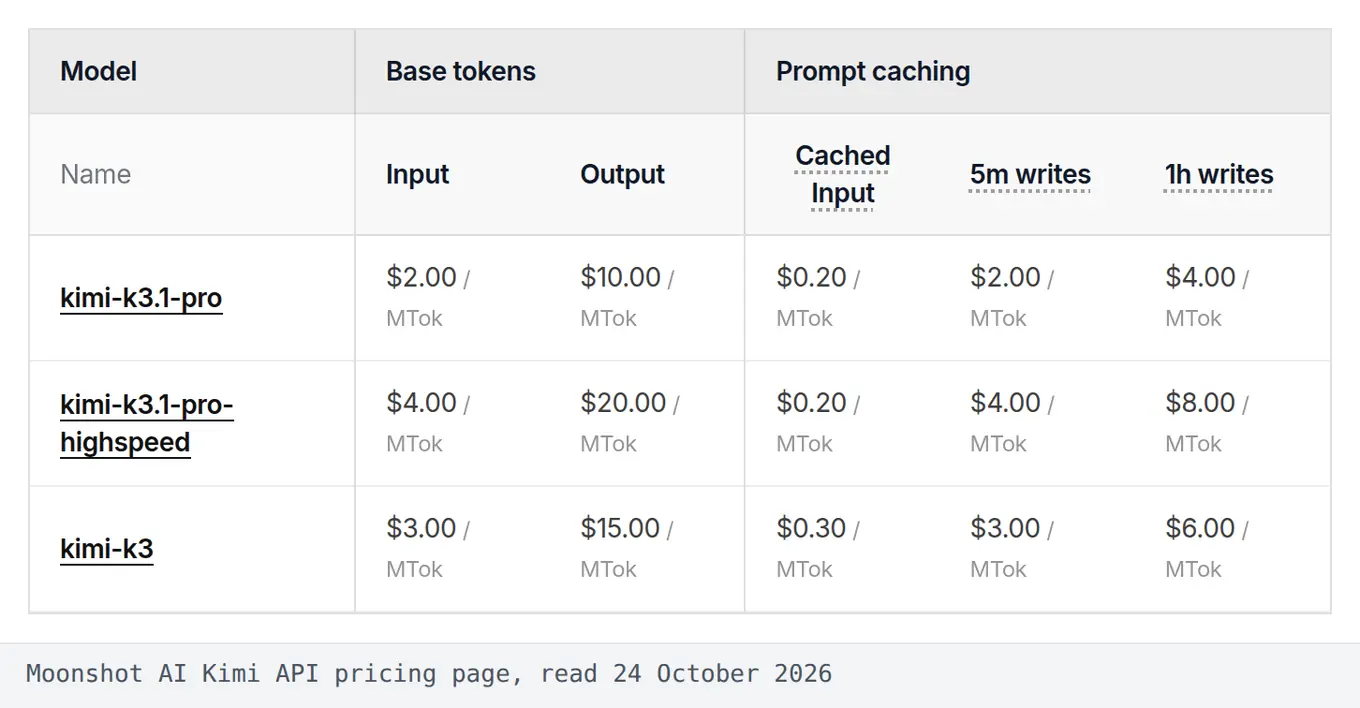
As of 24 October 2026, the Kimi API model pricing page lists five billing items for K3.1 Pro. The cache-write split by TTL only appears in that docs table: the platform homepage shows a single $2.00 write figure, which is the 5-minute tier.
| Kimi K3.1 Pro billing item | Price per million tokens |
|---|---|
| Input (cache miss) | $2.00 |
| Output | $10.00 |
| Cached input (cache hit) | $0.20 |
| Cache write, 5m TTL | $2.00 |
| Cache write, 1h TTL | $4.00 |
| Highspeed input / output | $4.00 / $20.00 |
| Highspeed cache hit | $0.20 |
| Highspeed cache write, 5m / 1h | $4.00 / $8.00 |
Two details matter more than they look. The default 5-minute write costs exactly the same as plain input, so automatic caching never makes a one-off request more expensive. And the Highspeed variant doubles every rate except the cache hit, which stays at $0.20.
Flat across the 1M-token window
Moonshot’s K3.1 Pro FAQ states it plainly: the model “uses flat pay-as-you-go pricing”, with “no tiering by context length”. The pricing page puts the K3 series window at 1,048,576 tokens.
That is the real selling point for long-document and agent work. Several US grids charge a premium once a prompt crosses a threshold, so a 600K-token request does not cost three times a 200K one there. On K3.1 Pro it does, and nothing more.
A 900K-token prompt on Kimi K3.1 Pro costs $1.80 in input, the same $2.00 per million as a 9K-token prompt.
From K3 to K3.1 Pro
Kimi K3 stays on the grid at $3.00 input, $15.00 output, $0.30 cache hit, and $3.00 / $6.00 cache writes. K3.1 Pro cuts every one of those lines by a third.
The older K2 series is on its way out. According to the same pricing page, K2 models stop being available to newly registered users on 31 October 2026, and Moonshot plans to retire them all by the end of December 2026.
Kimi K3.1 Pro against Claude Opus 5.5
The comparison everyone is making is with Opus 5.5, because Moonshot pitches K3.1 Pro at the same coding and agent work. Anthropic’s Claude API pricing page lists Opus 5.5 at $4 input, $20 output, $5 and $8 for 5-minute and 1-hour cache writes, and $0.20 for cache hits, all covered in my Claude Opus 5.5 pricing breakdown.
Independent measurement puts K3.1 Pro close to the top of the field, which is why the price gap is worth taking seriously. Artificial Analysis ranked it fourth on its Intelligence Index on launch day.
Kimi K3.1 Pro launches at 4th on the Artificial Analysis Intelligence Index scoring 55, making large gains in agentic performance; it will be the leading open-weights model once its weights are published @Kimi_Moonshot’s new reasoning model gains 11 points over Kimi K3
@ArtificialAnlys
https://x.com/ArtificialAnlys/status/2113688083145314416
A 1M-token job without caching
Take a batch job that pushes 1M fresh input tokens through the model and gets 100K tokens back. No prefix is reused, so caching plays no part. Here is the bill on each grid.
| Model | 1M input + 100K output |
|---|---|
| Kimi K3.1 Pro | $3.00 |
| Kimi K3 | $4.50 |
| Kimi K3.1 Pro Highspeed | $6.00 |
| Claude Opus 5.5 | $6.00 |
K3.1 Pro comes out at exactly half of Opus 5.5, because both of its base rates are half. Highspeed and Opus 5.5 tie to the cent.
A cached codebase queried for an hour
Caching changes the picture, because Opus 5.5 and K3.1 Pro charge the same $0.20 for a cache hit. Take a 200K-token codebase written once with a 1-hour TTL, then queried nine more times within the hour, each answer running to 4K tokens.
- Kimi K3.1 Pro: $0.80 write, $0.36 for nine hits, $0.40 of output, so $1.56.
- Claude Opus 5.5: $1.60 write, $0.36 for nine hits, $0.80 of output, so $2.76.
- Kimi K3.1 Pro Highspeed: $1.60 write, $0.36 for nine hits, $0.80 of output, so $2.76.
The gap shrinks from 50% to about 43%, because the cached reads cost the same on both sides. The more of your input is cache hits, the more K3.1 Pro’s advantage comes down to output and writes alone.
Highspeed lands on the Opus 5.5 grid
K3.1 Pro Highspeed costs $4 input, $20 output, $0.20 per cache hit and $8 for a 1-hour write. Those are Opus 5.5’s numbers line for line, and Highspeed only undercuts Anthropic on the 5-minute write ($4.00 against $5.00).
Moonshot’s quickstart describes Highspeed as 2 to 3 times the speed of K3.1 Pro. So the real question for Highspeed is not price but whether Kimi at that speed beats Opus 5.5 on your own tasks, since the bill will come out the same.
The cache-write TTL tiers
Caching on K3.1 Pro is automatic: no manual cache creation, and the default TTL is 5 minutes. To get the 1-hour tier you pass prompt_cache_options with ttl set to “1h” on Chat Completions or Responses, or a top-level cache_control with ttl “1h” on the Messages endpoint, as Moonshot’s context caching guide explains.
The TTL is locked at the first write. A hit renews the entry for free under its original TTL, and you can only switch tiers once the entry has fully expired.
When the 1h write pays for itself
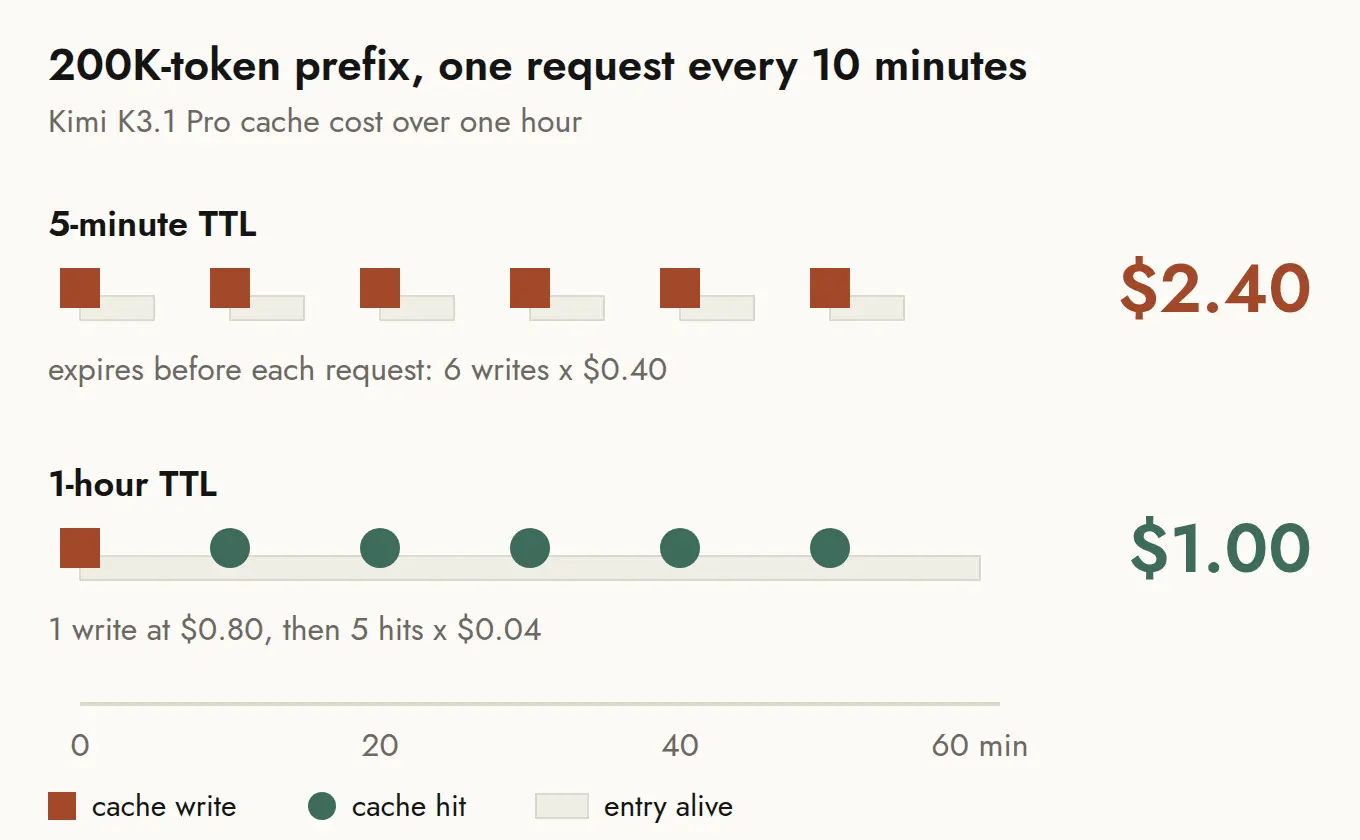
The 1-hour write costs $2.00 more per million tokens than the 5-minute one. Every request that would have found an expired 5-minute entry saves $1.80 per million instead, because it pays $0.20 for a hit rather than $2.00 for a fresh write.
The break-even follows from those two numbers. Here is how I would choose:
- Requests arrive less than 5 minutes apart: stay on 5m, since every hit renews the entry for free.
- Gaps run past 5 minutes but the prefix comes back within the hour: take 1h, which wins from the second avoided rewrite.
- The prefix only returns after more than an hour: neither tier helps, so do not bother configuring one.
On a 200K-token prefix hit every 10 minutes for an hour, the 5-minute tier pays six writes for $2.40. The 1-hour tier pays one $0.80 write and five $0.04 hits, so $1.00.
Two cache hits that would otherwise have missed are enough to repay the extra $2.00 per million of a 1-hour write on K3.1 Pro.
What still bills as a cache miss
The cache is stored in blocks. Any trailing part of a prefix that does not fill a whole block cannot be written, and it is billed at the regular $2.00 input rate.
Three habits keep the miss share low, and they apply to any prefix cache:
- Put the stable part first: system prompt, tool definitions, reference documents, code.
- Keep timestamps, request IDs and other changing fields out of that prefix.
- Check usage.prompt_tokens_details.cache_write_tokens and cached_tokens on Chat Completions to see what was actually written and hit.
Before your first call
K3.1 Pro is not available on a fresh account straight away. Moonshot classes it as a flagship model that unlocks after a successful top-up, with a $1 minimum, and your cumulative top-up also sets your rate-limit tier (concurrency, RPM, TPM, TPD).
A few other limits affect the bill and the integration:
- Thinking is always on and cannot be disabled. The reasoning_effort field takes low, high or max, and the default is max, so if your bill is output-heavy, that default is the first thing to check.
- max_completion_tokens defaults to 131,072 and can be raised to 1,048,576.
- Temperature, top_p and the penalty parameters are fixed; omit them from requests.
Moonshot also says the full open weights will be released by 4 November 2026. Once they are out, third-party hosts can serve it at their own prices, as they already do for the open models in my roundup of the cheapest LLM APIs.
My verdict
At $2 / $10, Kimi K3.1 Pro puts a model that Artificial Analysis ranks fourth on its index at half the Opus 5.5 rate, and the flat grid makes 1M-token prompts easy to budget. On uncached work it halves an Opus 5.5 bill outright.
The saving narrows on heavily cached agent loops, since both models charge $0.20 for a hit, and it disappears entirely on Highspeed. My advice: run your own agent traces on standard K3.1 Pro with the 1-hour TTL, and keep Highspeed only if latency is the thing you are actually paying to fix.