Gemini 4 Hydrogen is Google’s fast Gemini 4 model, released on 12 November 2026 for coding, agents and everyday work, and it scores above Argon on the Artificial Analysis Intelligence Index. On the Gemini API it costs $1.50 / $7.50: $1.50 per million input tokens and $7.50 per million output tokens, thinking included, flat across its whole 1M-token window. Cached input is $0.075, and unlike Argon and Carbon it also runs on the free tier. That is a quarter below Argon’s introductory rate today, and less than half of Argon from 1 December.

What Gemini 4 Hydrogen is
Hydrogen is the model Google built to put Gemini 4 in front of everyone, not only paying developers. Google’s launch post of 12 November 2026 pitches it for “rapid execution across diverse agentic workflows”, while Carbon and Argon keep the deep, long reasoning jobs.
Where it sits in the Gemini 4 line
The Gemini 4 family now has three text models. Gemini 4 Carbon’s pricing and benchmarks put it at the top, Argon is the efficient frontier model, and Hydrogen is the fast tier, pitched as the upgrade for teams on 3.8 Flash.
The model card says Hydrogen “is adapted from Gemini 4 Carbon”, so it is not a scaled-down 3.8 Flash. Google expects teams to pair them: Carbon or Argon plans the work, Hydrogen writes the code, runs the tests and checks the changes.
What it takes in and gives back
These are the specifications listed on the Gemini 4 Hydrogen model card, published on 12 November 2026:
- input: text, images, audio and video;
- one 1M-token context window shared by input and output;
- up to 64K output tokens per synchronous call, and up to 1M through background long decode;
- four thinking levels: low, medium, high (the default) and a new xhigh;
- knowledge cutoff: March 2026;
- access: Gemini API and Google AI Studio on all tiers, Gemini for business, the Gemini app, Google Search, Google Sheets, and Google Antigravity for paid AI Pro and Ultra subscribers.
What sets it apart, by Google’s numbers
Every figure here comes from Google’s launch post and model card, so treat them as vendor claims.
Speed and the jump from 3.8 Flash
Against Gemini 3.8 Flash, Google says Hydrogen finishes tasks 2.5 times faster at its default high setting. It more than triples the Terminal-Bench 4.1 score, 57% against 18.2%, and cuts fabricated claims by more than five times.
Partners testing it on graph, SQL and data-heavy enterprise work saw it run 2x to 2.8x faster while using 12% to 23% fewer tokens than 3.8 Flash. That token saving matters as much as the speed, because thinking tokens are billed as output.
Hydrogen scores 51 on the Artificial Analysis Intelligence Index at its default high thinking level, against 50 for Argon, and 54 at xhigh, according to Google.
Google DeepMind’s launch post carries the headline speed claim and the chart behind it:
Meet Gemini 4 Hydrogen: built for rapid coding, multimodal synthesis, and everyday workflows. It finishes tasks 2.5x faster than 3.8 Flash and surpasses Argon on the @ArtificialAnlys Intelligence Index.
@GoogleDeepMind
https://x.com/GoogleDeepMind/status/2120940338869055788
Benchmarks against Sonnet 5.5 and GPT-6.1 Terra
The model card compares Hydrogen with Claude Sonnet 5.5 and GPT-6.1 Terra, results as of November 2026. I kept the rows an API buyer will care about:
| Benchmark | Hydrogen / Sonnet 5.5 / GPT-6.1 Terra |
|---|---|
| SWE-sweep, find and fix bugs | 13.5% / 3.1% / 5.8% |
| Terminal-Bench 4.1, cheating-adjusted | 57.0% / 63.9% / not reported |
| AutomationBench-AA, knowledge work | 76.1% / 71.8% / 60.2% |
| OSWorld-2.1, computer use | 77.6% / 83.9% / 74.2% |
| HLE-Diamond, reasoning | 58.8% / 53.3% / 47.3% |
| Vending-Bench 2, final balance | $14,549 / $11,165 / $9,107 |
The pattern is clear. Hydrogen leads on bug repair, knowledge work and reasoning, while Sonnet 5.5 still wins on terminal coding and computer use.
The limits Google admits
The model card lists hallucinations, “occasional slowness or timeout issues” and higher token use at the higher thinking levels. It also reports more unjustified refusals than 3.8 Flash, up 5.57 points, mostly on multimodal prompts.
If your 3.8 Flash pipeline handles borderline images, run your own set through Hydrogen before migrating.
What Google has built with Hydrogen so far
Hydrogen has been public for barely a day, so the demos that show a finished build are Google’s own. They still show what the model is tuned for: fast web and 3D coding, and agents that work inside Google’s apps.
Geminisland, a voxel island built from prompts
Geminisland is a shared voxel island where anyone types a prompt and Hydrogen generates a structure live on the map. Players then walk around it in first person. Google AI posted the demo on launch day:
Beyond knowledge work, Hydrogen brings that same speed and first-pass accuracy to live coding by turning natural language into working, interactive code in seconds. See it in action in Geminisland, a demo game where users can prompt to build new 3D voxel structures with Hydrogen
@GoogleAI
https://x.com/GoogleAI/status/2120940684924403798
A one-shot storefront and a spreadsheet that animates
Paired with Google’s new front end design skill in Antigravity, Hydrogen built an e-commerce storefront in one shot. It includes a WebGL2 shader, scrollytelling and a live finish configurator.
In another demo, Hydrogen turned Google Sheets into an animated pixel canvas. It combined Python, =LET formulas and conditional formatting to play full-motion scenes in the cells.
Slides, a lightning globe and a glass visualizer
Google’s launch post shows four more builds, each one a different kind of output:
- a multi-slide Google Slides deck generated from a YouTube keynote and a template, followed by an automatic audit-and-fix pass on overlapping text;
- an interactive 3D globe with a Web Audio music engine, driven by real-time lightning strike data;
- a WebGL2 water and glass visualizer built from pure math, with refraction, reflection, dispersion and absorption;
- an archival sizzle reel about the element hydrogen, cut from public-domain footage with narration.
None of these come with a token count or a bill. Independent builds with a time and a cost will tell more, and they usually appear within the first week.
Gemini 4 Hydrogen API pricing
Here is what Google’s Gemini API pricing page shows for gemini-4-hydrogen, standard tier, as of 13 November 2026.
The grid, flat across 1M tokens
| Line, paid tier | Price |
|---|---|
| Input, per million tokens | $1.50 |
| Output, thinking included, per million tokens | $7.50 |
| Cached input, per million tokens | $0.075, implicit caching only |
| Grounding with Google Search | 5,000 free requests a month, then $14 per 1,000 |
| Free tier | Input and output free of charge |
Two details change the maths. There is no long-context surcharge, so a 900K-token prompt pays the same rate per token as a 9K one. Explicit caching is not supported: you get the $0.075 rate only when Google’s implicit cache hits.
The free tier is the real novelty in the family. Argon and Carbon are paid-only, while Hydrogen can be tried on the free tier, where Google’s page notes your content is used to improve its products. The page also has Batch, Flex, Priority and Contributor tabs for Hydrogen, so check those before you price a batch workload.
Hydrogen's cached input is $0.075 per million tokens, one twentieth of its $1.50 input rate.
Hydrogen next to Argon, Carbon and 3.8 Flash
Argon and Carbon share one introductory grid that doubles on 1 December 2026, as I covered in Gemini 4 Argon’s pricing breakdown. 3.8 Flash runs on its own promotion until 31 December. Standard rates, input / cached input / output per million tokens:
| Model and period | Input / cached / output |
|---|---|
| Gemini 4 Hydrogen, no end date published | $1.50 / $0.075 / $7.50 |
| Gemini 4 Argon or Carbon, through 30 Nov 2026 | $2.00 / $0.10 / $10.00 |
| Gemini 4 Argon or Carbon, from 1 Dec 2026 | $4.00 / $0.20 / $20.00 |
| Gemini 3.8 Flash, through 31 Dec 2026 | $0.75 / $0.075 / $3.75 |
| Gemini 3.8 Flash, from 1 Jan 2027 | $1.50 / $0.15 / $7.50 |
Look at the last row. From 1 January 2027, Gemini 3.8 Flash’s per-token price rises to exactly Hydrogen’s input and output rates, with a cache twice as expensive. From that date, staying on 3.8 Flash saves nothing. Above Hydrogen, the only Gemini 4 model with no dated price rise is Neon, covered in my Gemini 4 Neon pricing breakdown.
A monthly bill worked through
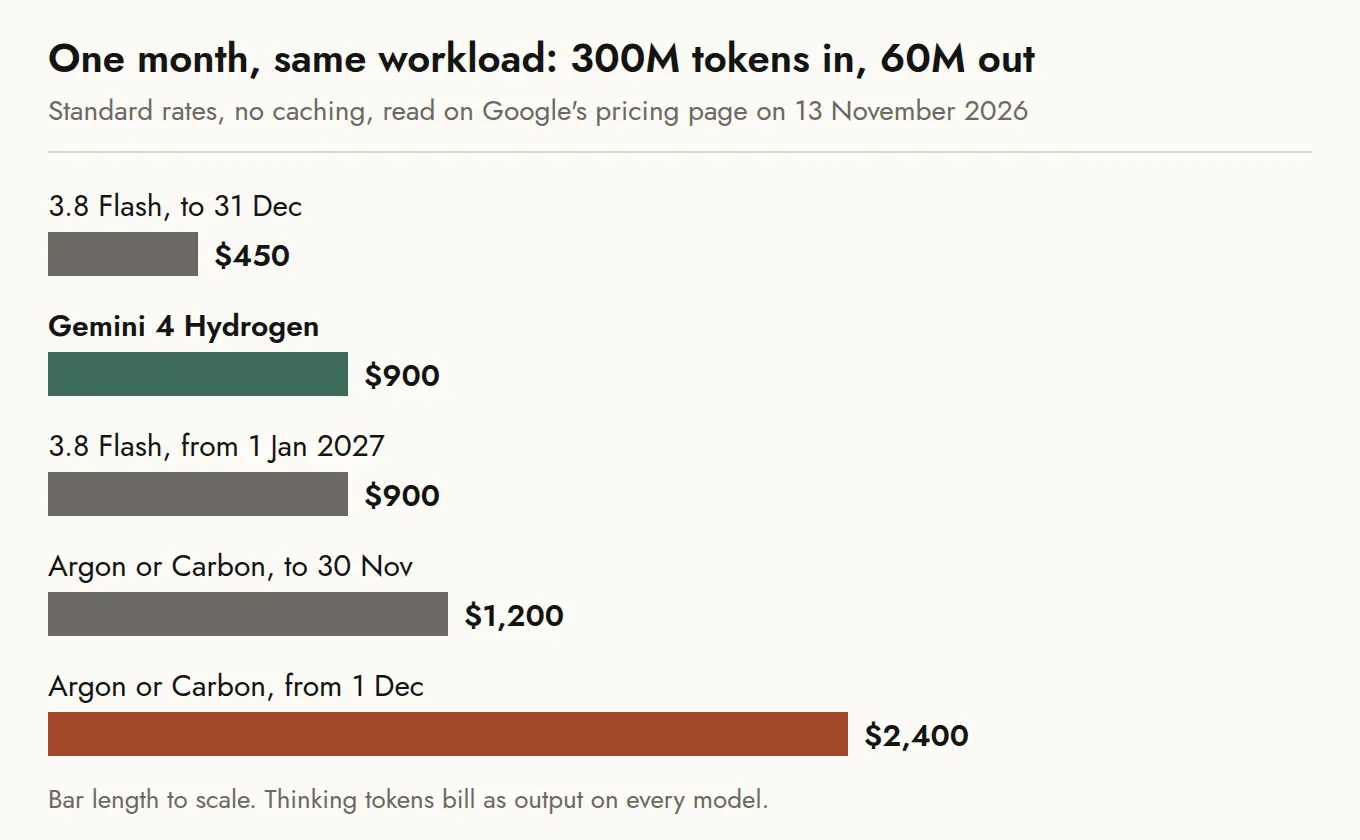
Take a coding agent that reads 300 million tokens and writes 60 million a month, thinking included, at standard rates with no cache hits:
- Gemini 4 Hydrogen: $450 for input plus $450 for output, $900 a month;
- Gemini 4 Argon or Carbon through 30 November: $600 plus $600, $1,200;
- Gemini 4 Argon or Carbon from 1 December: $1,200 plus $1,200, $2,400;
- Gemini 3.8 Flash through 31 December: $225 plus $225, $450, then $900 from 1 January 2027.
If 60% of that input hits the implicit cache, Hydrogen drops to $643.50: $180 for 120 million fresh input tokens, $13.50 for 180 million cached ones, and $450 of output. Google says Hydrogen often uses fewer output tokens than rivals, so measure your own run.
My verdict on who should switch
If you run Argon for everyday coding agents, move the execution work to Hydrogen now: the same family, a higher index score at default settings, and a quarter off the bill today. From 1 December the gap becomes 62.5%, which is hard to ignore.
If you are on 3.8 Flash, the promotion makes it half the price of Hydrogen until 31 December. Test Hydrogen this month and switch before 1 January, when 3.8 Flash costs the same and has the weaker benchmarks.
Keep Carbon or Argon for the planning and the hardest debugging, where Google itself still points you. And if your pipeline relies on explicit caching, note that Hydrogen only offers the implicit kind.