Gemini 4 Neon is the Gemini 4 model Google released on 18 November 2026 to sit between the fast Hydrogen and the heavyweight Carbon, with a 1M-token window and four thinking levels. On the Gemini API it costs $3 per million input tokens and $15 per million output tokens, thinking included, with cache hits at $0.15 and no free tier. Until 30 November that makes it the dearest Gemini 4 model per token; on 1 December Carbon and Argon double to $4 and $20, and Neon becomes the cheaper of the three.

What Gemini 4 Neon is, and where it sits
Google pitches Neon as frontier-level intelligence with fast end-to-end task completion, aimed at software engineering, knowledge work and science. Its what’s new page for Gemini 4 Neon places it between Hydrogen, the everyday default, and Carbon, which Google keeps for the hardest architecture, debugging and security problems. In practice I read it as the model you reach for when Hydrogen starts to fumble a long agent run but Carbon feels like overkill.
The spec sheet
The numbers below come from Google’s model page and migration guide, read on 22 November 2026.
- Model ID
gemini-4-neon, paid tier only, on bothgenerateContentand the Interactions API. - Text, image, video, audio and PDF in, text out.
- One shared window of 1,048,576 tokens for input, thinking and output, with 65,536 output tokens per synchronous call and long decode up to the full window through background execution.
- Four thinking levels:
low,medium,high(the default) andxhigh. Carbon and Argon default tomediumand stop athigh. - No explicit caching, no
temperature,top_portop_k, andminimalthinking returns an error.
What Google’s own numbers claim
Every figure in this paragraph is Google’s, from its Gemini 4 Neon launch post. Neon scores 61 on the Artificial Analysis Intelligence Index at xhigh, third overall at launch, and 58.6 on the Artificial Analysis Coding Agent Index, first overall. Google also quotes 65.2% on Terminal-Bench 4.1, 70.9% on the Vals Index and a 32% lower cost per task than Carbon at the default high level, without saying which Carbon price that comparison used.
The first hands-on comparisons are less one-sided. Peter Yang ran Neon against Claude Opus 5.5 on his own tasks and kept Opus ahead on 3D and design.
Gemini 4 Neon is getting rave reviews, so I made a new video comparing it to Opus 5.5, my favorite model for everyday work.
Some takeaways:
1. Opus is still better at 3D and design from my testing, but Neon is on par or better at writing and personality, which is a huge@petergyang
https://x.com/petergyang/status/2123540875733315815
What people have built with Neon in its first four days
Most early builds ran in Google Antigravity, where Pro and Ultra subscribers use Neon under their plan rather than per-token API billing. Keep that in mind before you translate any of them into an API bill.
A photorealistic lab bench in Blender, shown by Sundar Pichai
Driving Blender through an MCP server, Neon modelled a lab bench that pairs Bunsen flames with Carbon and Hydrogen and gas discharge tubes with Argon and Neon. Google’s post says it used the /swarm command, so several agents worked in parallel.
Below Neon 3D modeled a photorealistic lab simulation in Antigravity via Blender MCP 🔥
@sundarpichai
https://x.com/sundarpichai/status/2123184309137965524
A glowing 3D Earth, by Harshith
Google opened its thread of community builds with this one: a neon-lit globe built on the high thinking level, the default you get without touching any setting.
Seeing what everyone’s building with Gemini 4 Neon has been electric.
Starting with a literal neon world: @HarshithLucky3 used Neon on high thinking in @Antigravity to build this glowing 3D Earth.
More Neon builds that caught our eye 🧵
A 3D seaplane on xhigh, by Lumina
Lumina posted this seaplane test on launch day, run on xhigh, the thinking level that spends the most output tokens, and still found the model very fast to use.
Gemini 4 Neon xhigh 3D seaplane test
This feels really really fast to use, the UI is fixed too finally 😂 much cleaner@LuminaBench
https://x.com/LuminaBench/status/2123166304664191391
Seventeen demos in one day, by Chubby
Chubby had early access and published eight of the seventeen demos, from shooters to 3D worlds. The useful part is in the logs: 13 sessions on xhigh made 762 tool calls, including 313 file reads, 266 edits, 104 new files and 13 sub-agents. That ratio of reads to edits is what you pay for in input tokens.
1/ I got early access to Gemini 4 Neon and spent the day testing it in Antigravity. It built 17 interactive demos for me, from shooters to 3D worlds. Here are 8 of them, plus coding and tool use tests. I’m also sharing what went right and what went wrong.
A thread:@kimmonismus
https://x.com/kimmonismus/status/2123168299890704735
A ski simulator on real Chamonix terrain, by Google
Google’s launch post shows a first-person WebGL2 freeride simulator on Mont Blanc and Chamonix elevation data, written from scratch: 10,200 lines of custom shaders, 120 Hz ski physics across six lines, slab avalanches and spatial audio, with no pre-made assets.
A photo relit inside a Google Sheet, by Google
The same post describes a Neon agent swarm that turned one image into a 100,000-cell Google Sheet with no embedded image and no Apps Script. Over 500,000 live formulas run edge detection, map depth and relight the scene in six modes.
The Gemini 4 Neon rate card, tier by tier
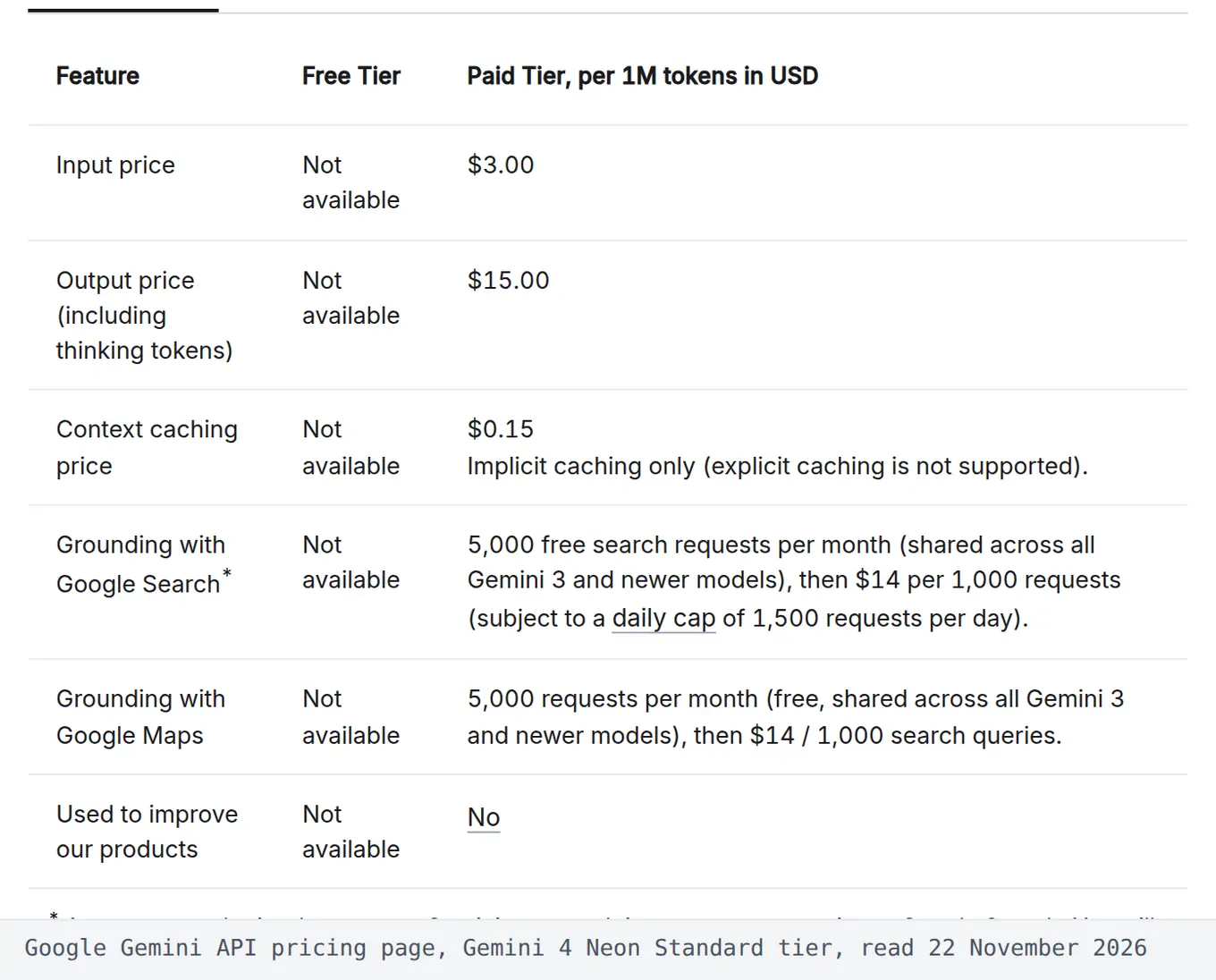
I read these rates on Google’s Gemini API pricing page on 22 November 2026; the old ai.google.dev address now redirects there. All prices are per million tokens on the paid tier.
| Tier | Input / output / cache hit |
|---|---|
| Standard | $3.00 / $15.00 / $0.15 |
| Batch | $1.50 / $7.50 / $0.075 |
| Flex | $1.50 / $7.50 / $0.075 |
| Priority | $5.40 / $27.00 / $0.27 |
| Free tier | Not available |
Batch and Flex halve every line, which puts Neon in Batch at exactly Hydrogen’s Standard price. Priority costs 1.8 times Standard.
Thinking tokens are output tokens
The $15 output line includes thinking. Google’s note under the model says every token is billed, including thinking tokens and the internal tool instructions added when you use grounding. Moving from high to xhigh does not change the rate, it changes how many tokens you buy at $15.
Gemini 4 Neon bills thinking at the output rate: every reasoning token costs $15 per million on the Standard tier, the same as the answer you read.
Caching is automatic or nothing
Neon only does implicit caching. It kicks in on prompts of at least 4,096 tokens and bills cache hits at $0.15, a 95% discount on input, with no storage fee to manage. If your code still calls caches.create from Gemini 3, remove it before you switch.
Search and Maps grounding
Grounding with Google Search gives 5,000 free requests a month, shared across all Gemini 3 and newer models, then $14 per 1,000 requests with a cap of 1,500 a day. Maps grounding has the same 5,000 free and $14 per 1,000. One prompt can trigger several searches, and each one counts.
Why 1 December flips the comparison
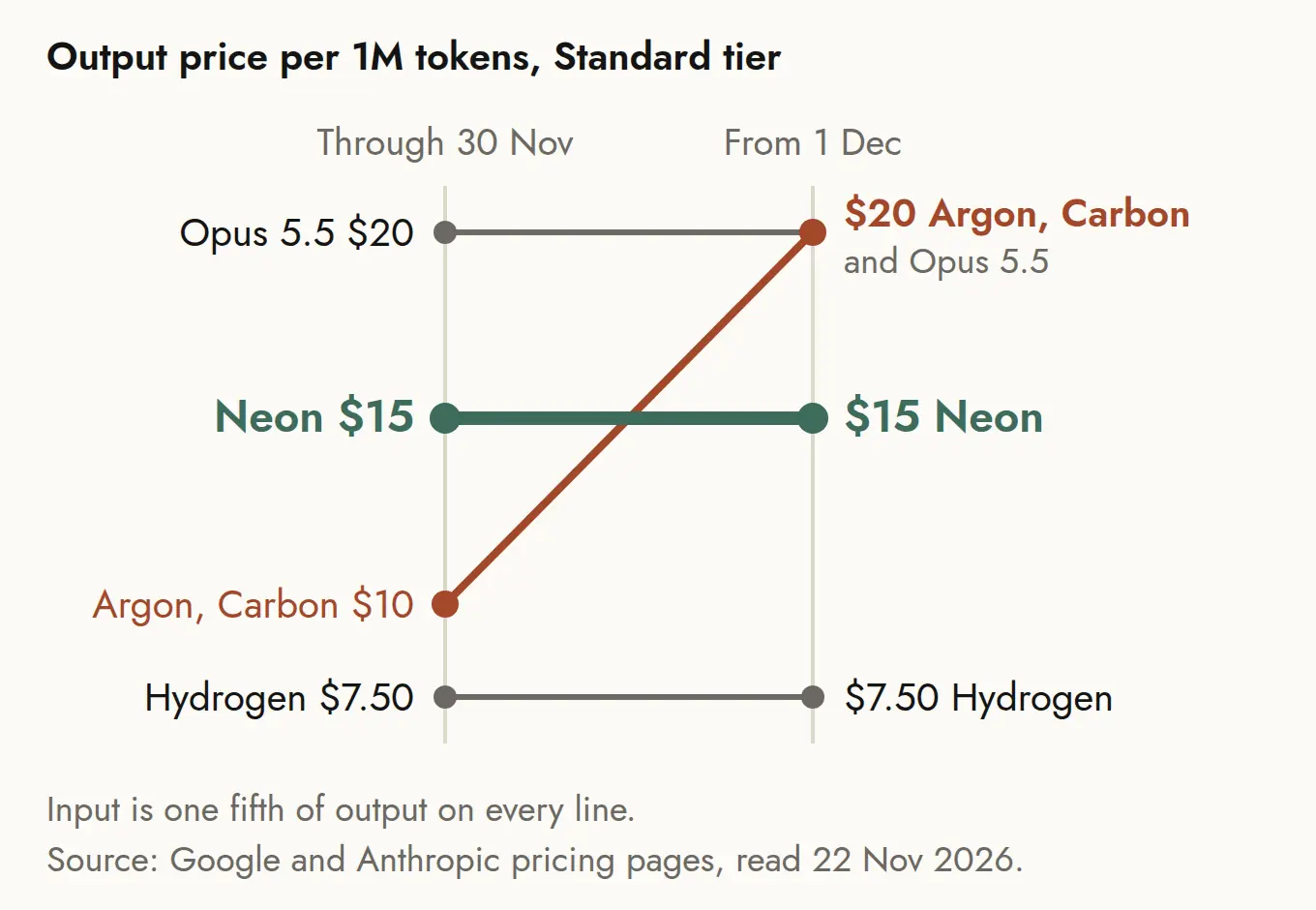
Carbon and Argon launched at an introductory $2 in and $10 out. Google’s pricing page dates that offer: it runs through 30 November 2026, and from 1 December both move to $4 in, $20 out and $0.20 for cache hits. Neon’s line carries no such date.
| Model, Standard tier | Input / output per 1M, to 30 Nov then from 1 Dec |
|---|---|
| Gemini 4 Hydrogen | $1.50 / $7.50, unchanged |
| Gemini 4 Neon | $3 / $15, unchanged |
| Gemini 4 Argon | $2 / $10, then $4 / $20 |
| Gemini 4 Carbon | $2 / $10, then $4 / $20 |
| Claude Opus 5.5 | $4 / $20, unchanged |
Until 30 November, Neon costs 50% more per token than Gemini 4 Carbon pricing shows today. From 1 December, Carbon and Argon cost a third more than Neon and land on the same sticker as Claude Opus 5.5’s per-token price.
From 1 December 2026, Gemini 4 Carbon and Argon cost $4 in and $20 out per million tokens, a third more than Neon's $3 and $15.
One month of agent work, priced both ways
Take an agent that reads 10 million input tokens and writes 2 million output tokens a month, thinking included, with no cache hits. On Neon that is $30 plus $30, so $60. Carbon comes to $40 this month and $80 from December, the same as Opus 5.5, while the cheaper Gemini 4 Hydrogen stays at $30.
Now let 8 million of those input tokens hit the cache, which is realistic for an agent that rereads its repository. Neon drops to $37.20 ($6 fresh input, $1.20 cached, $30 output). Carbon from December lands at $49.60 for the same work.
Which Gemini 4 model to pick after 1 December
My verdict, on price alone, is simple once the promo ends.
- Pick Hydrogen for everyday coding and agents: half Neon’s price, and it has a free tier.
- Pick Neon when Hydrogen drops the thread on long, tool-heavy runs: it is now the cheaper of the frontier Gemini 4 models.
- Keep Carbon for the problems Neon fails on, and test that claim on your own tasks before paying a third more per token.
- If you run Carbon or Argon today, use the last days of November to run your evaluation set on Neon at
mediumandhigh; switching needs only the model ID.
Frequently asked questions
Is there a free tier for Gemini 4 Neon?
No. The pricing page lists every Free tier line as not available, and the migration guide says Neon runs on the paid tier only. Pro and Ultra subscribers can use it in the Gemini app, Google AI Studio and Antigravity under their plan.
Will the Neon price change on 1 December?
Nothing on the pricing page says so. Carbon and Argon carry dated lines for 30 November and 1 December; Neon’s $3 and $15 have no date attached, as read on 22 November 2026.
Does Gemini 4 Neon support the Batch API?
Yes. Batch and Flex both cost $1.50 in and $7.50 out per million tokens, with cache hits at $0.075.
How long can a Neon answer be?
Up to 65,536 tokens per synchronous call. With background execution or client-side continuation, the answer can run to the full 1,048,576-token window minus your input, all billed at the output rate.