Gemini 4 Carbon is Google’s strongest Gemini 4 model, built on Gemini 4 Argon and tuned to think longer on hard coding, science and security work. It opened to paying Gemini API developers on 10 November 2026, with a 1M-token window, text, image, video, audio and PDF input, and first place on the Artificial Analysis Intelligence Index v5.0 at 59. It costs the same as Argon: $2 per million input tokens and $10 per million output tokens through 30 November 2026, then $4 and $20 from 1 December, according to Google’s pricing page read on 11 November.

What Gemini 4 Carbon is
Google’s Gemini 4 Carbon model card, published on 10 November 2026, says it plainly: Carbon “is based on Gemini 4 Argon”. It is not a new family but the same model pushed to spend more thinking tokens per turn, so it explores, checks and verifies more before it answers.
Argon’s heavier sibling
Google positions the two side by side. Argon stays “the ideal choice for the majority of software engineering and knowledge work”, while Carbon is meant for tasks that test the limits of a model, such as multi-step debugging across a large codebase or open-ended research. The trade is explicit in Google’s What’s new in Gemini 4 Carbon guide: more tokens per turn and more latency than Argon.
You steer that with a thinking level, low, medium or high, with medium as the default. Google advises running your evaluations at all three and keeping the lowest one that meets your quality bar.
What it takes in and gives back
These are the specifications listed on the gemini-4-carbon model page and the model card, as I read them on 11 November 2026:
- input: text, images, video, audio and PDF; output: text only;
- one unified window of 1,048,576 tokens shared by input, thinking and output;
- 65,536 output tokens per synchronous call, and up to 1M with long decode in background mode;
- tools: code execution, computer use, function calling, file search, URL context, structured outputs, and grounding with Google Search and Google Maps;
- knowledge cutoff: March 2026;
- access: paid tier of the Gemini API and Google AI Studio, Gemini for business, and Google AI Ultra in the Gemini app, AI Mode and Google Antigravity.
Antigravity is where Google shows Carbon at its most ambitious. It is previewing a /swarm feature that turns one prompt into a team of agents, with Carbon in the roles that need the deepest reasoning.
Where Google says it leads
The model card compares Carbon with Argon and the main rivals on results dated October 2026. I kept the rows that matter for an API buyer, with Claude Opus 5.5 as the reference rival:
| Benchmark | Carbon / Argon / Claude Opus 5.5 |
|---|---|
| Artificial Analysis Intelligence Index v5.0 | 59 / 50 / 58 |
| Terminal-Bench 4.0, agentic coding | 65.2% / 57.1% / 59.6% |
| OSWorld-2.1, computer use | 81.5% / 74.7% / 87.2% |
| AutomationBench, knowledge work | 53.9% / 51.3% / 42.5% |
| GraphWalks 256k to 1M, long context | 96.2% / 84.2% / 66.8% |
| CWE-bench, vulnerability patching | 71.0% / 68.0% / 67.0% |
| ExploitGym, exploitation | 54.8% / 42.0% / 34.5% |
Two readings stand out. Carbon’s long-context score is far ahead of every model in the table, and Opus 5.5 still wins on computer use. Google adds that the cybersecurity results reflect access through its Fairwind Program for verified defenders, so the public API may not show the same edge there.
Gemini 4 Carbon scores 96.2% on GraphWalks between 256k and 1M tokens, against 84.2% for Argon and 66.8% for Claude Opus 5.5, according to Google's model card.
The limits Google admits
The model card lists hallucinations, “occasional slowness or timeout issues” and higher token use at high thinking levels as known limitations. Independent numbers point the same way: Artificial Analysis measured that Carbon answers more questions correctly than Argon but hallucinates more, 58% against 48% accuracy and an 11% against 4% hallucination rate.
My verdict on the model itself: Carbon is the one to try on long, verifiable engineering work where a test suite catches its mistakes. For writing and quick answers, Argon gives you the same family for fewer tokens and fewer invented facts.
What people have built with Carbon
The first public demos are mostly coding and 3D, which matches where Google pitches the model. Several date from the preview period, before the 10 November release. I kept the ones that show the build itself, ideally with a time or a cost.
A Chrome Dino remake for $5.20, by noclipepe
noclipepe runs one Chrome Dino prompt across models and logs the time and the bill. Carbon took 34 minutes 41 seconds and $5.20, against 38 minutes 55 seconds and $8.53 for Opus 5.5, while GPT-6.1 Terra finished in 4 minutes for $0.17. That spread is the most useful number on this page for anyone budgeting Carbon on long builds.
GEMINI 4 CARBON GAVE THE CHROME DINO LEG DAY. GPT-6.1 TERRA GAVE IT A BBL 🍑
I added Carbon to my Chrome Dino test:
Gemini 4 Carbon → 34m 41s · $5.20
Opus 5.5 → 38m 55s · $8.53
GPT-6 Astra → 15m · $4.61
GPT-6.1 Terra → 4m · $0.17
Carbon even animated the pterodactyls’ flight
My aimlapi.com test rating at the end of the video@noclipepe
https://x.com/noclipepe/status/2115953941808550313
A Greek world in three.js, by Chetaslua
Chetaslua posted this walk through a Greek world built in three.js on 30 October, while Carbon was still in preview. There is no time or cost in the post, only the video, but it shows the level of 3D detail testers were getting before the public release.
Gemini 4 Carbon : Greek World in threeJS https://t.co/DjgEAiduZk
@chetaslua
https://x.com/chetaslua/status/2116082604151914668
Seven projects from early access, by Ashutosh Shrivastava
Ashutosh Shrivastava had early access and used Carbon for coding and 3D work. His launch-day post opens a thread of seven builds, starting with a demo called Adiyogi Divya Darshanam, shown in the video.
Google just dropped Gemini Carbon for Google AI Ultra subscribers on desktop, mobile, and web.
I’ve had early access and been playing around with it for coding and 3D Work. Here are 7 incredible things I’ve built with it.
First up, Adiyogi Divya Darshanam. Working on this demo was an incredible experience because this place is very close to my heart.
Honestly, Gemini Carbon feels like the way forward and a real step up from Argon. All the demo videos in this thread were also recorded by Carbon inside Antigravity.
You can play with all the live demos and learn how everything was built on my showcase page linked below.@ai_for_success
https://x.com/ai_for_success/status/2120187064184664162
The White House in 3D, by m0h
m0h gave Carbon and Claude Opus 5.5 the same task, the US White House in 3D with Three.js, and put both results side by side in the video. It is a single comparison, not a controlled test, but it shows where the two models differ on 3D layout.
🚨 Gemini 4 Carbon VS Claude Opus 5.5
finally, a model that genuinely challenges Opus 5.5.
Google DeepMind claims Gemini 4 Carbon is better than Opus 5.5, so this is their comparative test result.
both model built the U.S. White House in 3D using Three.js, and these are the final results.
honestly, i’m having a hard time picking a winner here. both delivered really strong outputs.
so i’ll leave this one to you guys:
did Gemini 4 Carbon beat Opus 5.5?@exploraX_
https://x.com/exploraX_/status/2115841153635418347
Theme Park ported to the web, by Demis Hassabis
Demis Hassabis, who runs Google DeepMind, posted this on launch day, so treat it as a showcase from Google’s own side: Carbon reverse-engineered the original binaries of Theme Park, the 1990s game he programmed, added a DeepMind-themed ride and ported it to the web in one shot.
Our latest frontier model Gemini 4 Carbon is rolling out today! Amazing progress from Gemini 3 → Gemini 4 in less than a year… Carbon reverse engineers my original Theme Park binaries, adds a new DeepMind themed ride, and ports it to the web in one shot – kind of mindblowing to see!
@demishassabis
https://x.com/demishassabis/status/2120210297948696997
13 coding briefs in Antigravity, by Chubby
Chubby, who had early access in Antigravity, gave Carbon 13 coding briefs, from 3D scenes to websites and apps, and posted the results one by one. The thread opens on an orrery where one control drives the gears and folding petals, even in reverse, and he notes where a follow-up prompt was needed.
1/ I had early access to Google’s new Gemini 4 Carbon in Antigravity. I gave it 13 coding briefs, from 3D to websites and apps. Here’s what came back. Its very impressive.
First: ORRERY. One control drives the gears and folding petals, even in reverse. One follow-up improved the framing. Several more examples and my resume. A 🧵:@kimmonismus
https://x.com/kimmonismus/status/2120186125591646250
A 3D helicopter in 30 minutes, by Lumina
Lumina ran the same 3D helicopter brief on a preview checkpoint of Carbon in Arena and on Claude Opus 5.5 in Claude Code, and timed both: a little over 30 minutes for Carbon, 55 for Opus 5.5 on its extra effort setting.
Gemini 4 Carbon vs Opus 5.5: 3D Helicopter
Carbon was done in arena in a tad over 30 minutes, Opus 5.5 is on Extra and took 55 minutes
Something to keep in mind is that Opus 5.5 is in its preferred harness, Claude Code, I personally prefer Carbon’s design but Opus 5.5 is more polished overall@LuminaBench
https://x.com/LuminaBench/status/2113963313591705768
None of these is a controlled test, and most were one prompt or one brief. What they do show is the kind of job Carbon is being tried on: long, multi-file builds that run for half an hour or more, which is exactly where its thinking tokens pile up on the bill.
What Google charges for Carbon
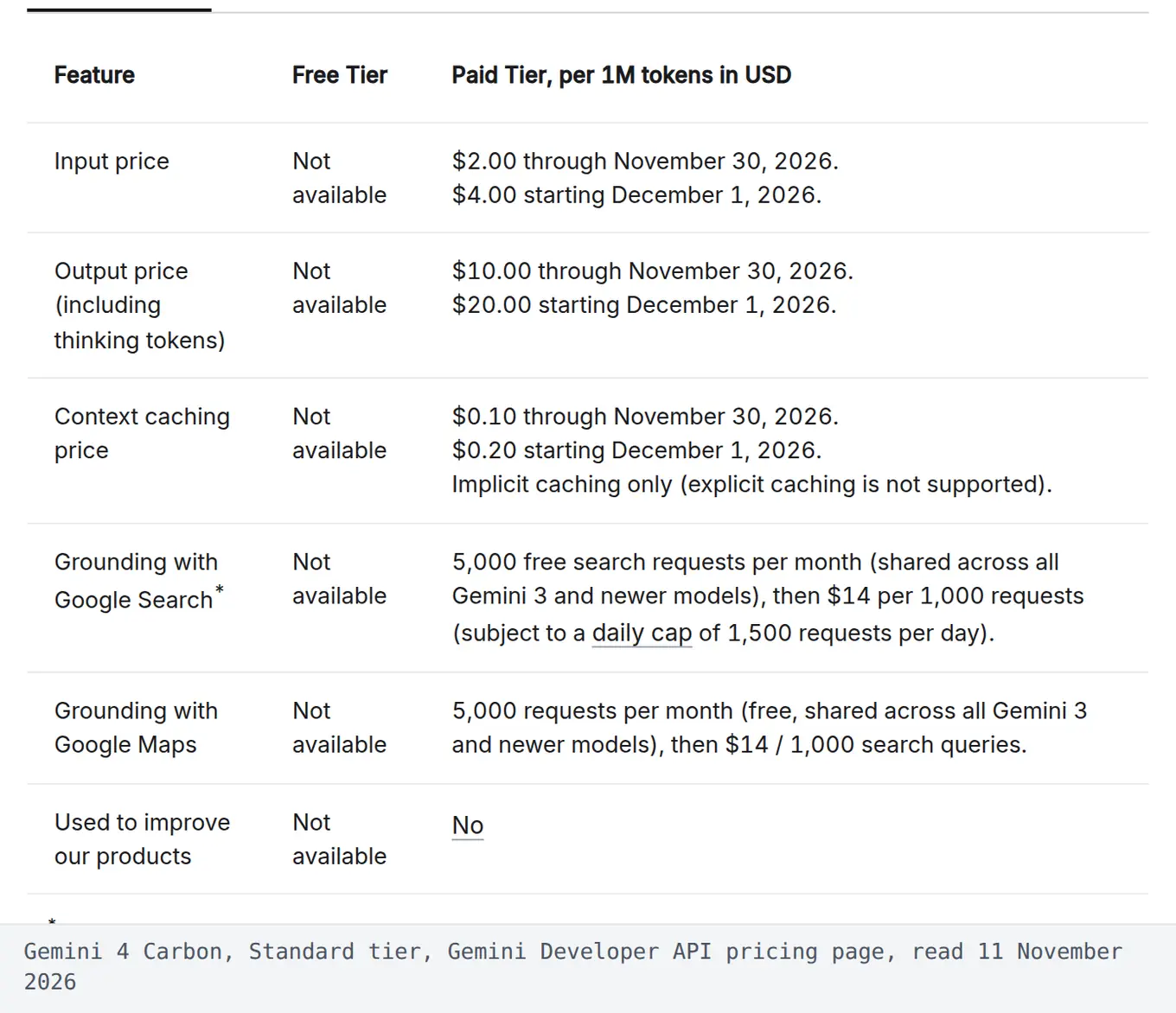
Carbon was announced on 28 October with a price but no developer access. On 10 November Google wrote that Gemini 4 Carbon is now available through the Gemini API to all paying developers, and the gemini-4-carbon row is on the Gemini Developer API pricing page as a stable model.
Four tiers, one switch date
Google lists Carbon on four tiers, and every one of them doubles on 1 December 2026. Batch and Flex sit at half the Standard price, Priority at 1.8 times. These are the rows I copied from the grid on 11 November:
| Line, per million tokens | Through 30 Nov 2026, then from 1 Dec 2026 |
|---|---|
| Standard input | $2.00, then $4.00 |
| Standard cached input | $0.10, then $0.20 |
| Standard output, thinking included | $10.00, then $20.00 |
| Batch or Flex input | $1.00, then $2.00 |
| Batch or Flex output | $5.00, then $10.00 |
| Priority input | $3.60, then $7.20 |
| Priority output | $18.00, then $36.00 |
There is one price across the whole context window. Carbon has a unified window of 1,048,576 tokens for input, thinking and output, and the grid carries no higher rate for long prompts.
Implicit caching only
The cache line comes with a note: “Implicit caching only (explicit caching is not supported)”. In practice, that means three things for your bill:
- you pay no hourly storage fee, unlike Gemini 3.8 Flash, and no cache write fee, unlike Claude;
- you cannot pin a prefix, so a hit depends on Google’s routing, and the 95% discount is never guaranteed;
- the discount covers input only; output and thinking tokens are always billed in full.
Keep the stable part of your prompt at the start and identical from call to call. That is the only lever you have on the hit rate.
What else lands on the bill
Google’s What’s new in Gemini 4 Carbon guide spells out what counts as a billed token. I would read these before budgeting:
- thinking tokens are billed at the output rate, which is the line that grows fastest on Carbon;
- tool system instructions and function declarations count when you use grounding;
- Grounding with Google Search gives 5,000 free requests a month shared across Gemini 3 and newer models, then $14 per 1,000, capped at 1,500 a day;
- there is no free tier at all.
One technical number also touches the bill. With long decode, a single answer can run up to 1M tokens minus your input, and a 1M-token answer would cost $10 of output today and $20 in December.
What a month of Carbon costs
I reused the workload from my Gemini 4 Argon price breakdown, so the two models compare line for line. It is a coding agent that rereads the same repository on every turn.
A coding agent at 10,000 turns a month
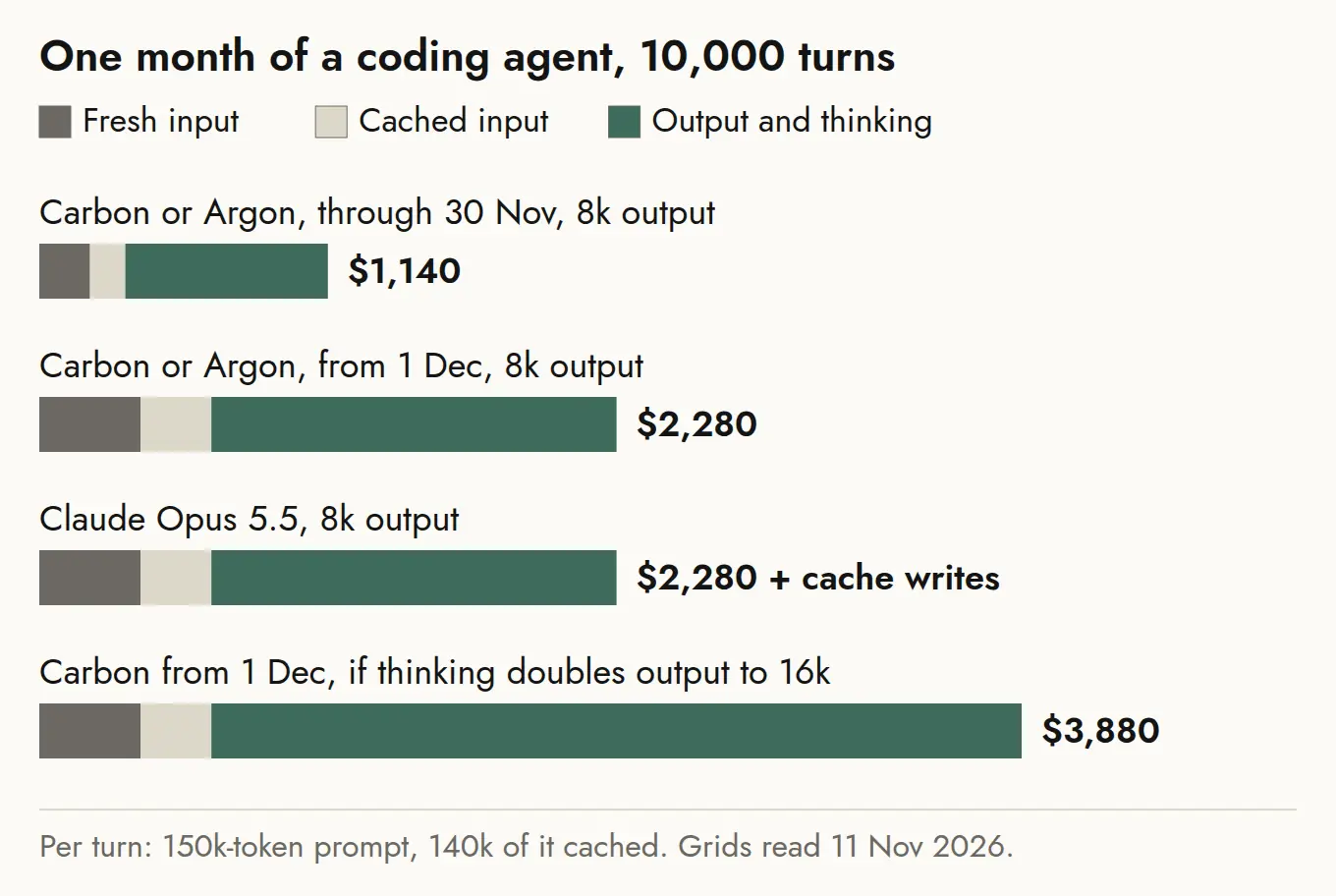
Each turn sends a 150,000-token prompt, of which 140,000 tokens are the same repository context and hit the implicit cache, and gets 8,000 tokens back, thinking included. At the introductory price one turn costs $0.114: $0.02 of fresh input, $0.014 of cached input and $0.08 of output.
Over 10,000 turns that is $1,140 a month through 30 November. The same month from 1 December costs $2,280, because every line doubles. Without any cache hit, it would be $3,800 and then $7,600.
Output is 70% of this agent's bill on Carbon, at both prices. Caching has already done its work; only fewer thinking tokens make the month cheaper.
Thinking tokens decide the real price
Google is explicit that Carbon “spends more thinking tokens per turn” than Argon, at the same per-token price. It does not say how many more. So the honest way to budget is per thousand tokens: on this agent, every extra 1,000 output tokens per turn adds $100 a month at the introductory price and $200 from December.
If Carbon’s thinking doubled the output to 16,000 tokens per turn, the month would cost $1,940 now and $3,880 from 1 December. The thinking level is your control here: Google’s guide sets medium as the default and tells you to pick the lowest of low, medium and high that meets your quality bar.
Batch work after 1 December
Take a reporting job that runs 2,000 documents a month through the Batch API, with 30,000 tokens in and 20,000 tokens out each. It costs $260 a month on Carbon Batch through 30 November and $520 from 1 December.
That $520 is also what the same job costs on Carbon Standard today. If your work can run asynchronously, December’s Batch price is November’s interactive price, and that is the cheapest way to keep Carbon after the promo.
Carbon against Argon and Claude Opus 5.5
I re-read Anthropic’s Claude pricing grid and Google’s Argon row on 11 November 2026. Per token, the three models collapse onto two price points:
| Model | Input / cached input / output, per million tokens |
|---|---|
| Gemini 4 Carbon, through 30 Nov 2026 | $2.00 / $0.10 / $10.00 |
| Gemini 4 Argon, through 30 Nov 2026 | $2.00 / $0.10 / $10.00 |
| Gemini 4 Carbon, from 1 Dec 2026 | $4.00 / $0.20 / $20.00 |
| Gemini 4 Argon, from 1 Dec 2026 | $4.00 / $0.20 / $20.00 |
| Claude Opus 5.5 | $4.00 / $0.20 / $20.00, plus $5 or $8 cache writes |
| Claude Opus 5.5 Batch | $2.00 in / $10.00 out |
Same grid as Argon, more tokens per turn
Argon and Carbon share the price, the 1M window, the tools and the end date of the introductory period. Google’s own guide says the only difference is token spend: Argon answers faster with fewer thinking tokens, Carbon explores and verifies more before it answers.
Artificial Analysis measured what that means per task on its Intelligence Index, at the $4 and $20 standard prices:
Gemini 4 Carbon costs $7.76 per Intelligence Index task, ~23% less than Claude Opus 5.5 (max, $10.04) but ~1.2x GPT-6 Astra (max, $6.25). It uses 123k output tokens per task, 29% fewer than Claude Opus 5.5 (max, 173k). At the same $4/$20 standard pricing, its Cost per Task is in line with Gemini 4 Argon ($7.68), while scoring 9 points higher on the Intelligence Index.
@ArtificialAnlys
https://x.com/ArtificialAnlys/status/2115494556548599953
The post is cut off before the Argon figure. Evan Otero quoted it the same day with the missing comparison: at the same prices, Carbon’s cost per task is in line with Argon’s, $7.76 against $7.68.
My reading: on a benchmark mix, the extra thinking costs about 1% per task. On your own hard agent loops it can cost far more, which is why I would measure output tokens per task on both models before moving a workload.
Opus 5.5 is Carbon’s December price
From 1 December, Carbon lands exactly on Claude Opus 5.5’s per-token price: $4 in, $0.20 cached, $20 out. Opus 5.5 also bills cache writes, $5 per million for five minutes and $8 for an hour, so a 140,000-token repository costs $0.70 each time it is written for five minutes. Carbon has no write fee, but it gives you no explicit cache either.
At equal rates, the token count decides. Artificial Analysis measured 123,000 output tokens per task on Carbon against 173,000 on Opus 5.5 at its max setting: at $20 per million, those 50,000 tokens are worth $1.00 per task in Carbon’s favour.
From 1 December 2026, Carbon, Argon and Claude Opus 5.5 all charge $4 in and $20 out per million tokens. Price per token stops being a reason to pick one of them.
Should you switch before 30 November?
Counted from 11 November, the introductory price has 20 days left. That is enough to test, not enough to plan a budget on. My verdict:
- budget every Carbon workload at $4 and $20, because December is the first full month you will pay;
- use November to log output tokens per task on Carbon and Argon side by side, since the price is identical and only the count differs;
- move anything that does not need an instant answer to Batch, which keeps the November price after the switch;
- if you already run on Opus 5.5, compare token counts, not grids, because from December the grids are the same.
For translating any Gemini grid into per-request costs, my Gemini token cost guide walks through the method.
Frequently asked questions
Is Gemini 4 Carbon free to use?
No. Google’s pricing page lists Carbon as “Not available” on the Free tier, and every token is billed on the paid tier, thinking tokens included.
When does the Carbon introductory price end?
On 30 November 2026. From 1 December 2026, Standard moves to $4 input, $0.20 cached input and $20 output per million tokens, and Batch, Flex and Priority double too.
What is the knowledge cutoff of Gemini 4 Carbon?
March 2026, according to Google’s model card, which adds that some domains may be less up to date than that.
Do long prompts cost more on Carbon?
Not on the current grid. Carbon has a single rate across its 1,048,576-token window, with no surcharge above a prompt length, as I read it on 11 November 2026.