Gemini 4 Argon is Google’s first Gemini 4 model and, since Gemini 4 Carbon arrived on 10 November, the faster, lighter-thinking half of the pair: a reasoning model with a 1M-token window shared by input and output, built for coding agents and long legal, financial or technical documents. It has been on the paid Gemini API since 13 October 2026. Google’s pricing page, which I read on 11 November, puts it at $2 per million input tokens and $10 per million output tokens through 30 November 2026, then $4 and $20 from 1 December, with no free tier.

What makes Gemini 4 Argon different
Google calls Argon its “efficient Gemini 4 frontier reasoning model”. The Gemini 4 Argon model card, published on 13 October 2026, describes a large sparse mixture-of-experts model that reads text, images, audio and video and writes text, and it insists that Argon “is not a modification or a fine-tune of a prior model”. Its knowledge cutoff is March 2026.
Argon or Carbon: same price, different thinking budget
Carbon is not a premium tier above Argon. Google’s What’s new in Gemini 4 Argon guide says the two share the 1M window, the built-in tools and the per-token price. The difference is how many thinking tokens each one spends per turn: Argon gives “faster responses and lower token spend per turn”, while Carbon explores and checks more before it answers. Argon defaults to the medium thinking level, and you can drop it to low or raise it to high.
A 1M window that the answer can fill
Input, thinking and output share 1,048,576 tokens. A normal call still stops at 65,536 output tokens; past that, you switch on background execution and Google’s servers continue the answer in 64K hops, up to 1M tokens minus your prompt. That is what Google means when it says Argon “works longer and harder”.
The tool list covers what an agent needs: code execution, computer use, file search, function calling, structured outputs, URL context and grounding with Google Search or Maps. Argon does not generate images or audio and is not on the Live API. Two habits also have to go when you migrate: explicit context caching is not supported, and temperature, top_p and top_k are ignored.
Where Google says it leads
The scores below come from Google’s model card, dated October 2026, so they are Google’s own. I kept the rows where Argon leads clearly and the two where it does not, against GPT-6 Astra and Claude Opus 5.5:
| Benchmark | Argon / GPT-6 Astra / Claude Opus 5.5 |
|---|---|
| Vals Index, finance, legal, tax and coding | 68.9% / 63.1% / 67.0% |
| Harvey’s Legal Agent Benchmark | 19.6% / 5.4% / 3.8% |
| DeepSWE v1.1, agentic coding | 77.9% / 74.1% / 74.2% |
| GraphWalks 256k to 1M, long context | 84.2% / 71.8% / 66.8% |
| LVBench, long video | 91.7% / 87.5% / 83.7% |
| Terminal-bench 4.0, agentic coding | 57.4% / 58.2% / 66.4% |
| FrontierSWE v2, agentic coding | 55.0% / 65.5% / 62.3% |
On Google's own model card, Gemini 4 Argon leads Claude Opus 5.5 on the Vals Index, 68.9% against 67.0%, but trails it by nine points on Terminal-bench 4.0, 57.4% against 66.4%.
Independent tests put Argon close to the leaders rather than ahead of them. Epoch AI scored it 165 on its Capabilities Index, level with Claude Fable 5.1, one point behind GPT-6 Astra and two behind Opus 5.5, and well above Gemini 3.8 Flash at 157:
Gemini 4 Argon scores 165 on the Epoch Capabilities Index (ECI), on par with Fable 5.1 (165) but behind Opus 5.5 (167) and GPT-6 Astra (166).
While behind the ECI frontier, Argon is the closest Google’s come since Gemini 3.1 Pro in Feb, and a big jump from Gemini 3.8 Flash (157)@EpochAIResearch
https://x.com/EpochAIResearch/status/2110693857742717372
HackerRank ran it on long-horizon software engineering tasks on 20 October, during the introductory price: 49.7% overall, just behind Opus 5.5 and Fable 5.1, at about a third of the cost of Opus 5.5.
HackerRank Bench just added Gemini 4 Argon to the leaderboard of frontier models on real-world, long-horizon SWE tasks.
Argon scored 49.7% overall, just behind @AnthropicAI’s Opus 5.5 and Fable 5.1. It did so at just a third of the cost of Opus 5.5! 👀
Here’s where Argon stands out: it tops the leaderboard for greenfield implementation (63%), building working systems from scratch faster and more completely than every other model we tested, including Opus 5.5. It also leads frontend & interaction fidelity among non-GPT models (63%).
Its weak spot: Identity & provisioning integration, where it trails Claude Opus 5 and several others – implementing standards-based identity lifecycle and synchronization across tenant boundaries is still its toughest category.
Every task on our benchmark is original, unpublished, and scored by hand-written behavioral verifiers.
Find the full report with the leaderboard, cost curves, and task-type breakdowns.
hackerrank.com/bench/report@hackerrank
https://x.com/hackerrank/status/2112592834180399143
The card lists hallucinations and “occasional slowness or timeout issues” as known limitations, and Google’s migration guide asks for client timeouts of at least 15 minutes on hard prompts. My verdict on the model: Argon is the Gemini 4 to start with for coding agents and document work. Move a task to Carbon only when it fails on Argon at the high thinking level.
What people have built and measured with Argon
Argon has been on the API since 13 October, so there is more to show than for Carbon. The benchmark scores are in the section above; here I kept builds you can see, including one where Argon came off worse than Claude.
Six browser games with their prompts, by Ammaar Reshi
Ammaar Reshi leads product and design for Google AI Studio, so read this as a showcase from Google’s side. On launch day he posted a thread of six games made with prompts and code, shared so you can play or remix them. The first, Argon Tennis, turns your phone into the racket.
Gemini 4 Argon is AMAZING at making games 🎮
It can create 3D assets from scratch and build amazing mechanics, all in one shot.
Here’s a thread of games I made with prompts and code so you can play or remix them too!
1/6 Argon Tennis: use your phone as a tennis racket 🧵 https://t.co/vl6yFJHNcn@ammaar
https://x.com/ammaar/status/2110057926799073462
A 200,000-line Python codebase optimised overnight, by Google
This one is also Google’s own account, but it is the most detailed real-code example I have found. Google engineers left Argon running unattended for 11 hours in Antigravity on google/adk-python, about 205,000 lines with 16,892 unit tests. It proposed six optimisations across 32 files. The maintainers kept two: a faster session copy that cut in-memory session preparation by about 40 percent in long sessions, and lazy imports that made a cold import about 21 percent faster.
The four rejected changes are the useful part: a cache that could return stale data, a check that read a private OpenTelemetry attribute, and two rewrites whose gains only showed on synthetic benchmarks. The merged change touched 22 files with 17 new tests, as Google describes in its write-up of the overnight run.
Excaliflow, an animated diagram app, by Shubham Saboo
Shubham Saboo built Excaliflow with Argon in Antigravity and open-sourced it: a hand-drawn diagram editor in the Excalidraw style where data flows along the arrows in real time, with PNG and video export, all in a single HTML file. The Excaliflow repository has the code and a test suite; the post shows the app running.
This is NOW 100% open-source.
Built with Gemini 4 Argon in Antigravity (plus gemini 4 argon is now available for pro users).
GitHub Repo: https://t.co/t1nRB1FenF https://t.co/UjMTs8s5iA@Saboo_Shubham_
https://x.com/Saboo_Shubham_/status/2110957935144960331
Gummy bears that stayed rigid, by Semichenko
Not every build goes Argon’s way. Semichenko gave Argon and Claude Opus 5.5 the same gummy-bear physics prompt and put both through the same moves: pull a paw, yank the head, squash, throw. Opus’s bears behaved like jelly; Argon’s stayed stiff, gummy statues as the post puts it. It is one prompt, but it is the clearest failure on video I have seen.
Opus 5.5 made gummy bears. Gemini 4 Argon made gummy statues
Same prompt. Opus on top, Gemini below
I put both through the same moves – pull a paw, yank the head, squish it flat, throw it, then pour a whole bag on top
Opus bears are actual jelly. Pull a paw and it stretches into a thin rubbery strand, then snaps back and wobbles. Squash one and it pancakes, then launches itself back up. Throw it and it bounces off the floor and shoves its friends out of the way
Gemini bears are solid plastic. The arm turns into a stick, the bear flies straight through its neighbor, and the pile at the end just clips into itself
And Opus nailed the look too – translucent, glossy, light passing right through them
Opus: $7.2
Gemini: $22@semichenkko
https://x.com/semichenkko/status/2110131790136401989
A Leonardo da Vinci workshop in 3D, by TechHalla
TechHalla gave Argon and Opus 5.5 the same brief, a Leonardo da Vinci workshop with 3D recreations of his inventions, and posted both results in one video. In a follow-up post TechHalla judged Opus 5.5 at medium effort closer to the intended result, while noting that Argon spent half as much time thinking.
gave Gemini 4 Argon and Opus 5.5 the exact same task
to build a Leonardo da Vinci workshop with 3D recreations of his inventions
which approach do you prefer? prompt below 👇 https://t.co/yE8pcB91Au@techhalla
https://x.com/techhalla/status/2110121002332295599
A humanoid 3D robot in 30 hours, by Bee
Bee built a humanoid 3D robot with Three.js and Blender that runs in the browser. The post says it took around 30 hours of iteration and direction, a useful reminder that the one-prompt demos are not the norm.
Gemini 4 Argon – A futuristic humanoid 3D robot..
Built with Three.js & Blender..
You can try it out here: thtbee.github.io/waggles/kestre…
And explore the demos from my previous posts here: github.com/thtbee/waggles
This took around 30hrs of iteration and direction.. Initially, I only planned to build a robotic hand. When I saw how good it was.. I expanded the scope to build a full interactive robot!
It looks so good, and the exploded view is insane too.. I asked it to add some premade poses (it even added a sassy one 😉
There’s still a lot to show, and something cool is almost ready.. I might announce it today if I get everything set up! So stick around 🙂@thtbee_
https://x.com/thtbee_/status/2110390964028330106
What Google charges for Argon
Argon’s price first appeared in one sentence and one footnote of the Gemini 4 Argon launch post of 30 September 2026, by Koray Kavukcuoglu. The footnote has since gained a date: in Google’s general availability post of 13 October, the introductory period “expires on November 30, 2026”. The Gemini API pricing page, as of 11 November 2026, carries the same two dates.
The introductory price and the one after it
On the Standard tier, Argon costs $2 per million input tokens and $10 per million output tokens through 30 November 2026, then $4 per million input tokens and $20 per million output tokens starting 1 December 2026. Output includes thinking tokens, and Google bills every token the model processes, including the hidden instructions of its tools when you use grounding. In other words, the price you see today is exactly half of the price you should plan for.
| Line, per million tokens | Through 30 Nov 2026, then from 1 Dec 2026 |
|---|---|
| Input | $2.00, then $4.00 |
| Cached input (95% off input, implicit only) | $0.10, then $0.20 |
| Output, thinking included | $10.00, then $20.00 |
| Free tier | Not available |
Google’s Logan Kilpatrick posted the same introductory figure on launch day, which confirms the $2 and $10 come from Google and not from a reseller.
Introducing Gemini 4 Argon, our new frontier model, rolling out to cyber defenders starting today, and more widely as soon as possible. I am really excited by the progress we have made here. Argon is priced at $2 in and $10 out during introductory pricing!
@OfficialLoganK
https://x.com/OfficialLoganK/status/2105388054274080946
What the 95% cache discount means in dollars
The launch post only said cached input tokens are “priced at 95% off input token price”. The pricing page now prints the result: $0.10 per million cached tokens through 30 November and $0.20 from 1 December, 5% of the input price in both cases. The catch is that Argon supports implicit caching only. You cannot create a cache yourself; Google discounts a repeated prefix on its own, on prompts of at least 4,096 tokens, when the request hits its cache.
That ratio matters more than the headline price. Gemini 3.8 Flash bills its cached input at $0.075 against $0.75 fresh, a 90% discount, so a cached Argon token keeps 5% of the input price where a cached Flash token keeps 10%.
At the introductory price, a cached Argon token costs $0.10 per million. That is less than the $0.15 Gemini 3.8 Flash will charge for its own cached tokens from 1 January 2027.
Batch, Flex and Priority rates
As of 11 November 2026, the Gemini Developer API pricing page lists Argon under the model ID gemini-4-argon, with the rates that were still missing in October:
- Batch and Flex: $1 in, $5 out and $0.05 cached through 30 November, then $2, $10 and $0.10;
- Priority: $3.60 in, $18 out and $0.18 cached, then $7.20, $36 and $0.36;
- no higher tier for long prompts, unlike the long-context rate OpenAI charges on gpt-6.1-sol;
- no cache storage fee per hour, where Gemini 3.8 Flash charges $0.50 per million tokens per hour through 2026;
- no free tier: Argon is “not available on the Free tier”.
There is also an invite-only Contributor tier at $1 and $5 with no end date, but Google uses what you send it to improve its products there, so it is not a budget option for most teams.
The output limit is the other number that touches the bill: with background execution, one response can run to 1 million tokens, up from 64K. A single maxed-out answer would therefore cost $10 of output through 30 November and $20 after it.
What the cache discount does to a real bill
A 95% discount sounds like it cuts the bill by 95%. It does not, because it only applies to input you have already sent once, and never to output. The three workloads below use Google’s Standard rates and nothing else. Argon has no cache write or storage fee, so nothing is left out, but the cached figures assume the implicit cache hits, which Google does not guarantee.
A coding agent that rereads its repository
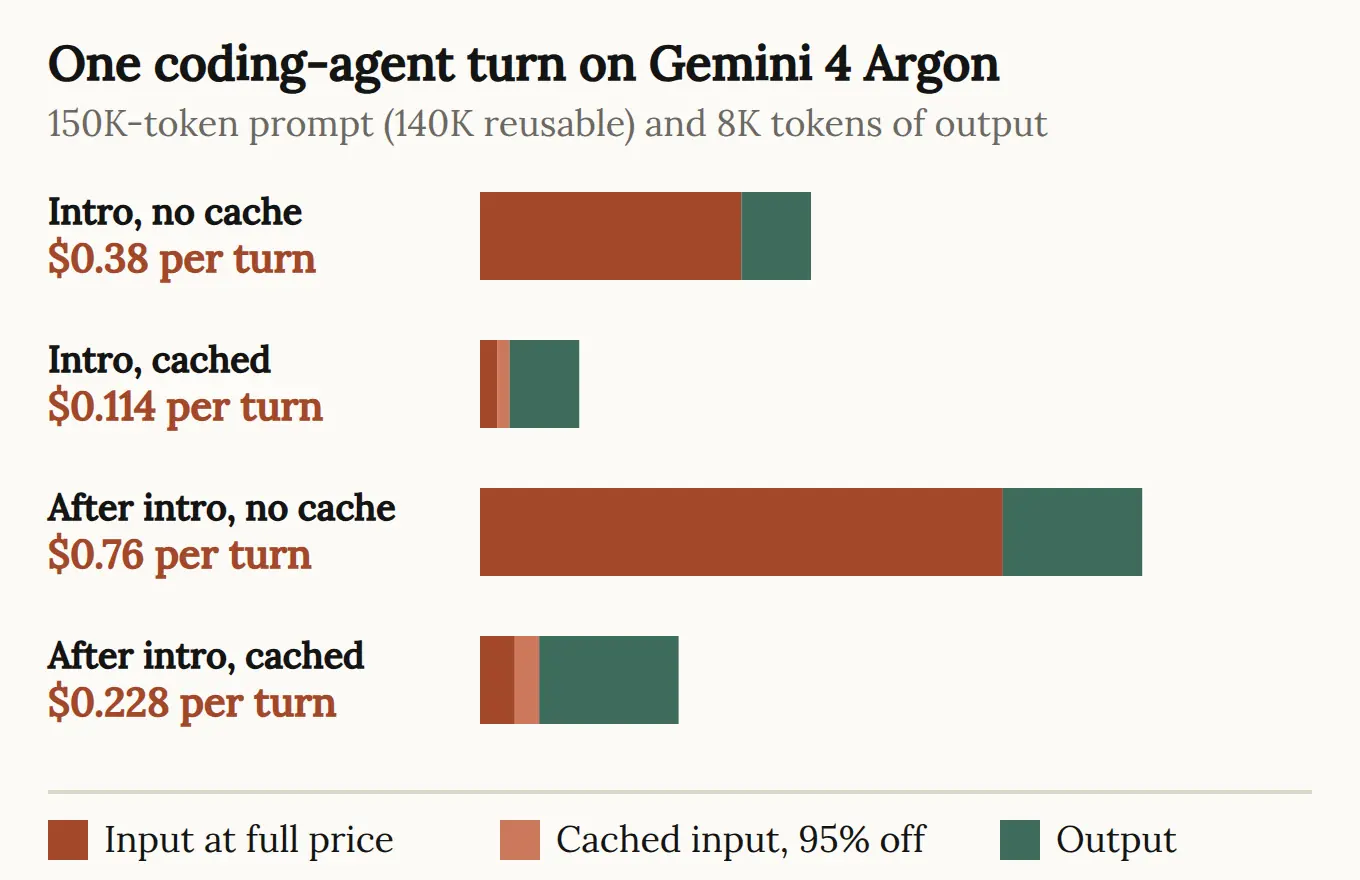
Take an agent turn with a 150,000-token prompt, of which 140,000 tokens are the same repository context every time, plus 8,000 tokens of output. Without caching, one turn costs $0.38 at the introductory price. With the repository cached, it drops to $0.114: $0.02 of fresh input, $0.014 of cached input and $0.08 of output.
From 1 December, the same turn costs $0.76 uncached and $0.228 cached. Over 10,000 turns a month, that is $1,140 cached through November and $2,280 from December, against $3,800 and $7,600 if you never cache.
Once the repository is cached, output is 70% of every agent turn on Argon, at both prices. Caching has done its job; only shorter answers lower the bill further.
Questions over one long document
Now a support or legal tool that keeps a 100,000-token document in context and asks 2,000-token questions that get 1,000-token answers. Uncached, each question costs $0.214 at the introductory price. Cached, it costs $0.024, an 89% cut, because almost all of the bill was rereading the document.
This is the workload Argon’s pricing rewards. From December the cached question costs $0.048, which is still more than four times cheaper than the uncached question at the introductory price.
Output-heavy work, where caching does nothing
Long reports, code generation from a short spec and deep reasoning all look like this: 5,000 tokens in, 60,000 out. That call costs $0.61 at the introductory price and $1.22 after it, and caching the whole prompt would save less than one cent.
Verbosity, not the rate card, then decides what you pay per task. Artificial Analysis measured that effect across its own index on launch day:
Google’s new Gemini 4 Argon equals GPT-6 Astra on the Artificial Analysis Intelligence Index at 60% of the Cost per Task with discounted prices. Google is now back to being one of the top three labs in intelligence achieved
Gemini 4 Argon is @GoogleDeepMind’s first proprietary model above the Flash class in over 7 months. With high reasoning (the highest available), it scores 53 on the Artificial Analysis Intelligence Index, matching GPT-6 Astra (max, 53) and 1 point ahead of GPT-6.1 Sol (max, 52), with gains driven by lower hallucinations and stronger agentic capabilities.
At its current 50% pricing discount and with cache discounts increased to 95%, Gemini 4 Argon costs $1.99 per Intelligence Index task, 60% of GPT-6 Astra (max), but 2.7x GPT-6.1 Sol (max). After the discount ends, this will rise to $3.98 (~1.2x GPT-6 Astra (max)).
Gemini 4 Argon is currently being rolled out to selected users and is not publicly available. The 50% discount is an initial promotion. Google has not yet confirmed the promotion end date
Key benchmarking results for Gemini 4 Argon with high reasoning:
➤ Google returns as one of the top three labs on intelligence: Gemini 4 Argon (high) scores 53 on the Artificial Analysis Intelligence Index, matching GPT-6 Astra (max, 53) and 1 point ahead of GPT-6.1 Sol (max, 52). This is 23 points above Google’s previous non-Flash model, Gemini 3.1 Pro Preview (30) and 12 points ahead of Gemini 3.8 Flash (high)
➤ Launch discounts of 50% make Gemini 4 Argon competitive on Cost per Task: At current discounted pricing, Gemini 4 Argon (high) costs $1.99 per Intelligence Index task, 60% of GPT-6 Astra (max, $3.26) for a comparable level of intelligence. This cost efficiency is driven by lower token prices, rather than reduced token use, with Gemini 4 Argon averaging 62k output tokens per task, compared with 27k for GPT-6 Astra (max). Google has not yet confirmed the promotion end date, but on standard pricing, Cost per Task will increase to $3.98
➤ Stronger agentic performance: Historically a weaker area for Gemini models, Gemini 4 Argon shows improvements across agentic evaluations. It ranks #1 on AutomationBench-AA at 77.5%, 6 points ahead of Claude Sonnet 5.5 (max, 71.3%). On Terminal Bench 4, Gemini 4 Argon achieves 57%, a +53 point improvement from Gemini 3.1 Pro Preview, only behind Claude Sonnet 5.5 (max, 64%), Claude Opus 5.5 (max, 60%) and GPT-6 Astra (59%). On AA-Briefcase, it reaches 1494 Elo. This is driven by a 65% rubric pass rate, the highest we have recorded, but lower Analytical Quality (1576 Elo) and Presentation Quality (1308 Elo)
➤ Lowest hallucination rate among leading models: On AA-Omniscience, Gemini 4 Argon has a 15% hallucination rate, the lowest of any model scoring 45+ on the Intelligence Index, compared with 51% for GPT-6 Astra (max) and 54% for GPT-6.1 Sol (max). This means Argon is much more likely to acknowledge when it does not know an answer rather than guess incorrectly. On accuracy, Gemini 4 Argon scores 50%, a 5 point decrease from Gemini 3.1 Pro Preview, and 13 points below GPT-6 Astra (max, 63%). With this slightly lower accuracy, its overall AA-Omniscience score of 42 remains in line with GPT-6 Astra (43) and GPT-6.1 Sol (42)
Key model details:
➤ Context Window: 1M tokens
➤ Multimodality: Text, image, video, and speech input, with text output
➤ Pricing: $4/$20 per 1M input/output tokens at standard pricing, currently discounted 50% to $2/$10. Cached input tokens receive a 95% discount ($0.10 per 1M at discounted pricing), up from 90% on Gemini 3.8 Flash
➤ Long Decode Continuation: We tested Gemini 4 Argon with Long Decode Continuation, a new Gemini API feature that pauses long responses and resumes them across follow-up calls. This lets reasoning run up to 1M output tokens without request timeouts@ArtificialAnlys
https://x.com/ArtificialAnlys/status/2105392625788637299
Note the words “with discounted prices”: at $4 and $20 that 60% figure does not hold, and per token Argon would still be well under GPT-6 Astra’s $10 and $50.
Argon against the models it will be weighed against
Google did not invent new price points for Argon. Both of its prices already exist on rival grids, as the Anthropic, OpenAI and Google pricing pages listed them on 11 November 2026. These rates fall between the cheaper Gemini 4 Hydrogen and the premium offerings. Since 10 November, Gemini 4 Carbon pricing sits on exactly the same grid.
| Model | Input / cached input / output, per million tokens |
|---|---|
| Gemini 4 Argon, through 30 Nov 2026 | $2.00 / $0.10 / $10.00 |
| Claude Sonnet 5.5 | $2.00 / $0.10 / $10.00 |
| gpt-6.1-sol, short context | $2.00 / $0.10 / $10.00 |
| Gemini 4 Argon, from 1 Dec 2026 | $4.00 / $0.20 / $20.00 |
| Claude Opus 5.5 | $4.00 / $0.20 / $20.00 |
| Gemini 3.8 Flash, through 31 December 2026 | $0.75 / $0.075 / $3.75 |
| Gemini 3.8 Flash, from 1 January 2027 | $1.50 / $0.15 / $7.50 |
The same sticker as Sonnet 5.5 and gpt-6.1-sol
Until 30 November, Argon matches Claude Sonnet 5.5 and gpt-6.1-sol on all three lines. Some launch-week comparisons list Sonnet 5.5’s cache read at $0.20; Anthropic’s pricing grid says $0.10, a 0.05x multiplier it applies to Sonnet 5.5 and Opus 5.5.
The differences sit outside the per-token price. Anthropic bills cache writes at $2.50 for five minutes and $4 for an hour on Sonnet 5.5, and OpenAI lists $2.50 cache writes on gpt-6.1-sol with a long-context tier at $4 and $15, as I noted in my GPT-6 Sol and Luna price breakdown. Argon has neither a write fee nor a long-context tier, so until 30 November it is the cheapest of the three on a long, repeated prompt, provided the implicit cache hits.
Opus 5.5 is the price after the promo
From 1 December, Argon lands exactly on Claude Opus 5.5’s per-token price: $4 in, $0.20 cached, $20 out. Even Batch lines up: Argon Batch moves to $2 and $10 that day, the same as Opus 5.5 Batch.
My verdict: treat the $2 and $10 as a trial price that ends on 30 November. If your workload only pencils out at Sonnet 5.5 rates, Argon keeps that price in December only on Batch or Flex, where you give up speed for it.
Gemini 3.8 Flash and its January 2027 rise
Google’s own pricing page states that Gemini 3.8 Flash pricing moves from $0.75 and $3.75 to $1.50 and $7.50 on 1 January 2027, with cached input going from $0.075 to $0.15. Today, Argon at its introductory price costs 2.7 times Flash on input and output.
On the coding-agent turn above, cached Flash costs $0.048 today and $0.096 from January, against $0.114 for Argon through November and $0.228 from December. Because Argon’s promo ends a month before Flash’s rise, December is the worst month for Argon on that workload, at almost five times Flash per turn, before you count the cache storage fee that Flash charges and Argon does not.
Who can use it, and what to do before 30 November
Anyone on a paid Gemini API plan. Argon went from the cyber defenders of Google’s Fairwind Program to general availability on 13 October 2026: the paid tier in Google AI Studio and Android Studio, the Gemini platform for enterprises, and Google Antigravity for Google AI Ultra subscribers. If the 1 December rise to $4 and $20 is a problem, Gemini 4 Neon at $3 and $15 keeps its price after that date. Fairwind remains for defenders who want Argon without its cyber guardrails.
Before the price doubles, check three things on your own traffic:
- output and thinking tokens per task, since output is most of the bill once the prompt is cached;
- your implicit cache hit rate, because the cached figures above are only as good as that rate;
- which calls can wait, since Batch and Flex cost from December what Standard costs today.
From 1 December 2026, budget with the $4 and $20 column: it is the only Argon price Google has not put an end date on.