Inception is shutting down the Mercury API: its own docs say requests stop being served after 28 December 2026, and the dashboard and every piece of data on the platform go with it. If you run Mercury 3 for chat or agents, GPT-6 Luna and Claude Haiku 5.5 are the closest replacements on quality and price, and gpt-oss-20b on Groq is the one that keeps the speed. Expect your output bill to rise from the $0.35 launch rate you pay today, unless you move to Groq.

What Inception has announced
The notice sits on a dedicated Mercury API wind-down page in Inception’s docs, headed “Action needed by December 28, 2026”. It gives no reason for the decision, and I am not going to guess one. What it does give is a date, and that date is all you need to plan around.
The timeline on the wind-down page
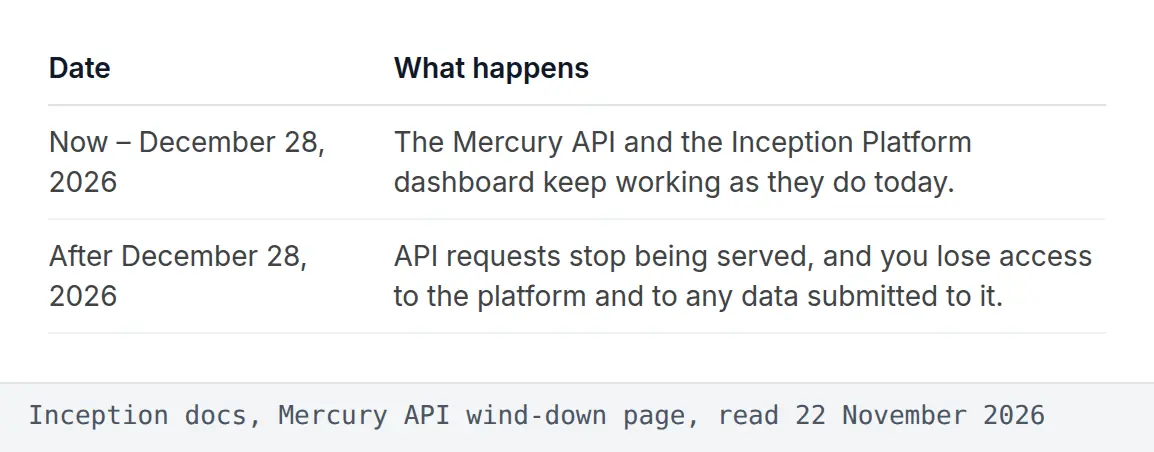
The page holds a two-row table. Until 28 December 2026, the Mercury API and the Inception Platform dashboard keep working as they do today. After that date, API requests stop being served and you lose access to the platform and to any data you submitted to it.
There is no grace period, no read-only phase and no paid extension on the page. Inception’s advice is to move every application that calls api.inceptionlabs.ai to another provider before the cutoff, “so requests do not start failing”.
After 28 December 2026, Mercury API requests stop being served and access to the platform and its stored data ends, per Inception's wind-down page read on 22 November 2026.
Some doors are already closed
The wind-down is already visible outside Inception’s own site. On 22 November 2026, OpenRouter’s API returned zero active endpoints for inception/mercury-3, and no Inception model appeared in its 476-model catalogue. If you reached Mercury through OpenRouter, that route has already stopped working.
The Vercel AI SDK team saw it coming too. A pull request adding an Inception provider was opened and closed on 12 November 2026, with the closing comment “Mercury API is winding down – closing this PR” on the Vercel AI repository. Do not wait for an official SDK package: there will not be one.
What to export before the date
The wind-down page names request logs, billing history and invoices as things to save from the dashboard. Here is what I would export while you still can:
- Your request logs, if you want a record of real prompts to replay against a replacement model.
- Your billing history and invoices, which your accountant will ask for long after the platform is gone.
- Any prompt templates or settings you only kept in the dashboard, since nothing on the platform survives the cutoff.
Which replacement fits which Mercury model
Inception sold several products under the Mercury name, and they do not all point to the same exit. I read every price below at the source on 22 November 2026.
Mercury 3 for chat and agents
Inception launched Mercury 3 by claiming it beats GPT-6 Luna and Claude Haiku 5.5 on its benchmarks, which makes those two the natural landing spots. On OpenAI’s GPT-6 Luna model page, Luna costs $0.10 input, $0.01 cached and $0.50 output per million tokens, with a 1,050,000-token context window. Haiku 5.5 matches those three rates for prompts up to 100,000 tokens, then jumps to $0.50 input and $2.50 output.
My pick for most Mercury 3 users is Luna. It speaks the same OpenAI-style API, it keeps a context window as large as Mercury 3’s, and its long-prompt surcharge only starts past 272K input tokens. My GPT-6 Luna pricing breakdown covers the Batch and Flex rates if part of your traffic can wait.
Mercury 3 for raw speed
If you chose Mercury for latency, Luna and Haiku are a step down. Inception’s own launch post rates Mercury 3 at 1,068 tokens per second and calls it 4 to 8 times faster than both, and that claim is the vendor’s, not mine.
The closest match on speed is an open-weight model on Groq. The GroqCloud models page lists gpt-oss-20b at 1,000 tokens per second for $0.075 input and $0.30 output, and gpt-oss-120b at 500 tokens per second for $0.15 input and $0.60 output. The catch is the context: both stop at 131,072 tokens, far below Mercury 3’s 1M.
My Groq Cloud pricing page explains what the speed premium buys.
Mercury Edit 2 for autocomplete
Mercury Edit 2 served two endpoints, fill-in-the-middle and next-edit, at $0.25 input and $0.75 output. Mistral’s Codestral is the cleanest swap for the first one: Mistral documents it on the same /v1/fim/completions path, and its pricing page lists it at $0.30 input, $0.03 cached and $0.90 output. That is 20% more on every line.
Next-edit has no drop-in equivalent that I could find on a public price list. If your editor plugin used it, plan on losing that feature or moving to an editor that ships its own next-edit model.
Mercury Decide and Mercury Voice
Mercury Decide returned probabilities, choices and scores and billed input only. Two APIs work the same way: read my OpenAI Decisions API pricing page and the Gemini Decision 1 breakdown before you choose, because their request shapes differ from Inception’s.
Mercury Voice was a text model tuned for voice agents, sold as working with LiveKit, Pipecat, Vapi, Retell or your own stack. The model was one swappable piece of that pipeline: point the same slot at Luna or gpt-oss on Groq, then measure the delay before the first word on real calls.
Here is the short version, one Mercury product per line:
| If you use | Move to |
|---|---|
| Mercury 3, quality first | GPT-6 Luna, or Claude Haiku 5.5 for short prompts |
| Mercury 3, speed first | gpt-oss-20b or gpt-oss-120b on Groq |
| Mercury 2.5 or Mercury 2 | Same as Mercury 3 |
| Mercury Edit 2, autocomplete | Codestral on Mistral |
| Mercury Decide | OpenAI Decisions API or Gemini Decision 1 |
| Mercury Voice | Luna or gpt-oss on Groq inside your voice framework |
What the switch does to your bill
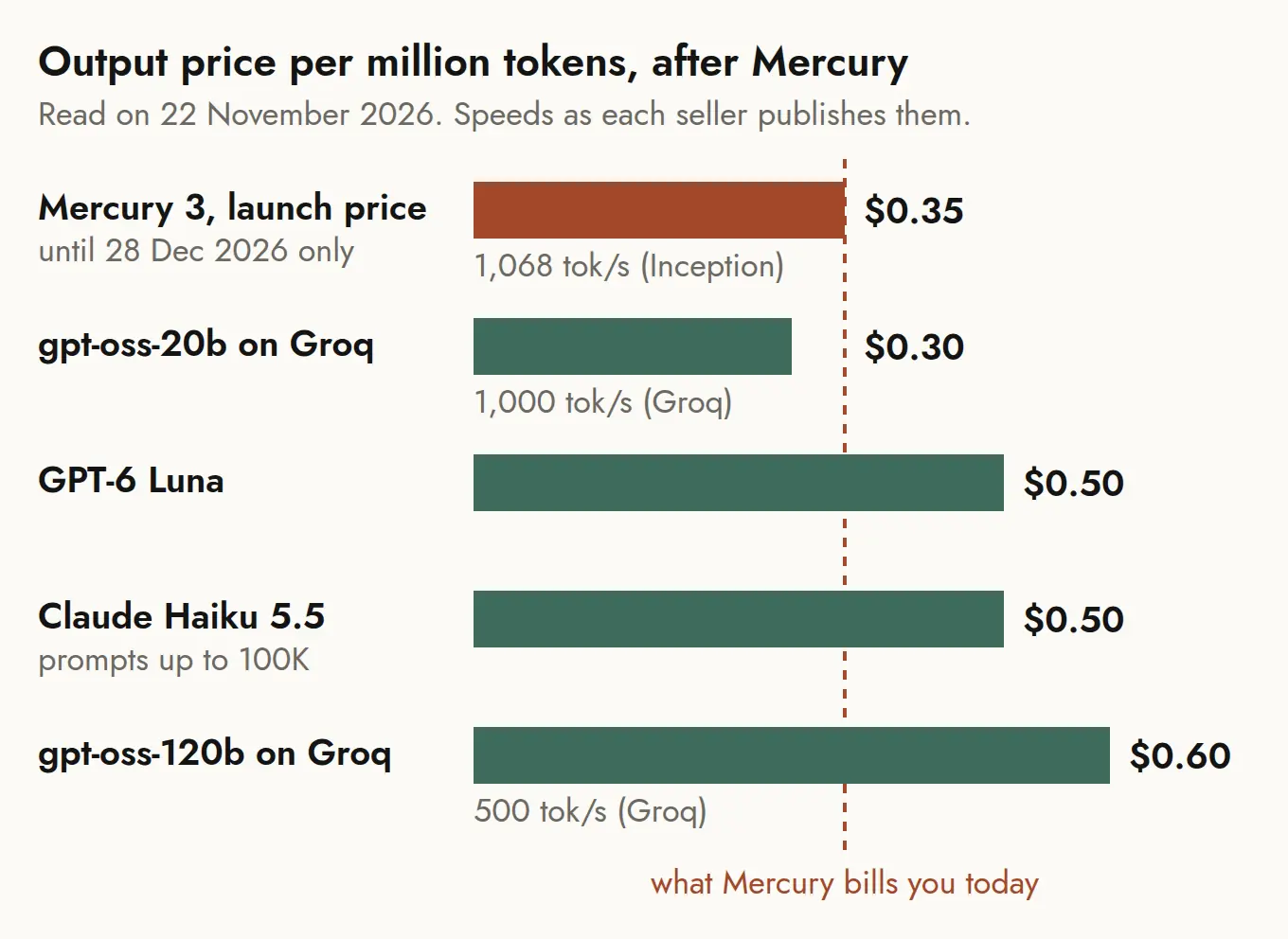
On 22 November 2026, Inception’s models page still shows Mercury 3 at its 50% launch price: $0.10 input, $0.01 cached and $0.35 output per million tokens. That is the rate you are leaving, and only one of the replacements beats it on output.
Per-token rates side by side
Every rate below was read on the provider’s own page on 22 November 2026:
| Model | Input / output per 1M tokens |
|---|---|
| Mercury 3, launch price (ends with the API) | $0.10 / $0.35 |
| GPT-6 Luna | $0.10 / $0.50 |
| Claude Haiku 5.5, prompts up to 100K | $0.10 / $0.50 |
| gpt-oss-20b on Groq | $0.075 / $0.30 |
| gpt-oss-120b on Groq | $0.15 / $0.60 |
The input side barely moves. Output is where the bill changes, by up to 71% if you land on gpt-oss-120b. For the Mercury 3 rates in more detail, list price included, see my Mercury 3 pricing page.
The same monthly workload, before and after
I reuse the workload from my Mercury 3 article: a support assistant sending 100 million input tokens and receiving 20 million output tokens a month, with no prompt caching. The totals are straight multiplications of the rates above:
- Mercury 3 at launch price, today: $10.00 input plus $7.00 output, so $17.00.
- gpt-oss-20b on Groq: $7.50 plus $6.00, so $13.50.
- GPT-6 Luna: $10.00 plus $10.00, so $20.00.
- Claude Haiku 5.5: $10.00 plus $10.00, so $20.00.
- gpt-oss-120b on Groq: $15.00 plus $12.00, so $27.00.
Moving to Luna or Haiku costs you $3 a month on this workload, 18% more. That is a small price for a provider with no shutdown date, and it is the move I would make unless latency is the whole product.
On 100 million input and 20 million output tokens a month, Mercury 3 at its launch price costs $17.00; GPT-6 Luna and Claude Haiku 5.5 cost $20.00, and gpt-oss-20b on Groq costs $13.50.
How to migrate without breaking requests
Mercury used an OpenAI-compatible API, so most of the work is configuration. The traps are in the parameters Mercury accepted quietly.
Change the base URL and the model name
Mercury requests went to https://api.inceptionlabs.ai/v1 with a model such as mercury-3. For Luna, point the same client at OpenAI and set the model to gpt-6-luna. For Groq, the base URL is https://api.groq.com/openai/v1 and the models are openai/gpt-oss-20b and openai/gpt-oss-120b.
Claude Haiku 5.5 goes through Anthropic’s own Messages API, which is a bigger rewrite.
Check the parameters Mercury tolerated
Inception’s FAQ says Mercury clamped temperature to the 0.5 to 1.0 range and silently reset anything outside it. If your code sent 0 or 0.2 for deterministic output, Mercury never honoured it, and your replacement will: rerun your evaluations, because answers may change.
Tool calling needs a second look on Luna. OpenAI’s model page says Chat Completions supports function calling on GPT-6 Luna only with reasoning_effort set to none; for tools with reasoning, you need the Responses API. Mercury agents that called tools through chat completions will fail on tool calls if you miss this.
Run both in parallel before the date
Send a slice of real traffic to the replacement now, while Mercury still answers, and compare outputs and latency side by side. Your exported request logs make a ready-made test set. Switch the default only once your own numbers look right, and do it well before 28 December, not on the day.
Frequently asked questions
Will Mercury keep working until 28 December 2026?
Inception’s wind-down page says the API and the dashboard keep working as they do today through 28 December 2026. Access through OpenRouter has already gone, so that promise covers the direct API only.
Can I still get my data after the cutoff?
No. The page says you lose access to the platform and to any data submitted to it after 28 December 2026. Export request logs, billing history and invoices before then.
Is there another diffusion LLM I can switch to?
Not one I can find on a public price list today. The replacements above are conventional autoregressive models, and gpt-oss-20b on Groq is the one that comes closest to Mercury’s speed.