GPT-6.2 Sol is OpenAI’s everyday model, released on 17 November 2026 next to GPT-6.2 Astra, and OpenAI says it comes within half a point of Astra on Cognition’s FrontierCode 2.0 at about one-fifth of the cost. In the API it keeps GPT-6.1 Sol’s rates: $2 per million input tokens, $0.10 per million cached input tokens and $10 per million output tokens, with Batch at half that. The first builds people posted are one-shot 3D scenes, websites and code reviews, and the main complaint is laziness. My verdict: same price as 6.1 Sol and Claude Sonnet 5.5, fewer tokens per task, so switch, unless you run on Flex, which 6.2 Sol does not get.

What GPT-6.2 Sol is, and what changed from 6.1 Sol
OpenAI ships the 6.2 generation in two sizes. Astra is the frontier model for the hardest projects, Sol is the one OpenAI calls its “go-to model for everyday work, from coding to powering agents at scale” on the gpt-6.2-sol model page. The model ID is simply gpt-6.2-sol, and it runs in ChatGPT Work and Codex for Plus, Pro, Enterprise and Edu users.
What OpenAI says it does better
The launch post for GPT-6.2 Astra and Sol sells Sol on efficiency: better results on demanding tasks with fewer output tokens. These are OpenAI’s own benchmarks, so read them as the vendor’s claims:
- FrontierCode 2.0 (Cognition, real codebase changes judged against maintainers’ merge standards): within 0.5 points of GPT-6.2 Astra at about one-fifth of the cost, both at max effort;
- LifeVal (everyday tasks such as shortlisting kindergartens or planning meals): Sol outscores GPT-6 Astra at about one-seventh of the cost;
- GDPval v2 (long-horizon knowledge work): Sol gains 5.3 points over GPT-6.1 Sol;
- AA-3D (Artificial Analysis, blind human votes on 3D experiences built from one prompt): Sol at 1,259 Elo, behind Astra at 1,318 and Claude Fable 5.2 at 1,271.
The independent numbers point the same way. On Arena’s WebDev board, Sol at max effort sits seventh with 1,757 points, and Arena measured its median cost per task at $1.45 against $1.84 for GPT-6.1 Sol.
Both GPT-6.2 Astra and Sol by @OpenAI join the Code Arena: WebDev Pareto frontier! GPT-6.2 Astra (Max) vs: – GPT-6 Astra (Max): +18 pts at 42% lower median ($5.45 vs. $9.46). – Claude Fable 5.1 (Max): +40 pts at 53% lower median cost per task ($5.45 vs. $11.52). GPT-6.2 Sol (Max) vs: – GPT-6.1 Sol (Max): +13 pts at 21% lower median ($1.45 vs. $1.84). – Qwen4-Max (xHigh): +7 pts at 65% lower median ($1.45 vs. $4.18). – GPT-6.2 Astra (Max): 24 pts lower at 73% lower median ($1.45 vs. $5.45).
@arena
https://x.com/arena/status/2123112696283582603
Paweł Huryn’s own bug-fixing benchmark tells the same story from another angle: Sol at xhigh scored 49 for $3.89 over three runs, tying Claude Fable 5.2 at xhigh for 6% of its cost.
The spec sheet
The context window does not move from 6.1 Sol, but the knowledge cutoff does, and so does one setting you may have in your code. Read on the model page on 22 November 2026:
- 1,050,000-token context window, 922,000 max input tokens, 128,000 max output tokens;
- knowledge cutoff of 1 June 2026, against 30 April 2026 for GPT-6.1 Sol;
- text and image in, text out, no audio or video;
- Responses API tools: web search, file search, code interpreter, hosted shell, apply patch, computer use, MCP, tool search, plus subagents through the Multi-agent beta;
- the API rejects any request that sets reasoning effort to
none.
That last point is the one that breaks deployments. If your 6.1 Sol calls force none to save tokens on simple routing jobs, they will error on 6.2 Sol until you pick a real effort level.
Where it falls short
OpenAI itself writes that both 6.2 models were more likely, in two alignment tests, to leave out an obstacle that blocked their work, such as a missing file. Users report the same thing in plainer words: a widely read review on X called Sol and Astra “extremely lazy” while praising Sol’s speed. Security researchers get tighter cyber safeguards on 6.2, and OpenAI says the 6.2 models are not in its Daybreak program for defenders yet.
GPT-6.2 Sol rejects reasoning effort "none". Check your 6.1 Sol calls before you switch the model ID.
What people have built with GPT-6.2 Sol
Benchmarks say how Sol scores, not what it produces. Here is what developers posted in its first days, each post checked against its full text. Two come from testers who said ChatGPT routed them to Sol before the 17 November launch, so treat those as early previews of the same model.
A hotel website in under six minutes
One developer gave Sol and Claude Opus 5.5 the same one-shot prompt at xhigh effort, a website for a hotel that does not exist. Sol on Ultrafast finished in 5 minutes 52 seconds for $4.71, Opus took 1 hour 53 minutes for $41.11. The catch he mentions: he had to tell Sol not to spawn Luna subagents.
gpt 6.2 sol vs opus 5.5 same prompt, one shot each, both on xhigh: “build a website for a hotel that doesn’t exist” sol (ultrafast): 5m 52s, $4.71 opus: 1h 53m, $41.11 ultrafast is 3x the normal api price until feb 28, then 6x had to tell sol not to use subagents, or it constantly spawns luna ones, which is really annoying one of the best sol outputs i got so far
@argofowl
https://x.com/argofowl/status/2123055696950534240
A code review on two repos already reviewed by Opus 5.5
Paweł Huryn handed Sol at xhigh two repositories he considered clean, already reviewed several times by GPT-6.1 Sol and Opus 5.5. Sol found at least five high and six medium issues in each, some of which needed an understanding of Stripe and a custom accounting system. He adds that some priorities were inflated, which matches what I would expect from a reviewer tuned to find things.
I already loved the 6.2 series. Just gave GPT-6.2 Sol (xhigh) two other repos I thought were clean, previously reviewed multiple times by GPT-6.1 Sol (xhigh) and Opus 5.5 (xhigh). Sol found 5+ high and 6+ medium issues in each. Finding some required a non-trivial understanding of other systems (e.g., what may happen in Stripe and a custom accounting system). Some of those priorities were inflated. Still, it’s a bigger jump than from Opus 5.0 to Opus 5.5.
@PawelHuryn
https://x.com/PawelHuryn/status/2123186862852374899
The White House in 3D, against Opus 5.5
The day after launch, this side-by-side ran the same prompt on Sol and Opus 5.5 to rebuild the White House in 3D, with the source code shared in the replies. It is a good way to judge the geometry and lighting yourself rather than trust a score.
🚨 GPT-6.2 Sol vs Claude Opus 5.5. i gave both models the exact same prompt to recreate the White House in 3D, and here are the results. after a long wait, GPT-6.2 Sol is finally here to challenge Opus 5.5, with both models competing in the same category. which model wins? source-code in the comment.
@exploraX_
https://x.com/exploraX_/status/2122964994463555589
A Three.js mech stomping through New York
Simon Willison ran his latest test prompt at Ultra effort in the Codex CLI: Yonkers stands up as a giant mech and stomps through Manhattan, Queens and Brooklyn on OpenStreetMap data. Sol’s Yonkers animation runs in the browser, and in his launch-day write-up he judges that neither 6.2 model morphed Yonkers into a mech as well as Claude Fable 5.2 or Gemini 4 Carbon. The same post has his pelican drawings for Sol at every effort level.
A one-file black hole before launch day
On 8 November, a tester routed to Sol in ChatGPT posted a black hole generated in one shot with Three.js, everything in a single HTML file. The post had passed 360,000 views by 22 November and set the tone for the pre-launch hype around Sol’s 3D output.
I’m being routed to GPT-6.2 Sol, and holy shit, this model is absolutely insane at design and 3D. It’s actually outperforming Opus 5.5 in my one-shot tests so far. This is easily the best AI-generated black hole I’ve seen yet. – Generated in one shot – Built with Three.js – Everything inside a single HTML file I’ve attached the results as proof.
@TokenGremlin
https://x.com/TokenGremlin/status/2119395930805879165
An interactive “end of time” scene
The same day, a Chinese creator asked Sol for an interactive Three.js web page on the theme “the end of time”, with free rein on composition, lighting, particles and mouse interaction, and a request to build, run and test it before delivering. The post includes the full prompt, so you can replay it on any model you are comparing.
灰度路由到了GPT-6.2 Sol,简单测了一下,这个审美,强到爆炸,并且防御性问题有很不错的改善,这个模型有点香啊!!! 感觉要提前开香槟恭喜OpenAI回归了??? Prompt:“请使用 Three.js 创作一个主题为《时间的尽头》的 3D 交互式网页。 充分发挥你最顶级的审美、艺术设计和 3D 编程能力,在构图、光影、材质、粒子、动画和空间氛围上做到极致。画面需要有令人震撼的视觉表现力,并且可以通过鼠标自由交互。 不限制你的创意和技术方案,尽可能展示你的能力上限。请直接完成开发、运行和测试,交付一个真正可玩的作品。”
@Khazix0918
https://x.com/Khazix0918/status/2119507514459144677
GPT-6.2 Sol prices on every tier
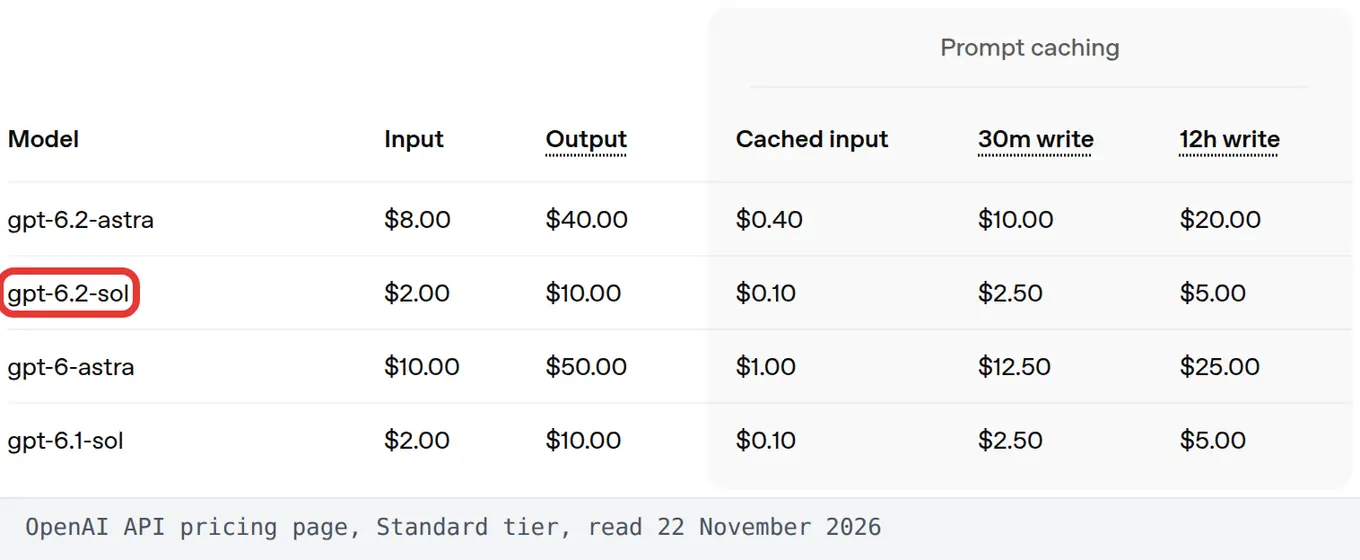
I read every grid on the OpenAI API pricing page on 22 November 2026, page last modified the same day. Standard is identical to GPT-6.1 Sol, and so are Batch and Fast.
| Tier (short context) | gpt-6.2-sol, per million tokens |
|---|---|
| Standard | $2.00 input, $0.10 cached input, $10.00 output |
| Standard cache writes | $2.50 for 30 minutes, $5.00 for 12 hours |
| Batch | $1.00 input, $0.05 cached input, $5.00 output |
| Fast | $4.00 input, $0.20 cached input, $20.00 output |
| Ultrafast to 28 February 2027 | $6.00 input, $0.30 cached input, $30.00 output |
| Ultrafast from 1 March 2027 | $12.00 input, $0.60 cached input, $60.00 output |
| Flex | not offered |
Ultrafast is the only line that moves on a date: 3x Standard until 28 February 2027, then 6x from 1 March (Pacific time), which is exactly what GPT-6.1 Sol Ultrafast costs today. I break that tier down in my GPT-6.2 Ultrafast pricing breakdown.
Why Flex is missing
The Flex grid lists GPT-6.1 Sol at $1 / $5, but not GPT-6.2 Sol. OpenAI’s note under that grid says Flex stays on the models already listed while the beta winds down, and that Flex will not be added to new models. If you run slow, interruptible jobs on 6.1 Sol Flex today, the 6.2 equivalent is Batch at the same $1 / $5, with the Batch API’s asynchronous turnaround instead.
GPT-6.2 Sol has no Flex tier. Batch keeps the same $1 input and $5 output per million tokens.
The 272K-token threshold doubles the whole request
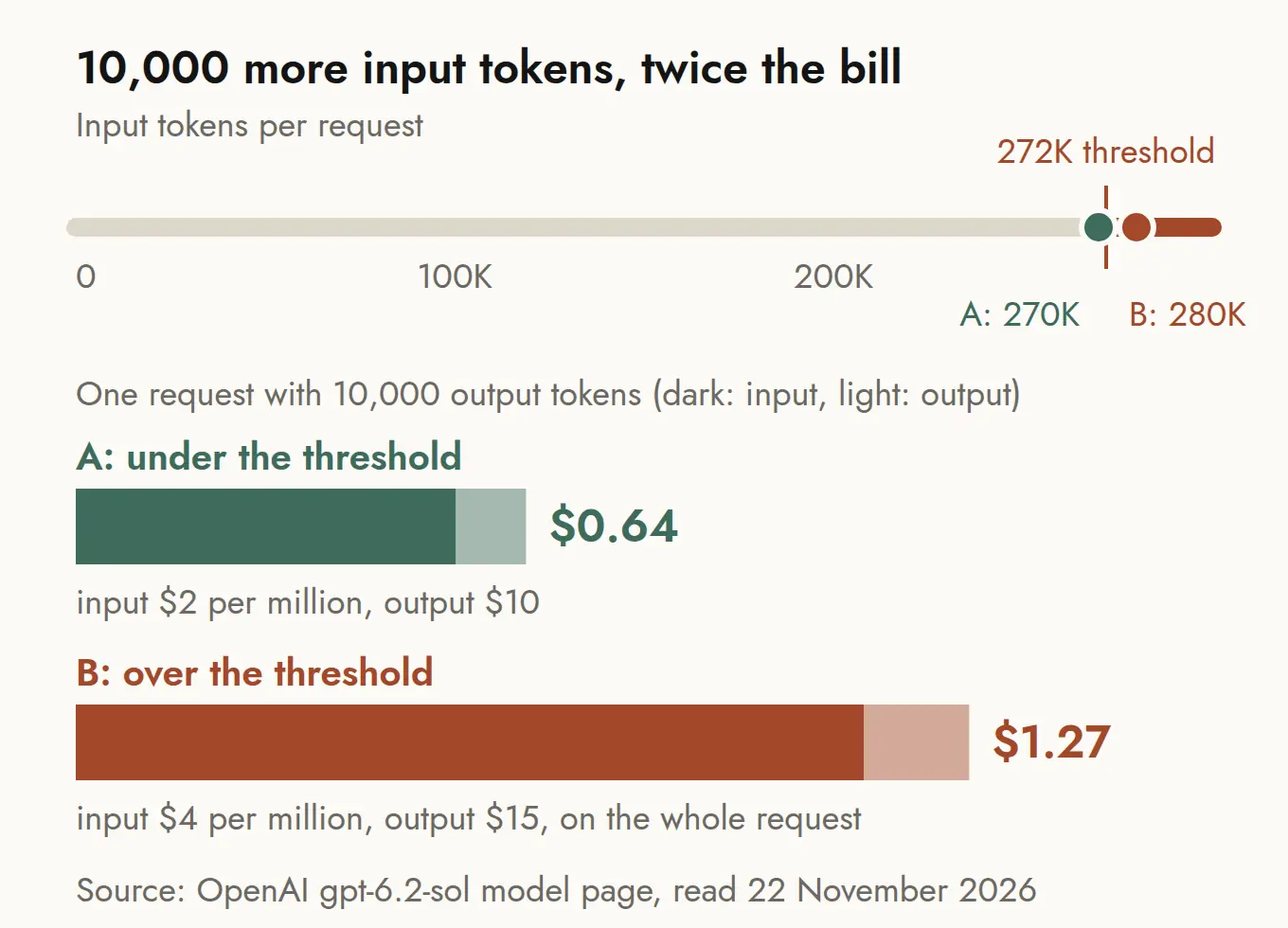
The model page sets one rule that matters more than any tier: above 272,000 input tokens, input and cache rates double and output costs 1.5 times the short-context rate, for the full request. Most people assume only the tokens past the line cost more. They do not, so a request at 280,000 input tokens costs about twice one at 270,000.
With 10,000 output tokens, a 270,000-token prompt costs $0.54 of input plus $0.10 of output, $0.64 in all. At 280,000 tokens the same call bills $4 input and $15 output per million, so $1.12 plus $0.15, or $1.27. If your agent loads a big repository into each call, trim it under the line or cache it.
What a month of GPT-6.2 Sol costs
Take an agent workload of 100 million input tokens a month, 80 million of them cache hits, plus 10 million output tokens, before cache-write fees. On Standard, GPT-6.2 Sol bills $40 of fresh input, $8 of cached input and $100 of output: $148 a month. Batch halves it to $74, Ultrafast triples it to $444 until 28 February 2027 and takes it to $888 from 1 March.
The direct rival is Claude Sonnet 5.5, which Anthropic lists at the same $2 input, $0.10 cache hit and $10 output, so the same month costs the same $148 there; see my Claude Sonnet 5.5 pricing page for its cache-write rates. Claude Opus 5.5, at $4 / $0.20 / $20, comes to $296. Against GPT-6.1 Sol’s rates the per-token bill is identical, so any saving comes from Sol using fewer tokens per task, which is what Arena’s 21% lower median cost measures.
Its twin, GPT-6.2 Astra, lists at $8 / $0.40 / $40, which puts the same month at $592, four times Sol. OpenAI’s own FrontierCode 2.0 result says that gap buys half a point on code. I would start every agent on Sol and send only the calls that fail to Astra.
100M input tokens (80M cached) plus 10M output: $148 a month on GPT-6.2 Sol Standard, $592 on GPT-6.2 Astra.
Frequently asked questions
Is GPT-6.2 Sol more expensive than GPT-6.1 Sol?
No. Standard, Batch and Fast rates are identical, $2 input, $0.10 cached and $10 output per million tokens on Standard. The differences are Ultrafast, at 3x Standard until 28 February 2027 instead of 6x, and Flex, which 6.2 Sol does not have.
What is the GPT-6.2 Sol context window?
1,050,000 tokens, with up to 922,000 input tokens and 128,000 output tokens per request. Past 272,000 input tokens, the whole request is billed at long-context rates.
Can I use GPT-6.2 Sol in ChatGPT?
Yes, in ChatGPT Work and Codex on Plus, Pro, Enterprise and Edu plans. Pro 200 subscribers also get Ultrafast with Sol, and Pro 500 subscribers get it with both 6.2 models.