Claude Ultra’s $200 a month in API credits buys exactly what $200 paid at the counter buys, at list price, and the balance expires at the end of each billing cycle. On the standard tier that is 4 million output tokens on Fable 5.1 (5 million on Fable 5.2, listed at $40 on 9 November 2026), 10 million on Opus 5.5, 20 million on Sonnet 5.5 and 400 million on Haiku 5.5 for short prompts, from the Anthropic grid read on 1 November 2026. The credit covers the Messages API, Batch, Managed Agents and the Agent SDK, not interactive Claude Code, so the real question is which API workload fits inside it.

I have spent the weekend reading the two support pages Anthropic published with the rename and redoing the arithmetic against the public grid. The press got the headline right and stopped there. Nobody priced the credit in tokens, which is the only number a developer paying $200 a month actually needs.
The $200 credit is prepaid API balance, not a discount
Anthropic does not sell the credit as a rebate, and I will not either. It is a $200 balance dropped into one Claude Console organization each billing cycle, spent at the same per-token prices everyone pays. There is no multiplier, no bonus tier and no cheaper rate hiding behind it.
What changed on 30 October and what did not
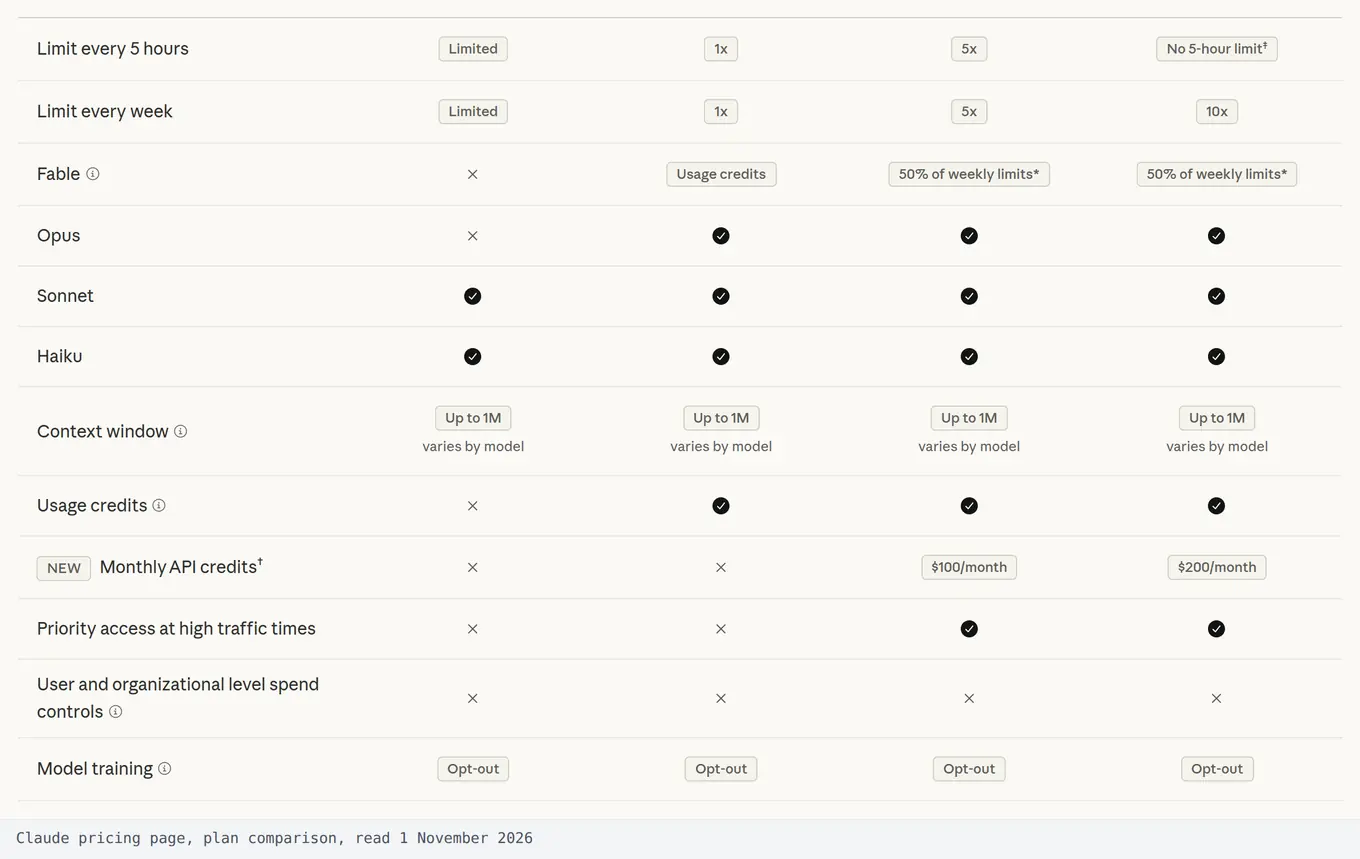
On 30 October 2026 Anthropic renamed its two Max tiers. Max 5x is now simply Max, Max 20x is now Ultra, and the Ultra plan page, read on 1 November 2026, says existing Max 20x subscribers moved over automatically with no price change. Max stays at $100 a month and Ultra at $200 a month, monthly billing only.
Two things moved with the name. Ultra lost its five-hour limit for verified accounts, and the monthly API credit went from $100 on Max to $200 on Ultra. The weekly limit did not move at all, Ultra still gets 10x the Pro weekly usage, with a separate weekly cap for Fable at half of it.
The official announcement from the Claude account states the rename and the five-hour change in two lines, which is why I quote it rather than a press rewrite.
We’re renaming our Max plans:
Max 5x → Max
Max 20x → Ultra
Max is still $100/month, and Ultra is still $200. If you’re a subscriber, there’s nothing you need to do.
We’re also removing the 5-hour limit for verified Ultra accounts, starting today with most existing https://t.co/9QR5ASBbeb@claudeai
https://x.com/claudeai/status/2116220869479428500
Verification is automatic and based on account and payment history. The support page is explicit that adding a phone number at checkout does not remove the temporary limit, and that the test is in Settings then Usage, where a verified account shows no Current session bar.
Where the credit works and where it does not
The monthly API credits page, read on 1 November 2026, lists what the balance pays for. It covers the Messages API, the Message Batches API, the Console Playground, Claude Managed Agents and the Agent SDK, all inside the one Console organization you link.
It does not cover the things most Ultra subscribers actually touch all day. The same page lists the exclusions, and three of them catch people out.
- Interactive Claude Code in the terminal, the IDE, the desktop app or the web, which runs on your plan limits.
- Extra usage bought inside the Claude apps, Claude Code or Cowork, which is billed separately.
- Anything served through Bedrock, Vertex AI or Foundry, which never sees the credit at all.
One exception is worth knowing. Running Claude Code non-interactively with the print flag does draw on the credit, but only when the process authenticates with an API key from the linked organization, which rules out the normal login from your subscription.
What $200 buys on each Claude model
Every number below comes from the platform pricing page read on 1 November 2026, standard tier, no regional surcharge. I checked it against claude.com/pricing the same morning and the two grids agree to the cent.
Output tokens only, the expensive side of the bill
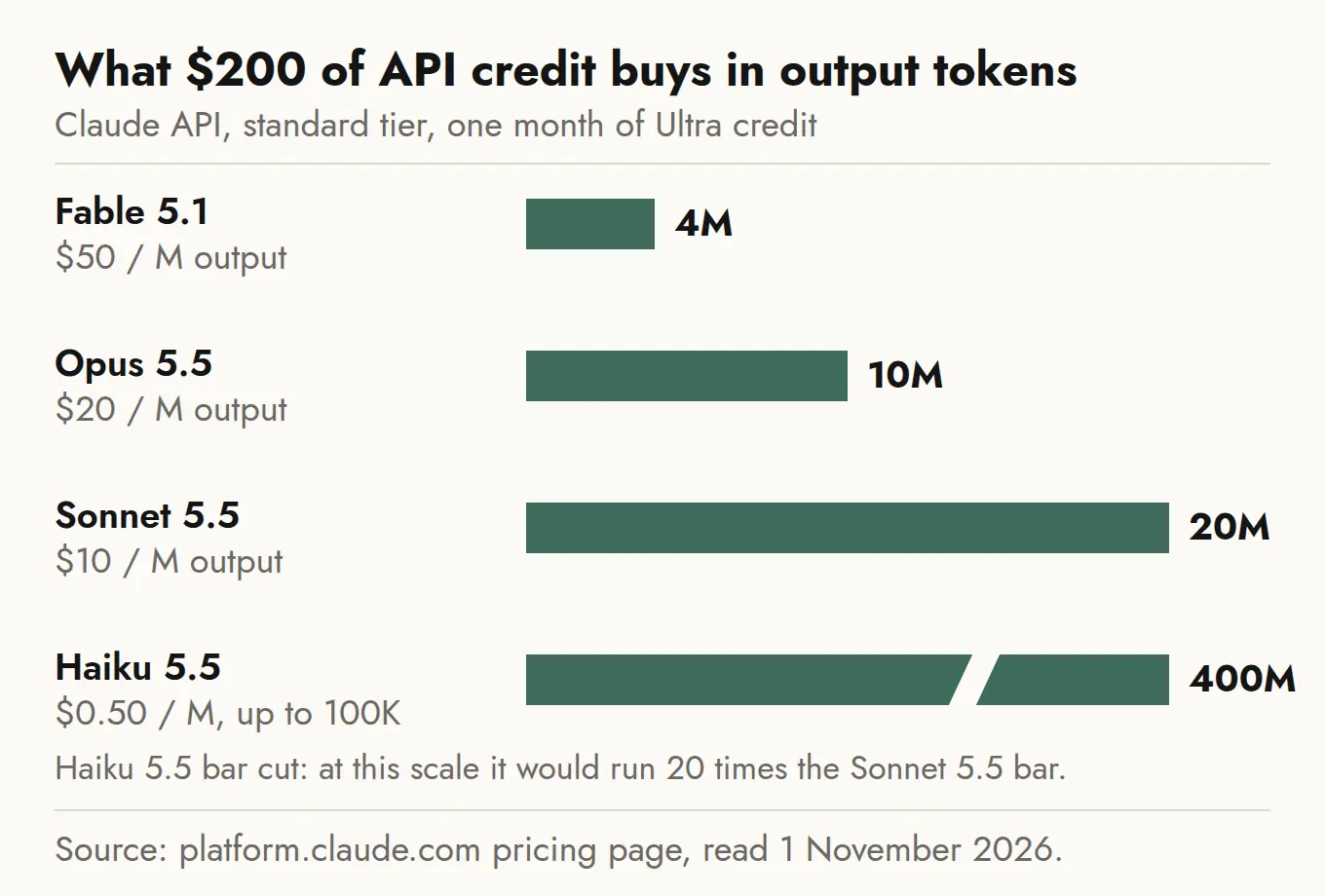
Output is where the money goes, so start there. At $50 per million, Fable 5.1 turns the credit into 4 million output tokens, roughly 3 million English words. Opus 5.5 at $20 gives 10 million, Sonnet 5.5 at $10 gives 20 million, and Haiku 5.5 at $0.50 gives 400 million as long as each prompt stays under 100K tokens.
| Model, standard tier | Output tokens for $200 |
|---|---|
| Fable 5.2 ($40 per million, from 9 November 2026) | 5 million |
| Fable 5.1 ($50 per million) | 4 million |
| Opus 5.5 ($20 per million) | 10 million |
| Sonnet 5.5 ($10 per million) | 20 million |
| Haiku 5.5, prompts up to 100K ($0.50 per million) | 400 million |
| Haiku 5.5, prompts over 100K ($2.50 per million) | 80 million |
On the grid read on 1 November 2026, the same $200 is 4 million output tokens on Fable 5.1 and 400 million on Haiku 5.5 for short prompts. The model choice moves the credit by a factor of 100 before you write a single line of code.
The Haiku split matters more than people think. The price tier is decided per request by the prompt length, and cache reads count toward the 100K threshold, so a long cached system prompt can push an otherwise cheap call into the 5x tier. I covered that trap in the Haiku 5.5 pricing breakdown.
Input tokens and cache reads
Input is five times cheaper than output on every model, so a prompt-heavy workload stretches the credit a long way. $200 of input alone is 20 million tokens on Fable 5.1, 50 million on Opus 5.5, 100 million on Sonnet 5.5 and 2 billion on Haiku 5.5 under 100K.
Cache reads are where the credit becomes almost silly. Fable 5.1 reads cached tokens at $0.25 per million, Opus 5.5 at $0.20, Sonnet 5.5 at $0.10 and Haiku 5.5 at $0.01, so $200 of pure cache reads is 800 million tokens on Fable 5.1, 1 billion on Opus 5.5, 2 billion on Sonnet 5.5 and 20 billion on Haiku 5.5. Writing the cache costs 1.25x the input price for the five-minute window and 2x for the one-hour window, details I keep updated in the Claude API cache pricing guide.
A realistic agent mix, with and without Batch
Nobody buys pure output. A chat product reads about four input tokens for each one it writes, and an agent loop that reuses its context reads far more from the cache than it generates. I priced two mixes against the grid to get numbers you can hold a budget to.
The first mix is 80 percent input and 20 percent output with no caching, the shape of a classic chat or extraction API. The second is an agent loop at 80 percent cache reads, 10 percent cache writes at the five-minute rate and 10 percent output. The table gives the total tokens $200 buys under each.
| Model and mix | Total tokens for $200 |
|---|---|
| Fable 5.2 (from 9 November 2026), chat mix / cached agent mix | 14 million / 39 million |
| Fable 5.1, chat mix / cached agent mix | 11 million / 31 million |
| Opus 5.5, chat mix / cached agent mix | 28 million / 75 million |
| Sonnet 5.5, chat mix / cached agent mix | 56 million / 150 million |
| Haiku 5.5 under 100K, chat mix / cached agent mix | 1.1 billion / 2.8 billion |
Batch doubles every line. The Message Batches API is on the list of covered products and bills at 50 percent of the standard grid, so $200 of Batch work is 8 million Opus 5.5 output tokens instead of 4, or 40 million on Sonnet 5.5, as long as you can wait up to 24 hours for results.
Which API workloads fit inside the credit
With the token counts in hand, the fit question answers itself. The credit is sized for a small production app, not for a pipeline that runs all night.
Small production apps on Sonnet 5.5 and Haiku 5.5
A support bot handling 2,000 conversations a day at around 3,000 blended tokens each burns roughly 180 million tokens a month. On Haiku 5.5 under 100K that is about $32 at the chat mix, comfortably inside the credit with room for a Sonnet 5.5 escalation path. The same bot entirely on Sonnet 5.5 costs about $650 a month at the chat mix, so the credit covers less than a third of it.
Where Sonnet 5.5 fits is lower volume and higher value, the kind of internal tool I priced in the Sonnet 5.5 pricing article. Fifty million blended tokens a month, say 500 long document reviews a day, costs about $180 at the chat mix and fits the credit with change.
Heavy Opus 5.5 or Fable 5.1 pipelines burn it in days
Opus 5.5 at $7.20 per million blended tokens on the chat mix eats $200 in 28 million tokens. A coding agent that reads a 50K-token repository context and writes 5K tokens of patch per task, without caching, spends about $0.30 per task, so the credit is about 650 tasks, two or three busy days for a team. With caching at the agent mix the same task drops to about $0.11 and the credit stretches to around 1,800 tasks, which is why the Opus 5.5 pricing page spends so long on cache design.
Fable 5.1 is in another league. At $18 per million blended tokens on the chat mix, $200 is 11 million tokens, a few hundred serious agentic runs, and the Ultra plan’s own Fable allowance in the chat app is capped at half the weekly limit anyway. Fable 5.2, at $14.40 on the same mix since 9 November 2026, stretches that to 14 million. If Fable 5.1 is your production model, read the Fable 5.1 pricing breakdown and treat the credit as a rounding error on the invoice.
Ultra against Max, the extra $100 question
The comparison most readers are actually making is not Ultra against the API. It is Ultra at $200 against Max at $100, on the same claude.com pricing page read on 1 November 2026.
What the second $100 buys beyond the credit
Max gives 5x Pro usage every five hours and every week, plus $100 a month of API credit. Ultra gives 10x Pro usage every week, no five-hour limit once the account is verified, plus $200 a month of API credit. Both include Fable up to half the weekly limit and priority access at busy times.
So the second $100 buys three things, and only one of them has a dollar value you can check.
- Another $100 of API balance at parity, worth exactly $100 if you spend it and nothing if you do not.
- Double the weekly allowance for chat and Claude Code, 10x Pro instead of 5x.
- No five-hour throttle on a verified account, worth whatever your interrupted afternoons cost you.
When Ultra is free and when it is a $200 chat bill
Here is my verdict, and it is arithmetic rather than opinion. If you already spend $100 a month or more on the Claude API through one organization, the Ultra upgrade over Max costs you nothing, because the extra credit refunds the extra subscription. If you spend $200 a month or more on the API, the whole Ultra subscription is covered and the chat, Claude Code and Cowork allowance comes on top for free.
If you spend nothing on the API, Ultra is a $200 a month chat and Claude Code plan, full stop. The credit sits in a Console organization you may never open and evaporates on your billing date. In that case the honest comparison is Ultra against Max against two Pro seats, not Ultra against the API.
Spend $100 a month on the API and the Ultra upgrade over Max is free. Spend $200 and the whole plan is paid for. Spend $0 and you bought a $200 chat plan with an unused balance attached.
How to claim the credit and spend it before it expires
The mechanics are not automatic. Nothing shows up until you act, and here is the sequence as documented on 1 November 2026.
Linking one Console organization
The credit becomes claimable seven days after you start the plan. You then go to Settings, Billing, API credits in the Claude app and link one Console organization, the one whose API keys will draw on the balance. Anthropic warns that you cannot change the linked organization yourself afterwards, so pick the one where your production spend actually lives.
The balance is shared across everyone in that organization and shows up at the billing page of the Console. Free, Pro and Enterprise plans are not eligible, Team gets $20 per Standard seat and $100 per Premium seat pooled up to $500, and a Max subscriber who upgrades to Ultra mid-cycle gets a prorated top-up before the full $200 kicks in.
Order of consumption, expiry and auto-reload
The plan credit is consumed before any credit you purchased, which protects your paid balance but also means the free one disappears first. It refreshes each billing cycle and does not roll over, so an unspent $150 on day 30 is simply gone.
When the plan credit runs out, requests stop unless the organization holds purchased credits or has auto-reload switched on. For a production key that is the setting to check before you link anything, because a quiet failure at 2 a.m. on the 29th is the predictable outcome of relying on a balance that was always going to hit zero.
Frequently asked questions
Is the weekly limit gone on Ultra?
No. The Ultra plan page read on 1 November 2026 states a weekly limit across all models at 10x Pro, plus a separate weekly limit for Fable. Only the five-hour limit was removed, and only for verified accounts, with unverified accounts keeping a temporary one until verification completes.
Do unused API credits roll over?
No. The monthly API credits page says the balance refreshes every billing cycle and does not carry forward. Spend it or lose it, every month.
Can I spend the credits in Claude Code?
Not in the way most people use it. Interactive Claude Code sessions in the terminal, IDE, desktop or web run on the plan’s usage limits. The credit only applies to non-interactive runs authenticated with an API key from the linked organization, and to the Agent SDK.
Is Ultra the same thing as Ultraplan?
No, and the overlap in names is unlucky. Ultra is the subscription tier that replaced Max 20x on 30 October 2026. Ultraplan is a planning mode inside Claude Code and has nothing to do with billing or credits.