Claude Fable 5.1 costs $10 per million input tokens and $50 per million output tokens, with cached input at $0.25 and cache writes at $12.50 for the five-minute window or $20 for the hour, read from the Anthropic pricing page on 5 September 2026. That is the same headline rate as the Fable 5 it succeeds. One line moved, the cache read, and it fell from $1.00 to $0.25.

Mythos 5.1 carries identical rates, but only for organizations Anthropic has verified through one of its access programs, such as the Cyber Verification Program. Anthropic positions Fable 5.1 for demanding reasoning and long-horizon agentic work, and its model ID is claude-fable-5-1.
What Fable 5.1 costs, line by line
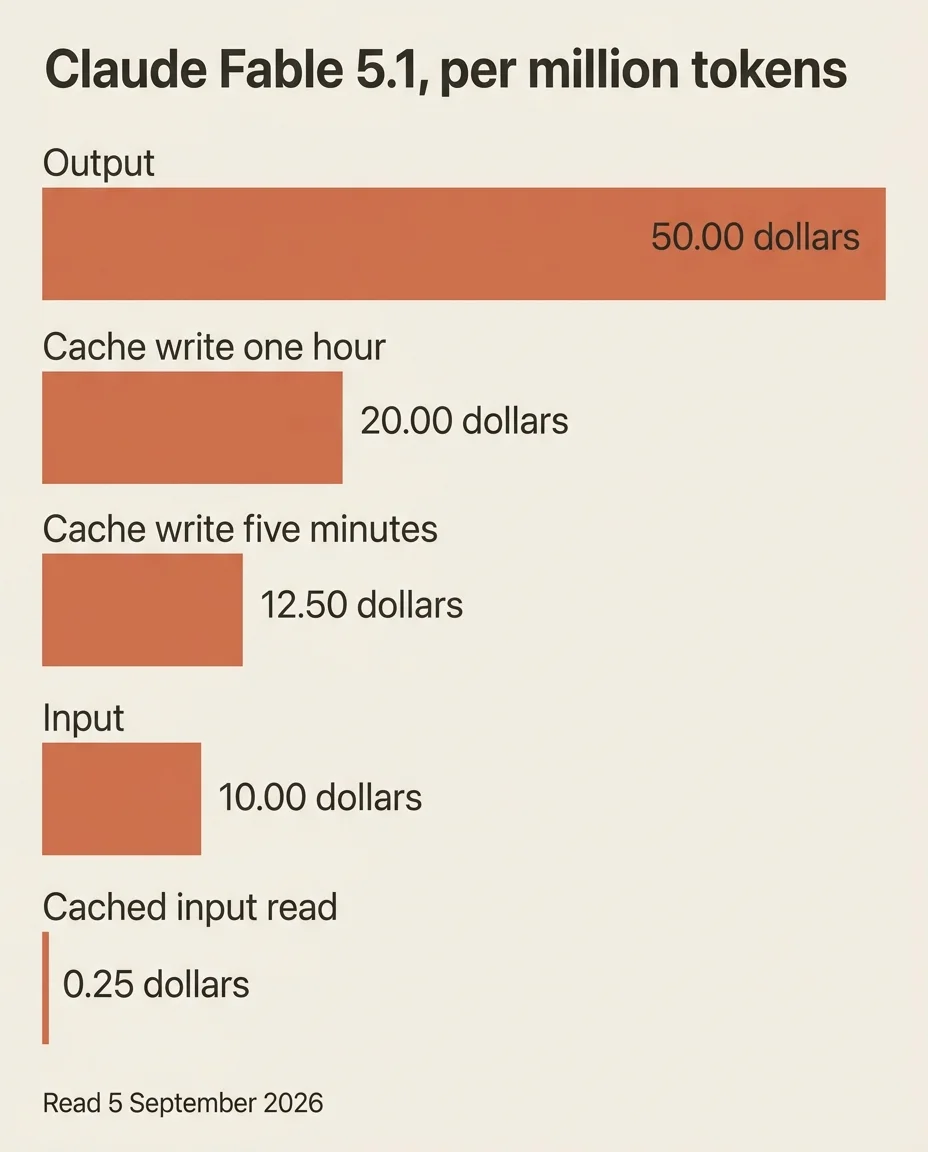
Anthropic bills Claude on five lines rather than two. The two cache write columns are the ones most price summaries leave out, and they decide whether keeping a long prompt alive is cheap or expensive.
| Line | Per million tokens |
|---|---|
| Input | $10.00 |
| Cache write, five minutes | $12.50 |
| Cache write, one hour | $20.00 |
| Cached input, read | $0.25 |
| Output | $50.00 |
Output costs five times input, which is the ratio Anthropic applies across its whole line. Your bill is therefore driven by how much the model writes, not by how much you send it, and that stays true at every tier.
The one line that separates 5.1 from Fable 5
Put the two grids side by side and only one cell differs. Input, output and both cache write columns are identical, so a workload that never reuses a prompt pays exactly what it paid before.
Every million tokens you read from cache costs $0.75 less on Fable 5.1 than on Fable 5. Nothing else about the two grids differs.
Why a fortieth instead of a tenth
Across the Claude range the cache columns are fixed multiples of the input price: 1.25x to write a five-minute entry, 2x to write a one-hour entry, and 0.1x to read either. Fable 5.1 and Mythos 5.1 break the read multiplier at 0.025x. On a $10 input price that is $0.25 rather than $1.00. Since our 5 September 2026 reading they are no longer the only exception: the Anthropic pricing page, re-read on 24 October 2026, lists Claude Opus 5.5 and Claude Sonnet 5.5 with cache reads at 0.05x, which is $0.20 on a $4.00 input for Opus 5.5 and $0.10 on a $2.00 input for Sonnet 5.5.
The write multipliers did not move, so the arithmetic of when caching pays is unchanged. A five-minute entry still repays itself on the first read, and a one-hour entry on the second. What changed is how much it pays after that, compared to the Opus 5.5 cache read.
What the cheaper read is worth per million
The saving is mechanical rather than proportional to your bill. Each million tokens served from cache costs $0.25 instead of $1.00, so you keep $0.75 per million read, whatever your output volume looks like.
That points at a specific shape of workload:
- A support assistant resending the same system prompt on every call.
- An agent that keeps a large tool schema and a document in context across a long run.
- A retrieval product that pins the same corpus for a session.
Workloads that read little from cache gain almost nothing. On a month with no caching at all, Fable 5.1 and Fable 5 cost the same to the cent.
Where Fable 5.1 sits on the Claude ladder
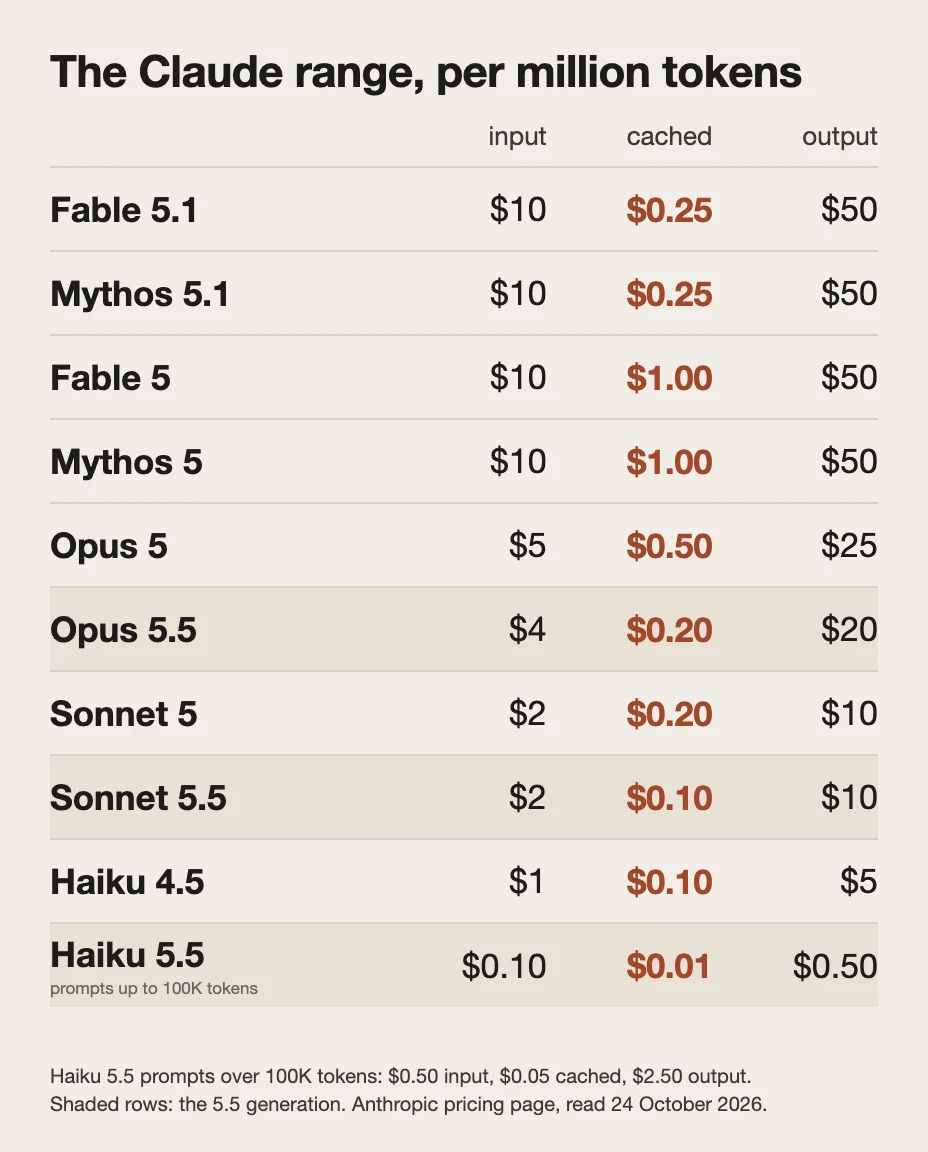
Fable 5.1 no longer sits at the top of the Claude ladder. Since 9 November 2026 Anthropic lists Claude Fable 5.2 and Claude Mythos 5.2 at $8 and $40, a fifth below the four models that still share the $10 and $50 headline price, where the cache column is what separates the point releases from the models they replaced. The grid below was re-read on the Anthropic pricing page on 10 November 2026.
| Model | Input / cached / output, per million |
|---|---|
| Claude Fable 5.2 | $8.00 / $0.20 / $40.00 |
| Claude Mythos 5.2, limited availability | $8.00 / $0.20 / $40.00 |
| Claude Fable 5.1 | $10.00 / $0.25 / $50.00 |
| Claude Mythos 5.1, limited availability | $10.00 / $0.25 / $50.00 |
| Claude Fable 5 | $10.00 / $1.00 / $50.00 |
| Claude Mythos 5, limited availability | $10.00 / $1.00 / $50.00 |
| Claude Opus 5 | $5.00 / $0.50 / $25.00 |
| Claude Opus 5.5 | $4.00 / $0.20 / $20.00 |
| Claude Sonnet 5 | $2.00 / $0.20 / $10.00 |
| Claude Sonnet 5.5 | $2.00 / $0.10 / $10.00 |
| Claude Haiku 4.5 | $1.00 / $0.10 / $5.00 |
| Claude Haiku 5.5, prompts up to 100K tokens | $0.10 / $0.01 / $0.50 |
| Claude Haiku 5.5, prompts over 100K tokens | $0.50 / $0.05 / $2.50 |
Sonnet 5.5 keeps the Sonnet 5 headline rate and halves its cache read. Haiku 5.5 is priced by prompt length: a request whose prompt runs over 100,000 tokens, cache reads and writes included, pays the higher line in full.
Fable 5.1 is exactly twice Claude Opus 5 on input and output, and five times Claude Sonnet 5. Anthropic now lists Claude Fable 5 among its legacy models, still available and still sold at the same headline rate.
What a month actually costs
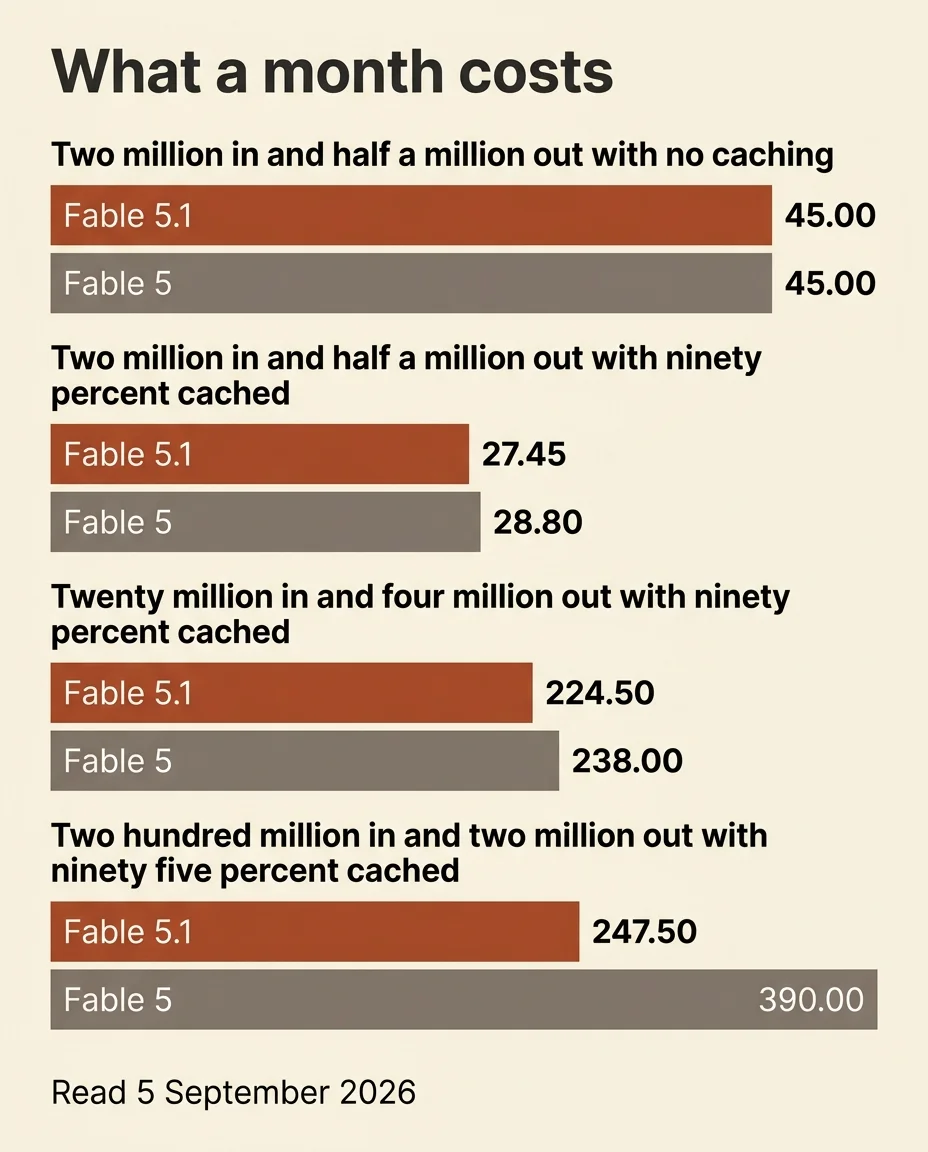
Rates per million are hard to feel. Four shapes, all priced on the 5 September 2026 grid, make the difference tangible.
| Monthly shape | Fable 5.1 / Fable 5 |
|---|---|
| 2M in, 0.5M out, no caching | $45.00 / $45.00 |
| 2M in, 0.5M out, 90 percent cached | $27.45 / $28.80 |
| 20M in, 4M out, 90 percent cached | $224.50 / $238.00 |
| 200M in, 2M out, 95 percent cached | $247.50 / $390.00 |
The last row is the one worth staring at. A workload dominated by a repeated context pays 37 percent less on 5.1, and it gets there without changing a single line of your code beyond the model ID.
When Fable 5.1 is the right tier
At $50 per million output tokens Fable 5.1 now costs more than its successor, so the question is no longer only whether the work justifies a Fable tier. Unless a pipeline is pinned to the claude-fable-5-1 model ID, the cheaper Fable 5.2 grid does the same job 20 percent below it on every line.
Three readings help:
- If your bill is mostly output, the cache line barely helps and the tier choice is the whole decision.
- If your bill is mostly repeated input, 5.1 is meaningfully cheaper than 5 and the tier premium is easier to carry.
- If the task fits a tier below, Opus 5.5 is the cheaper step down at $4.00 input and $20.00 output, with a cache read at $0.20, re-read on 6 October 2026. Opus 5 halves every line and its cache read is $0.50.
We work through what the extra cache columns change across the whole Claude range on our Claude API pricing page, cache included.
How you buy it changes the price
Everything above is the rate at the Claude API. Two levers move it, and they stack, though you may also benefit from $200 of monthly API credit if you’re enrolled in certain programs.
The Batch API takes fifty percent off input and output alike, putting Fable 5.1 at $5.00 and $25.00 per million, which is the standard Opus 5 grid for a Fable 5.1 answer. The trade is that batch work is asynchronous, so it only fits jobs nobody is waiting on. Prompt caching then applies on top of that.
Fast mode does not apply here. The Anthropic pricing page, re-read on 24 October 2026, lists it for Claude Opus 5.5 at $8 and $40 per million, for Claude Fable 5.2 and Mythos 5.2 at $16 and $80 (read on 10 November 2026), and for Claude Opus 5 and Opus 4.8, still in research preview, at $10 and $50 (Anthropic retires the Opus 4.8 option on 30 November 2026). That last pair happens to be the standard Fable 5.1 grid, so at that budget you are choosing between a different model and a faster one, and a fast Opus 5.5 comes in just under it. An Enterprise seat does not change the token rate either, which we detail on our Claude Enterprise pricing page.
Frequently asked questions
How much does Claude Fable 5.1 cost per million tokens?
$10.00 for input and $50.00 for output, with cached input at $0.25 and cache writes at $12.50 for five minutes or $20.00 for an hour. Read from the Anthropic pricing page on 5 September 2026.
Is Fable 5.1 more expensive than Fable 5?
No, and on any workload that uses caching it is cheaper. The two models share input, output and both cache write columns; the cache read is $0.25 on 5.1 against $1.00 on Fable 5.
What is the difference between Fable 5.1 and Mythos 5.1 on price?
None. Mythos 5.1 carries identical rates, so what separates them is access. Fable 5.1 is generally available, while Mythos 5.1 is reserved for organizations verified through Anthropic’s programs. Since 6 October 2026 the Cyber Verification Program grants it at three tiers, Defense, Red Team and Specialized Access, and the Life Sciences Verification Program covers it for biology work.
What is the cheapest way to run Fable 5.1?
The Batch API, at $5.00 input and $25.00 output, a flat fifty percent off, stacked with prompt caching at a fortieth of fresh input. The cost is that batch requests are asynchronous.
Does fast mode apply to Fable 5.1?
No. Fast mode covers Claude Fable 5.2 and Mythos 5.2, at $16 input and $80 output per million, Claude Opus 5.5, at $8 input and $40 output, and Claude Opus 5 and Claude Opus 4.8, in research preview, at $10 and $50, until Anthropic retires the Opus 4.8 option on 30 November 2026.
What we verified and what we did not
Verified: all five billing lines for Fable 5.1 and Mythos 5.1, the same five lines for Fable 5, Mythos 5, Opus 5, Sonnet 5 and Haiku 4.5, the fifty percent Batch API discount, the cache multipliers and the footnote stating that cache reads are 0.025x on Fable 5.1 and Mythos 5.1 against 0.1x elsewhere, the model ID claude-fable-5-1, the 1M token context window and 128K maximum output, and the retirement commitment of not sooner than 1 September 2027. All read from the Anthropic pricing page and models overview on 5 September 2026. Re-read on 10 November 2026: the Fable 5.2 and Mythos 5.2 rows, standard and fast mode. Re-read on 24 October 2026: the Claude ladder, which now includes Opus 5.5, Sonnet 5.5 and Haiku 5.5 with its two prompt-length tiers, the fast mode grid, which now includes Opus 5.5 (with the Opus 4.8 fast mode retirement read in the release notes on 3 November 2026), and the access rule for Mythos 5.1, which Anthropic has spelled out since 6 October 2026: only organizations verified through one of its programs, such as the Cyber Verification Program, can use it.
Not verified, and therefore not asserted: any benchmark or quality claim, since this page prices a model rather than ranking it; and the rates on Amazon Bedrock and Google Cloud, which set their own grids and their own lifecycle dates.
Prices in this category move. Everything here carries the date it was read, and the grid is worth checking again before you commit a budget to it.