Groq Cloud bills per million tokens like everyone else, and on those numbers it is cheap rather than premium: gpt-oss-20b runs at $0.075 input and $0.30 output and gpt-oss-120b at $0.15 and $0.60, re-read from Groq’s own model documentation on 6 October 2026. The two Llama models that sat beside them, llama-3.1-8b-instant and llama-3.3-70b-versatile, are now listed as enterprise models priced through a sales contact, with no public rate. What Groq actually sells is throughput, up to 1,000 tokens per second on gpt-oss-20b, and no price per token can express that.

The comparison that makes the offer legible is the cost per second of latency removed on the same task.

What Groq Cloud charges per million tokens
Groq publishes a single grid covering price, token speed, rate limits and context window in the same table, which is unusual and genuinely useful. Below is that grid, restricted to the models Groq labels production ready, as it stood on 15 August 2026 and as we re-read it on 6 October 2026.
The production grid, read on 15 August and 6 October 2026
| Model | Model ID | Speed | Input | Output |
|---|---|---|---|---|
| GPT OSS 20B | openai/gpt-oss-20b | 1,000 t/s | $0.075 | $0.30 |
| GPT OSS 120B | openai/gpt-oss-120b | 500 t/s | $0.15 | $0.60 |
| Llama 3.1 8B | llama-3.1-8b-instant | 560 t/s | Contact Sales | Contact Sales |
| Llama 3.3 70B | llama-3.3-70b-versatile | 280 t/s | Contact Sales | Contact Sales |
Groq no longer publishes a public pricing page
The two Llama rows carried public prices on 15 August 2026, $0.05 input and $0.08 output on Llama 3.1 8B, $0.59 and $0.79 on Llama 3.3 70B. On 6 October 2026 Groq labels both Enterprise and prints Contact Sales in the price column, and their speeds are unchanged, a reading confirmed on 13 October 2026. Groq’s deprecation page dates the end of their self-serve availability to 16 August 2026 and points developers to replacements for Groq’s Llama models, specifically gpt-oss-20b and gpt-oss-120b.
One figure deserves attention. gpt-oss-20b is both the fastest model on the platform and, now that the Llama models have left the public grid, the cheapest production model with a published price, which breaks the usual assumption that speed is a paid upgrade. Its output costs four times its input, where the frontier providers charge five or six times more for output than for input.

Alongside the production tier, Groq lists preview models that it explicitly tells you not to run in production because they can be withdrawn at short notice. Qwen3.6-27B sat there on 15 August 2026 at $0.60 input and $3.00 output for 500 tokens per second; Groq shut it down on 14 September 2026, and by 6 October 2026 the preview slot had passed to Qwen3.8-27B, at $0.80 input and $4.00 output for 450 tokens per second, and MiniMax M2.7 is still enterprise only with pricing behind a sales contact. Groq Compound, the agentic system that bundled web search and code execution, is gone: Groq announced its deprecation on 24 August 2026 and shut down Compound and Compound Mini on 21 September 2026, with no replacement named on its deprecation page.
Speech models are billed by the hour, not by the token
Transcription and speech synthesis leave the per token logic entirely. Whisper Large V3 is $0.111 per hour of audio and Whisper Large V3 Turbo is $0.04 per hour, both read on 15 August 2026 and unchanged on 6 October 2026. Text to speech goes to a third unit again: the Orpheus voices are priced per million characters, $22.00 for English and $40.00 for Arabic, read on the same date. If you are budgeting a voice product, none of the three units convert into each other and you need three separate lines in your model.
Batch cuts the bill in half
Groq’s Batch API, read on 15 August 2026, applies a flat 50 percent discount against synchronous pricing, with a processing window you set between 24 hours and 7 days, and batch requests do not consume your standard rate limits. One detail matters and Groq states it plainly: the batch discount does not stack with prompt caching. Every batch token is billed at the 50 percent rate whatever its cache status, so a heavily cached workload can be cheaper synchronously than in batch.
Why price per token is the wrong lens on Groq
Rank Groq on price per million tokens alone and you reach a conclusion that is true but useless: it is inexpensive. That ranking puts it next to the cheap tier of every other provider and tells you nothing about why anyone would choose it, because the models on the grid are open weight models that several providers serve. The differentiator is not the number in the price column, it is the number in the speed column next to it.
This is also where the comparison against the frontier tier becomes dishonest if you are not careful. Setting gpt-oss-20b at $0.30 output against a closed frontier model at $75.00 output is a comparison of model classes, not a comparison of vendors. Our full pricing comparison across every major model carries the frontier grid, and the honest way to read it next to this page is that Groq competes on the open weight rung of that ladder, at a speed nobody else on that rung matches.
Cost per second saved, the comparison that makes the premium legible
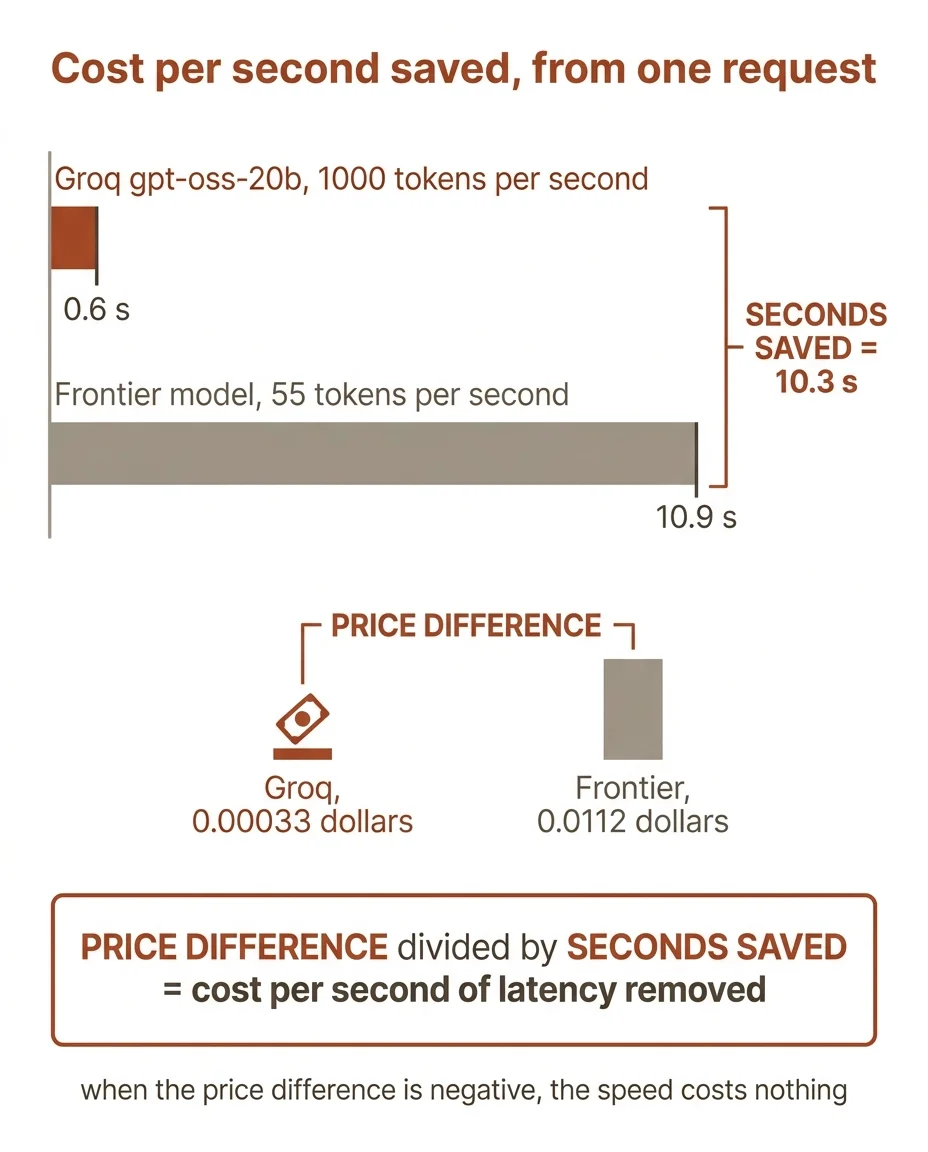
If speed is the product, then the unit that matters is money per unit of time removed. It is the same reasoning an airline applies to a business class seat: nobody prices it per kilometer.
The formula, in one line
Take one request. Generation time is output tokens divided by tokens per second, on each side. Subtract the two to get the seconds saved. Then take the cost of that request on each side, subtract them to get the price difference, and divide the price difference by the seconds saved. The result is what one second of removed latency costs you, per request, on your own workload rather than on a benchmark.
What the number looks like on a real workload
Take a typical assistant call, 2,000 tokens in and 600 tokens out. On gpt-oss-20b the generation phase takes 0.6 seconds. On a frontier model producing 55 tokens per second, which is a plausible order of magnitude for a large closed model but a figure you should measure yourself, the same 600 tokens take just under 11 seconds. Ten seconds disappear, and the Groq call also costs less. The cost per second saved is zero, or rather negative, because you are paid to be faster.
That result flips only when you compare against the genuinely cheap tier. Put qwen3.8-27b on Groq against a low cost frontier model and the price difference becomes positive, at which point the formula gives you a real figure in fractions of a cent per second saved, and you can decide whether removing ten seconds from a user’s wait is worth that.
Where the speed actually pays for itself
Interactive products where the wait is the product
Autocomplete, inline rewriting, live translation, voice agents. In these products the model’s latency is not a background cost, it is the interaction. Below roughly one second, a suggestion feels like a feature of the editor. Above three seconds, users stop waiting for it and type past it. Groq’s value here is not that it saves money on the invoice, it is that it moves a product from the second category into the first.
Agent loops that chain a dozen calls
The other case is multiplication. An agent that makes twelve sequential model calls to complete a task inherits twelve times the per call latency. At 55 tokens per second and 400 output tokens per step, that is nearly a minute and a half of pure generation. At 500 tokens per second it is under ten seconds. This is the profile where a fast small model beats a slow strong one on total task quality, because you can afford retries, self checks and a verification pass inside the same time budget.
Rate limits are the ceiling long before the price is
The free plan, and what it really allows
On the free plan, read on 15 August 2026 and unchanged when we re-read Groq’s rate limit page on 13 October 2026, gpt-oss-20b, gpt-oss-120b and the qwen3.8-27b preview are each capped at 30 requests per minute, 1,000 requests per day, 8,000 tokens per minute and 200,000 tokens per day. Whisper Large V3 and V3 Turbo allow 20 requests per minute, 2,000 requests per day, 7,200 audio seconds per hour and 28,800 per day, and Groq states that cached tokens do not count towards these limits. As documented in every Groq free tier limit, Llama 3.1 8B was more generous on requests in that reading, 14,400 per day, but only 6,000 tokens per minute; on 6 October 2026 the Llama models no longer appear in Groq’s rate limit table, their limits being set by contract. Those ceilings are fine for evaluation and hobby work and will not carry a product. The developer plan lifts gpt-oss-20b to 250,000 tokens per minute and 1,000 requests per minute, and llama-3.3-70b stood at 300,000 tokens per minute before it moved to contract terms. Note what that means in practice: an 8,000 tokens per minute cap makes the 1,000 tokens per second headline unreachable on the free tier, since you would exhaust a minute of quota in eight seconds.
Flex, performance and the tiers above on demand
Groq exposes a service_tier parameter with four values, read on 15 August 2026. The default is on_demand. Flex is available to paid accounts at 10 times higher rate limits for the same price, best effort, and returns a 498 with capacity_exceeded when there is no capacity, so it needs jittered retries. Performance is the low latency enterprise tier. And auto lets Groq pick the best tier available to you. Upgrading to the developer plan carries no upfront charge; billing runs in arrears with progressive thresholds that trigger an invoice at $1, $10, $100, $500 and $1,000 of cumulative usage, read from Groq’s billing documentation on the same date.
What we verified and what we could not
Every price and speed on this page was read on 15 August 2026 from Groq’s own model, rate limit, batch and billing documentation on console.groq.com, and the model grid was re-read on 6 October 2026, when the two Llama models had moved to enterprise pricing and Qwen3.8-27B had replaced Qwen3.6-27B in preview. On 13 October 2026 the model grid, the free plan limits and the deprecation page were read again: no price had moved, and Compound had been shut down. We did not take the figures from an aggregator.
What we could not verify: groq.com/pricing, the page most readers land on, returned no pricing grid at all when we fetched it, only marketing copy and a fundraise announcement. There is therefore no archived Groq screenshot on this site, unlike the OpenAI, Anthropic, DeepSeek, xAI and Mistral grids we capture on the day we read them. We also could not verify any guaranteed throughput. The tokens per second figures are Groq’s own published numbers for its models, not a service level commitment, and any throughput you compare them against should be your own measurement, because no provider publishes a contractual speed. Finally, Compound and Compound Mini never carried a token price, and they were shut down on 21 September 2026, so we have not priced them.
One more cost sits outside every grid on this page. If you reach Groq through a gateway rather than directly, the gateway takes its own cut, and we price that separately in our breakdown of what a router adds to your bill.
Frequently asked questions
Is Groq Cloud free to start?
Yes. There is a free plan with no payment method required, capped at 30 requests per minute and a few thousand tokens per minute depending on the model. Upgrading to the developer plan requires a card, a US bank account or SEPA debit, and triggers no immediate charge.
Is Groq the same thing as Grok?
No, and the confusion is constant. Groq is an inference provider running its own LPU hardware and serving open weight models. Grok is the model family built by xAI, with its own separate grid that we cover in what xAI actually charges for the Grok API. Different companies, different products, one letter apart.
Does Groq charge for reasoning tokens?
Reasoning models bill their internal reasoning as output tokens, which is the industry norm and the most common surprise on a first invoice. Groq’s grid does not carry a separate reasoning column, so budget reasoning output at the standard output rate and assume the visible answer length understates your real token count.
Can you buy a guaranteed throughput?
Not on the public plans. The performance service tier is described as the reliable low latency option and is restricted to enterprise accounts, which means throughput commitments are a contract conversation rather than a line on a pricing page. Everything below that is best effort, and flex explicitly trades reliability for higher limits.