Groq’s free plan costs nothing and needs no card, and on its main chat models (gpt-oss-120b, gpt-oss-20b and the qwen3.8-27b preview) it caps you at 30 requests per minute, 1,000 requests per day, 8,000 tokens per minute and 200,000 tokens per day, as printed on Groq’s rate limits page on 20 October 2026. Nothing on the plan expires: the minute and day quotas refill, and Groq’s billing documentation sets no end date for the Free tier. You pay nothing until you upgrade to the Developer plan, which bills in arrears and sends its first invoice once your usage reaches $1.

The free plan limits, model by model
Groq sets its limits per model, and the numbers below come from the Free Plan tab of the official Groq rate limits page. Groq calls them a summary; your exact limits sit on the Limits page of your console settings.
The chat models get 30 requests and 8,000 tokens a minute
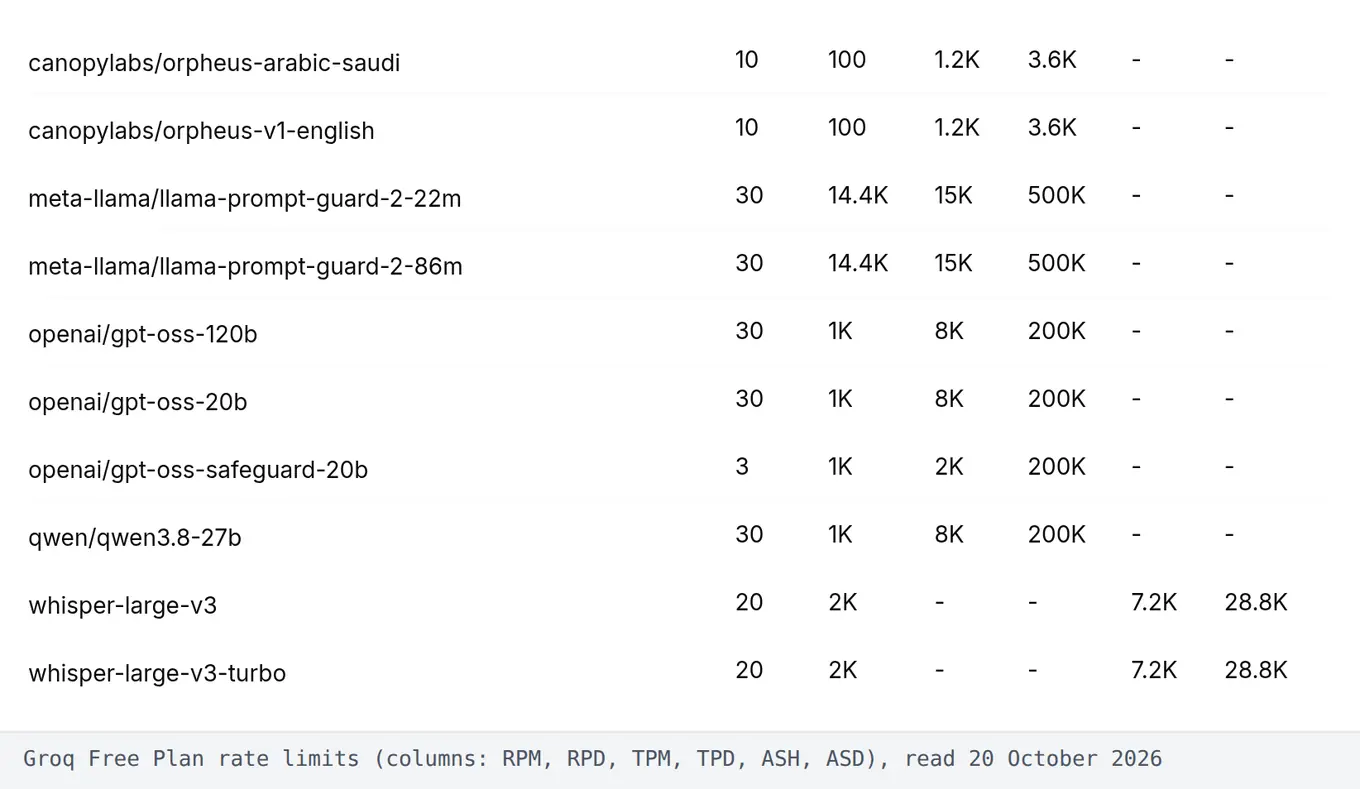
Three of the four chat models share the same ceiling, and the safeguard classifier is far tighter per minute:
| Model | Free plan limits |
|---|---|
| openai/gpt-oss-120b | 30 RPM, 1,000 RPD, 8,000 TPM, 200,000 TPD |
| openai/gpt-oss-20b | 30 RPM, 1,000 RPD, 8,000 TPM, 200,000 TPD |
| qwen/qwen3.8-27b (preview) | 30 RPM, 1,000 RPD, 8,000 TPM, 200,000 TPD |
| openai/gpt-oss-safeguard-20b | 3 RPM, 1,000 RPD, 2,000 TPM, 200,000 TPD |
RPM and RPD count requests per minute and per day, TPM and TPD count tokens per minute and per day. Input and output tokens both count toward the token limits. Groq labels qwen3.8-27b a preview model, meant for evaluation and liable to be discontinued at short notice, so I would not build on it even after paying.
Whisper, the guard models and Orpheus speech
Outside chat, the other rows of the same table read as follows:
- whisper-large-v3 and whisper-large-v3-turbo: 20 requests per minute, 2,000 per day, 7,200 audio seconds per hour and 28,800 audio seconds per day, which is eight hours of audio a day.
- llama-prompt-guard-2-22m and 2-86m: 30 requests per minute, 14,400 per day, 15,000 tokens per minute and 500,000 tokens per day, the most generous rows on the page.
- canopylabs/orpheus-v1-english and orpheus-arabic-saudi (text to speech): 10 requests per minute, 100 per day, 1,200 tokens per minute and 3,600 tokens per day, enough to hear the voice and little else.
Eight free hours of Whisper a day is the best deal on the plan, worth setting against what OpenAI charges per Whisper hour.
What the free plan does not include at all
Some models and features never appear on the free plan, whatever your usage. Llama 3.1 8B, Llama 3.3 70B, Muse Spark Open and MiniMax M2.7 are all labelled Enterprise on Groq’s models page, with Contact Sales in both the price and the rate limit columns, and none of them sits in the free table. Batch processing, the Flex service tier and spend limits are listed by Groq as Developer tier benefits, and Flex is explicitly reserved for paid customers.
Free plan, gpt-oss-120b and gpt-oss-20b: 30 requests per minute, 1,000 per day, 8,000 tokens per minute, 200,000 tokens per day. No card, no end date.
Which limit you hit first
Groq’s rule is that you hit whichever threshold you reach first, and on the free plan that is almost never the request count.
Tokens per minute run out long before requests do
Divide 8,000 tokens by 30 requests and you get about 266 tokens per request if you want to use all 30 slots in a minute. A single chat turn with a 2,000-token system prompt and a 500-token answer uses 2,500 tokens, so you get three of those a minute, not thirty. Any agent loop or retrieval pipeline with a fat context hits the TPM wall on its first few calls.
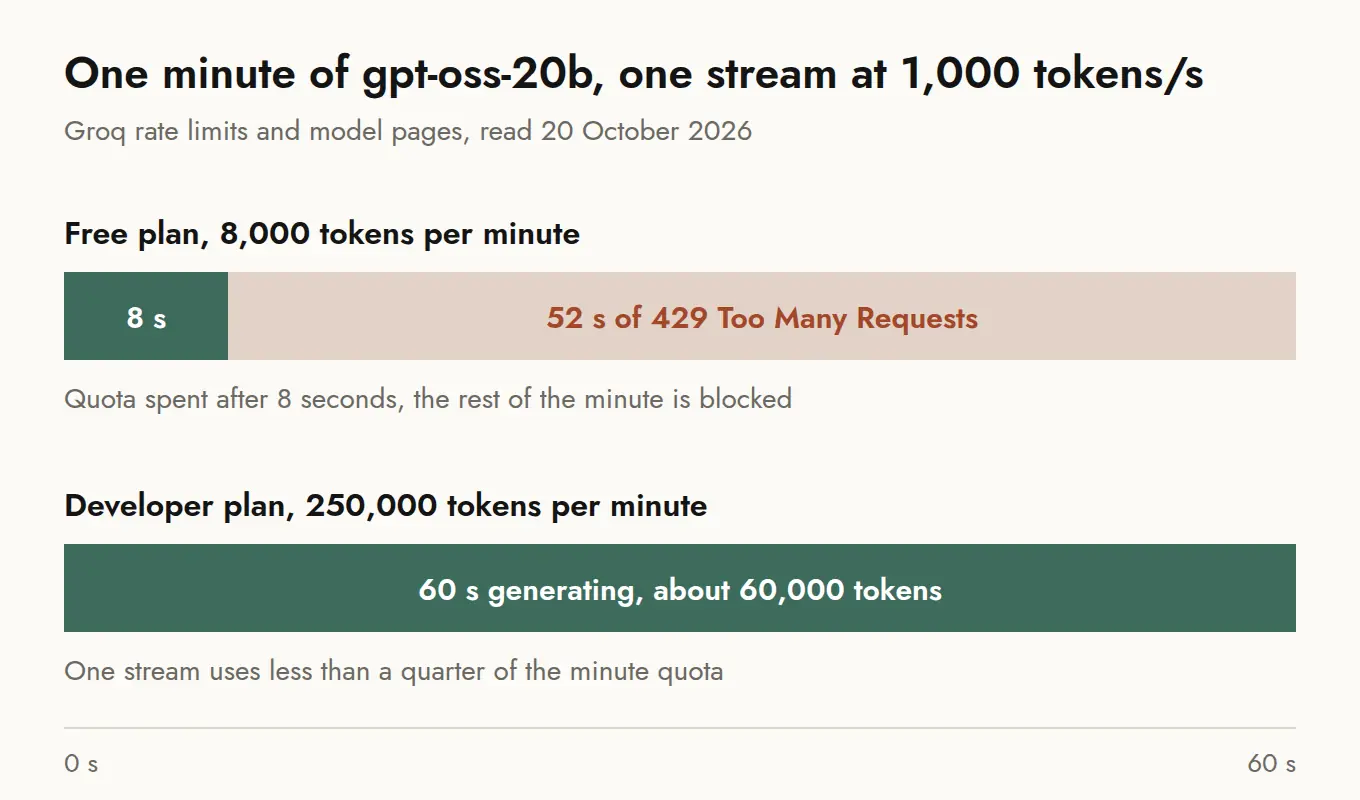
Speed makes it worse, not better. Groq rates gpt-oss-20b at about 1,000 tokens per second, which means one streaming request can burn the whole minute’s 8,000 tokens in roughly eight seconds and then sit on 429 errors for the remaining 52.
The daily budget is 25 minutes at full speed
The 200,000 tokens per day cap is 25 minutes of the 8,000 tokens per minute rate. Run at the ceiling from 9am and your day is over before 9:30. The 1,000 requests per day cap only binds first if your average request stays under 200 tokens, which happens with short classification calls and almost nothing else.
At paid prices that daily allowance is small change. 200,000 output tokens on gpt-oss-120b would cost $0.12 at Groq’s $0.60 per million, and 200,000 input tokens $0.03. The free plan caps volume, not money, and that is why it is useful for testing and useless for traffic.
What resets, what expires, and what never does
Most people asking about the free tier fear a trial clock. Groq documents none, but three different things do reset or expire on their own schedule:
- The minute and day quotas refill continuously; the response headers tell you how long until each one is back.
- Cached prompt prefixes, on the three gpt-oss models that support caching, expire after two hours without use, according to Groq’s prompt caching documentation, and cached tokens do not count toward your rate limits while they are live.
- Promotional credits, handed out occasionally at hackathons and events, are separate from the free plan, with no general expiry rule published.
The free plan itself has no documented end date. Groq’s billing FAQ even lets you downgrade back to Free at any time, which only makes sense if Free is permanent.
Read the headers before the 429 arrives
Every response carries rate limit headers, and two of them are easy to misread. The request headers always refer to the daily count, while the token headers always refer to the per-minute count. Here is what each one tells you:
- x-ratelimit-limit-requests and x-ratelimit-remaining-requests: requests per day, total and left.
- x-ratelimit-limit-tokens and x-ratelimit-remaining-tokens: tokens per minute, total and left.
- x-ratelimit-reset-requests and x-ratelimit-reset-tokens: time until each refills.
- retry-after: seconds to wait, set only when you get a 429.
Throttle on remaining-tokens, not remaining-requests, and you see the wall coming before the 429.
More API keys will not buy more quota
Groq applies rate limits at the organization level, not to individual users or keys. Five keys in the same organization share one 8,000 tokens per minute budget.
The first paid threshold
Upgrading costs nothing on day one
To upgrade from Free to Developer you add a payment method: a credit card, a US bank account or a SEPA debit account. The upgrade is immediate and there is no upfront charge. You then pay per token at the published prices, gpt-oss-20b at $0.075 input and $0.30 output per million and gpt-oss-120b at $0.15 and $0.60, as covered in my read of Groq Cloud pricing and its speed premium.
Progressive billing at $1, $10, $100, $500 and $1,000
New Developer accounts are invoiced in steps, according to Groq’s billing FAQ. An invoice fires and payment is taken when your lifetime usage first crosses $1, then $10, $100, $500 and $1,000; usage between thresholds waits for the monthly invoice. Groq does not bill amounts under $0.50, and customers with an Indian billing address follow a different ladder: $1, $10, then every $100.
Your first Groq charge comes when lifetime Developer usage reaches $1. Below $0.50, Groq does not bill at all.
What the Developer plan lifts
The Developer Plan tab of the same rate limits page shows the base ceilings after upgrade. No tokens-per-day cap appears for these models on that tab. Groq adds that higher limits exist for select workloads and enterprise use.
| Model | Developer plan limits |
|---|---|
| gpt-oss-120b, gpt-oss-20b, qwen3.8-27b | 1,000 RPM, 500,000 RPD, 250,000 TPM |
| gpt-oss-safeguard-20b | 1,000 RPM, 500,000 RPD, 150,000 TPM |
| whisper-large-v3 | 300 RPM, 200,000 RPD, 200,000 audio seconds per hour, 4 million per day |
| whisper-large-v3-turbo | 400 RPM, 200,000 RPD, 400,000 audio seconds per hour, 4 million per day |
| Prompt Guard 2 (22M and 86M) | 100 RPM, 50,000 RPD, 30,000 TPM |
On the chat models, tokens per minute jump about 31 times, from 8,000 to 250,000, and that is the limit the free plan makes you hit first.
When the free plan is enough
My verdict is simple: the free plan is a test bench, and a good one. It is enough in these cases:
- Evaluating gpt-oss or Qwen output quality and latency before committing.
- A personal tool or bot that sends short prompts a few hundred times a day.
- Transcribing up to eight hours of audio a day with Whisper.
- Screening prompts with Prompt Guard at up to 14,400 calls a day.
It stops being enough the moment two users hit your app in the same minute with a real context window. The upgrade is free and the first bill is $1, so if price is your only filter, compare Groq with the cheapest metered LLM APIs and move on.
Frequently asked questions
Does the Groq free tier expire?
No end date appears in Groq’s documentation. The quotas refill, and you can downgrade from Developer back to Free at any time.
What happens when you exceed the free tier limits?
The API returns 429 Too Many Requests with a retry-after header in seconds. You are not charged, and requests work again as soon as the exceeded window refills.
Can you use the Groq free tier in production?
Technically yes on production models like gpt-oss, but 8,000 tokens per minute shared across your whole organization will not carry real traffic. Preview models such as qwen3.8-27b are meant for evaluation only, whatever plan you are on.