GPT-6.2 Astra in its healthcare configuration costs $8 / $40 per million input and output tokens, with cached input at $0.40, and gpt-6.2-sol-healthcare costs $2 / $10 with a $0.10 cache. Both match the base GPT-6.2 Astra and Sol rates line for line, so the clinical search harness adds no premium per token. The catch is the label: OpenAI lists every healthcare row as promotional pricing “available at least through December 31, 2026”, while the base models carry no such date. Web search must be on to reach the healthcare index, and that tool is billed on top.

GPT-6.2 healthcare pricing per million tokens
OpenAI prints the healthcare models in their own block, “Healthcare model configurations”, inside the Specialized models section of its API pricing page. The block sits under the cyber, life sciences and legal rows, not in the flagship table where the base GPT-6.2 models live. As of 25 November 2026 it holds four models: two new GPT-6.2 configurations and two older ones.
Standard rates for the four healthcare models
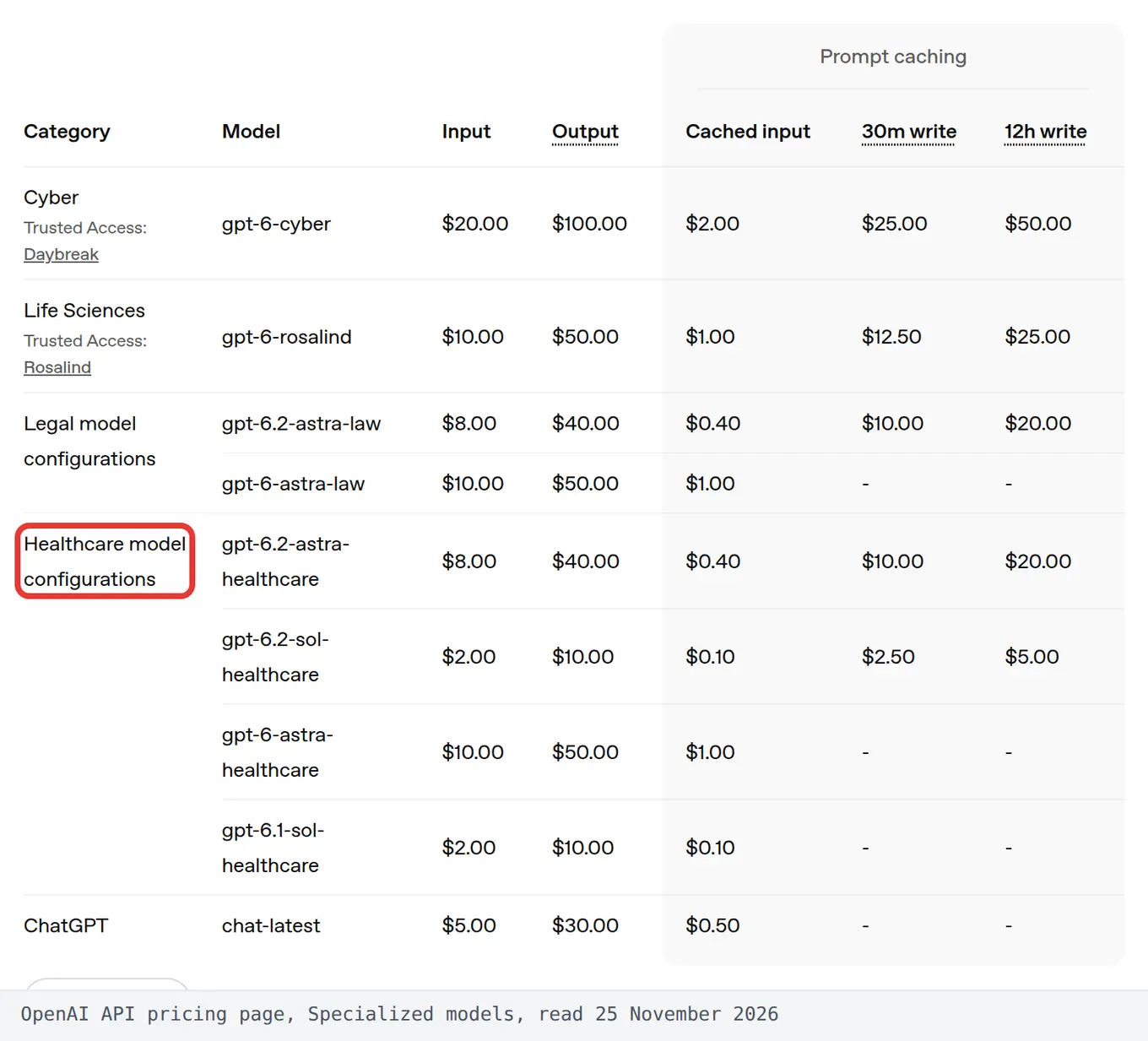
Here is the Standard tier, short context, per million tokens. The two GPT-6.2 rows also carry cache-write prices; the two older rows show a dash in both write columns.
| Model (Standard, short context) | Input / cached input / output |
|---|---|
| gpt-6.2-astra-healthcare | $8.00 / $0.40 / $40.00 |
| gpt-6.2-sol-healthcare | $2.00 / $0.10 / $10.00 |
| gpt-6-astra-healthcare | $10.00 / $1.00 / $50.00 |
| gpt-6.1-sol-healthcare | $2.00 / $0.10 / $10.00 |
Cache writes on the new rows follow the base grid. gpt-6.2-astra-healthcare charges $10.00 for a 30-minute write and $20.00 for a 12-hour write; gpt-6.2-sol-healthcare charges $2.50 and $5.00.
Long prompts above 272K tokens
The pricing page has a Long switch for the same block, and it applies the usual OpenAI rule: input and cache double, output rises by half, for the full request. The four healthcare rows read as follows on that view:
- gpt-6.2-astra-healthcare: $16.00 input, $0.80 cached, $60.00 output, with writes at $20.00 (30 minutes) and $40.00 (12 hours).
- gpt-6.2-sol-healthcare: $4.00 input, $0.20 cached, $15.00 output, with writes at $5.00 and $10.00.
- gpt-6-astra-healthcare: $20.00, $2.00 and $75.00.
- gpt-6.1-sol-healthcare: $4.00, $0.20 and $15.00.
Clinical search pulls long evidence into the context, so this threshold matters more here than on a chatbot. A literature synthesis that crosses 272K input tokens bills the whole call at the long rate, not only the tokens past the line.
Fast mode, and the tiers that are missing
The healthcare block has a second table for Fast mode, which doubles the Standard rate. It is easy to mistake for the long-context view, because both show $16 on Astra input. The difference sits in the output column:
| Fast mode, per million tokens | Input / cached input / output |
|---|---|
| gpt-6.2-astra-healthcare, short context | $16.00 / $0.80 / $80.00 |
| gpt-6.2-astra-healthcare, above 272K | $32.00 / $1.60 / $120.00 |
| gpt-6.2-sol-healthcare, short context | $4.00 / $0.20 / $20.00 |
| gpt-6.2-sol-healthcare, above 272K | $8.00 / $0.40 / $30.00 |
What the block does not show matters as much. There is no Batch row and no Ultrafast row for any healthcare model, while base GPT-6.2 Astra gets Batch at $4 / $20 and the GPT-6.2 Astra pricing grid lists Ultrafast at 3x Standard. If you planned to push overnight evidence reviews through Batch, the pricing page gives you no healthcare rate to plan with. Regional processing endpoints add the usual 10 percent uplift for models released on or after 5 March 2026.
Same price as the base models, with one difference
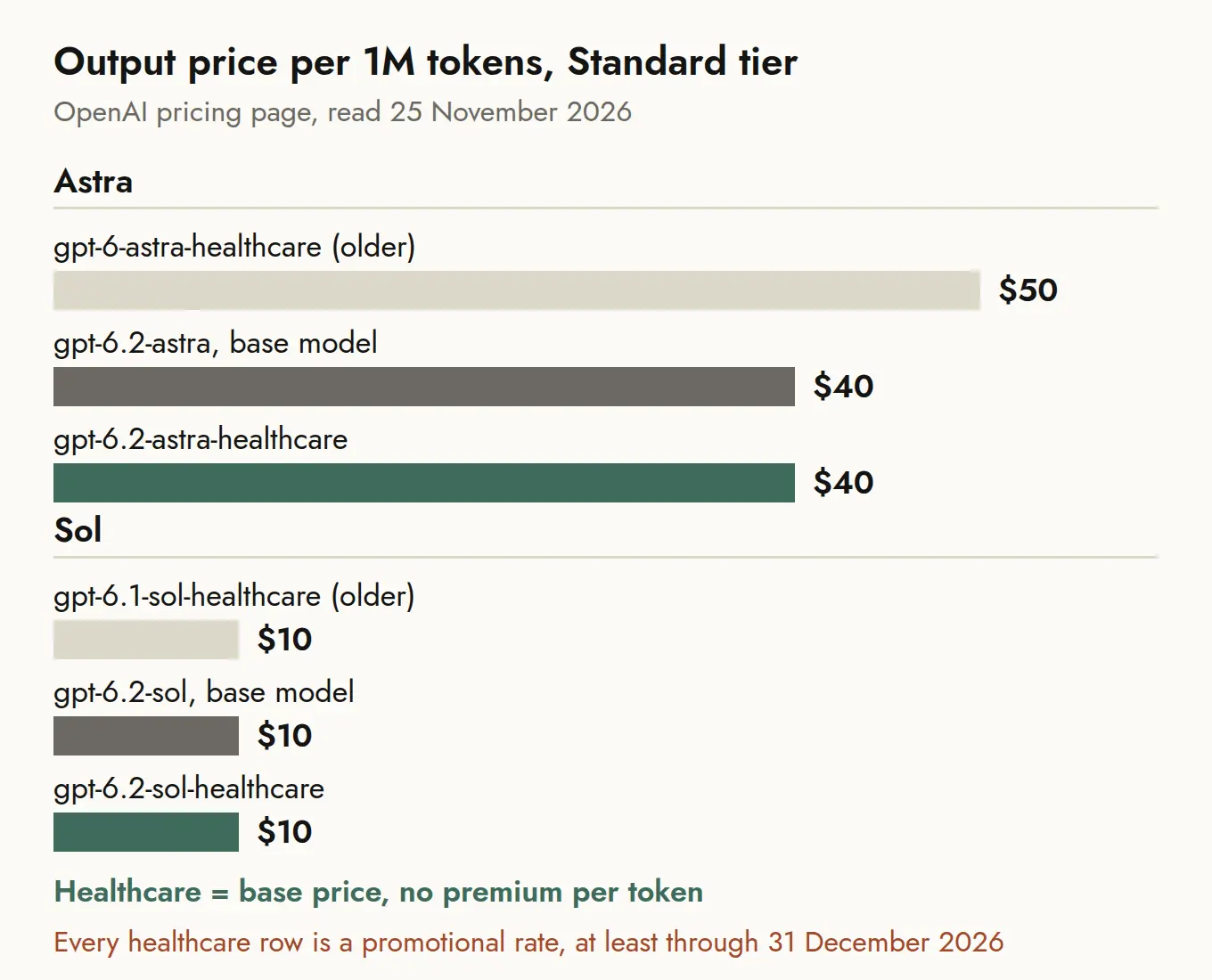
I compared every healthcare cell with its base-model cell in the flagship tables of the same page. On Standard, Long and Fast, they are identical. The chart above makes the point on output, the line that dominates most bills.
Astra healthcare against base GPT-6.2 Astra
Base gpt-6.2-astra is $8.00 input, $0.40 cached and $40.00 output, and the GPT-6.2 Astra model page states the long-context rule as “input and cache rates double and output costs 1.5 times”. The healthcare configuration matches all of it, cache writes included. Against the older gpt-6-astra-healthcare at $10 / $1 / $50, the new configuration is 20 percent cheaper on input and output and 60 percent cheaper on cached input.
gpt-6.2-astra-healthcare = gpt-6.2-astra on every Standard, Long and Fast cell: $8 / $0.40 / $40 per million tokens, read 25 November 2026.
Sol healthcare against base GPT-6.2 Sol
gpt-6.2-sol-healthcare costs exactly what the base GPT-6.2 Sol model costs: $2.00 / $0.10 / $10.00, with $2.50 and $5.00 cache writes. The older gpt-6.1-sol-healthcare has the same three token prices, so moving from 6.1 to 6.2 Sol in healthcare changes nothing on the bill. Sol is a quarter of Astra on every line, which is the real decision on this grid.
The promotional date to watch
Under the Specialized table, OpenAI adds one sentence that the base models do not get. Alongside the legal and Rosalind models, it names GPT-6.2 Astra Healthcare, GPT-6.2 Sol Healthcare, GPT-6 Astra Healthcare and GPT-6.1 Sol Healthcare, and says their “promotional pricing is available at least through December 31, 2026”.
Two things follow from that wording, and I would plan around both:
- “At least through” is a floor, not an end date. OpenAI has not published what these models will cost after 31 December 2026, nor whether the promotion will be extended.
- The base GPT-6.2 Astra and Sol rows carry no promotional label, so today’s parity is a promotional parity. A healthcare premium could appear in 2027 without the base price moving.
Healthcare rates are promotional "at least through December 31, 2026". OpenAI has published no price for after that date.
What the healthcare configuration adds
The token price is the base price, so the value has to come from somewhere else. OpenAI describes the configuration as the model paired with “a harness tailored to clinical questions and trusted clinical search”, available through the Responses API in its ChatGPT for Healthcare announcement.
Trusted clinical search and the web search bill
The OpenAI help article on healthcare configurations spells out the mechanics. You pass a healthcare model ID such as gpt-6.2-astra-healthcare in a Responses API request, and “web search must be enabled to use the healthcare search index”. No ChatGPT for Healthcare or Enterprise workspace is required: any API organization can call it.
That web search requirement is where the extra cost hides. The pricing page has no separate line for the healthcare index, so the general Tools line is the one to budget: web search at $10.00 per 1,000 calls, plus search content tokens billed at model rates. On Astra, those content tokens land at $8 per million, or $16 once the request passes 272K.
HealthBench Professional and the $1.37 answer
OpenAI’s own benchmark numbers come with the launch, and they are OpenAI’s, not independent. On HealthBench Professional, 525 physician-written tasks, it reports a length-adjusted score of 74.4% for GPT-6.2 Astra with the healthcare configuration, 6.3 points ahead of Claude Fable 5.2 with web search. It also reports an average of 23 seconds per response, against nearly three minutes for the same model on general web search.
The cost claim is the one I find most useful: $1.37 per scored response for Astra healthcare against $2.90 for Fable 5.2, both at their highest reasoning settings. Fable 5.2 lists at the same $8 / $40 per million tokens on Anthropic’s grid (see my Claude Fable 5.2 pricing breakdown), so the gap comes from how many tokens and searches each system spends per answer, not from a cheaper token rate. Fable’s cache read is even cheaper, at $0.20 against $0.40.
For an outside view of the benchmark itself, Artificial Analysis runs public leaderboards for HealthBench and HealthBench Professional:
We’re launching leaderboards for HealthBench and HealthBench Professional, two benchmarks evaluating how AI models respond in realistic health conversations HealthBench and HealthBench Professional are benchmarks from @OpenAI that grade model replies to realistic health https://t.co/P95IauqTXc
@ArtificialAnlys
https://x.com/ArtificialAnlys/status/2112318755321868493
BAA and protected health information
Calling a healthcare model does not by itself authorize you to send protected health information. The help article requires an applicable Business Associate Agreement with OpenAI, plus the account and tool configuration that HIPAA-eligible use demands. The pricing page lists no separate fee for the BAA, so the agreement itself adds no published line to the bill.
Which healthcare model to pick
With parity on the grid, the choice comes down to answer quality against a four-to-one price gap. My verdicts, as of the 25 November 2026 grid:
- Coming from gpt-6-astra-healthcare: switch to gpt-6.2-astra-healthcare. It is 20 percent cheaper on input and output, 60 percent cheaper on cache, and it is the configuration OpenAI benchmarked.
- Running gpt-6.1-sol-healthcare: the move to 6.2 Sol costs nothing per token and adds published cache-write rates, so there is no price reason to stay.
- Point-of-care answers at volume: start on gpt-6.2-sol-healthcare at $2 / $10 and escalate to Astra only for the questions Sol gets wrong.
- Batch evidence reviews: no healthcare Batch rate exists, so compare the base model on Batch at $4 / $20 against the harness’s search quality before committing.
Whatever you pick, build a price review into your January budget. Unlike the base GPT-6.2 rows, the healthcare rows carry a promotional label, and 31 December 2026 is the earliest date it can change.