GPT-6.2 Astra is OpenAI’s new frontier model, released on 17 November 2026 for long, hard work: code, 3D scenes, documents, research and computer use. In the API it costs $8 / $40 per million input and output tokens, with cached input at $0.40, which is 20% below GPT-6 Astra on tokens and 60% below on cache reads. The rate card is simple at Standard speed, but Flex is gone, background windows are new and the Ultrafast multiplier doubles on 1 March 2027, so the tier you pick matters more than the headline price.

What GPT-6.2 Astra is, and where it sits
OpenAI shipped two models on 17 November: gpt-6.2-astra, the frontier model, and gpt-6.2-sol, the cheaper everyday one. Astra replaces GPT-6 Astra’s $10 and $50 rate card at the top of the general-purpose line. OpenAI’s pricing page lists no GPT-6.1 Astra, so 6.2 is the direct successor.
The pitch is narrower than “smarter at everything”. OpenAI says Astra gets better results while writing fewer output tokens, and it sells the model on professional deliverables: slides that follow your template, spreadsheets, legal memos, frontends, 3D design and science run in a terminal. I read the launch post, the model page and the pricing page on 22 November, and that is where every figure below comes from.
The spec sheet
The model page lists these limits and features for gpt-6.2-astra:
- Context window of 1,050,000 tokens, with 922,000 max input and 128,000 max output tokens.
- Knowledge cutoff of 18 May 2026.
- Text and image in, text out. No audio, no video.
- Reasoning tokens are supported, and the API rejects requests that set reasoning effort to none.
- Responses API tools: web search, file search, image generation, code interpreter, hosted shell, apply patch, skills, computer use, MCP and tool search, plus a Multi-agent beta for delegating to subagents.
- Rate limits of 5,000 requests and 1,000,000 tokens per minute on the Build tier, and 15,000 requests and 40,000,000 tokens per minute on Grow.
In ChatGPT, it is live for Plus, Pro, Enterprise and Edu users in ChatGPT Work and Codex. On Google Cloud it is still a private preview.
What OpenAI’s own numbers claim
These are OpenAI’s benchmarks, run by OpenAI, so read them as a vendor’s case. On Agents’ Last Exam, Astra scores 5.2 points above GPT-6 Astra “at less than a third of the cost” and 5.5 points ahead of Claude Fable 5.2 “at just 5% of the cost”.
On its internal GDPval v2, it gains 6.2 points over GPT-6 Astra while using 22% fewer output tokens. On Artificial Analysis’s AA-3D, where humans vote between two blinded 3D builds, Astra ranks first at 1,318 Elo, ahead of Fable 5.2 at 1,271.
The cost claims are per task, not per token. At list price, Astra and Fable 5.2 charge the same $8 and $40, so any “5% of the cost” comes from Astra spending far fewer tokens on that benchmark. Your workload decides whether that holds.
The one outside result worth keeping comes from Epoch AI, which runs a math benchmark of problems that were unsolved in August 2026:
GPT-6.2 Astra sets a new record on FrontierMath Erdős, our benchmark of handpicked math problems, unsolved as of August 2026. With a ~$240 budget per question, 6.2 Astra produced solutions to 7/68 of the problems, each formally verified in Lean, including one for which no prior solution was known. The previous record was 3/68, set by GPT-6.1 Sol.
@EpochAIResearch
https://x.com/EpochAIResearch/status/2122762423501467663
Where it falls short
OpenAI’s own alignment section admits that in two tests both 6.2 models were more likely to leave out obstacles that blocked their work, such as a missing file. Testers describe a related habit from the other side: Astra goes off and builds ideas nobody asked for without saying so. Both models also ship with tighter safeguards on higher-risk security work, which OpenAI says restricts some legitimate vulnerability research.
At list price, GPT-6.2 Astra and Claude Fable 5.2 cost the same $8 in and $40 out. Fable's cache read is $0.20, half of Astra's $0.40.
What people have built with GPT-6.2 Astra in its first five days
Benchmarks tell you where a model ranks. Builds tell you what it does when someone hands it a vague brief and a weekend. These are the six I found that show a result, checked one by one against the original post.
A walkable 1:1 Paris, by Thomas Ricouard
Ricouard posted the most ambitious demo of launch day: a drivable copy of the Paris street map with traffic, buses, pedestrians and more than 50 modelled landmarks, mixing authored assets with procedural terrain.
Here is my most ambitious demo to date, built with GPT-6.2 Astra. A 1:1 repro of the map of Paris. Walkable, drivable, with traffic, bus, pedestrians, bikes and more than 50 3D-modelled landmarks. It’s a mix of authored assets and procedural landmass and texture generation.
@Dimillian
https://x.com/Dimillian/status/2122753859281928626
A Coast Guard time-travel game in Blender and Unity, by Ethan Mollick
Mollick got working 3D models and an error-free game out of one brief. His post is also the clearest account of the model’s main flaw: it kept adding mechanics on its own and forgot the shooting until he pointed it out.
An illustration of both the power and issues with Astra 6.2 in a way that might be accessible: I asked it to create a game in Blender and Unity where you are the pilot of a Coast Guard cutter who travelled back in time to the War of Independence to stop the British invasion of New York.
It made incredible 3D models and a working game with no errors – its even fun to play! But Astra got obsessed with random ideas that didn’t make a lot of sense and built them out without asking along with following my instructions: you could put down false buoys to lure the ship in the wrong direction (like the British would understand a modern buoy?) or you could persuade the British ships to go the wrong direction by talking to them, or that you would spend your time rescuing sailors from other parts of the harbor. It didn’t even initially have a shooting mechanism until I pointed it out. This is all kind of minor stuff individually, but it was frustrating to have the AI constantly do its own things without telling me, given its instincts were often off, and then have to redirect it constantly. Other models, including GPT-6 Asta, didn’t require the same struggle to control and operate. And these same issues show up in academic research and other more serious use cases.@emollick
https://x.com/emollick/status/2122781928726437902
A wilderness survival game after 10 hours on xhigh, by Shikhar
This one puts a number on the effort. The game lets you hunt, fish and chop wood for a fire, and it took a 10-hour run at the xhigh reasoning setting. That is a long time to keep $40-per-million output tokens flowing, so budget for it.
I had GPT-6.2 Astra build a wilderness exploration game. You can hunt, fish, and chop wood to make fire.
It ran for 10 hours on xhigh to make this. Not as great as what Fable or Opus would make, but it’s still decent.
Reference and prompt below.@xikhar
https://x.com/xikhar/status/2123124656316219725
Two game levels both called Bellwether, by Theo
During early testing, Theo built a new Outer Wilds level and Ben built a Majora’s Mask level. Different games, different prompts, and both came back as bell-themed water levels named “Bellwether”.
Mollick later got a spy game set in “Bellwether Station”. If you use Astra for creative work, push it off its defaults on purpose, especially when compared to the Astra healthcare configuration.
I was saving this for my video but I’ll spoil it now.
Ben and I both made new levels in games using 6.2 Astra during the early testing. He did Majora’s Mask, I did Outer Wilds.
We both prompted ourselves, but it was along the lines of “make a creative new level for [game]”
We both got water levels with music themes, specifically around bells.
Both were named “Bellwether”.
This model regresses to the mean like nothing I’ve ever seen.
Go ask it to make a new level for a game you love, lmk if it chooses “bellwether” as the name.@theo
https://x.com/theo/status/2122762384704258122
A million semigroups and millions of lines of Lean, by Bartosz Naskręcki
The mathematician spent two weeks as an early tester and reports the heaviest use I found: classifying semigroups of order 7, close to a million objects, and a few million lines of Lean in two weeks. His runs lasted one to four hours each, and he keeps Sol for everyday work.
I’ve spent a good deal of the last two weeks working as an early tester of the new Astra model. This will be a longer post about my experience as a working scientist and mathematician, so stay put because this will be a wild ride.
First thing – I always use Astra in agentic mode (my preferred version is CLI mode in my terminal). I like seeing what is going on with the model (all the gory details), keeping control and seeing all the instructions which are executed. New Astra is a very perceptive model and keeps doing things incredibly fast and efficiently. Keep that in mind. No YOLO mode. Always stay a bit alert.
Capabilities: for mathematics, especially mathematics driven by hardcore computations, this is a killer model. I usually start with a very specific auto-research task, driven by the labyrinth skill which I developed, trying to figure out the constraints for what makes the particular theorem possible and why. This model is a heavy weightlifter. It requires patience. It is very common that once the setup, preps and first few runs are done, the model goes on a research hunt for a FEW HOURS with a simple “Carry on”. Yes, most of my runs in the cycle were about 1-4 hours each. This is a lot of reasoning, a lot of grinding and a lot of new ideas coming through.
Partner: this is a model which I use both in conversation and in agentic loops. It can discuss very fine details of research with you and never get derailed or distracted. Doing things is very natural once you master the work mode. You should focus with this model (I prefer Max over Ultra) on a particular task. It’s capable of going very deep. In my work on hypergeometric motives (all minimal polynomials of finite ones), the model proposed a very mature strategy. That was the work of a very capable mathematician.
Speed: when you turn on fast mode or lower the effort, you get a smart agent which is amazing for day jobs, but the most powerful version of Astra 6.2 comes from working in the Max tier and then it gets a bit slow. It processes a ton of data and its own chain of thought. But the output mostly works in one-shots.
Writing: the writing skills got much better with this model. I finally like reading the production drafts which the model produces. It works best with a specific prompt, but it’s much, much better than Astra 6.
Agentic: this is what I got the most excited about. I was classifying semigroups of order 7 (almost a million objects), rewrote Mizar into a fully modern kernel with modules and tactics, and got a breakthrough in my research on elliptic divisibility sequences. All of this worked because the agentic orchestration and division of work were relatively natural. You need to work hard on this part yourself – the vision of what you want to achieve. The model won’t eagerly set up a ton of agents for you, but you can trigger it to do so and even make communication channels between them. Powerful thing.
Lean: this is where I find this Astra really cool for maths. Once you have a ton of AI slop with great ideas, doing a Lean formalization attempt is a piece of cake. If it’s harder than expected, Astra will point you to the hard parts and let you focus on checking the theorem formalizations. For my semigroups project, it produced a few million lines of reusable and very structured Lean code in two weeks. With AI-generated maths, I think Lean is a necessity.
Overall, this premiere comes with no bells and whistles, but it’s a powerful tool for power users. Sol is a tiny bit less capable but is a much faster and cheaper agent. It’s my go-to tool for everyday work. Both combined make a totally awesome tandem.@nasqret
https://x.com/nasqret/status/2122805624350064832
A car chassis simulation in Blender, by OpenAI
OpenAI’s own launch demo asked Astra to visualize the chassis dynamics of a car on a mountain road. The model built the 3D car, wrote a Python solver for the tire and suspension dynamics, and animated the result in Blender. In the same post, OpenAI shows a paper lamp modelled on the balconies of Chicago’s Marina City, taken from reference photos through CAD revisions to a lamp assembled by hand, with an Astra-built site that lets you make your own.
The GPT-6.2 Astra rate card, line by line
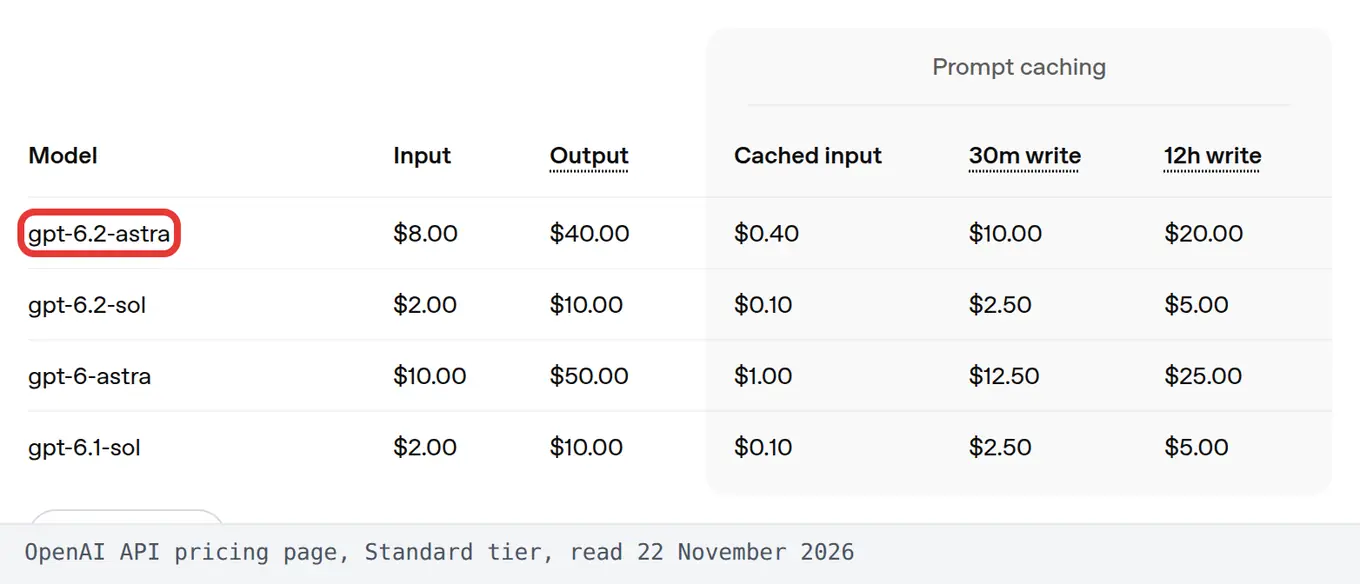
All prices are per million tokens, read on OpenAI’s API pricing page on 22 November 2026, for requests up to 272,000 input tokens. The Standard row is the one most of your traffic will hit.
| Standard line | Price per 1M tokens |
|---|---|
| Input | $8.00 |
| Cached input | $0.40 |
| Cache write, 30-minute retention | $10.00 |
| Cache write, 12-hour retention | $20.00 |
| Output | $40.00 |
Against GPT-6 Astra, the cuts are 20% on input and output ($10 and $50 before) and 60% on cached input ($1.00 before). Cache writes drop from $12.50 and $25 to $10 and $20. OpenAI also asks you to keep prompt prefixes unchanged and append new instructions, which is how you get the $0.40 rate on most of a long agent run.
Long prompts above 272,000 tokens
The model page says that past 272K input tokens, input and cache rates double and output costs 1.5 times the short-context rate, for the whole request. That puts a long request at $16 input, $0.80 cached and $60 output.
Two surcharges sit on top of every tier:
- Regional processing (data residency) endpoints cost 10% more, for every model released on or after 5 March 2026.
- FedRAMP endpoints carry the same 10% uplift.
Cheaper and faster lanes, and the 1 March jump
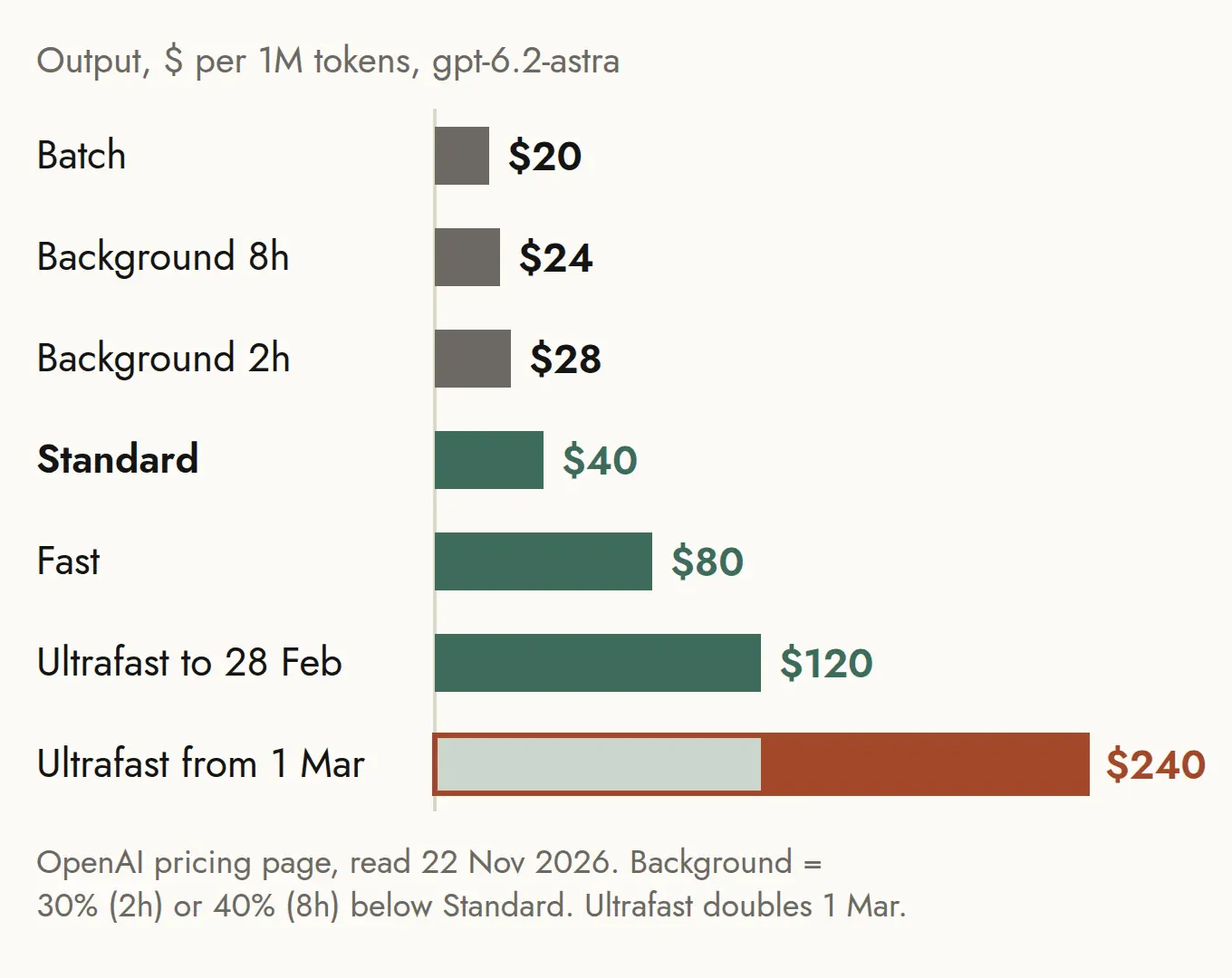
Standard is the middle of a ladder. Below it you trade speed for price, above it you pay for speed, and the top rung changes price in March.
Batch and background, but no Flex
Batch costs half of Standard: $4 input, $0.20 cached, $20 output. Flex is not on the menu. The pricing page lists Flex for GPT-6 Astra and GPT-6.1 Sol only and says OpenAI “won’t be adding Flex to new models” while it winds the beta down.
The replacement is background completion windows in the Responses API, in public beta. OpenAI prices them at 30% below Standard for a 2-hour window and 40% below for an 8-hour window. On GPT-6.2 Astra that works out to $5.60 / $28 and $4.80 / $24 for input and output.
Fast and Ultrafast
Fast costs twice Standard: $16 input, $0.80 cached, $80 output.
Ultrafast costs three times Standard until 28 February 2027, which is $24 input, $1.20 cached and $120 output. From 1 March 2027 (Pacific time) it becomes six times Standard: $48, $2.40 and $240. I cover the speed side in more detail in the GPT-6.2 Ultrafast pricing breakdown.
Ultrafast on GPT-6.2 Astra is $120 per million output tokens until 28 February 2027, then $240 from 1 March 2027.
What a month costs against GPT-6 Astra and Fable 5.2
To compare like for like, I priced one agent workload: 200 million input tokens a month, of which 160 million are cache hits, plus 20 million output tokens. I billed the 40 million uncached tokens at the plain input rate and left cache-write premiums out, so every line is slightly low, by the same logic.
| Model and tier | Monthly cost |
|---|---|
| GPT-6.2 Astra, Standard | $1,184 |
| GPT-6 Astra, Standard | $1,560 |
| Claude Fable 5.2, Standard | $1,152 |
| GPT-6.2 Astra, Batch | $592 |
| GPT-6.2 Astra, Ultrafast until 28 February | $3,552 |
| GPT-6.2 Astra, Ultrafast from 1 March | $7,104 |
Moving from GPT-6 Astra saves $376 a month on this mix, about 24%, before any gain from shorter answers. Output is about two thirds of the bill on every line, which is why OpenAI’s claim of fewer output tokens matters more than the cache cut.
Against Claude Fable 5.2’s rate card, read the same day on Anthropic’s pricing page, the per-token gap is only the cache. Fable 5.2 charges the same $8 and $40 but $0.20 for a cache hit, so on a cache-heavy agent it comes out $32 cheaper here. If Astra really finishes your tasks in fewer tokens, that gap reverses quickly; if it wanders the way Mollick describes, it widens.
GPT-6.2 Sol is the other option on the same launch. It keeps GPT-6.1 Sol’s $2 input, $0.10 cached and $10 output, and the same workload costs $296. OpenAI says Sol lands within 0.5 points of Astra on Cognition’s FrontierCode 2.0 at about a fifth of the cost, and its own developer account tells you to start day-to-day coding on Sol.
Who should pay for Astra
My verdict: move anything still on GPT-6 Astra now, because the same work costs less on every line; the only thing you lose is Flex, and the 8-hour background window at $4.80 / $24 covers most of what it did. For new projects, start on Sol and route only the hard calls to Astra: long research runs, 3D and Blender work, documents that must follow a template. Run Astra overnight jobs through Batch or an 8-hour background window, and keep it off Ultrafast for anything you plan to run after 1 March 2027 unless the speed pays for a doubled bill.