DeepSeek’s speech to text API lists at $0.116 per hour of audio and its text to speech API at $0.45 per 10,000 characters, with both currently sold at a limited-time 50% discount ($0.058 an hour and $0.225), according to DeepSeek’s pricing page read on 22 November 2026, which gives no end date for the discount. That makes DeepSeek the cheapest batch transcription hour I can find while the discount lasts, and second behind xAI at list price. Narration is a different story: at about $2.43 an hour at list price, DeepSeek’s voice costs more than three times Mistral’s Voxtral TTS 3, and the two-minute cap on each transcription upload means you have to split your audio yourself.

What DeepSeek launched on 13 November
On 13 November 2026, DeepSeek opened the tools behind its consumer app to developers: web search, file parsing, URL reading, safety checks and voice. Most of them run as built-in tools of deepseek-flash, but five are sold as standalone APIs with their own meter: Search, Fetch, OCR, speech to text (ASR) and text to speech (TTS).
The launch post on X names the speech endpoints in its first lines.
🚀 The full DeepSeek App experience, now via API
Search, files, links, safety, and voice. The capabilities behind the DeepSeek App are now available through the DeepSeek API.
Enable built-in features with a few parameters, or call standalone APIs such as OCR, ASR, and TTS.@deepseek_ai
https://x.com/deepseek_ai/status/2121247896918253875
Speech to text: one file in, one transcript out
The DeepSeek speech to text guide describes a single endpoint, POST /v1/tools/asr, that takes a whole audio file and returns the whole transcript. There is no streaming mode and no language parameter: the language is detected from the audio. The docs list 21 languages, including English, Chinese, Cantonese, Japanese, Korean, the main European languages, Arabic, Hindi and several South-East Asian languages.
The response is deliberately thin. You get a request ID, the text and the audio duration in milliseconds, and nothing else: no word timestamps and no speaker labels appear in the documented response.
Text to speech: two voices, two ways to call it
The DeepSeek text to speech guide offers a full-text mode over HTTP, where the audio streams back as it is synthesized, and a WebSocket mode that accepts text in chunks while a model is still writing its answer. That second mode is the one you want for a voice assistant.
The catalogue is small. You choose between two voices, Stella (female, the default) and Tide (male), and the docs list 10 languages, with Mandarin, Cantonese, English, Japanese and Korean among them. Output is WAV or raw 24 kHz PCM over HTTP, PCM or Opus over WebSocket, and Markdown is stripped from the text by default so a chatbot answer is not read out with its asterisks.
The speech price card, list and discount
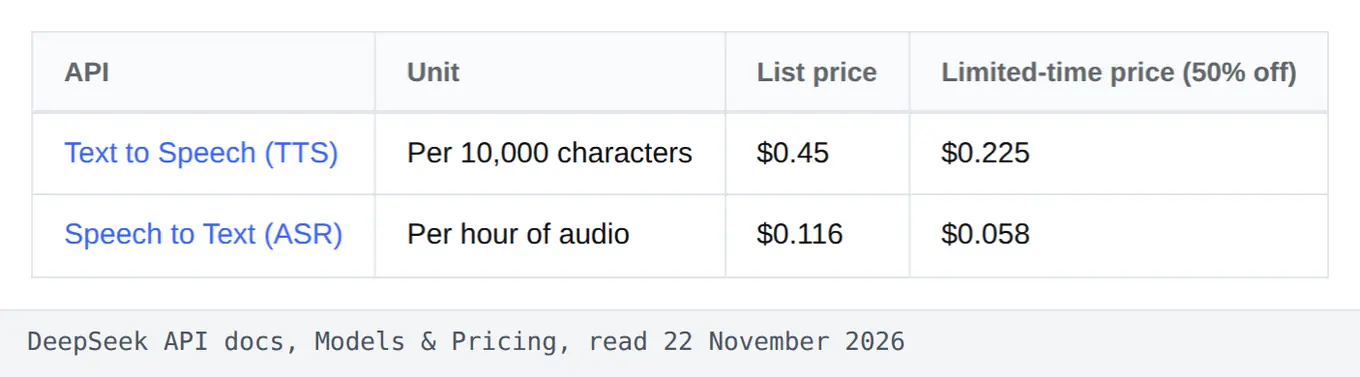
Both speech APIs sit in a “Speech Pricing” table near the bottom of the DeepSeek Models and Pricing page, separate from the token prices of deepseek-flash and deepseek-v4-pro. Here is what it shows on 22 November 2026:
| DeepSeek speech API | List price, then limited-time price |
|---|---|
| Speech to text (ASR), per hour of audio | $0.116, now $0.058 |
| Text to speech (TTS), per 10,000 characters | $0.45, now $0.225 |
| Text to speech, per million characters | $45, now $22.50 |
The 50% discount has no end date
DeepSeek labels the second column “Limited-time price (50% off)” and does not say when it ends, on the pricing page or in either guide. Budget on the list price and treat the discount as a bonus: the page also says DeepSeek reserves the right to adjust prices.
The pricing post of the launch thread carries the same grid as an image, with the list prices struck through.
💰 API pricing
Extended capabilities incur tool usage fees in addition to standard token charges.
See the tool pricing breakdown below.
3/4@deepseek_ai
https://x.com/deepseek_ai/status/2121247903603941471
How each meter counts
The two meters do not count the same way, and both details matter on a real bill:
- Speech to text is billed on audio duration to the second, and a fraction of a second counts as a full second. A 3.2-second voice command is billed as 4 seconds.
- Text to speech is billed per character, spaces and digits included. A Chinese character counts as 2, so 10,000 billed characters is only 5,000 characters of Chinese text.
- Tokens are separate. If a deepseek-flash answer is what you read aloud, you pay the model’s tokens first and the TTS characters on top.
What an hour costs on each side
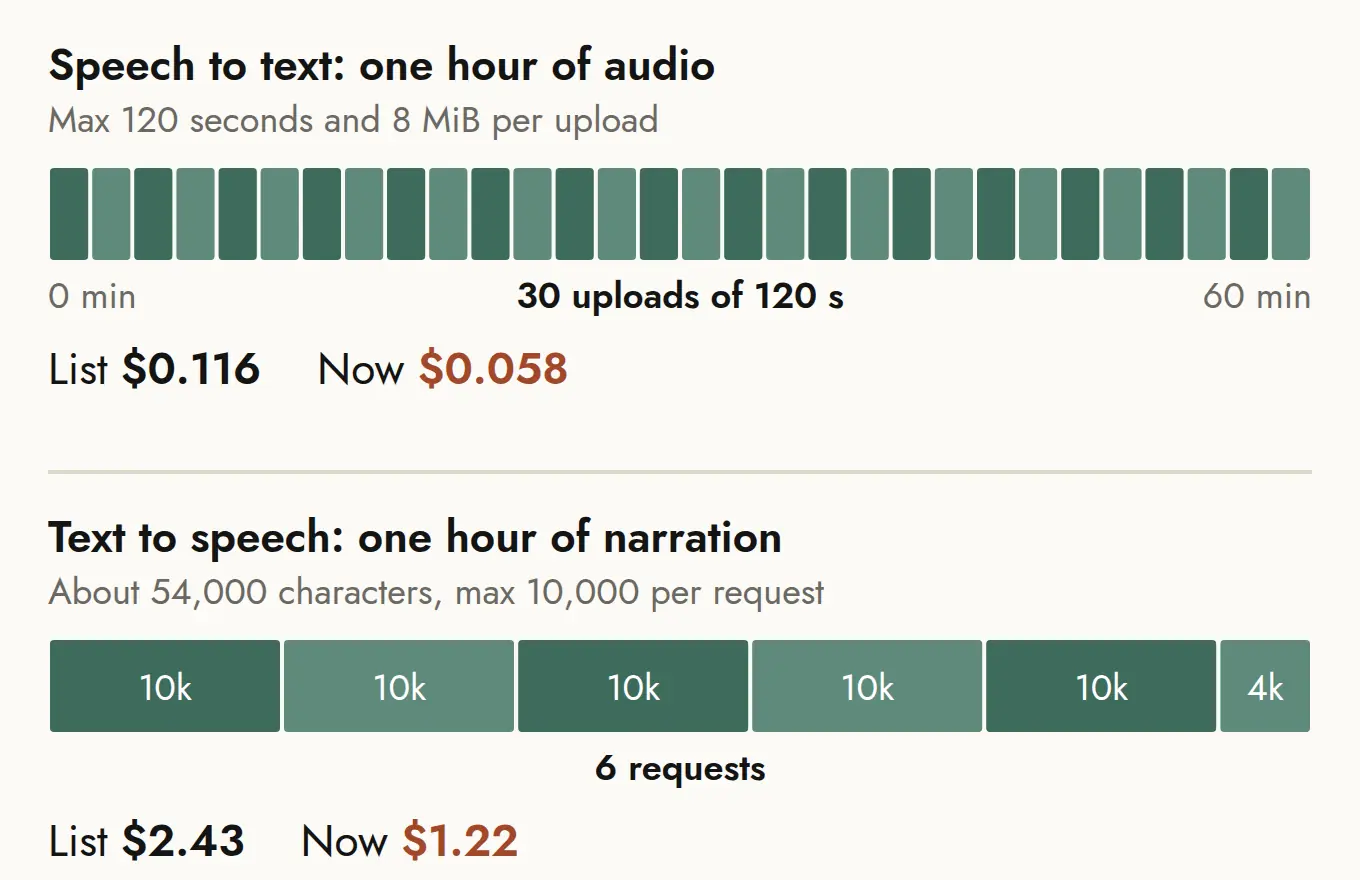
An hour is the unit people budget in, so here are both APIs converted to one. The transcription side needs no conversion, the narration side needs a reading pace.
An hour of transcription
One hour of audio costs $0.116 at list price and $0.058 today. A thousand hours comes to $116 at list price and $58 with the discount.
Rounding to the second adds at most one second per request. Split an hour into 30 two-minute uploads and you pay for at most 30 extra seconds, under a tenth of a cent.
DeepSeek caps each transcription upload at 120 seconds and 8 MiB, so one hour of audio is at least 30 requests.
An hour of narration
I use the same pace as on the rest of this site: 150 words a minute at six characters a word, about 54,000 characters for an hour of speech. At $45 per million characters, an hour of DeepSeek narration costs $2.43 at list price and $1.22 with the discount.
Read in Chinese, every character is billed twice. Since one request takes at most 10,000 billed characters, an English hour also means at least six requests stitched together.
DeepSeek against Whisper, Scribe, Voxtral and xAI
Every rate below was read on the vendor’s own pricing page on 22 November 2026 and converted to an hour. Per-minute rates are multiplied by 60, per-character rates by 54,000.
Transcription, per hour of audio
| Batch transcription model | Price per hour of audio |
|---|---|
| DeepSeek ASR, limited-time price | $0.058 |
| xAI Speech to Text (REST) | $0.10 |
| DeepSeek ASR, list price | $0.116 |
| ElevenLabs Scribe v3 | $0.20 |
| Mistral Voxtral Mini Transcribe 3 | $0.21 |
| Mistral Voxtral Small Transcribe 3 | $0.24 |
| OpenAI gpt-transcribe | $0.27 |
| OpenAI whisper-1 (deprecated) | $0.36 |
At list price DeepSeek sits 1.6 cents above xAI and well under everything else. The comparison is not like for like, though: Scribe v3 labels speakers and takes a list of key terms, as I covered in the Scribe v3 pricing breakdown, while DeepSeek returns plain text.
Narration, per hour of speech
| Text to speech model | Price per hour of narration |
|---|---|
| Mistral Voxtral TTS 3 | $0.70 |
| xAI Text to Speech | $0.81 |
| DeepSeek TTS, limited-time price | $1.22 |
| ElevenLabs v4 Turbo and Flash | $2.16 |
| DeepSeek TTS, list price | $2.43 |
| ElevenLabs v4 | $4.32 |
Here DeepSeek is mid-table. Voxtral TTS 3 at $13 per million characters is the cheap hour (details in the Voxtral 3 TTS pricing page), and ElevenLabs v4 is the expensive one for reasons covered in what an hour of Eleven v4 costs: cloned voices, audio tags and 90-plus languages. With two stock voices and ten languages, DeepSeek at list price costs more than ElevenLabs’ fast tier.
At list price, an hour of DeepSeek narration costs $2.43, against $0.70 on Voxtral TTS 3 and $2.16 on ElevenLabs v4 Turbo.
Where the limits bite
The prices are low, the guardrails are tight. These are the limits I would check before writing any integration code:
- 120 seconds and 8 MiB per transcription upload. The size cap often bites first: a 16-bit stereo WAV at 48 kHz fills 8 MiB in about 44 seconds. Convert to 16 kHz mono, which takes under 4 MB for two minutes.
- Left channel only. On stereo audio only the left channel is recognized, so a call recording with one speaker per channel loses half the conversation.
- No live transcription. The ASR endpoint has no streaming mode, which rules it out for a voice agent that must react while the caller is talking.
- No timestamps or speaker labels. Subtitles and meeting minutes need a second tool.
- Two voices, no speed control. The TTS docs say speed control and resuming an interrupted request are not supported.
- 50 requests in progress per account. Each guide sets that ceiling, and the next request gets a 429.
Text sent to TTS also goes through content review: a refused text returns a 400 with “Content Exists Risk”, and a synthesis that fails mid-stream simply cuts the audio short, so check the length of what comes back.
Which jobs I would send to DeepSeek
For bulk transcription of short clips, voice notes and voice commands, DeepSeek is the hour I would buy while the discount lasts: $0.058 an hour, and the 120-second cap does not matter when every clip is under two minutes anyway. At list price, xAI is a cent and a half cheaper, so the choice comes down to which account you already have.
For a chatbot already running on deepseek-flash, the TTS WebSocket is the simple path: same key, same bill, audio that starts while the answer is still being generated. If you already pay for DeepSeek’s Search and Fetch APIs, the speech meters land on the same balance.
For audiobooks, podcasts and anything a listener hears for an hour, I would not use it. Voxtral TTS 3 is cheaper per hour, and ElevenLabs is better per voice.
Frequently asked questions
Is the DeepSeek speech API free?
No. DeepSeek bills speech to text at $0.116 per hour of audio and text to speech at $0.45 per 10,000 characters, both currently at half price, and charges them to your topped-up or granted balance like token usage.
When does the 50% discount on DeepSeek ASR and TTS end?
DeepSeek has not published an end date. The pricing page read on 22 November 2026 calls it a “limited-time price”, so budget on the list price.
Can DeepSeek transcribe a one-hour file?
Not in one request. Each upload is capped at 120 seconds and 8 MiB, so you split the file into at least 30 pieces and join the transcripts yourself.