Voxtral 3 TTS costs $13 per million characters on the Mistral API, with batch and realtime billed at the same rate, read on Mistral’s API pricing documentation on 21 October 2026. At a narration pace of 150 words a minute, an hour of audio is about 54,000 characters, so an hour of speech costs about $0.70. That is down from $16 per million characters, or $0.86 an hour, on the first Voxtral TTS, and roughly a sixth of what Eleven v4 charges for the same hour.

The price is the headline, but three details decide whether it is the cheapest voice for your job: the model is still in public preview, it charges realtime and batch the same, and two Google voices still undercut it until the end of the year.
What Voxtral 3 TTS costs per character and per hour
Mistral bills text to speech by the character you send, the same meter ElevenLabs and OpenAI’s tts-1 use. There is one rate for the model, with no plan tiers and no separate realtime price.
The rate card in Mistral’s docs
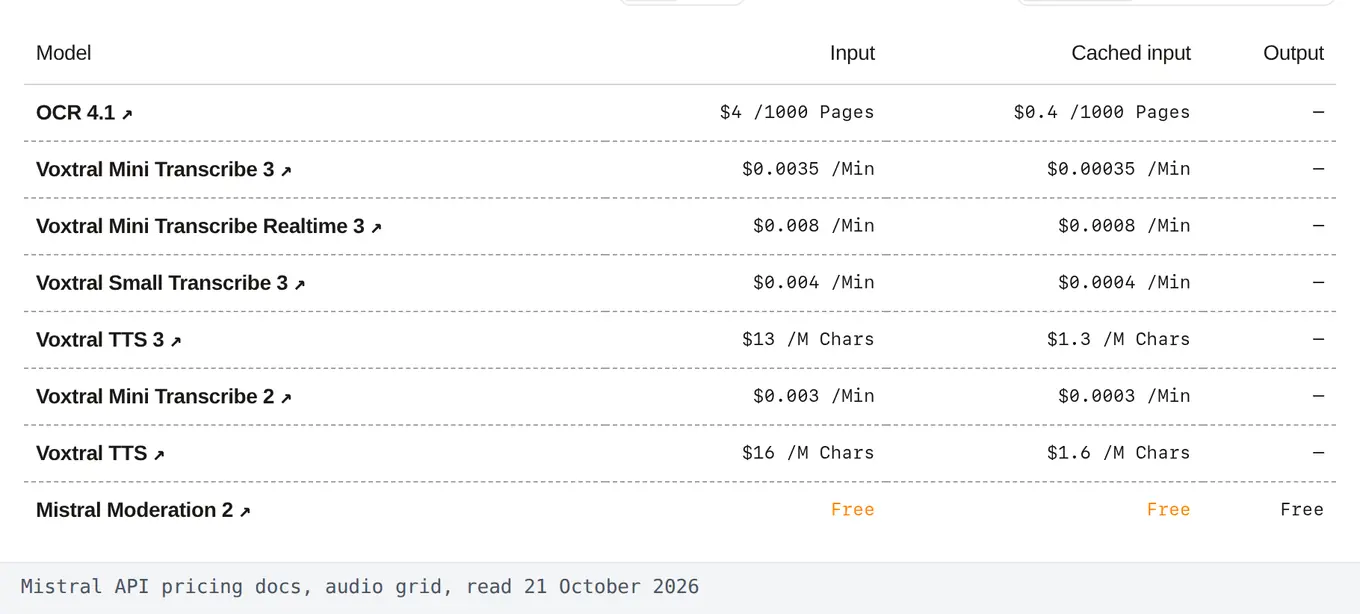
The launch post on 20 October 2026 announced the price, and the Mistral API pricing documentation carries it in the same grid as the transcription models. The second column converts each speech rate to one hour of narration at 54,000 characters.
| Mistral speech model | Per million characters (per hour of narration) |
|---|---|
| Voxtral TTS 3 | $13 ($0.70) |
| Voxtral TTS 3, cached rate | $1.30 ($0.07) |
| Voxtral TTS (March 2026) | $16 ($0.86) |
| Voxtral TTS (March 2026), cached rate | $1.60 ($0.09) |
Mistral’s own naming is loose. The launch post calls the model both Voxtral Mini TTS 3 and Voxtral Speech 3, the docs call it Voxtral TTS 3, and the API id on the Voxtral TTS 3 model card is voxtral-mini-tts-3-0. All four names point to the same $13 line.
One hour of narration on Voxtral 3 TTS: 54,000 characters x $13 per million = $0.70. On the first Voxtral TTS, $0.86.
How a million characters turns into hours
A million characters is about 18.5 hours of narration at 150 words a minute, counting six characters per word with the space. An eight-hour audiobook is roughly 432,000 characters, which comes to $5.62 at list price before any retakes.
Three things push the bill above the length of your script, and none of them is specific to Mistral.
- Retakes. Every regenerated line is a new request and a new set of billed characters.
- Inline direction. Voxtral 3 accepts tags such as [emotion=sad] and [pace=slow] written into the text. Mistral’s pages do not say whether they are excluded from the count, so I would assume they are billed like any other text.
- Voice preparation. Pro Voice adaptation needs about 30 minutes of sample audio, according to the launch post, and no price for it appears on the API grid.
What the $1.30 cached rate is, and is not
The docs grid has a “Cached input” column, and it lists $1.30 per million characters for Voxtral TTS 3, a tenth of the list price. Neither the model card nor the launch post says what makes a speech request count as cached.
I would not budget on it. Until Mistral documents which repeated text qualifies, plan at $13 and treat anything billed at the cached rate as a bonus.
What changed from the first Voxtral TTS
Mistral released its first Voxtral TTS on 23 March 2026, according to its model card. Voxtral 3 replaces it in the launch post, but not in the price list.
$16 to $13, and the old model is still billable
The new rate is 19% below the old one: $13 against $16 per million characters. The first Voxtral TTS still sits in the pricing grid at $16, so a pipeline that names the old model keeps paying the old price until someone changes the model id.
If you run Voxtral TTS in production today, switching to voxtral-mini-tts-3-0 saves about $0.16 per hour of narration. That is small per hour, and worth a config change on anything that runs every day.
Preview, not open weights
The two model cards differ on more than price. The first Voxtral TTS is listed as GA under a CC BY-NC 4.0 licence, with downloadable weights. Voxtral TTS 3 is listed as Public Preview with a Premier label and no weights tab, so the self-deployment the launch post mentions goes through Mistral’s sales team rather than a download.
The language count also disagrees between pages. The launch post claims 35+ languages and 50+ dialects, with voice presets in 18 languages, while the model card says the model supports 9 languages. Before you plan a production in anything other than English or French, test your language in the Studio playground.
First Voxtral TTS: GA, CC BY-NC 4.0, $16 per million characters. Voxtral TTS 3: Public Preview, Premier, $13 per million characters.
Batch and realtime on one price
Mistral prints a single line for “batch and realtime, same API”. Mistral demoed the direction tags in its launch thread, and it is a good picture of what the realtime side is built for:
Voxtral Mini TTS 3 achieves state-of-the-art expressiveness in 35+ languages and 50+ dialects. Implicit instruction-following reads emotion, pace, and emphasis from the conversation. With explicit instruction-following, tags like [emotion=sad][pace=slow] set them line by line.
@MistralAI
https://x.com/MistralAI/status/2112574621182775528
The flat price helps voice agents, which need streaming and get no surcharge for it. It does nothing for overnight narration, which on other APIs earns a batch discount. That is where the comparison below gets interesting.
Where Voxtral 3 sits against Eleven v4, OpenAI and Gemini
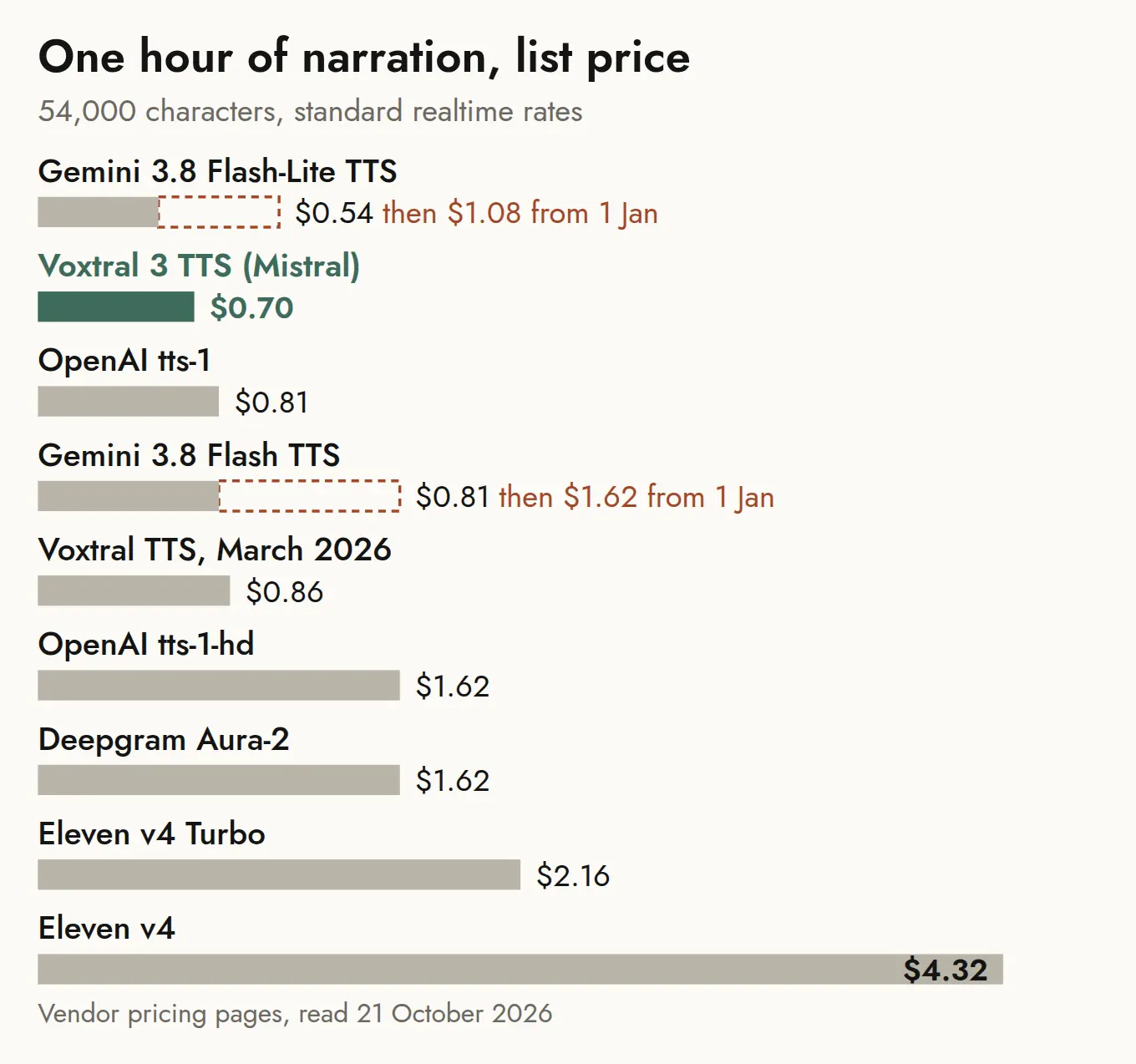
The other voices bill on different meters. ElevenLabs, OpenAI’s tts-1 and Deepgram charge per character, while Google bills its TTS models per audio token at 25 tokens a second. The chart converts all of them to one hour of narration, using 54,000 characters for the per-character models and 3,600 seconds of audio for Google’s, every price read on its vendor page on 21 October 2026.
About six times cheaper than Eleven v4
On the ElevenLabs API pricing page, Eleven v4 costs $0.08 per 1,000 characters and v4 Turbo $0.04, which is $4.32 and $2.16 per hour. Voxtral 3 is about six times cheaper than v4 and three times cheaper than Turbo or Flash. I worked through what the ElevenLabs hour includes in my Eleven v4 cost per hour breakdown, and the gap here is a gap in price, not in what is billed.
Mistral says Voxtral 3 costs less than OpenAI tts-1, Deepgram, ElevenLabs Flash and Gemini Flash. At standard rates, that holds: tts-1 at $15 per million characters is $0.81 an hour, Deepgram Aura-2 at $0.030 per 1,000 characters is $1.62, and Gemini 3.8 Flash TTS is $0.81.
Price is not the whole picture. Artificial Analysis placed the model in the top 12 of its text to speech arenas on launch day, a measured rank rather than a vendor claim:
Mistral has released new Speech models! Voxtral Small Transcribe 3 takes the #3 spot on the Artificial Analysis Speech to Text leaderboard, and Voxtral 3 TTS enters the top 12 in both Text to Speech arenas
@ArtificialAnlys
https://x.com/ArtificialAnlys/status/2112587905222709432
The two Google voices that still undercut it
The claim leaves out Gemini 3.8 Flash-Lite TTS. On the Gemini API pricing page it costs $0.0015 per 10 seconds of audio through 31 December 2026, which is $0.54 an hour, below Voxtral 3’s $0.70. From 1 January 2027 it doubles to $1.08.
Batch makes the gap wider. Google halves its TTS rates in batch mode, so until the end of the year an hour costs:
- $0.27 on Gemini 3.8 Flash-Lite TTS in batch, then $0.54 from 1 January 2027.
- $0.41 on Gemini 3.8 Flash TTS in batch, then $0.81.
- $0.70 on Voxtral 3 TTS, batch or not, with no scheduled change.
Google also bills the text you send, $0.50 per million tokens at the introductory rate, which adds about a cent per hour. For narration you can render overnight, Gemini in batch is cheaper than Voxtral 3 through December and stays cheaper on Flash-Lite after the rise.
Which voice I would put on each job
Voxtral 3 earns its place where you need streaming and a fixed price per character. Here is how I would route the work at the rates above.
- Voice agents and live phone lines: Voxtral 3 at $0.70 an hour, the cheapest per-character voice with no batch-only catch. Mistral also sells a voice agent API at $0.04 a minute with Mistral Small 4 doing the reasoning, a separate line from the TTS rate.
- Overnight narration on a tight budget: Gemini 3.8 Flash-Lite TTS in batch, $0.27 an hour until 31 December 2026.
- Audiobooks where one narrator carries eight hours: Eleven v4 at $4.32 an hour remains the expensive option, and for ElevenLabs subscribers the ElevenLabs plan credits work differently from the API.
- Anything still running the first Voxtral TTS: change the model id, unless you rely on the open weights.
If the same agent also listens, Voxtral 3’s transcription models are priced per minute: $0.0035 for Mini Transcribe 3 and $0.008 for Mini Transcribe Realtime 3, or $0.21 and $0.48 an hour. That sits next to Whisper’s price per transcribed hour on the speech-to-text side, and Mistral’s text models are covered in my Mistral API pricing page.