Perplexity’s Orchestrator API bills each model at its published per-token rate, with no per-request fee and no platform fee on top of credits: Claude Opus 5.5 costs $4 in and $20 out per million tokens, GPT-6.2 Sol $2 in and $10 out, exactly what Anthropic and OpenAI charge directly. The catch is access, not price, because OpenAI and most Claude models need Tier 1 ($50 of cumulative credit purchases) and Opus 5, Opus 5.5 and the Fable models need Tier 2 ($250). Against OpenRouter, which takes 5.5% when you buy credits, the same $1,000 of tokens costs you $55 less.

What the Orchestrator API is, and what changed on 17 November
I read Perplexity’s Orchestrator models and pricing page on 22 November 2026, the day after its last update. Here is what the product does and what it now covers.
From open-weight only to Claude, GPT, Gemini and Grok
When Perplexity first listed the Orchestrator API in its July 2026 changelog, it was a single endpoint for open-weight models, sold with “per-token pricing at each model’s published rates, with no per-request fees”. On 17 November 2026 Perplexity relaunched it as one API for frontier and open-weight models, covering OpenAI, Anthropic, Google and xAI alongside GLM, Kimi and DeepSeek. The launch post on Perplexity’s blog adds one line I care about: “There’s no additional platform fee on top of credits.”
The announcement on X carries the pitch in Perplexity’s own words, with a short demo video:
Introducing the Perplexity Orchestrator API. Orchestrator lets you choose the right model for the right task, and automatically selects the provider based on availability, capacity, and latency. All open-weight and proprietary models are in one API with unified billing.
@perplexity_ai
https://x.com/perplexity_ai/status/2122785177135096053
One key, one balance, three request formats
You call every model with your Perplexity API key and pay from the same credit balance as the rest of the Perplexity API. The endpoint speaks OpenAI Chat Completions, OpenAI Responses and Anthropic Messages, so moving an existing integration means changing the base URL, the key and the model ID (openai/gpt-6-luna, not gpt-6-luna). The API is stateless: you send the whole conversation every time, and fields such as previous_response_id return HTTP 400.
What the frontier models cost through Perplexity
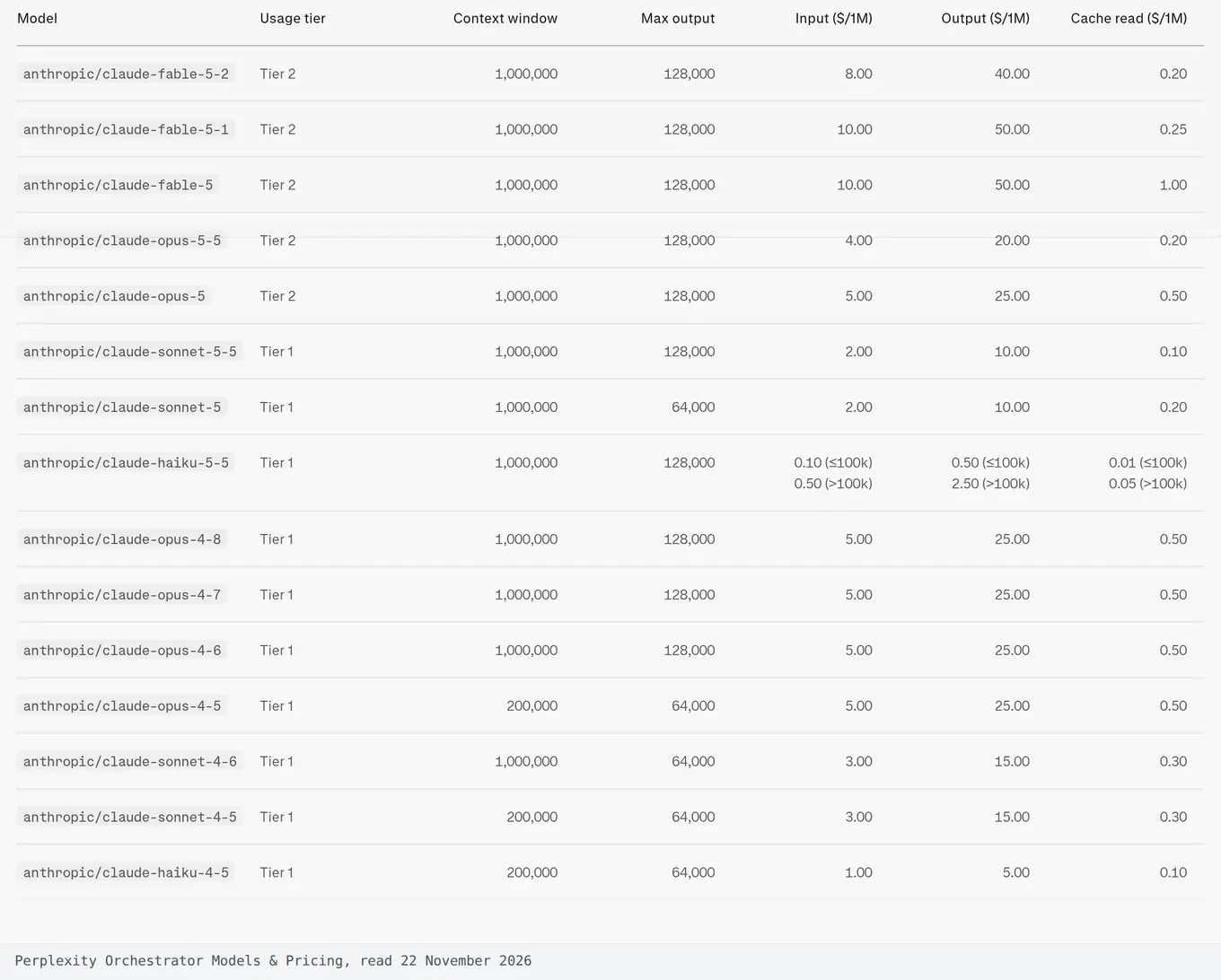
The catalogue lists 47 model IDs from seven providers. These are the rows most people will actually call, per million tokens, as read on 22 November 2026:
| Model (minimum tier) | Input / output / cache read |
|---|---|
| Claude Fable 5.2 (Tier 2) | $8 / $40 / $0.20 |
| Claude Opus 5.5 (Tier 2) | $4 / $20 / $0.20 |
| Claude Sonnet 5.5 (Tier 1) | $2 / $10 / $0.10 |
| Claude Haiku 5.5 (Tier 1) | $0.10 / $0.50 / $0.01 up to 100k input |
| GPT-6.2 Astra (Tier 1) | $8 / $40 / $0.40 up to 272k input |
| GPT-6.2 Sol (Tier 1) | $2 / $10 / $0.10 up to 272k input |
| GPT-6 Luna (Tier 1) | $0.10 / $0.50 / $0.01 up to 272k input |
| Gemini 3.8 Flash (Tier 0) | $0.75 / $3.75 / $0.075 through 31 December 2026 |
| Grok 4.7 (Tier 0) | $2 / $6 / $0.50 under 200k input |
| Kimi K3 (Tier 0) | $3 / $15 / $0.30 |
| GLM 5.3 (Tier 0) | $1.40 / $4.40 / $0.26 |
| DeepSeek V4 Pro 0813 (Tier 0) | $1.32 / $3.96 / $0.044 |
The same rates as buying direct
I checked six of those rows against the providers’ own pages the same morning. Fable 5.2, Opus 5.5 and Sonnet 5.5 match Anthropic’s pricing table to the cent, cache read included, and GPT-6.2 Sol, GPT-6.2 Astra and GPT-6.1 Sol match OpenAI’s Standard rates. You pay no premium for the convenience of one bill, which is the whole point of the product.
If you already watch what GPT-6.2 Sol costs per token, nothing changes on that line.
Long context works the way it does at the source. OpenAI models double their input and cache-read rates above 272k input tokens and raise output by half, and Grok doubles all three above 200k.
Cache writes, flex and priority
The per-token table is not the whole bill. Perplexity’s billing section adds four rules you should price in:
- Five-minute cache writes cost 1.25 times the input rate on Anthropic models and on the GPT-6.2, 6.1, 6 and 5.6 families, so $5 per million on Opus 5.5.
- One-hour cache writes, Anthropic only, cost 2 times input, $8 per million on Opus 5.5. Both figures match Anthropic’s own table.
- Reasoning tokens are billed at the output rate.
- On OpenAI models,
service_tierflex halves the token rates and priority doubles them; GPT-6.2 Sol and GPT-6.2 Astra refuse flex.
One gap: the billing section lists no Batch rate. If half-price batch jobs on Anthropic or OpenAI are part of your budget today, keep those jobs on the direct APIs.
Which models your usage tier unlocks
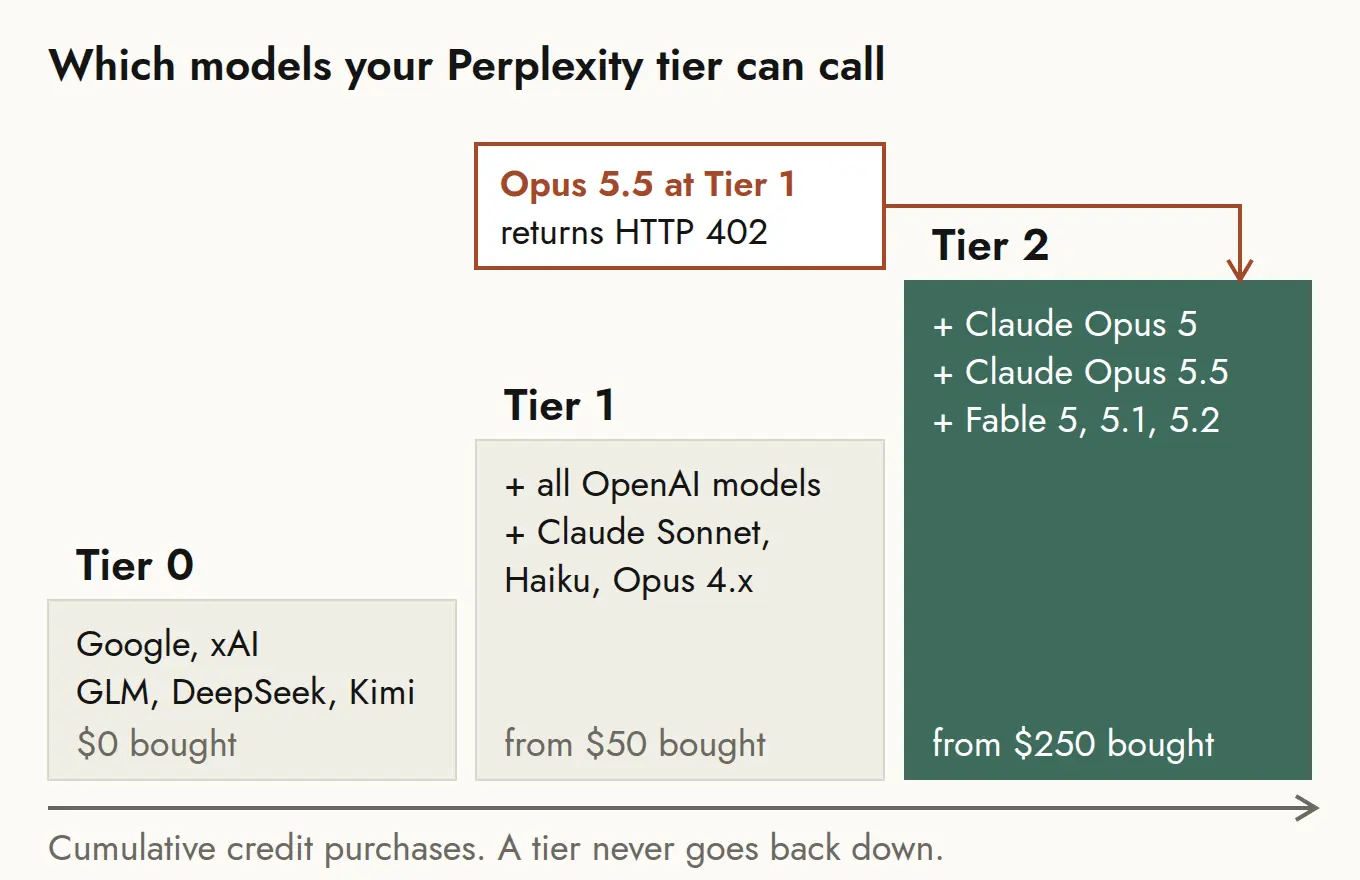
This is the part that will trip up most new accounts. The price is public, but the right to call a model depends on how much you have bought in total.
Tier 0, Tier 1 and Tier 2
Perplexity’s usage tiers page ties tiers to cumulative credit purchases over the life of the account: Tier 1 from $50, Tier 2 from $250, and once reached a tier never goes back down.
Google, xAI and the open-weight models work from Tier 0. Every OpenAI model, plus Claude Sonnet, Haiku and the Opus 4.x line, needs Tier 1. Claude Opus 5, Opus 5.5 and the three Fable models need Tier 2.
A new Perplexity account cannot call Claude Opus 5.5 until it has bought $250 of credits in total. Before that, the request returns HTTP 402.
Why Opus 5.5 returns a 402
The check reads your tier, not the credits sitting in your balance. Adding $100 on a fresh account gives you $100 to spend on Sonnet 5.5 or GPT-6.2 Sol, but Opus 5.5 still answers with a 402 that names your tier and the minimum it needs. My advice: if Opus or Fable is the reason you are here, budget the first $250 as an entry ticket you will spend on the cheaper models anyway.
What perplexity/auto bills you
Set the model to perplexity/auto and a decision model picks one model per request. Without your own routes, the default policy sends work to GPT-6.1 Sol and sends greetings, quick facts, titles and short rewrites to GPT-6 Luna, which is twenty times cheaper on both input and output. Perplexity’s routing and reliability docs say you are billed at the served model’s published rates, and they list no charge for the decision itself.
Three details change the bill in practice.
- Both default models need Tier 1, so a Tier 0 account must pass custom routes built from Google, xAI or open-weight models.
- Any image, audio, video or file in the conversation skips the decision and goes to the default model.
- Each model keeps its own prompt cache, so a conversation that hops from Luna to Sol between turns loses the cache hits it would have had on one model.
Perplexity vs OpenRouter vs LiteLLM on the same bill
The fair comparison is $1,000 of tokens at list price, the same models, on each route:
| Route | What $1,000 of tokens costs you |
|---|---|
| Perplexity Orchestrator | $1,000, no fee on credits or requests |
| OpenRouter, card payment | $1,055 with the 5.5% credit fee |
| LiteLLM, self-hosted | $1,000 paid to each provider, plus your server |
OpenRouter’s 5.5% on credits
OpenRouter’s FAQ states the same pass-through promise on token rates, then charges 5.5% when you buy credits, with a $0.80 minimum and 5% on crypto payments. Bring your own provider keys and the first $25,000 a month of usage carries no fee, then 5% above that. I break the rest down in what OpenRouter adds to your bill; on pure token cost, Perplexity now wins by those 5.5 points.
On $1,000 of tokens, OpenRouter's 5.5% credit fee adds $55. Perplexity's Orchestrator adds nothing, per its billing docs read on 22 November 2026.
LiteLLM, free software and your own server
LiteLLM is open source and self-hosted: you keep your own OpenAI and Anthropic keys, pay each provider directly, and carry the machine, the monitoring and the on-call yourself. That route also keeps the providers’ Batch pricing, which the Orchestrator billing section does not list. The trade-offs are laid out in OpenRouter vs LiteLLM for your stack; Perplexity’s Orchestrator is the closest thing to LiteLLM’s single endpoint without running it.
The OpenAI approval rule applies here too
Since 20 November 2026, OpenAI requires prior approval for any service that lets third parties directly access its models, and the Orchestrator resells GPT access to developers exactly like the routers covered in OpenAI’s router approval rule. The Orchestrator docs I read say nothing about it, so I would keep a direct OpenAI key as a fallback for production GPT traffic.
What to check before you move traffic
Before you point production at the new base URL, run through these points from the docs:
- Retired IDs still in the table: the changelog set 24 October 2026 as the retirement date of GPT-5.4, 5.4 mini, 5.4 nano, 5.2, 5.1, 5 and 5 mini, yet the models page still lists them on 22 November. Do not build on them.
- Zero data retention: an organisation with ZDR on cannot call Fable 5, 5.1, 5.2 or GPT-6.2 Astra, which return HTTP 403.
- No provider keys: the Orchestrator does not accept OpenAI or Anthropic keys, so any credits or commitments you hold there stay there.
- Dated rates: the Gemini 3.8 Flash and 3.7 Flash prices apply through 31 December 2026.
- Failures: a 429 is not billed and a request that fails before any output is not billed, but a stream that breaks midway is billed for the tokens delivered.
If you also need fetched web pages for your agent, that is a separate product with its own meter, covered in Perplexity’s Context API pricing.
Frequently asked questions
Does Perplexity add a markup on Orchestrator models?
Not on the rows I checked. Opus 5.5, Sonnet 5.5, Fable 5.2, GPT-6.2 Sol, GPT-6.2 Astra and GPT-6.1 Sol cost the same per token as at Anthropic and OpenAI, and Perplexity states there is no per-request fee and no platform fee on top of credits.
Can I use my own OpenAI or Anthropic key with the Orchestrator API?
No. Requests authenticate with your Perplexity API key only and are billed to your Perplexity credits at the rates on the models page.
Is perplexity/auto more expensive than naming a model?
Not by itself: you pay the rate of the model that served the request, and the docs list no fee for the routing decision. It can cost more indirectly when consecutive turns land on different models and miss the prompt cache.