Qwen4-Max is Alibaba’s new flagship Qwen model, a multimodal MoE with a 1M-token context, released on Model Studio on 16 November 2026 for coding, office work and agents. In the Singapore region it costs $1.50 per million input tokens and $4.50 per million output tokens, thinking included, flat across the window, with 1 million free tokens for 90 days. The Global deployment scope lists $1.413 in and $4.24 out. That is a quarter below Qwen3.8-Max, about a third of Claude Opus 5.5 on the same task, and a little above DeepSeek V4-Pro at peak hours.

What Qwen4-Max is
Qwen4-Max is the first model of the Qwen4 family and the top of Alibaba’s paid API line. Alibaba’s Qwen4-Max launch post pitches it as an “AI teammate” for long professional jobs: coding, 3D work, finance, law and healthcare.
Where it sits in the Qwen line
Model Studio’s own guide now reads like a three-step ladder. qwen3.7-plus is the default, qwen3.8-flash is the cheap option, and qwen4-max is the one to pick “for tasks with higher reasoning and understanding requirements”.
It replaces Qwen3.8-Max at the top, and it is cheaper than the model it replaces. A preview opened on 11 November through Alibaba’s Token Plan subscription only; the pay-as-you-go API arrived five days later, on 16 November.
What it takes in and gives back
These are the limits listed on Model Studio’s text generation model table, as of 16 November 2026:
- input: text, images (up to 2,048 per request) and video (up to 64 clips, two hours each);
- a 1M-token context window;
- up to 131,072 output tokens in non-thinking mode, 262,144 for thinking plus answer;
- thinking and non-thinking modes on the same model ID;
- function calling, built-in tools such as web search, and structured outputs;
- OpenAI-compatible and Anthropic-compatible endpoints.
What sets it apart, by Alibaba’s numbers
Every figure in this section comes from Alibaba’s launch post, so treat it as a vendor claim until independent runs land.
A bigger backbone with fewer active parameters
Qwen4-Max has a 2.4-trillion-parameter MoE backbone, with 71 billion parameters active per token and another 328 billion in N-gram embeddings. Alibaba says the base model beats Qwen3.8-Max-Base in every domain it tested while activating 25% fewer parameters.
On Work360, Alibaba’s in-house benchmark of real industry tasks, Qwen4-Max scores 52.69 against 47.74 for Qwen3.8-Max. It is Alibaba’s benchmark, built by the team that trained the model.
Fewer tokens per task
For a buyer, this is the claim that matters most. Alibaba says Qwen4-Max uses about 24% to 35% fewer tokens than Qwen3.8-Max on Work360, and about 48% to 49% fewer on Terminal-Bench 4.0.
Alibaba puts the average Work360 task at $1.67 on Qwen4-Max, against $4.43 on Qwen3.8-Max: 62% less, from cheaper tokens and fewer of them.
Qwen’s launch post on X carries the token-efficiency claim and the benchmark chart:
📢 Meet Qwen4-Max, your new AI teammate for work, creativity, and discovery! Qwen4-Max is built on a new MoE architecture with native vision and a 1M-token context window. Highlights: – Outperforms Qwen3.8-Max with up to ~50% fewer tokens, while average cost per task drops over
@Alibaba_Qwen
https://x.com/Alibaba_Qwen/status/2122148127520289151
What Alibaba has built with it so far
The pay-as-you-go API is one day old, so the builds that show a finished result are Alibaba’s own. They show what the model is tuned for: long, tool-heavy jobs that end in a file you can open.
Three playable games in Unreal and Unity
From one brief each, Qwen4-Max built Meow of Magic, a cat-mage wave shooter in Unreal Engine, and Yun Guan Xing, a sword-flying adventure, also in Unreal. The third, Flying Racer, is a West Lake racing game in Unity 6, shipped as an installable Android build.
Alibaba says the model ran each game and used what it saw to fix camera tracking, animation and hit feedback. No token count or bill is given.
A car part programmed in 24 minutes
At two automotive suppliers, SANF and Pacific Union, Qwen4-Max planned production lines, designed parts and generated toolpaths. Alibaba reports that programming a single workpiece fell from about 475 minutes to 24.
A due diligence report from 198 messy files
Given 198 badly named working papers for a pre-IPO review, the model sorted them into 14 folders and cross-checked public records. It then wrote an 86-page report covering 12 review areas, every conclusion citing a working paper.
Investment research across 90 MCP tools
In the finance demo, Qwen4-Max called 90 MCP tools for quotes, financials, rates and dividends across Chinese, Hong Kong and US markets. The deliverables were an Excel workbook and an editable PowerPoint deck whose charts map to the workbook cell by cell.
None of these comes with a cost per run. Independent builds with a time and a bill will say more.
Qwen4-Max API pricing
Here is what Alibaba’s Model Studio pricing page shows for qwen4-max as of 16 November 2026, per million tokens.
The grid, flat to 1M tokens
| Line | Price |
|---|---|
| Input, International (Singapore) | $1.50 |
| Output, International (Singapore) | $4.50 |
| Input, Global deployment scope | $1.413 |
| Output, Global deployment scope | $4.24 |
| Qwen3.8-Max, Singapore, for reference | $2.00 in, $6.00 out |
| Free quota, Singapore only | 1 million tokens for 90 days |
There is one tier for every request up to 1M input tokens, so no long-context surcharge. The output column is labelled “chain of thought + answer”: thinking tokens bill at $4.50 like the visible reply.
Against Qwen3.8-Max, the Singapore rates are exactly 25% lower on both input and output. On the Global scope, the cut is about 14%, from $1.65 and $4.951.
Regions and the free quota
Qwen4-Max is live in Singapore under the International scope, in Beijing for the Chinese mainland, and under the Global scope in Virginia, Frankfurt, Hong Kong and Tokyo. Outside the Chinese mainland, the Global rate is the cheaper of the two.
The free quota applies only in Singapore. It runs for 90 days from your Model Studio activation, the model’s release or your application approval, whichever comes last.
Cache and batch, the two open questions
Alibaba has not published a public cache price for qwen4-max. Its context cache page says the explicit cache prices for this model “do not follow the generic ratios” of 125% to write and 10% to read, and sends you to the Model Studio console for the figures.
Two more points before you plan around discounts:
- the qwen4-max row carries no “50% batch inference discount” label at launch, while qwen3.8-max does, so do not assume batch pricing yet;
- where both exist, batch and cache discounts cannot be combined, and cache only cuts input tokens.
What a task costs against Opus 5.5, GPT-6.1 Sol and DeepSeek
The other rates below are standard list prices as of 16 November 2026, from the Anthropic, OpenAI and DeepSeek pricing pages.
One agent task, priced four ways
Take a coding agent task that reads 2 million tokens and writes 200,000, thinking included, with no cache hits:
| Model, standard rate | Cost of the task |
|---|---|
| Claude Opus 5.5, $4 / $20 | $12.00 |
| GPT-6.1 Sol, $2 / $10 | $6.00 |
| Qwen4-Max, Singapore, $1.50 / $4.50 | $3.90 |
| Qwen4-Max, Global, $1.413 / $4.24 | $3.67 |
| DeepSeek V4-Pro, peak, $1.32 / $3.96 | $3.43 |
| DeepSeek V4-Pro, off-peak, $0.66 / $1.98 | $1.72 |
Per token, Qwen4-Max output is 4.4 times cheaper than Claude Opus 5.5’s per-token rates and 2.2 times cheaper than GPT-6.1 Sol. DeepSeek’s V4-Pro stays cheaper still, and halves again outside its peak hours.
A month of agent traffic
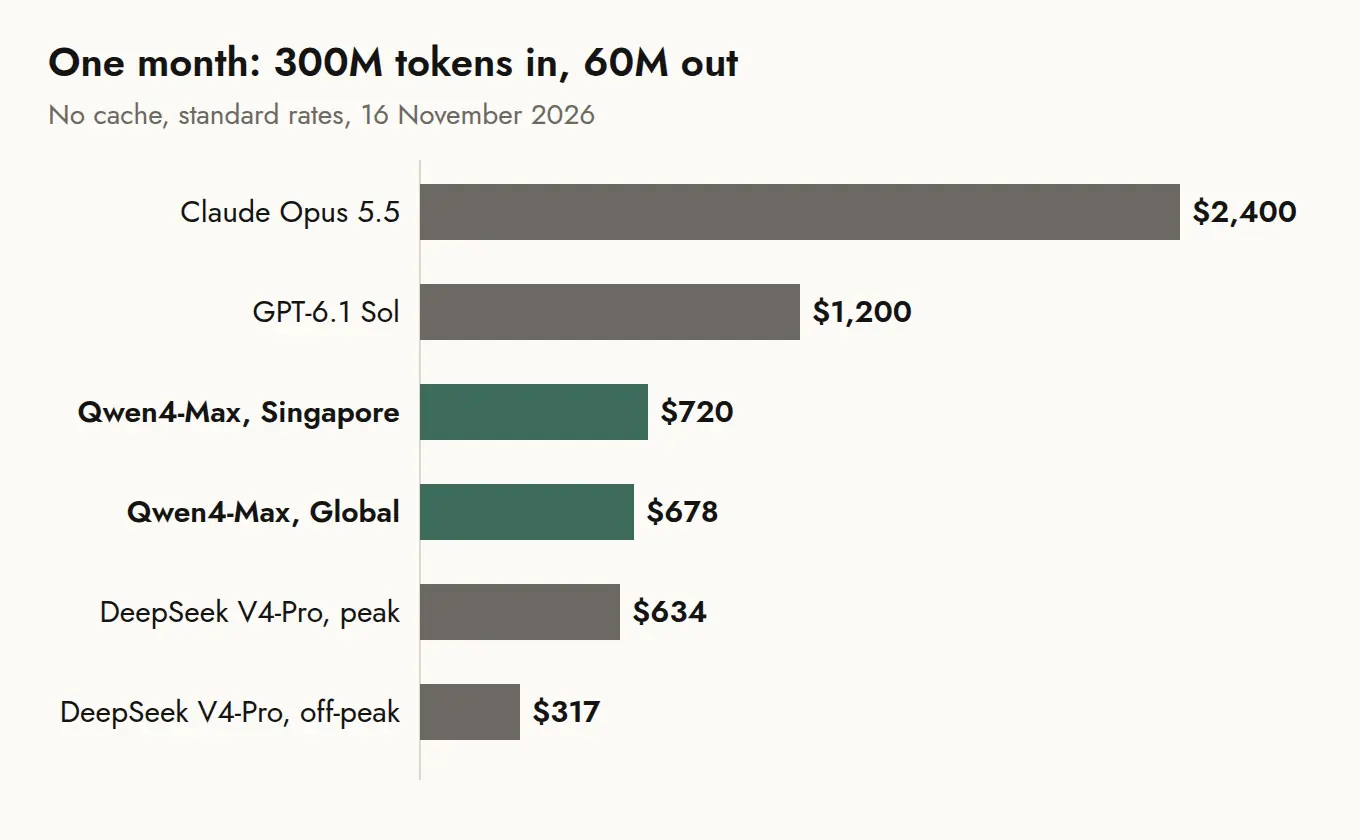
Scale that to an agent that reads 300 million tokens and writes 60 million a month, no cache:
- Claude Opus 5.5: $1,200 plus $1,200, $2,400 a month;
- GPT-6.1 Sol: $600 plus $600, $1,200;
- Qwen4-Max, Singapore: $450 plus $270, $720;
- Qwen4-Max, Global: $423.90 plus $254.40, $678.30;
- DeepSeek V4-Pro at peak: $396 plus $237.60, $633.60, or $316.80 entirely off-peak.
Where the gap narrows
Caching changes the picture, and Qwen4-Max is the one model here without a public cache rate. If 60% of that input hits the cache, Opus 5.5 falls to $1,716 and GPT-6.1 Sol’s halved cache rate brings it to $858.
Qwen4-Max at $720 with no cache discount at all is still below both. DeepSeek V4-Pro at peak, with the same cache hits, drops to $403.92, under anything Qwen4-Max could reach. If DeepSeek is your baseline, what DeepSeek actually charges is worth a look first.
My verdict
If you run Qwen3.8-Max, switch now: the same 1M window, a 25% lower grid in Singapore and, if Alibaba’s token figures hold, a much smaller bill per task.
If you pay Opus 5.5 or GPT-6.1 Sol rates for agent work, Qwen4-Max is worth a week of side-by-side runs on your own tasks. It costs a third of Opus on uncached traffic, and the free million tokens in Singapore cover a first test.
If cost is the only criterion, DeepSeek V4-Pro is still cheaper, especially off-peak and with caching. Pick Qwen4-Max over it for vision and video input, which V4-Pro does not support, and wait for the cache price before you budget a cache-heavy workload.