GPT-Live-1.1, OpenAI’s full-duplex voice model released in the API on 19 November 2026, costs $0.05 a minute while the session is active and $0.02 a minute on standby, billed per second. Standby is a new WebRTC option that pauses inference after 5 to 60 seconds of silence and wakes when someone speaks. An hour of non-stop talk costs $3.00 in voice charges, an hour that is mostly quiet drops toward $1.20, and backend model and tool calls are billed on top. GPT-Live-1 now has the same two rates.

What GPT-Live-1.1 is and what the update changes
GPT-Live is OpenAI’s voice front end: it listens and speaks at the same time, and hands reasoning and tool use to a backend model or agent that you configure. Version 1.1 keeps that architecture and the price, and works on transcription, accents and task completion. The pricing story sits in a new idle mode, not in a new per-minute rate.
A voice layer with a backend behind it
The voice session and the backend are two separate bills. The voice model handles the conversation, while a Responses call or your own client delegation does the thinking and runs the tools. That split is why the per-minute rate looks low: it never includes the model that answers the hard questions.
What changed from GPT-Live-1
The model page and the 19 November changelog list a short set of changes:
- more accurate transcription of what the user says;
- a more consistent accent and voice across languages, plus better pronunciation;
- delegation described in plain language in the session configuration;
- a standby mode for WebRTC sessions, available on both GPT-Live-1 and GPT-Live-1.1;
- separate concurrent-session limits for the two models, each applying across inference regions.
OpenAI’s own launch post on X names the standby option as the cost lever, alongside the accent work.
GPT-Live-1.1 is now available in the API. It speaks with more natural and consistent accents across languages, supports lower idle costs with a new standby option, and completes tasks even more reliably. https://t.co/8DkU6Q2IIt
@OpenAIDevs
https://x.com/OpenAIDevs/status/2123506733524136446
The GPT-Live-1.1 rate card
As of 20 November 2026, the OpenAI API pricing page carries a dedicated GPT-Live table, under Audio, with two columns: Active rate and Standby rate. Both models sit on the same line of prices.
Active and standby rates
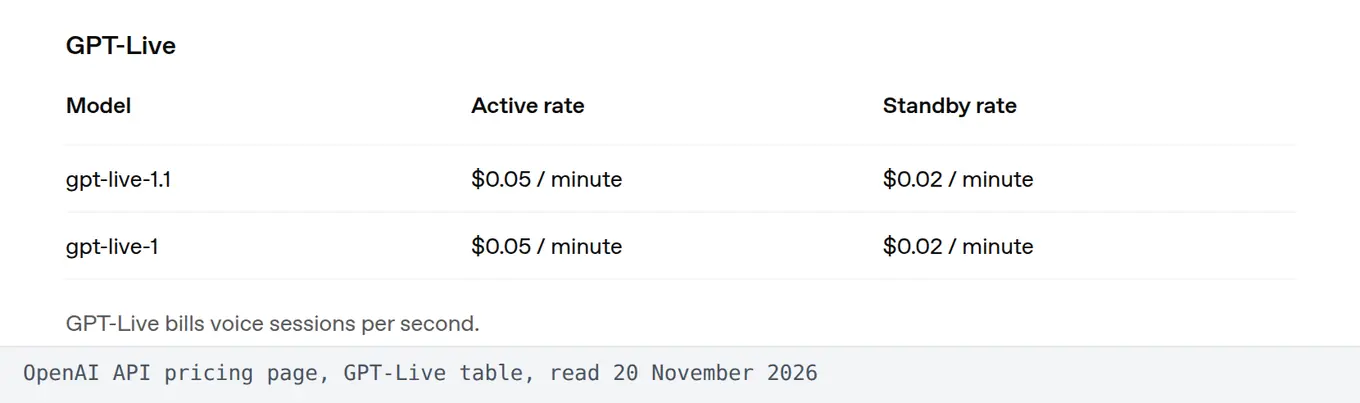
| GPT-Live-1.1 voice session | Price |
|---|---|
| Active, per minute | $0.05 ($3.00 an hour) |
| Standby, per minute | $0.02 ($1.20 an hour) |
| GPT-Live-1, active and standby | Same $0.05 and $0.02 |
| Billing unit | Per second, no rounding to the minute |
The standby rate only applies to WebRTC sessions while inference is paused. OpenAI documents standby for WebRTC only, so a WebRTC session without standby configured, like any session that never pauses, bills every second at the active rate.
Standby cuts the voice rate by 60%, from $0.05 to $0.02 a minute, but only for the seconds when inference is actually paused.
What counts as active time
This is where budgets go wrong. OpenAI’s GPT-Live cost guide counts all of the following as active:
- speech, from the user and from the model;
- silence before the idle timeout expires;
- time spent waiting for backend work while inference is running;
- time with the microphone muted, since muting does not trigger standby.
There is also a startup detail. Creating a WebRTC session bills 15 seconds of voice duration while it initializes, and that amount is credited against the duration once the session runs, so it is not an extra fee on a normal call.
Backend calls are a second bill
Every Responses call the voice layer delegates is billed at the normal rate of the backend model you configured, with its input, output, cached input and any tool charges. OpenAI’s guide makes a point I agree with: a faster backend can lower the total, because every minute the user waits on a slow tool is a minute of active voice time.
What an hour of conversation really costs
Since voice is billed per second at two rates, the cost of an hour is a mix. The formula is active minutes times $0.05 plus standby minutes times $0.02, then the backend on top.
Six ways to spend the same hour
Here is the voice bill for one hour of session time, before backend charges:
| How the hour is spent | Voice cost |
|---|---|
| 60 minutes active, non-stop talk | $3.00 |
| 45 minutes active, 15 on standby | $2.55 |
| 30 minutes active, 30 on standby | $2.10 |
| 15 minutes active, 45 on standby | $1.65 |
| 5 minutes active, 55 on standby | $1.35 |
| 60 minutes on standby, nobody speaks | $1.20 |
A full working day of eight hours sits between $9.60 and $24.00 in voice charges alone. Where you land depends less on how much people talk than on how fast the session drops into standby.
The idle timeout is the setting that matters
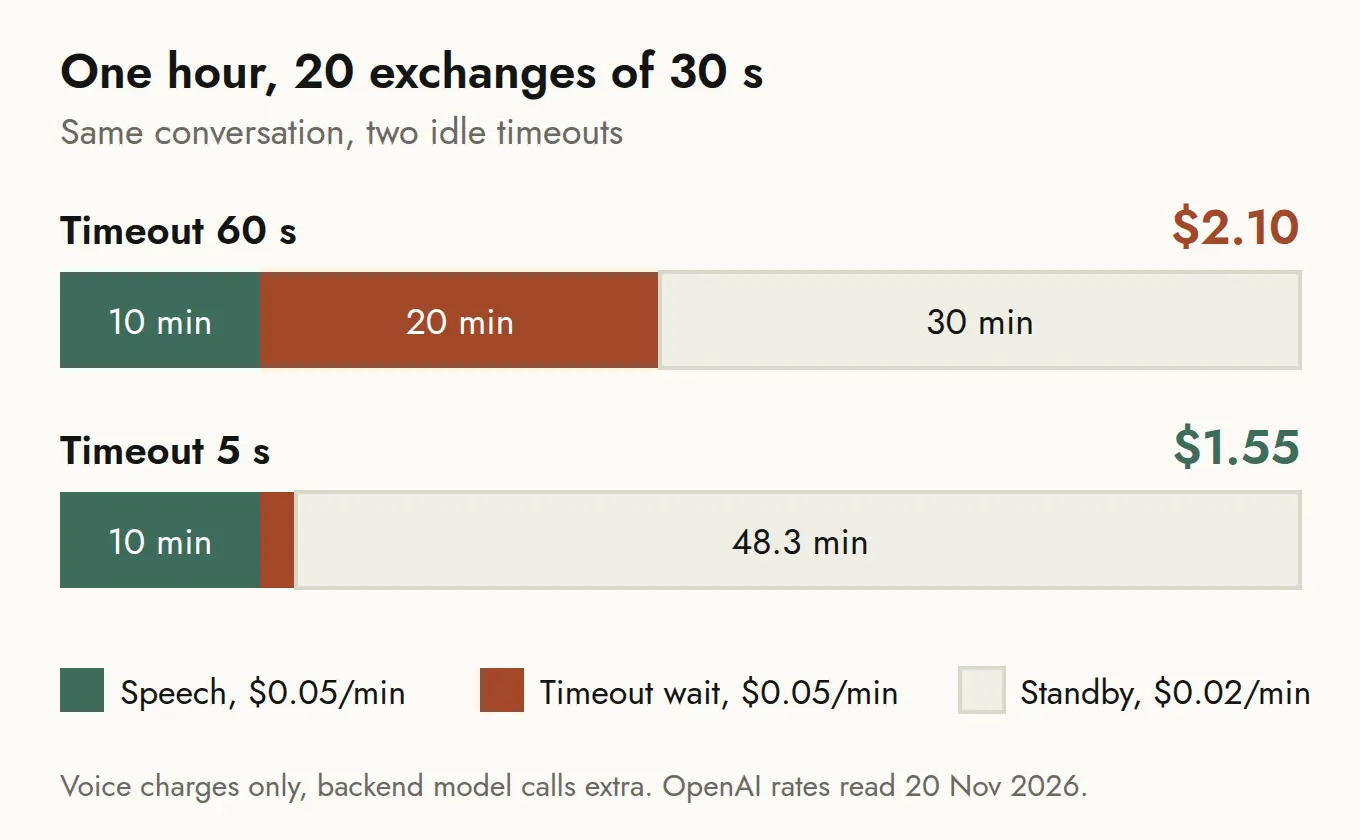
Each pause costs the idle timeout at the active rate before standby starts. Take an assistant woken 20 times in an hour, with 30 seconds of speech per exchange, so 10 minutes of real talk:
- with a 60-second timeout, 30 minutes are billed active and the hour costs $2.10;
- with a 20-second timeout, about 16.7 minutes are active and the hour costs $1.70;
- with a 5-second timeout, about 11.7 minutes are active and the hour costs $1.55.
The same conversation costs 35% more with the longest timeout. My verdict: start at 10 to 15 seconds, then lower it until users notice the slower first reply that OpenAI warns about after standby.
The $1.20 an hour claim, and the mute button
The $1.20 an hour figure going around for an always-on assistant is the standby rate times 60, and it only holds if almost nothing is said. One detail breaks the common version of it: muting the microphone keeps the session active, so a muted, always-on assistant costs $3.00 an hour, not $1.20. Leave the microphone track running and let the timeout do the work.
A muted GPT-Live session is billed at the active rate: $3.00 an hour, two and a half times the standby floor.
How to set standby up
Standby is opt-in and is set when you create the WebRTC session. Without it, nothing changes from the old per-minute billing.
The three session fields
OpenAI’s guide to managing GPT-Live sessions documents three settings:
- session.wake_policy.type set to speech, so inference waits for speech before starting;
- session.idle_timeout_s, a whole number from 5 to 60, the seconds without an input or output transcript before the session returns to standby;
- session.wake_policy.vad_threshold, optional, from 0 to 1 with a default of 0.5, how much evidence of speech wakes the model.
If you omit the timeout, inference stays active after the first wake until the session ends, which is the most expensive way to run it. The session emits session.paused when it enters standby and session.resumed when inference is ready, which is what you log to check the bill.
Standby or close the session
Standby keeps the connection, the session ID and the conversation history. Closing stops voice charges entirely, but you have to save context and seed a new session when the user comes back. A 10-minute silence costs $0.20 on standby, which is cheap for a call that should stay connected. For an agent that goes quiet for an hour while a backend task runs, I would close the session and reopen it on the result.
GPT-Live-1.1 against Grok voice and transcription
xAI also bills its speech-to-speech model by the minute, and the comparison also answers a question people ask about the cheaper, transcription-only route. Rates below are from the xAI API pricing page and OpenAI’s pricing page, read on 20 November 2026.
Grok voice at $0.08 a minute
grok-voice-3.0 is listed at $0.08 a minute, $4.80 an hour, plus $0.004 per text input, and xAI’s table shows no standby or idle rate. An hour of non-stop conversation therefore costs $3.00 on GPT-Live-1.1 against $4.80 on Grok voice, and the gap widens on quiet calls. If you also run Google’s stack, our page on what Gemini Live voice costs prices Google’s equivalent.
Can Grok transcribe audio instead?
Yes. xAI sells Speech to Text separately at $0.10 an hour over REST and $0.20 an hour streaming, which our Grok speech-to-text pricing page covers in detail. OpenAI’s own streaming transcription model, gpt-live-transcribe, has an estimated cost of $0.017 a minute, about $1.02 an hour.
If you only need text from audio, a transcription model costs a fraction of a voice session. GPT-Live-1.1 makes sense when the app has to talk back. Against Grok voice it wins on price at every mix of talk and silence, and for other per-minute voice stacks, compare it with the Eleven Realtime API rates, which bill per minute plus tokens.