Eleven Realtime on the API costs $0.08 per connected minute, so $4.80 an hour before a single token, on both v1 Mini and v1 Max. Tokens come on top: $0.20 in and $6.00 out per million on Mini, $1.80 in and $9.00 out on Max, rates read on ElevenLabs’ API pricing page on 21 October 2026. ElevenLabs’ own included-minute estimates put a typical hour at about $5.04 on Mini and $6.11 on Max, roughly eight to ten times what Gemini 3.8 Live charges for the same hour of voice.

What Eleven Realtime charges on the API
ElevenLabs launched Eleven Realtime on 20 October 2026: two speech-to-speech models, v1 Mini and v1 Max, that bundle recognition, turn-taking, the LLM and the voice into one model choice. On the Realtime API you pay two meters, and the second one is where Mini and Max differ.
The official launch post carries a short demo video of the model answering spoken questions, which shows what the per-minute meter is buying.
Introducing Eleven Realtime, a new class of Speech to Speech models. Voice agents usually make you choose between quick replies or precise answers. Eleven Realtime gives you both. It starts talking in half a second and gets spoken reasoning questions right. https://t.co/axAFCRinsV
@ElevenLabs
https://x.com/ElevenLabs/status/2112550782063247521
The connected-audio meter
The first meter is time. The ElevenLabs API pricing page lists $0.080 per additional minute of connected audio for both models, on every plan, free tier included. The meter counts connected audio, not who is speaking, so an agent that mostly listens pays the same minute as one that talks all the time.
That flat minute is the whole story of this pricing. It sets a floor of $4.80 for every hour a session stays connected, whatever the model says or does not say.
Token rates for v1 Mini and v1 Max
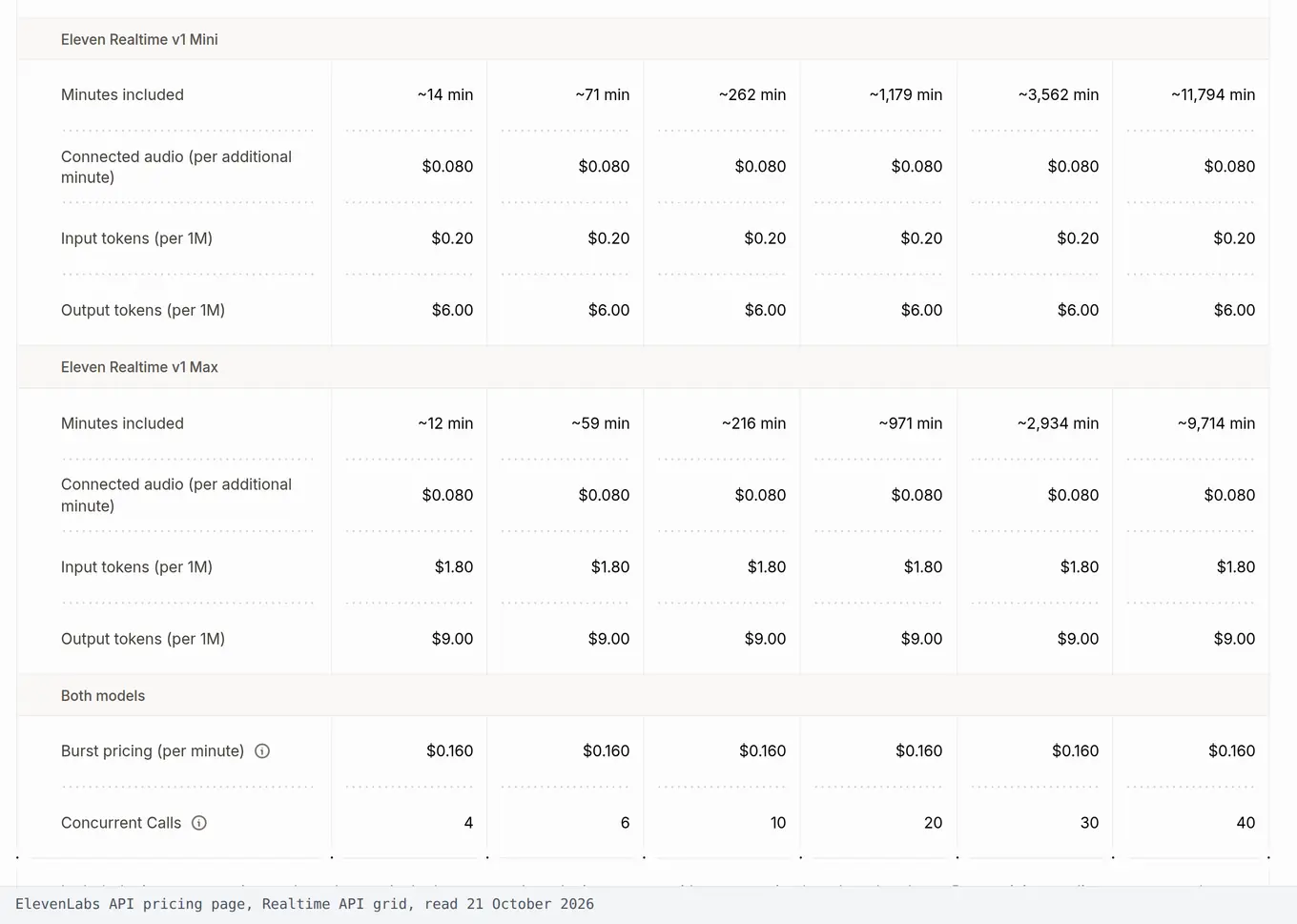
The second meter is tokens, priced per million, with the same token prices on every plan. Here is the grid as ElevenLabs published it on 21 October 2026.
| Line | Price |
|---|---|
| Connected audio, both models | $0.080 per minute |
| v1 Mini input tokens | $0.20 per million |
| v1 Mini output tokens | $6.00 per million |
| v1 Max input tokens | $1.80 per million |
| v1 Max output tokens | $9.00 per million |
| Burst minute, both models | $0.160 per minute |
Max costs nine times Mini on input and one and a half times on output.
Burst pricing above your concurrency limit
Each plan caps how many calls run at once, and the minutes above that cap are billed at the burst rate, double the normal minute. The pricing page lists these concurrency limits per plan:
- Free and pay as you go: 4 concurrent calls
- Starter ($6 a month): 6 calls
- Creator ($22 a month): 10 calls
- Pro ($99 a month): 20 calls
- Scale ($299 a month): 30 calls
- Business ($990 a month): 40 calls
A support line that spikes to 15 simultaneous calls on a Creator plan pays $0.16 a minute on the 5 extra calls. Size the plan on your peak, not your average.
What an hour of conversation costs
The minute is easy to price. The tokens are not, because ElevenLabs does not publish how many tokens a minute of conversation consumes.
The floor you pay before any token
Sixty connected minutes at $0.080 make $4.80 an hour on either model. That is a hard floor: no prompt trick or shorter answer brings it down, only hanging up sooner does.
One connected hour on Eleven Realtime costs $4.80 in audio minutes alone, on v1 Mini and v1 Max alike, before any input or output token.
What ElevenLabs’ own plan estimates imply
ElevenLabs does give one clue. Each plan shows how many Realtime minutes its monthly price buys, with the note that these are “estimates based on typical token usage”. Divide the plan price by those minutes and you get ElevenLabs’ own idea of a typical all-in minute.
The result is stable across plans, which tells me it is a deliberate assumption rather than noise:
- v1 Mini: $990 buys about 11,794 minutes on Business and $22 about 262 on Creator, so roughly $0.084 a minute, or $5.04 an hour
- v1 Max: $990 buys about 9,714 minutes and $22 about 216, so roughly $0.102 a minute, or $6.11 an hour
Take away the $0.080 audio minute and the typical token bill is about $0.24 an hour on Mini and $1.31 an hour on Max. On Mini the tokens are a rounding error; on Max they add about 27% to the floor.
Why ElevenLabs does not let you pin the token bill
Those per-hour figures are derived from ElevenLabs’ estimates, not published as rates. The pricing page adds that actual minutes “vary with conversation length and tool use”, and it does not say whether input tokens are text or audio tokens.
My advice: run one realistic test call on each model, read the token counts on the invoice, and only then multiply. On Max, a tool-heavy agent with a long system prompt can sit well above the $1.31 an hour that the plan estimates suggest.
Eleven Realtime against Gemini 3.8 Live
Google bills Gemini 3.8 Live per minute of audio in each direction instead of per connected minute. On Google’s Gemini API pricing page, read on 21 October 2026, audio in costs $0.005 a minute and audio out $0.018 a minute.
Three conversations, two pricing models
I priced the same three hours as on our Gemini page: an assistant talking 20%, 40% and 70% of the time. Eleven Realtime does not care about the split, so its line is the plan-estimate hour on each model.
| Model, rates read 21 October 2026 | One hour at 20% / 40% / 70% assistant talk |
|---|---|
| Gemini 3.8 Live ($0.005 in / $0.018 out per minute) | $0.46 / $0.61 / $0.85 |
| Eleven Realtime, audio minutes only | $4.80 at any split |
| Eleven Realtime v1 Mini, typical tokens | about $5.04 at any split |
| Eleven Realtime v1 Max, typical tokens | about $6.11 at any split |
On the balanced 40% hour, Mini costs about eight times Gemini 3.8 Live and Max about ten times. Even a tutor that talks 70% of the time, Gemini’s worst case, stays under a fifth of the Eleven Realtime floor.
Where the gap actually comes from
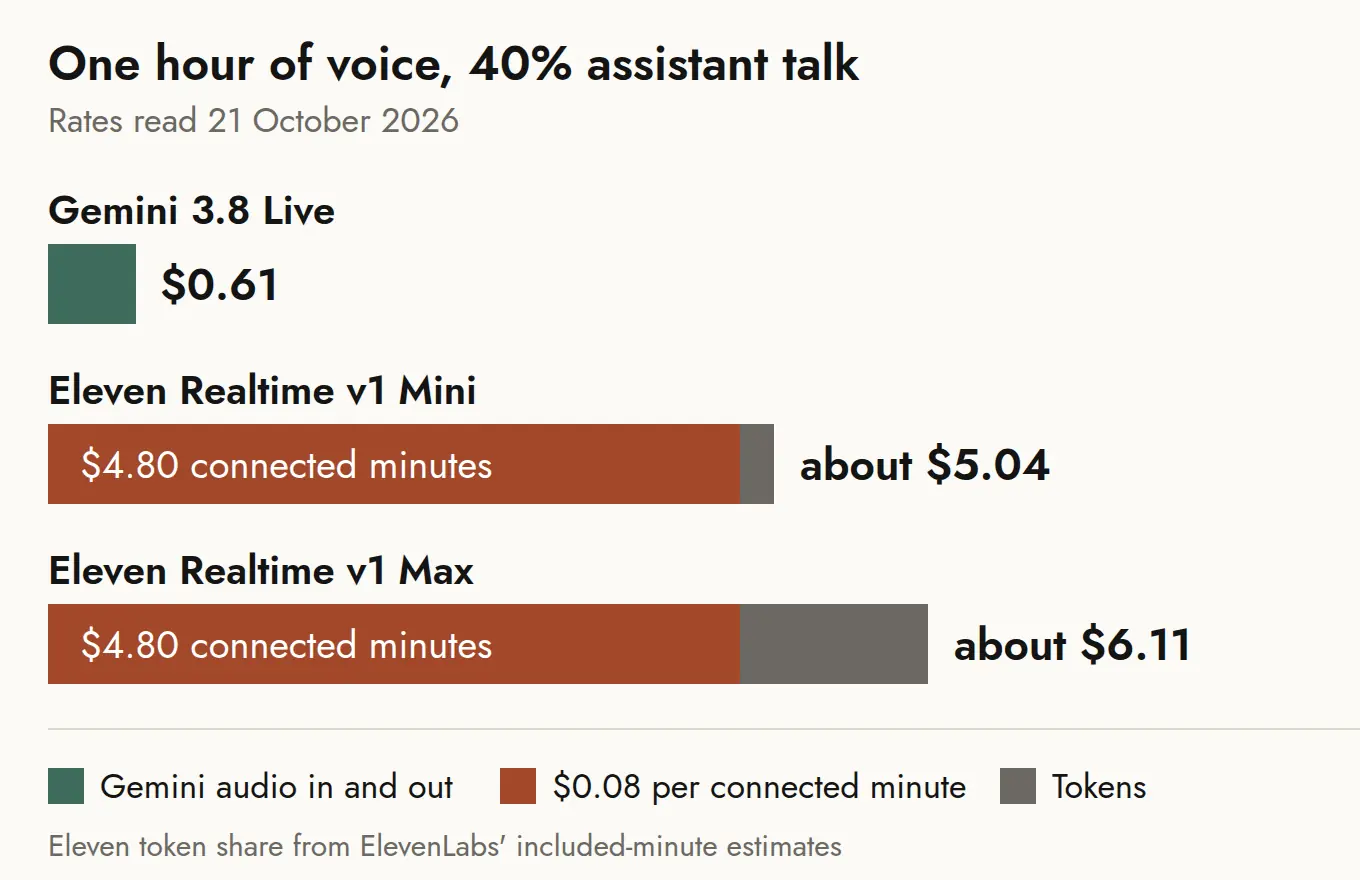
The tokens are not the problem. ElevenLabs charges $0.08 for every connected minute, while Google’s most expensive minute, audio out, is $0.018, and listening costs only $0.005.
Eleven Realtime's $0.08 connected minute is 16 times Gemini 3.8 Live's $0.005 audio-in minute and more than four times its $0.018 audio-out minute.
What you buy with that premium is the ElevenLabs voice library and its turn-taking, plus an endpoint that speaks OpenAI’s Realtime protocol. Whether that is worth eight times the price is a product question, not a pricing one.
Mini or Max, and when to skip both
Because the minute is identical, choosing between the two models is a token decision, and on most agents a small one.
Pick Mini unless the agent reasons or calls tools
ElevenLabs’ Realtime models documentation calls Mini the default with the lowest latency and cost, and says Max “reasons before it responds” for complex instructions and multi-step tool use. Two rules in that page can decide for you:
- Zero Retention Mode and HIPAA are available on Max only, in the US and the EU
- Max is not available in the India and Singapore data residency environments, where only Mini runs
My verdict: start on Mini. At about $1.07 more per typical hour, Max only pays off when Mini gets answers wrong or when compliance forces it.
What the Realtime API does not give you
The API is compatible with OpenAI’s Realtime API: you change the endpoint and model name and keep your handlers. At launch it connects over WebSocket only, with no WebRTC, and it runs separately from ElevenAgents, so phone channels, knowledge bases, guardrails and monitoring are not part of it.
If you do not need a live conversation at all, this is the wrong product. A pre-recorded hour of narration is priced on our Eleven v4 pricing page, and the subscription plans themselves are broken down in our ElevenLabs cost breakdown.