GPT Image 2.6 costs $8 in, $30 out per million image tokens on OpenAI’s API, with cached image input at $2 and text input at $5, for both Sunburst and Flare. Those rates match GPT Image 2.5 exactly. The bill per image does not: OpenAI’s own calculator gives 2.6 4.2 times the output tokens at low quality and 3.3 times at medium, so a 1024×1024 image goes from about $0.006 to $0.025 at low, while high quality stays at $0.053.

What GPT Image 2.6 costs per million tokens
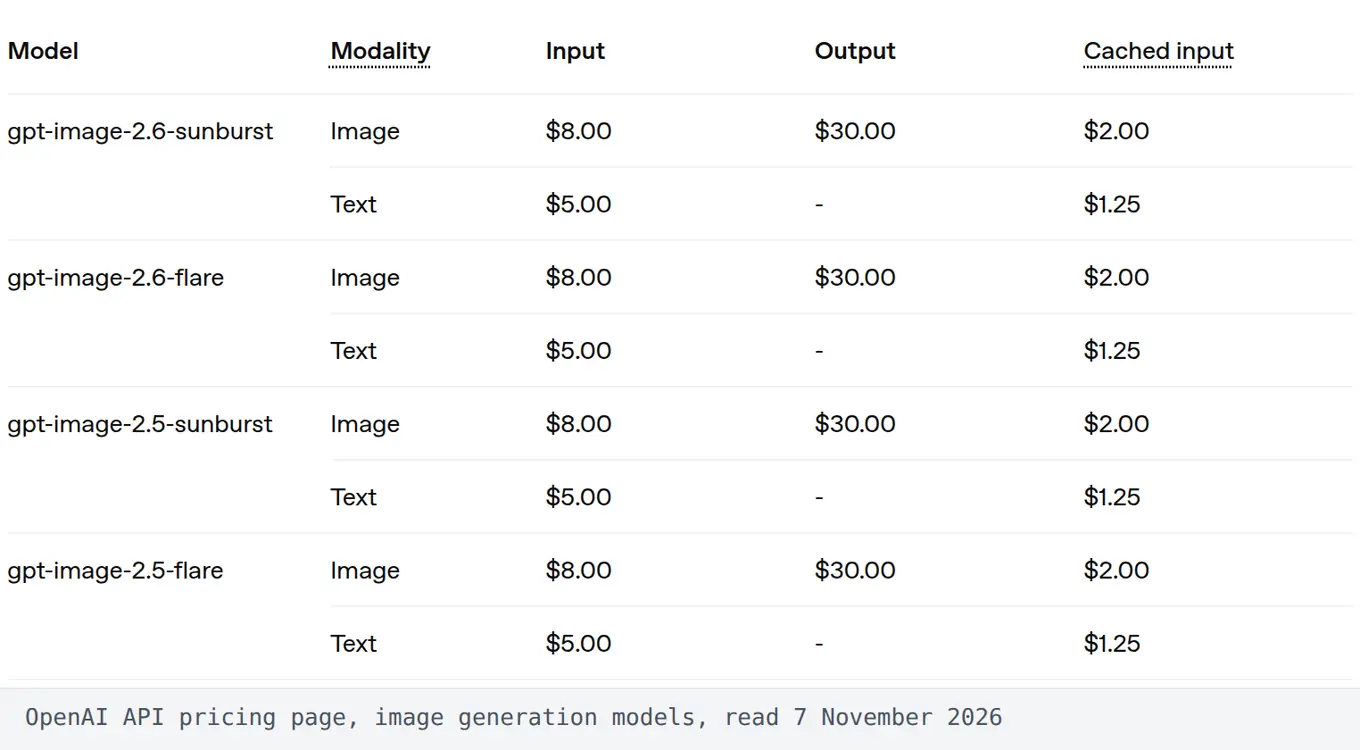
OpenAI released Images 2.6 on 4 November 2026 and added two API models, gpt-image-2.6-sunburst and gpt-image-2.6-flare, to the image table of its API pricing page. I read that table on 7 November 2026, and the two models share one row of prices.
| Per 1M tokens | Sunburst and Flare |
|---|---|
| Image input | $8.00 |
| Cached image input | $2.00 |
| Image output | $30.00 |
| Text input | $5.00 |
| Cached text input | $1.25 |
| Text output | None, the models only output images |
How token billing works for an image
There is no flat price per picture. You pay for the text tokens in your prompt, the image tokens of any reference image you send to the edits endpoint, and the image tokens the model produces. Size and quality set that last number, and on a plain generation request it usually dwarfs the prompt.
That is a different habit from video, where Google bills by the second, as our Gemini Omni 1.2 Flash pricing page shows. If you run a text model next to the image model, the text side of the bill is in our OpenAI cost calculator.
Sunburst or Flare is not a price decision
OpenAI pitches Flare at fast iteration and Sunburst at detailed visual work. Its launch post says Flare can generate an image in as little as six seconds at low quality, and that Sunburst holds details better across edits at medium or high. Pick on output, because the rate card will not separate them.
OpenAI Developers put the headline speed figure in its launch post on X: 50% faster than before.
Today, we’re bringing GPT-Image-2.6 to Codex and the API. Image-2.6 Flare and Sunburst, our two new API image models, generate images 50% faster than before. At medium or high quality, Sunburst keeps details more consistent from one edit to the next.
@OpenAIDevs
https://x.com/OpenAIDevs/status/2118124753340756055
Same rates as GPT Image 2.5, but not the same bill
Stop at the pricing table and the upgrade looks free. OpenAI’s image generation guide warns against that reading in one line: “Equal token rates don’t mean equal cost per image.”
Why low and medium quality cost more on 2.6
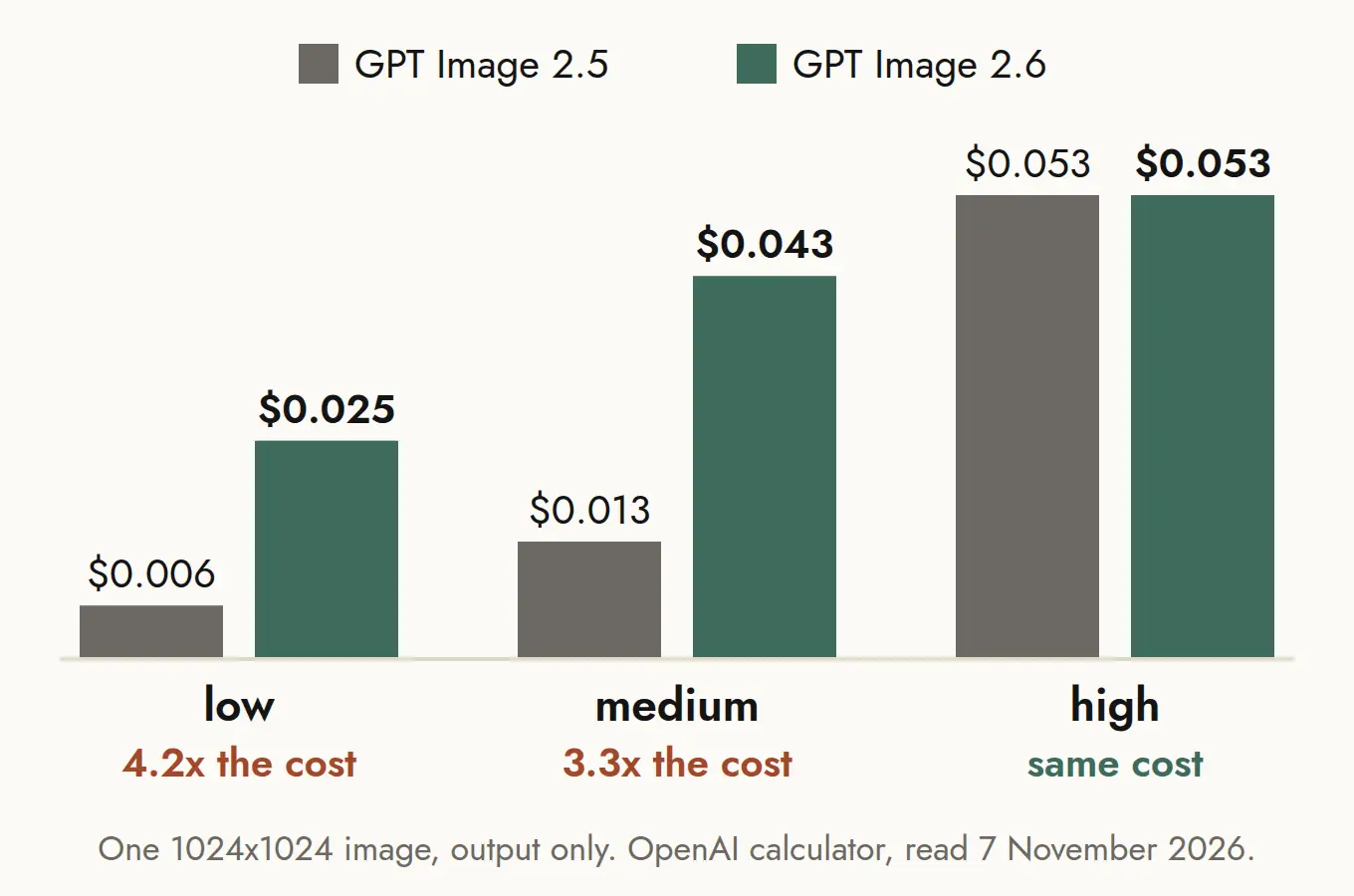
The cost calculator in that guide has separate entries for 2.6 and 2.5, so I read its script. Both versions start from the same token estimate for a given size and quality. Then 2.6 multiplies it by 4.2 at low and 3.3 at medium, while high, xhigh and max get no multiplier and land on the same token count as 2.5.
I checked that formula against two figures OpenAI displays. It returns the 823 tokens and $0.02469 the calculator shows on load, and its GPT Image 2 branch reproduces the $0.211 high-quality price in OpenAI’s published table.
Same $30 per million tokens, but a low-quality 1024x1024 image is 196 output tokens on GPT Image 2.5 and 823 on GPT Image 2.6.
Neither the launch post nor the API changelog mentions this. Both stick to features, so you will only find it in the calculator or on your invoice.
What that does to 1,000 images
Here is image output alone for 1,000 images at 1024×1024, using the calculator’s estimates. These are not measured runs: I did not call the API.
- Low: $5.88 on 2.5, $24.69 on 2.6
- Medium: $13.17 on 2.5, $43.47 on 2.6
- High: $52.68 on both
The quality ladder also gets much flatter. On 2.5, dropping from high to low saves 89% of the output cost. On 2.6 it saves 53%, so the old habit of drafting cheap at low and finishing at high pays far less than it did.
Arena’s first ranking tested both models at medium, the setting where 2.6 costs 3.3 times more, so that is the comparison to run on your own prompts.
GPT Image 2.6 Sunburst and Flare by @OpenAI are here, running almost 2x faster than GPT Image 2.5. In the Text-to-Image Arena, Sunburst (Medium) is #2 with 1409 pts, and Flare (Medium) #4 with 1384 pts! By category, Sunburst landed #1 in Cartoon, Anime & Fantasy.
@arena
https://x.com/arena/status/2118139063345787124
What one GPT Image 2.6 image costs at each size
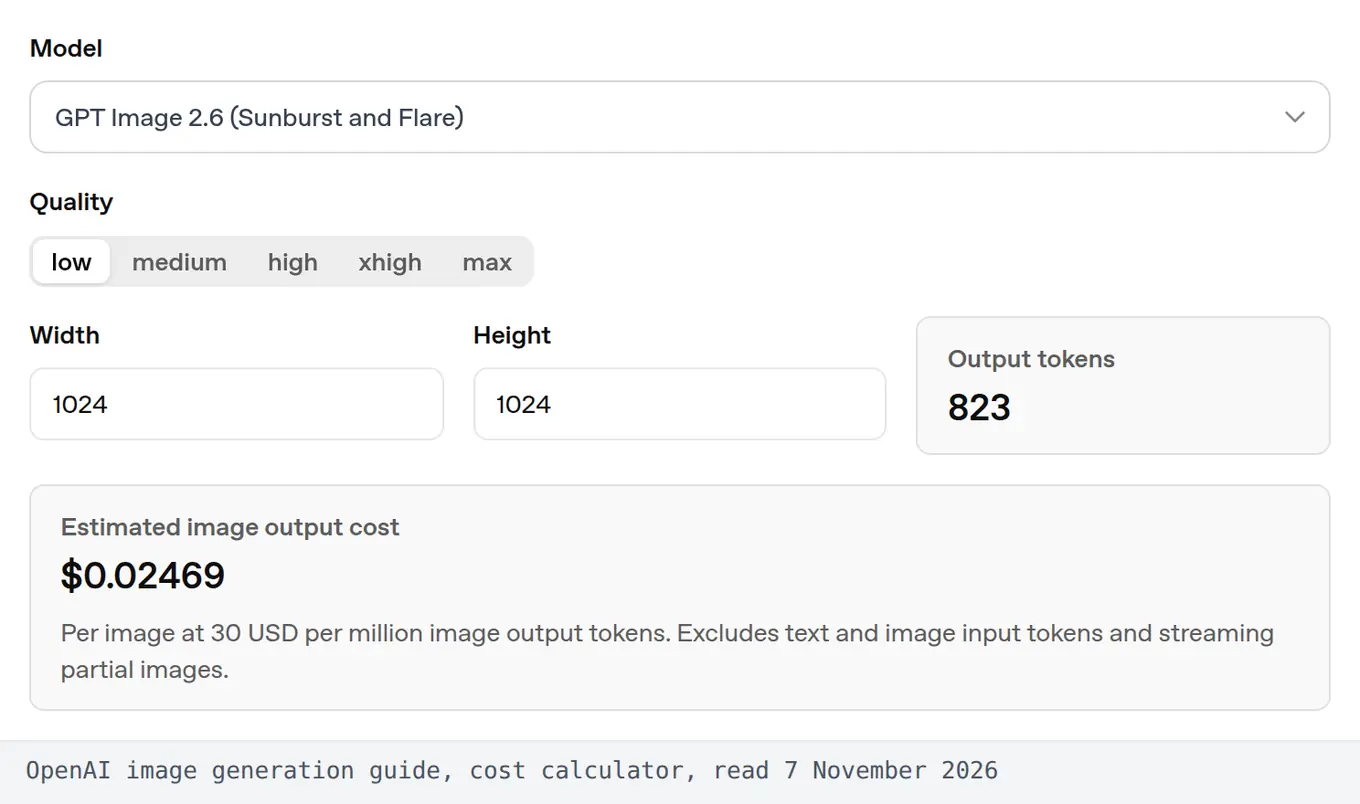
These are the calculator’s output estimates for 2.6, read on 7 November 2026 and rounded to a tenth of a cent. They apply to both Sunburst and Flare, because OpenAI’s calculator treats them as one entry.
| Quality | 1024×1024 / 1536×1024 / 2048×2048 |
|---|---|
| low | $0.025 / $0.020 / $0.050 |
| medium | $0.043 / $0.034 / $0.088 |
| high | $0.053 / $0.041 / $0.107 |
| xhigh | $0.094 / $0.074 / $0.190 |
| max | $0.211 / $0.165 / $0.428 |
Notice that 1536×1024 is cheaper than the smaller square. OpenAI says a larger non-square size can sometimes produce fewer output tokens, and portrait 1024×1536 gives the same figures as landscape. If your layout can take a 3:2 image, you save about 20% on the same quality setting.
What those figures leave out
The calculator covers image output only. Four other items can land on the invoice.
- Prompt text at $5 per million tokens, so a 200-token prompt adds $0.001.
- Reference images on edits at $8 per million image tokens. Read the count from the response’s usage field.
- Streaming: each partial image adds 100 image output tokens, or $0.003.
- SVG output: you pay the image rate for a reference image plus the rate of an authoring model for the tokens it uses. OpenAI gives no total.
Animated GIFs are the gap. I found no billing rule for them in the guide, and the calculator prices one image, not a GIF that defaults to 9 frames. Run one test and read the usage before you promise a price to anyone.
The new controls that add no fee
Markup-guided edits use the same rates as other edits, with no extra fee, and OpenAI says adjusting complexity has no separate fee either. If you omit the complexity field, both models use high. OpenAI recommends low for most edits, because higher settings can add latency and unwanted changes.
What GPT Image 2.6 does not offer yet
Three gaps favor 2.5 as of 7 November 2026. Each one could close quietly, so read the pages again before you plan around them.
No Batch price
The Batch tab of the pricing page lists gpt-image-2.5-sunburst and gpt-image-2.5-flare at half the standard rate: $4 image input, $15 image output, $1 cached, $2.50 text input. There is no 2.6 row, and the 2.6 model pages show the Batch endpoint greyed out while the 2.5 pages show it active.
Do not budget on the $2 cached rate
The guide says that for GPT Image 2 and 2.5, cached input pricing applies only to the image generation tool in the Responses API, not to direct Images API requests. The changelog lists 2.6 on the generations and edits endpoints, and the guide does not say where the $2 applies for 2.6. I would plan on the full $8 until your billing shows otherwise.
No dated snapshot
The 2.5 model page offers a pinned ID, gpt-image-2.5-sunburst-2026-09-08. The 2.6 pages list only the undated alias, which matters if you need reproducible output.
Should you move from 2.5 to 2.6?
Move if you render at high quality or above. Stay on 2.5 for cheap volume, at least until you have compared the two on your own prompts.
- High, xhigh or max: move now. The estimated cost is identical and OpenAI claims 50% faster generation.
- Low or medium at volume: stay on 2.5 unless 2.6 at low replaces 2.5 at a higher setting. A 2.6 low image ($0.025) costs almost twice a 2.5 medium one ($0.013).
- Jobs that can wait: stay on 2.5 Batch, the only half-price route of the two.
- SVG, GIF or the complexity setting: you need 2.6. Markup-guided edits do not force the move, since the changelog added them to 2.5 as well.
If you are still on gpt-image-1.5 or gpt-image-1-mini
OpenAI’s deprecations page shuts down gpt-image-1.5, gpt-image-1-mini and chatgpt-image-latest on 1 December 2026, and names the two 2.6 models as replacements. Do not take that swap without looking at the price.
OpenAI’s legacy table puts gpt-image-1-mini at $0.005, $0.011 and $0.036 for low, medium and high at 1024×1024, and gpt-image-1.5 at $0.009, $0.034 and $0.133. Against 2.6 at $0.025 for low, a mini user pays about five times more, while a 1.5 user at high drops from $0.133 to $0.053. Quality labels are not equal across generations, but for a mini workload 2.5 at low ($0.006) is the closer fit.
Frequently asked questions
How much does one GPT Image 2.6 image cost?
OpenAI’s calculator estimates $0.025 at low, $0.043 at medium and $0.053 at high for a 1024×1024 image, up to $0.211 at max. That is image output only, read on 7 November 2026.
Is GPT Image 2.6 more expensive than GPT Image 2.5?
The token rates are identical. Per image, 2.6 costs 4.2 times more at low and 3.3 times more at medium, and the same at high, xhigh and max.
Do Sunburst and Flare cost the same?
Yes. Both are listed at $8 image input, $30 image output and $5 text input per million tokens, and the calculator gives them one shared estimate.
Do these prices apply to ChatGPT?
No, they are API rates. OpenAI says Images 2.6 is available in ChatGPT and Codex across all subscription tiers.