Gemini Omni 1.2 Flash costs $0.07 a second of 720p video on the Gemini API, so a 15-second clip comes to about $1.04 and a 3-second clip to about $0.21. Google bills it as output tokens, 5,792 tokens per second of 720p at $12.00 per million. Drafting at 360p cuts the rate to $0.023 a second, while 1080p and 4K with upsampling run $0.104 and $0.209. That is 30% below Omni 1.1, with no free tier and no Batch discount.

What a Gemini Omni 1.2 Flash clip costs
Google launched Gemini Omni 1.2 Flash on 5 November 2026 and made it generally available on the Gemini API and Google Cloud the same day. The official launch post gives one headline number: $0.07 per second of 720p video. The useful numbers sit in the footnote of the pricing page, which prices every resolution.
Google’s own announcement on X carries the same rate and the draft-then-upscale pitch, which is the whole cost strategy in one line.
Meet Gemini Omni 1.2 Flash, our updated video generation model from @GoogleDeepMind 🎬 Get stronger consistency, more creative control, and faster, more cost-effective video creation at scale: ⚡ Fast & 30% lower cost: Draft at 360p or 720p ($0.07/s) and upscale to 1080p or 4K https://t.co/vBoyjdKHlg
The per-second rate at each resolution
As of 6 November 2026, the Gemini API pricing page lists four output resolutions for gemini-omni-1.2-flash. Each one burns a fixed number of output tokens per second, and the dollar figure follows from the $12.00 per million rate.
| Output resolution | Tokens per second, price per second |
|---|---|
| 360p | 1,931 tokens, $0.023 |
| 720p (default) | 5,792 tokens, about $0.07 |
| 1080p with upsampling | 8,688 tokens, $0.104 |
| 4K with upsampling | 17,376 tokens, $0.209 |
The ladder is clean. 360p costs a third of 720p, 1080p costs one and a half times 720p, and 4K costs exactly three times 720p.
Clip cost from 3 to 15 seconds
Omni 1.2 Flash lets you set the duration in one-second steps from 3 to 15 seconds, up from a 10-second ceiling on Omni 1.1. Since the bill is linear in seconds, the cost of any clip is the rate times the length. Here is the 720p output cost for the lengths people actually ask for.
| Clip length at 720p | Output cost |
|---|---|
| 3 seconds | $0.21 |
| 5 seconds | $0.35 |
| 8 seconds | $0.56 |
| 10 seconds | $0.70 |
| 15 seconds | $1.04 |
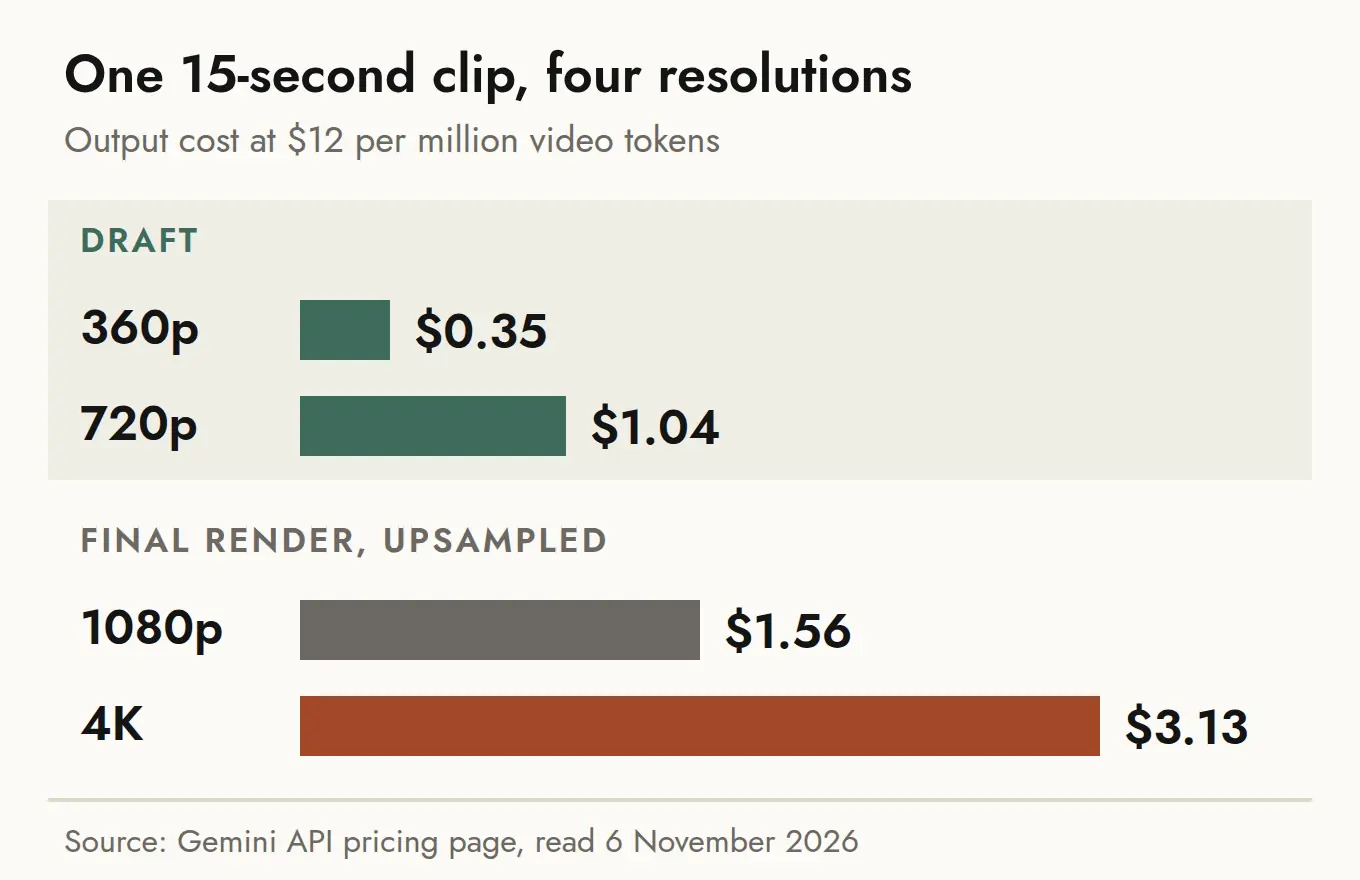
The same 15-second clip costs $0.35 at 360p, $1.56 at 1080p and $3.13 at 4K. My rule from these numbers: never pick the length before you pick the resolution, because resolution spans a ninefold price range while length spans only fivefold.
How Google turns tokens into seconds
Omni is priced like any other Gemini model, per million tokens, and the per-second figure is a conversion Google prints for you. If you already know how Gemini tokens map to dollars, the only new fact here is the fixed token count per second of video.
Output tokens at $12 per million
The paid tier row reads $9.00 per million for text output and $12.00 per million for video output. Billing is based on total output token consumption, so 5,792 tokens times $12.00 per million gives $0.0695 a second, which Google rounds to $0.07.
A 15-second 720p clip is 86,880 output tokens. Do not read that against Gemini 3.8 Flash per-token rates: a video token is billed at the $12.00 video rate, not at any text rate.
Omni 1.2 Flash caps output at 260,640 tokens per request: exactly one 15-second clip at 4K (15 x 17,376).
Input references at $1.50 per million
Everything you feed the model is input, billed at $1.50 per million tokens for text, image and video alike. That covers the prompt, character or product photos, and the short motion clips of up to three seconds you can pass as references.
The Google Cloud model card sets the limits that shape the input side:
- up to 131,072 input tokens per request;
- up to 10 images per prompt;
- input video up to 15 seconds for editing and for standalone upscaling;
- 16:9 and 9:16 output only.
On a normal prompt with two or three reference images, input is a rounding error next to the video output. It only matters when you feed long source video for editing or extension.
Draft low, upscale only the keeper
Google’s own advice is to draft at 360p or 720p, fix details with a follow-up edit instead of regenerating, then upscale the best result to 1080p or 4K. The numbers back it up, with two caveats about what the pricing page leaves unsaid.
Why 360p drafts are the cheap lever
Say you need four attempts to land a 15-second ad. The arithmetic is simple:
- four drafts at 360p: $1.39;
- four drafts at 720p: $4.17;
- four attempts straight at 4K: $12.51.
A 15-second draft at 360p costs $0.35, the same as a 5-second clip at 720p.
My verdict: 360p is good enough to judge framing, motion and timing, and those are the things you judge a draft on. Move to 720p only for the take you are about to approve.
What the pricing page does not break out
The footnote prices 1080p and 4K “with upsampling” per second of output. It does not publish a separate rate for upscaling a clip you already paid for at 720p. Until Google itemises it, budget the upscale as a full 1080p or 4K output, $1.56 or $3.13 for 15 seconds, on top of the draft.
Conversational edits and the output bill
Multi-turn editing works across full 15-second clips: swap a background, change the lighting, switch the aspect ratio. The pricing page lists no discounted edit rate, and billing follows output tokens. The safe planning assumption is that each edit turn costs what the clip it returns costs, so an edit at 360p stays cheap and an edit at 4K does not.
Omni 1.2 Flash against Omni 1.1 Flash
The two models share the same token rate per second of 720p. Only the price per token changed, along with the length ceiling.
The real size of the cut
Omni 1.1 Flash is listed at $17.50 per million video output tokens, about $0.10 a second of 720p. Moving to $12.00 is a 31% cut, which Google rounds to 30%. A 10-second 720p clip drops from about $1.01 to $0.70.
The December 3 auto-route
From 3 December 2026, every API request to gemini-omni-1.1-flash routes automatically to gemini-omni-1.2-flash and is billed at the 1.2 rates. You do not have to migrate to get the lower price, but the output will come from the newer model, so re-check any prompt you tuned on 1.1 before that date.
Logan Kilpatrick’s launch post lists the same changes, the 15-second ceiling and the 30% price cut among them.
Today we are rolling out Gemini Omni Flash 1.2, with: – longer video generation (15 seconds) – deeper cinematic controls for camera pov – support for multi-turn conversation editing – less visual drift – 30% lower price than Omni Flash 1.1 Read more: https://t.co/U0VgGTGcmW
@OfficialLoganK
https://x.com/OfficialLoganK/status/2118390838434693281
What you do not get with Omni 1.2 Flash
The Omni block on the pricing page has a single Standard tab, where most Gemini models carry Standard, Batch, Flex and Priority. In practice that means:
- no free tier, the model is paid tier only;
- no Batch discount, the Cloud model card marks batch inference as unavailable;
- Provisioned Throughput on Google Cloud for teams that need reserved capacity;
- paid tier data is not used to improve Google’s products;
- a SynthID watermark on every output.
Voice-only projects belong elsewhere: Omni generates speech inside the video, but if you need audio alone, what Gemini Live voice costs is a far smaller bill. My call for video teams: switch to 1.2 now, draft at 360p, and treat 4K as a final-render line item at $0.209 a second.