Genie 4 costs about $0.10 a second on the Gemini API, roughly $6.05 a minute of live, steerable world. Google bills its video output at $17.50 per million tokens, and every second at 24 fps burns 5,760 of them, with stereo audio included. A session is capped at 120 seconds, so the most a single world can cost you is about $12.10, as long as you call complete() when the player leaves. There is no free tier, no Batch, Flex or Priority discount and no context caching.

What Genie 4 is, and why it bills by the second
Genie 4 is Google DeepMind’s real-time world model, announced on 27 October 2026 and now listed on the paid tier of the Gemini API as models/genie-4. Instead of rendering a finished clip, it streams a world you walk through with WASD and the arrow keys, and you change it mid-session with plain text.
A world you steer, not a clip you render
The Genie 4 developer guide describes a four-step lifecycle: create the interaction, connect over WebRTC or WebSocket, seed the world, then call complete(). You seed it with a text prompt, a single 16:9 reference image, or both. Here is what the model page sets as the frame you work in:
- output at 1280×720, 16:9, 24 fps, with 48 kHz stereo audio bundled in;
- a hard cap of 120 seconds per session, with coherence strongest in the first 45 to 90 seconds;
- movement keys take effect in about 0.2 to 0.5 seconds, text events in about 1 to 2 seconds;
- serving from the United States, Western Europe and Japan only.
That is the real difference with a video model. If you want a fixed 15-second clip you can edit and upscale, Gemini Omni 1.2 Flash pricing is the cheaper line at $0.07 a second of 720p.
The Genie 4 rate card
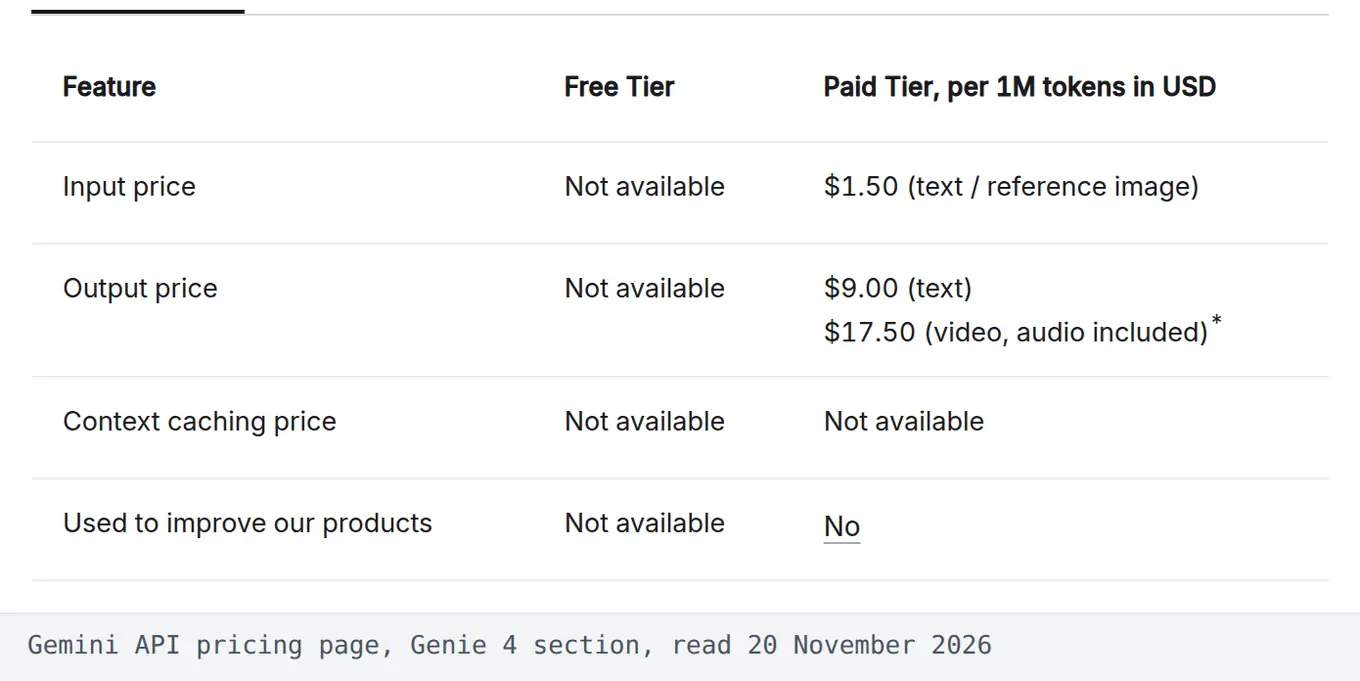
As of 20 November 2026, the Gemini API pricing page gives Genie 4 a single Standard tab. These are the paid tier rates, per million tokens:
| Line | Paid tier, per 1M tokens |
|---|---|
| Input (text, reference image) | $1.50 |
| Output, text | $9.00 |
| Output, video with audio | $17.50 |
| Context caching | Not available |
| Free tier | Not available |
Paid tier data is marked as not used to improve Google’s products. The video line is the one that matters: a 1,000-token prompt costs $0.0015, less than one 24 fps frame of output at about $0.0042.
From tokens to $0.10 a second
Billing counts emitted video tokens at 240 per frame, so 5,760 tokens a second at 24 fps. At $17.50 per million, that is $0.1008 a second and $6.048 a minute, which Google rounds to about $0.10 and $6.05.
5,760 video tokens a second x $17.50 per million = $0.1008 a second, audio included.
The Gemini token cost grid works the same way for every model, but do not mix the lines: a Genie 4 video token is billed at the video rate, never at $9.00.
Session budgets, from a quick test to a full daily quota
Because the rate is linear and the session is capped, budgeting Genie 4 is arithmetic. The hard part is the off switch, not the rate.
One session, capped at 120 seconds
Here is the video output cost of a single session at the published rate, before the input prompt:
| Streamed length | Video output cost |
|---|---|
| 10 seconds | $1.01 |
| 30 seconds | $3.02 |
| 60 seconds | $6.05 |
| 90 seconds | $9.07 |
| 120 seconds (cap) | $12.10 |
My verdict: plan around 60 to 90 seconds, not the cap. Google’s own limitations section says stability may degrade past 60 to 90 seconds, so the last 30 seconds still cost $3.02 and are the least reliable part of the session.
Ten minutes, an hour, a full daily quota
Longer play means chaining sessions, since Genie 4 does not support session resumption. The Genie 4 rate limits cap concurrent sessions and daily requests by tier, and that cap is also your worst-case bill:
- 10 minutes of streamed world: about $60.48, at least five sessions;
- one hour: about $362.88, at least 30 sessions;
- Tier 1, 2 concurrent sessions and 50 requests a day: up to $604.80 a day if every session runs to 120 seconds;
- Tier 2, 5 concurrent and 250 a day: up to $3,024 a day;
- Tier 3, 10 concurrent and 1,000 a day: up to $12,096 a day.
Movement keys and mid-session text events do not count against the request quota: the quota counts sessions, not keystrokes.
The complete() call is your off switch
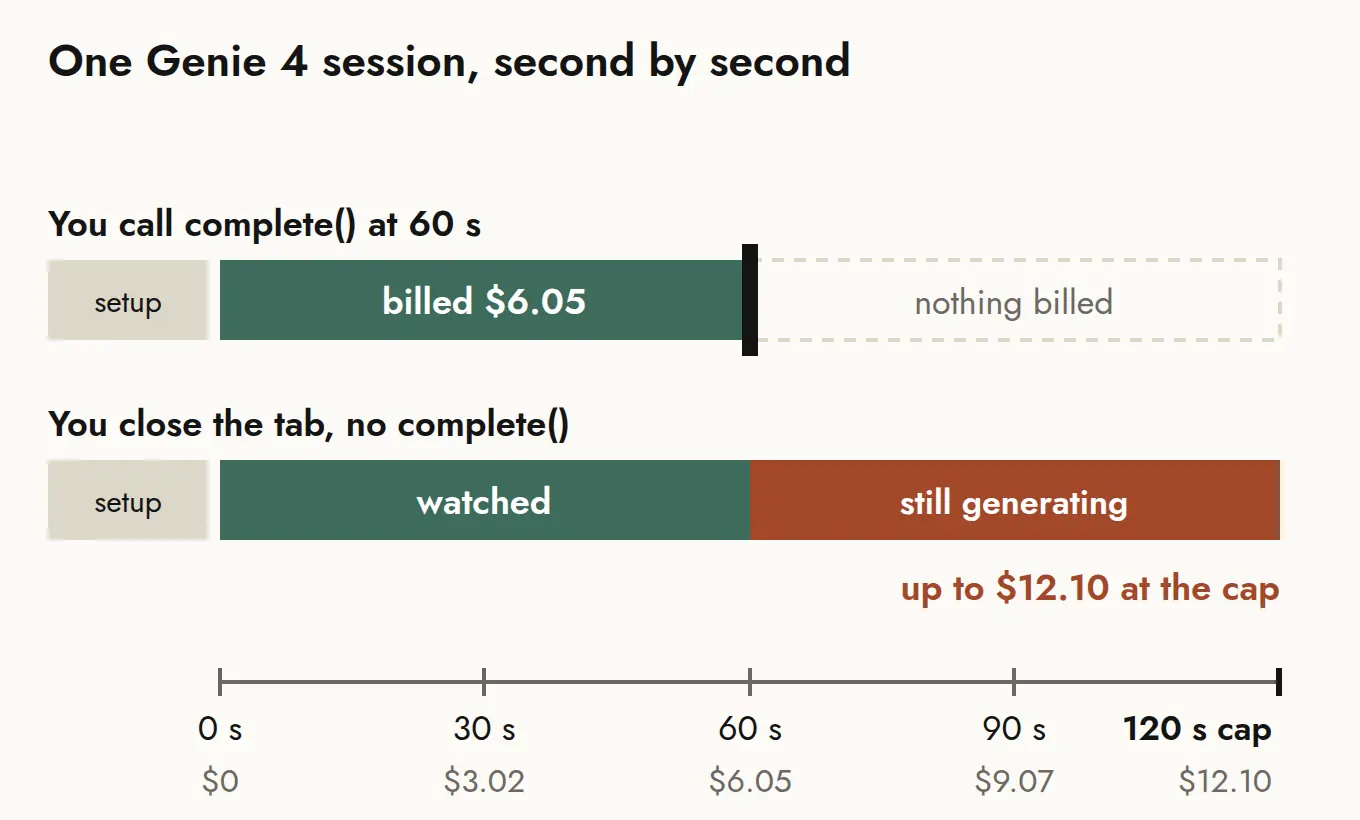
The developer guide is blunt about this. Closing a browser tab or leaving a Python async with block detaches the transport without immediately stopping server-side generation. Only complete() or cancel() ends the interaction and the token billing.
A tab closed without complete() can keep billing until the 120-second cap: up to $12.10 for a world nobody is watching.
In practice, I would wire three guards before shipping anything public:
- call complete() on every exit path, including beforeunload and visibility changes;
- run your own server-side timer that calls cancel() at the length you budgeted;
- mint one ephemeral auth token per interaction, so a leaked token opens one session, not your whole key.
Billing is based on emitted video tokens, and the 5 to 9 seconds of world setup come before the first frame. The pricing page lists no separate charge for that wait.
What people have shown with Genie 4 so far
Public material is still launch material. Google says trusted testers are working on filmmaking, game design, education and robotic simulation, with VFX pre-visualisation named as an early use. Its announcement shows the core loop: changing the weather, moving the camera and adding elements to a running world by text.
Introducing Genie 4 from @GoogleDeepMind, our most realistic and interactive world model yet 🌍 Now you can use natural language to dynamically steer the world and its soundscape in real-time, whether you’re changing the weather, moving the camera, or introducing new elements to https://t.co/ZfZGi9Chsx
@GoogleAI
https://x.com/GoogleAI/status/2115114625985368299
The clearest gameplay clip so far comes from Mark Kretschmann, who posted a game world being modified while it is played, with events triggered by prompts.
The first demo of Genie 4 by @GoogleDeepMind 🔥 This entire gaming world is generated in real-time and can be modified while playing. In the video you can see various events being triggered with prompts, which take effect in the game world immediately. Genie 4!
@mark_k
https://x.com/mark_k/status/2115122531292033493
The guide’s own sample is the pattern I would copy for a prototype: a first-person walk through a living oil painting, with E and Q bound to text events that make snow fall or fireworks burst. Each custom verb is a text event resent ten times over about 1.5 seconds, which adds only a few input tokens at $1.50 per million while the video meter runs at its usual rate.
What you do not get with Genie 4
The model page and the pricing footnote close most of the usual cost levers. Before you budget, know what is missing:
- no free tier, a paid tier key is required;
- no Batch API, Flex or Priority inference, so no 50% batch discount;
- no context caching, every session pays full input;
- no function calling, Google Search grounding or structured outputs;
- no live microphone or webcam input, and no 9:16 output;
- prompts with identifiable real people or brand IP can be blocked or cut mid-stream.
If what you need is a voice agent that listens and answers, Gemini Live voice pricing covers the model built for that. My call: Genie 4 at $6.05 a minute is a prototyping and pre-visualisation tool today, not a backend for an always-on consumer game.
Frequently asked questions
Is there a free tier for the Genie 4 API?
No. The pricing page lists the free tier as not available for every line, and the rate limits table marks the free tier as not supported. You need a paid tier Gemini API key.
How long can a Genie 4 session last?
Up to 120 seconds per session, according to the model page, which caps one session at about $12.10 of video output. For longer play you start a new session, since completed interactions cannot be resumed.
Does Genie 4 support the Batch API or Flex inference?
No. The pricing footnote says Genie 4 does not support the free tier, Batch API, Flex inference or Priority inference, so the $17.50 video rate is the only rate.
Is audio billed separately?
No. The 48 kHz stereo audio is bundled into the video output token rate, so the $0.10 a second already includes sound.