Eleven v4 Turbo costs $0.04 per 1,000 characters on the ElevenLabs API, half the $0.08 charged for Eleven v4, read on the ElevenLabs API pricing page on 22 October 2026. At 900 characters a minute of speech, that is $2.16 for every hour the voice actually talks. Inside ElevenAgents the meter changes: you pay $0.08 per call minute, $4.80 an hour, whoever is speaking. The 72% launch discount that put Turbo at $0.011 ended on 12 October.

Turbo shares its $0.04 price with two older real-time voices, so the price alone decides nothing. What decides your bill is where you run it: on your own stack, where only spoken characters cost money, or inside ElevenAgents, where the clock runs.
What Eleven v4 Turbo costs today
ElevenLabs released Eleven v4 and v4 Turbo on 28 September 2026, according to its changelog entry for the launch. Turbo is the real-time variant of the same model family, with a median inference latency of about 100 ms.
The rate and what it converts to
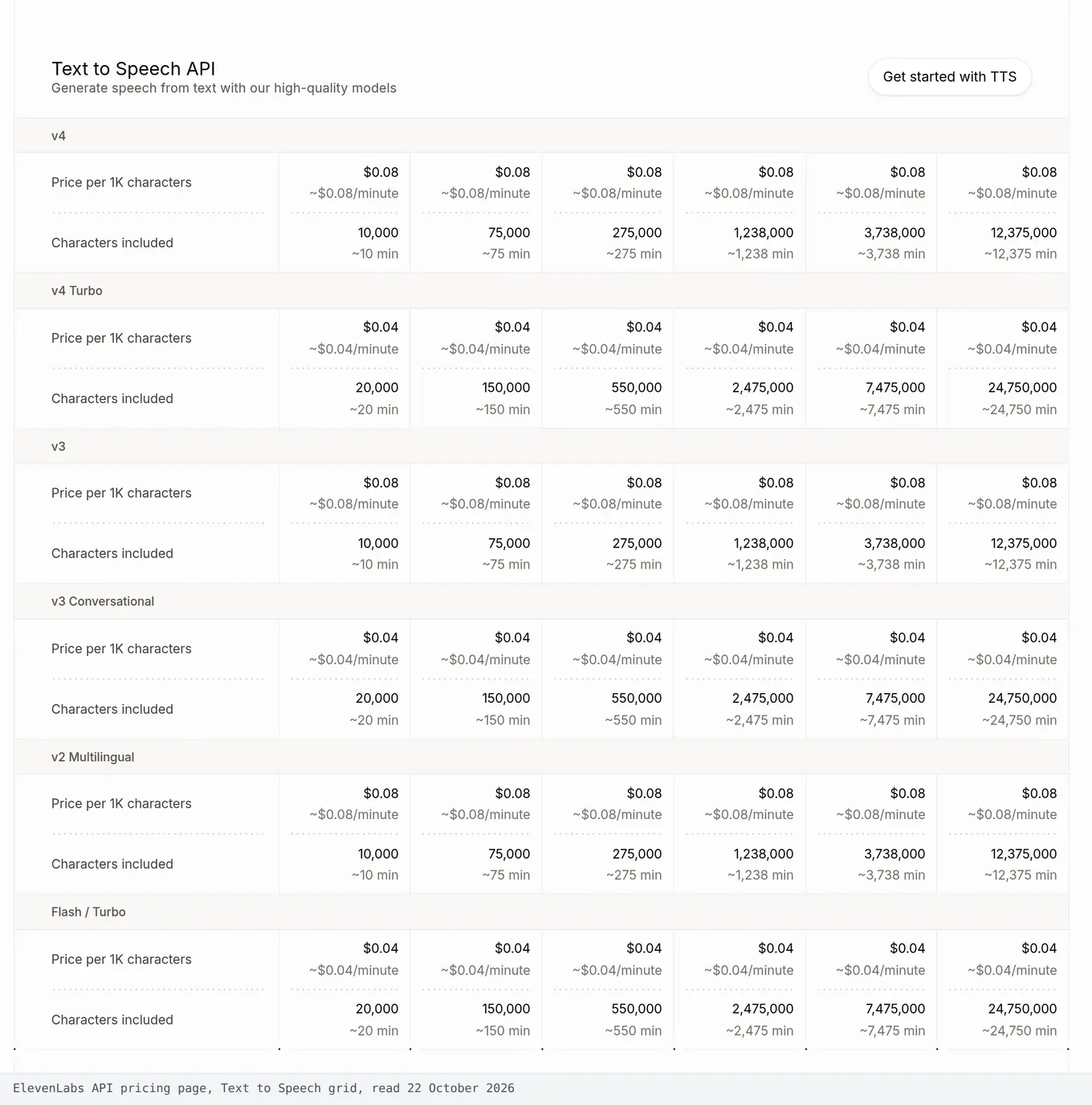
The ElevenLabs API pricing page bills Turbo in US dollars per character, at the same rate on every plan from Free to Business. Plans only change how many characters are prepaid: 20,000 on Free, 550,000 on Creator, 24,750,000 on Business, always at $0.04 per 1,000.
| Unit | Eleven v4 Turbo on the API |
|---|---|
| Per 1,000 characters | $0.04 |
| Per million characters | $40 |
| ElevenLabs’ own minute (1,000 characters) | about $0.04 |
| One hour of speech at 900 characters a minute | $2.16 |
| Same hour on Eleven v4 | $4.32 |
ElevenLabs prints “~$0.04/minute” next to the rate, which assumes 1,000 characters per minute. I use 900, a narration pace of 150 words a minute, the same convention as my Eleven v4 cost per hour page. A fast talker brings you closer to the vendor’s minute.
One hour of speech on Eleven v4 Turbo: 54,000 characters x $0.04 per 1,000 = $2.16. On Eleven v4, $4.32.
The launch price is gone
For the first two weeks, Turbo was much cheaper than it is now. ElevenLabs posted the launch rates on the day of release:
For the next two weeks, we’re making it even easier to try out Eleven v4 and Eleven v4 Turbo. The Eleven v4 API is discounted to $22 and Eleven v4 Turbo API to $11 per 1M characters and Eleven v4 is free for Creator+ plans in ElevenCreative, up to 2x your monthly credits.
@ElevenLabs
https://x.com/ElevenLabs/status/2104572138347004161
That $11 per million is $0.011 per 1,000 characters, or about $0.59 an hour of speech. The list price of $40 per million is 3.6 times higher. Any budget built in early October on the launch rate needs to be multiplied by 3.6.
The same happened inside ElevenAgents, where the promotional minute was tied to Turbo:
To celebrate the launch, agents using Eleven v4 Turbo in ElevenAgents are just 3.3 cents a minute through October 12th, then standard ElevenAgents pricing applies.
@ElevenLabs
https://x.com/ElevenLabs/status/2104939781943873792
At 3.3 cents, an hour of calls cost $1.98. At the standard $0.08 it costs $4.80, about 2.4 times more.
The same $0.04 buys three real-time voices

ElevenLabs sells three low-latency text to speech models at $0.04 per 1,000 characters. The ElevenLabs models documentation separates them on latency, languages and request size, not on price.
| Model at $0.04 per 1,000 characters | What the docs say about it |
|---|---|
| Eleven v4 Turbo | ~100 ms median inference latency, 90+ languages, audio tags |
| Eleven v3 Conversational | ~280 ms, 70+ languages, listed as previous generation |
| Eleven Flash v2.5 | ~75 ms, 32 languages, 40,000 characters per request |
All three latency figures exclude application and network time, so your caller hears the first sound later than that. On ElevenLabs’ own test, run in September 2026 over WebSocket streaming, Turbo’s median time to first speech was about 150 ms.
Why v3 Conversational has no reason left
Turbo is faster, speaks more languages and costs exactly the same per character. If an agent still runs eleven_v3_conversational, switching the model id to eleven_v4_turbo costs nothing on the bill. ElevenLabs made the same call for its own platform: its changelog of 5 October 2026 moved the default conversational voice of ElevenAgents from eleven_flash_v2 to eleven_v4_turbo.
One caveat before you switch a production agent. ElevenLabs says voice clones made before the v4 launch need to be retrained with v4 to work well.
When Flash v2.5 still wins
Flash v2.5 is still the fastest of the three on paper, and it accepts 40,000 characters per request. That is enough reason to keep it in a few cases:
- Latency is the only metric that matters. 75 ms against 100 ms is a small gap, but it is there.
- Long readouts. 40,000 characters per request is about 40 minutes of audio in one call.
- Agents that only speak English. Flash v2 covers English with a 30,000-character limit.
Watch the numbers, though. The docs say Flash v2.5 does not normalise numbers by default, so phone numbers, dates and prices can be read out oddly, and turning it on is reserved for Enterprise plans. On a billing or booking agent, that alone pushes me to Turbo.
Inside ElevenAgents, Turbo is billed by the minute
Here the price per character stops being the useful number. A voice agent does not talk all the time: it listens, waits and thinks. How you pay for that silence depends on where Turbo runs.
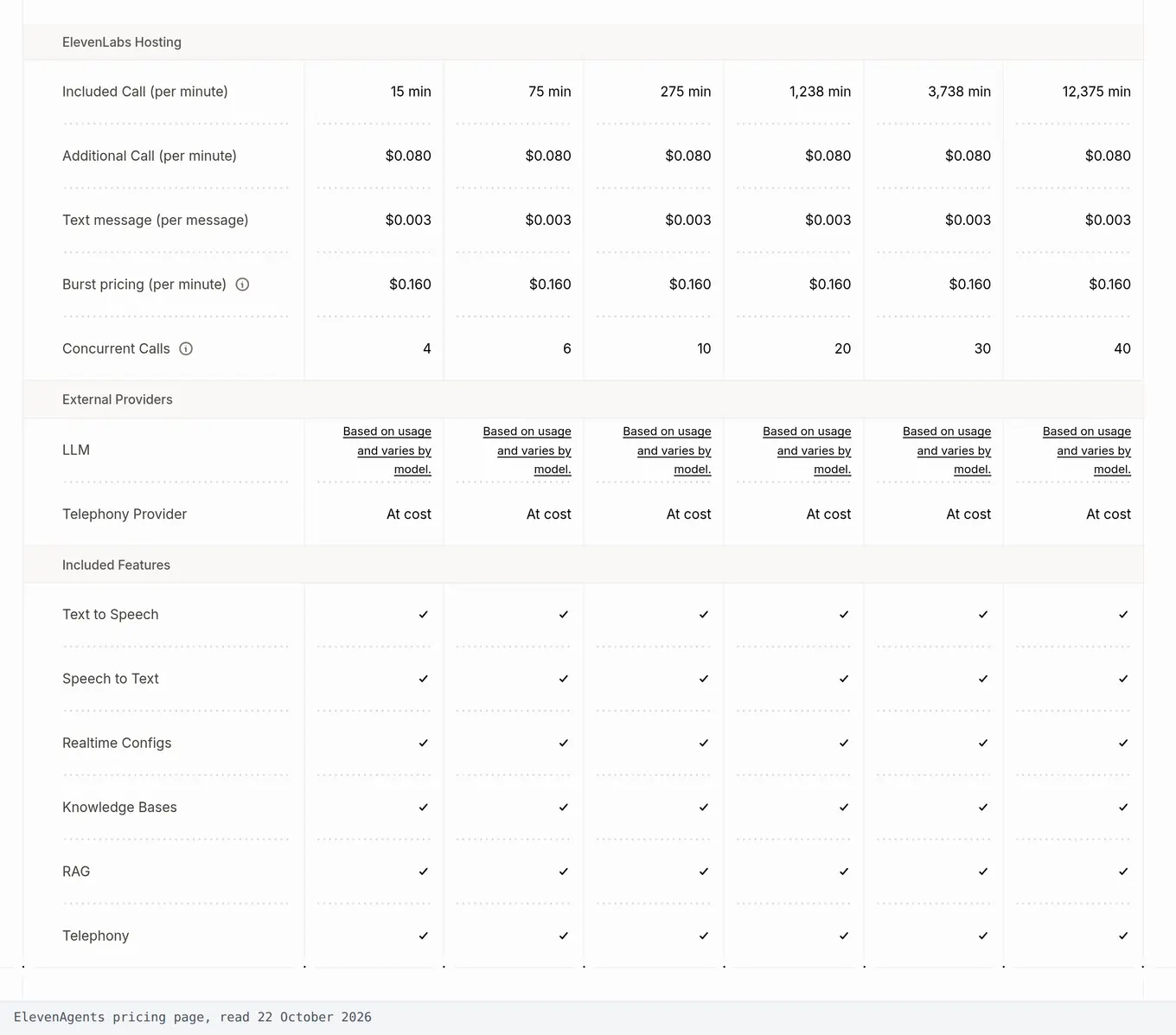
On the ElevenAgents pricing page, an additional call minute costs $0.08 on every plan, with text to speech and speech to text included. There is no separate line for Turbo: the minute costs the same whichever voice model the agent uses. The LLM is billed on top by usage, and minutes above your concurrency limit cost $0.16.
So an hour of calls is $4.80 plus the LLM, whether the agent talks for five minutes of it or fifty. Plans only prepay minutes at that rate, from 15 on Free to 12,375 on Business at $990 a month.
On your own stack, you pay for what the agent says
Call Turbo directly through the API and the meter becomes characters. Silence costs nothing on the voice side, and neither does the time the caller spends talking.
The same hour, three ways
To hear the caller you also need a transcription model, here Scribe v2 Realtime at $0.39 an hour on the same pricing page, streamed for the whole call.
| Assistant talking for | ElevenAgents, or own stack with v4 Turbo and Scribe v2 Realtime |
|---|---|
| 20% of the hour (12 min) | $4.80, or $0.43 + $0.39 = $0.82 |
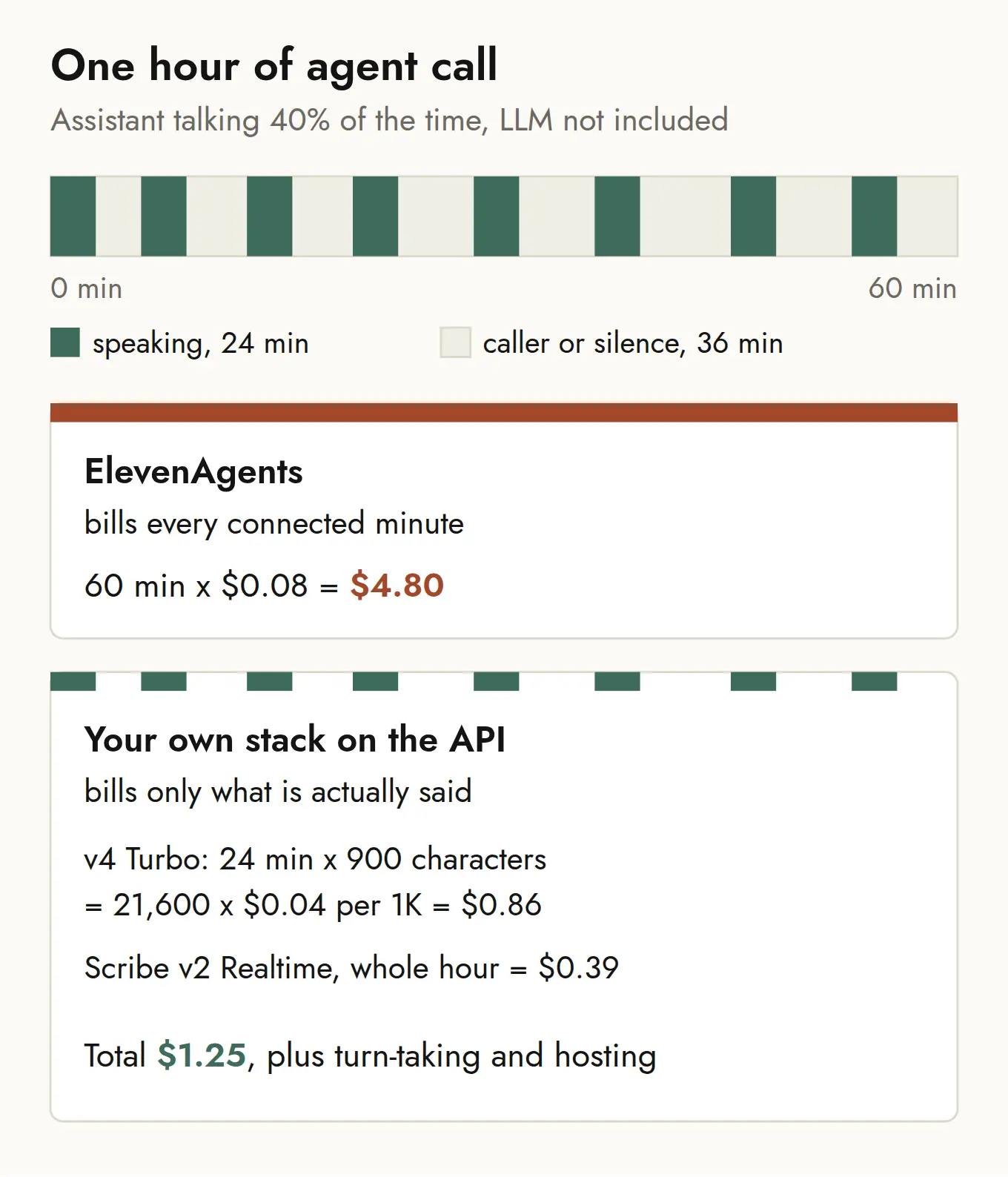
| 40% of the hour (24 min) | $4.80, or $0.86 + $0.39 = $1.25 |
| 70% of the hour (42 min) | $4.80, or $1.51 + $0.39 = $1.90 |
Both columns exclude the LLM. On an hour where the agent talks 40% of the time, the voice and the ears cost about a quarter of the ElevenAgents minute.
One hour of agent call at 40% talk: $4.80 on ElevenAgents, $1.25 with v4 Turbo and Scribe v2 Realtime on your own stack, LLM excluded on both.
What the cheaper route leaves you to build
ElevenAgents includes turn-taking, interruption handling, telephony integration, knowledge bases and hosting. On your own stack, you write and run all of that, and you pay for the servers that keep each WebSocket open.
The $3.55 saved per hour at 40% talk has to pay for that work. At 50 call hours a month it comes to about $178, less than a day of a developer; at 2,000 hours it is $7,100 a month, and building your own loop starts to make sense. If you want ElevenLabs to handle the whole loop, including the LLM, the Eleven Realtime API at $0.08 a minute is a third option with the same connected-minute logic.
When Turbo replaces v4, and when it should not

Halving the price is tempting on narration too. An eight-hour audiobook is about 432,000 characters: $34.56 on v4, $17.28 on Turbo. ElevenLabs is clear about the trade-off, though: its ElevenAgents FAQ says Turbo carries the full expressive range of v4 “with slightly lower audio quality in exchange for the speed”.
The docs also route the two models differently. Eleven v4 runs through the Text to Dialogue API for long-form audio, while v4 Turbo is documented on the Text to Dialogue WebSocket, built for streaming. Here is where I would put each one:
- Voice agents, IVR and live assistants: Turbo, every time. Same price as Flash and v3 Conversational, better range than both.
- Audiobooks, ads and voiceovers: Eleven v4. A listener spends hours with the voice, and $2.16 an hour saved is small next to a narrator who sounds slightly flatter.
- Drafts, previews and internal audio: Turbo is a fine way to halve the cost of iterations before the final render on v4.
- Agents on a tight budget: Turbo on your own stack, if you have the engineers. Otherwise ElevenAgents, and accept the $4.80 hour.
If you buy through the web app rather than the API, the credit system works differently, and I broke it down in our ElevenLabs cost breakdown.
Frequently asked questions
Is Eleven v4 Turbo cheaper than Eleven v4?
Yes, by half. Turbo costs $0.04 per 1,000 characters on the API and Eleven v4 costs $0.08, so an hour of speech at 900 characters a minute is $2.16 against $4.32.
Is the $0.011 launch price still available?
No. The launch rate of $11 per million characters ran for two weeks after the 28 September release and ended on 12 October 2026. The current list price is $40 per million characters.
Does ElevenAgents cost less when the agent uses v4 Turbo?
Not any more. The promotional 3.3 cents a minute for Turbo agents ended on 12 October. Since then, every ElevenAgents call minute costs $0.08, whatever the voice model, plus the LLM.
Which model id and endpoint does v4 Turbo use?
The model id is eleven_v4_turbo. ElevenLabs documents it on the Text to Dialogue WebSocket for agents and interactive apps, and since the 5 October 2026 changelog it is the default conversational voice model of ElevenAgents.