DeepSeek’s OCR API costs $0.225 per 1,000 pages recognised successfully, a rate I read on DeepSeek’s pricing page on 22 November 2026, and unlike the speech APIs launched the same day it carries no limited-time discount. A 10,000-page batch therefore costs $2.25, and failed or timed-out recognitions cost nothing. If you upload a file for deepseek-flash to read instead, DeepSeek bills the parsing once at that same page rate, then bills the parsed text as input tokens on every chat request that references it.

What the DeepSeek OCR API does
DeepSeek opened its app features to developers on 13 November 2026: web search, URL reading, file input and safety checks inside deepseek-flash, plus standalone Search, Fetch, OCR, ASR and TTS APIs. OCR is the one I care about here, because it is the cheapest way I have seen to turn a pile of PDFs into text through a hosted API.
Two ways in, one page price
There are two doors, and they are billed the same way per page. The standalone OCR endpoint takes a file at POST /v1/tools/ocr and sends back the text page by page. The file is not stored and never reaches a chat model.
The second door is File Parsing: you upload the document to the Files API, DeepSeek parses it during the upload, and you reference the returned file_id in a deepseek-flash request so the model can answer questions about it. Both doors share one line on the pricing page, “File parsing, OCR API”.
What one request can carry
The OCR guide sets these limits per request, and they decide how you split a large job:
- File formats: PDF, Word (DOC, DOCX), PowerPoint (PPT, PPTX) and images such as PNG, JPEG, WebP, GIF, BMP and TIFF.
- Size: 100 MiB per file, a 413 error above that.
- Pages: 1,000 per document.
- Time: 180 seconds from the start of the upload to the result.
- Concurrency: 15 recognitions in progress per account, counted apart from the chat models.
Two modes exist. text_recognition gives you text, and extracts it directly from Word and PowerPoint files without images. rich_layout_recognition runs every file page by page and keeps position tokens with coordinates, so you can locate a title or crop a figure yourself.
What DeepSeek charges for OCR
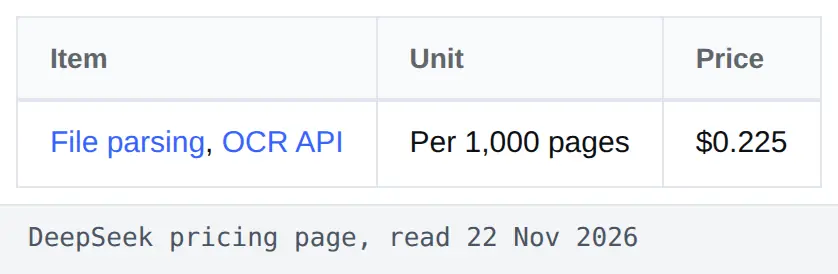
The pricing grid has one row for documents, and I read it in table form on 22 November 2026.
| Item | Price |
|---|---|
| File parsing, OCR API | $0.225 per 1,000 pages |
| Per page | $0.000225 |
Only successful pages count
The meter is page_count, the number of pages recognised successfully. A recognition that fails or times out is not billed, and on File Parsing a failed upload is neither stored nor billed.
The trap runs the other way. Disconnecting does not cancel a recognition: once DeepSeek has the file, it finishes the job and bills you if it completes. If your client times out at 60 seconds and retries, you can pay twice for the same document.
The OCR response also returns a usage block with input and output tokens. DeepSeek says it is for reference only and not used for billing, so ignore it when you reconcile an invoice.
DeepSeek bills OCR by pages recognised successfully: failed or timed-out runs cost nothing, but a run you abandon after upload is still billed if it completes.
No launch discount on OCR
The speech APIs launched on 13 November at half price, “limited time”, with no end date published. OCR did not. DeepSeek’s own pricing post shows ASR and TTS with a crossed-out list price and a 50% badge, and OCR with a single price.
💰 API pricing
Extended capabilities incur tool usage fees in addition to standard token charges.
See the tool pricing breakdown below.
3/4 https://t.co/2RwAOpuWlO@deepseek_ai
https://x.com/deepseek_ai/status/2121247903603941471
So $0.225 is the list price, not a promo that will double when the speech discount ends.
What a 10,000-page batch costs
At a flat rate, the arithmetic is short. Since one document tops out at 1,000 pages, a 10,000-page archive means at least ten requests, and the 15-request concurrency cap is the real ceiling on throughput.
| Pages recognised | OCR cost |
|---|---|
| 1,000 | $0.225 |
| 10,000 | $2.25 |
| 100,000 | $22.50 |
| 1,000,000 | $225 |
There is no volume tier on the page, and no free allowance either. As with the rest of the DeepSeek API, billing starts from the first unit, deducted from your granted balance first, then your topped-up balance.
The token bill comes after the parse
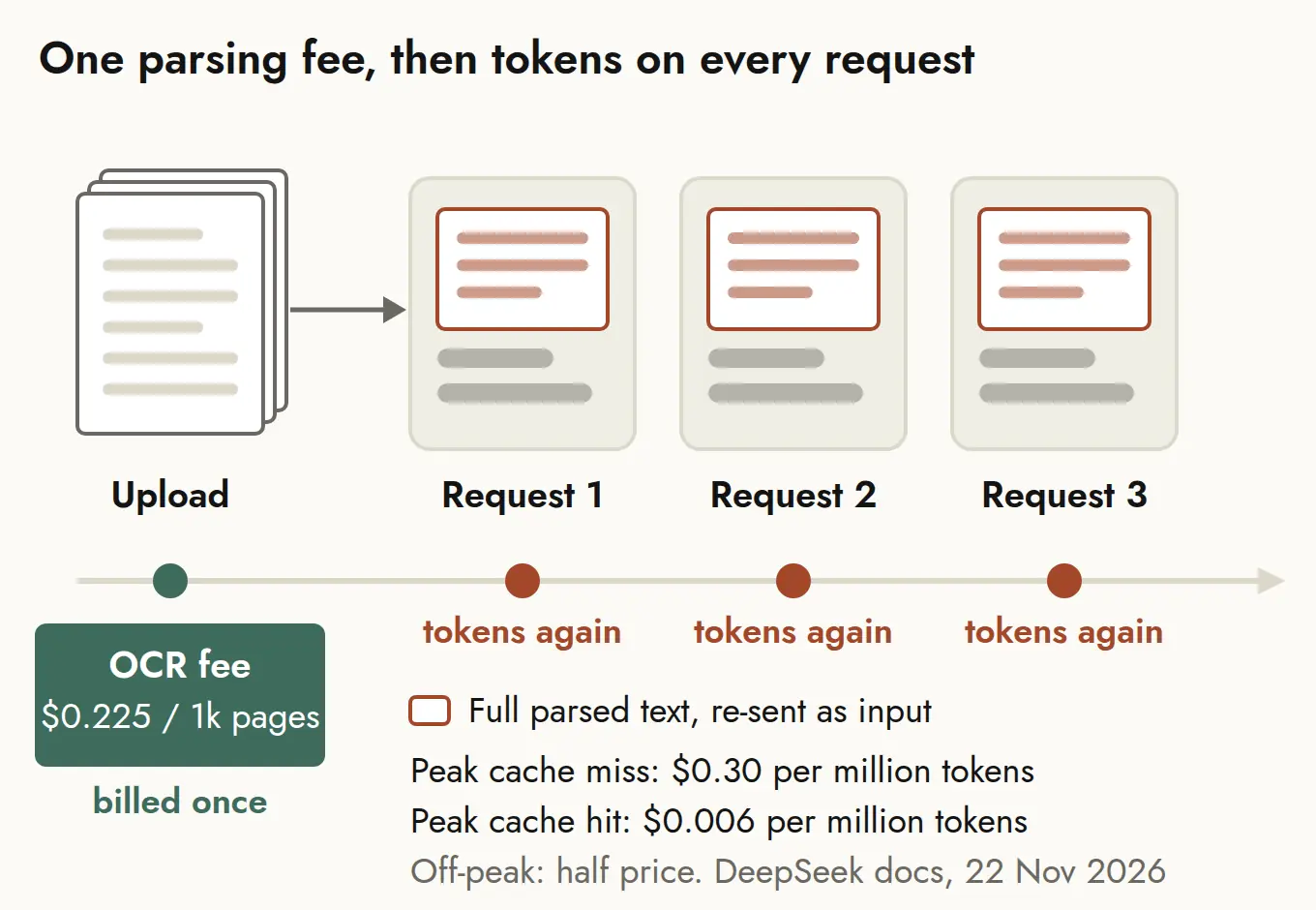
The standalone OCR endpoint stops at the page fee. File Parsing does not, and this is where a budget goes wrong.
Parsing once, tokens on every request
DeepSeek’s billing note is precise: parsing is billed once per page at upload, and “is not billed again” in chat. But each chat request that references the document is billed for its input tokens at the model’s input price, and across turns the full parsed content of a referenced file stays in context.
For deepseek-flash, that input price is $0.30 per million tokens at peak on a cache miss, $0.006 on a cache hit, and half those rates off-peak. Peak hours are 01:00 to 04:00 and 06:00 to 10:00 UTC, Monday to Friday.
At peak, every 1,000 tokens of parsed text costs $0.0003 each time a request sends it on a cache miss, more than the $0.000225 OCR fee for one page.
Put differently: a page whose text comes to 1,000 tokens costs more to send once on a cache miss than it cost to recognise. Ask five questions about a long report in five separate requests, and the parse fee becomes the small line. Keep the document in one conversation so the repeated prefix hits the cache, or extract the text once with the standalone endpoint and send only the passages you need.
Rich layout costs more than its page price
rich_layout_recognition crops charts, photos and diagrams and hands them to the model at their position in the text. Those crops use input tokens and count against the per-request image limit. If the model does not need the figures, text_recognition is the cheaper mode at exactly the same page price.
The same pattern shows up in DeepSeek’s Search and Fetch pricing: a small per-use fee up front, and the tokens behind it doing most of the billing.
How $0.225 compares with other OCR APIs
I read each rival’s public page on 22 November 2026. The outputs differ (layout markup, handwriting, structured fields), so treat this as a price floor comparison, not a quality one.
| OCR API | Price per 1,000 pages |
|---|---|
| DeepSeek OCR API | $0.225 |
| AWS Textract, Detect Document Text (US West, first million pages a month) | $1.50 |
| Google Document AI, Enterprise Document OCR (1,000 to 5 million pages a month) | $1.50 |
| Mistral OCR 3 | $2 |
| Mistral OCR 4.1 | $4 |
AWS Textract’s pricing page works its own example at $0.0015 per page for the first million pages in US West (Oregon), and new AWS customers get 1,000 free pages a month for three months. Google Document AI makes the first 1,000 pages free, charges $1.50 per 1,000 up to 5 million, then $0.60 above. Mistral lists both OCR models on the same page as the rest of its API pricing.
Against the cheapest of those, DeepSeek is about 6.7 times lower per page. Only Google’s top tier, beyond 5 million pages a month, gets within three times of it.
My verdict
For bulk text extraction, the standalone DeepSeek OCR endpoint is the cheapest hosted price I have found: $2.25 for 10,000 pages, no promo clock, no charge for failures. Before you move a pipeline over, watch three things:
- Client timeouts shorter than 180 seconds, which turn retries into paid duplicates.
- The cap of 15 recognitions in progress per account, which sets your throughput.
- File Parsing, where the page fee is the cheap part and the repeated input tokens are the bill.
Frequently asked questions
Is the DeepSeek OCR price a launch discount?
No. On 22 November 2026 the pricing page lists OCR at $0.225 per 1,000 pages with no discount column; only ASR and TTS show a 50% limited-time price.
Do failed OCR pages cost anything?
No. DeepSeek bills the pages recognised successfully, and a failed or timed-out recognition is not billed. A completed job is billed even if your client disconnected.
Is File Parsing billed again when you chat about the file?
The parsing is not, but the parsed text is. Each request that references the file pays deepseek-flash input token rates for it.
How many pages can one OCR request take?
Up to 1,000 pages and 100 MiB per file, within 180 seconds from the start of the upload.