Claude Fable 5.2 is the most capable Claude model open to every customer, released by Anthropic on 9 November 2026 for demanding reasoning and long-horizon agentic work. It sits above Opus 5.5 in the lineup, shares its underlying model with the gated Mythos 5.2, and pairs a 1M-token context window with 128k tokens of output and thinking you cannot switch off. Anthropic’s own benchmarks put it ahead of Opus 5.5 on almost every test it ran, and the first public builds are multi-hour agent runs, not chat.

It is also cheaper than the model it replaces: $8 per million input tokens and $40 per million output tokens, 20 percent below Fable 5.1, with cache reads at $0.20, as listed on Anthropic’s pricing page on 10 November 2026. That is still twice Opus 5.5 on everything except the cache read, so the pricing sections below work through when the premium is worth paying.
What sets Fable 5.2 apart
Anthropic presents Fable as the tier you move up to when Opus 5.5 at higher effort still falls short, and its developer docs say exactly that. The spec sheet shows why it is not a blind model-string swap.
The spec sheet
| Spec | Claude Fable 5.2 |
|---|---|
| API model ID | claude-fable-5-2 |
| Context window | 1M tokens |
| Max output | 128k tokens |
| Thinking | Adaptive, always on |
| Effort levels | low, medium, high, xhigh, max (API default: high) |
| Reliable knowledge cutoff | June 2026 |
| Retirement | Not sooner than 9 November 2027 |
| Platforms | Claude API, Amazon Bedrock, Google Cloud, Microsoft Foundry |
Context and output are the same as on Opus 5.5, Sonnet 5.5 and Haiku 5.5, per Anthropic’s models overview. The difference is depth: on the API, Fable defaults to high effort where Opus 5.5 defaults to medium. In the Claude apps and Claude Code, Fable runs at medium by default.
What changed from Fable 5.1
- Speed: outputs up to 30 percent faster than Fable 5.1, plus an optional fast mode that Anthropic says generates up to 2.5 times faster.
- Fewer false refusals: in Anthropic’s early testing the cyber and biology classifiers fired about 55 percent less often than on Fable 5.1, roughly 60 percent less in cybersecurity and 40 percent less in biology.
- Computer use moves to the computer_toolset_20260801 toolset. The older computer_20251124 tool now returns a 400 error everywhere except Amazon Bedrock.
- Price: a flat 20 percent cut on every billing line, detailed below.
If you write your own agent loop, two rules will bite. Any request that edits an earlier turn and sends the old thinking blocks back gets a 400 error on every account, where Fable 5.1 only enforced it on accounts created from 31 August 2026. And forced tool use (tool_choice set to any or to a named tool) is still not supported, so schema-valid output goes through strict tool use or JSON outputs.
Anthropic’s benchmarks, read as Anthropic’s
The launch post compares Fable 5.2 with Fable 5.1, Opus 5.5, GPT-6 Astra and Gemini 4 Carbon. These are Anthropic’s figures, with safeguards on and each model at its highest available effort unless noted. I have not reproduced them.
| Benchmark (what it tests) | Fable 5.2 vs Opus 5.5 |
|---|---|
| FrontierSWE v2 (agentic coding) | 69.9% vs 62.3% |
| FrontierCode 2.0 (agentic coding, Fable at Xhigh) | 49.1% vs 45.5% |
| Remote Labor Index (knowledge work, Fable at High) | 41.3% vs 21.3% |
| Humanity’s Last Exam, with tools (reasoning) | 74.2% vs 67.7% |
| OSWorld 2.1, partial offline set (computer use) | 89.3% vs 87.2% |
| AutomationBench (business workflows) | 51.4% vs 42.5% |
| RoboDojo Sim (robot control) | 64.9% vs 39.4% |
Not every row is a win. On AutomationBench, Gemini 4 Carbon scores 53.9 percent against 51.4 for Fable 5.2, and on the AA-Briefcase Elo rating Opus 5.5 still edges it, 1800 to 1785.
Outside Anthropic, Artificial Analysis, which runs independent model benchmarks, found Fable 5.2 leading its VIALS-AA test of scientific visual reasoning, and noticed that it calls tools more often than any other Anthropic model.
Claude Fable 5.2 leads scientific visual reasoning benchmark VIALS-AA; it makes more tool calls than any other Anthropic model, unlike OpenAI models which make fewer as they get smarter
VIALS-AA is our implementation of @joinHandshakeAI’s VIALS benchmark for visual reasoning in life sciences research, across artifacts such as gel blots, plasmid maps, and phylogenies. Claude Fable 5.2 (max with fallback) scores 67% on VIALS-AA, ahead of Gemini 4 Carbon (high) at 64% and GPT-6 Astra (max) at 63%. Fable averages ~37 tool calls per task, while Astra averages ~8, the fewest of any model we’ve tested.
On turn 4 of this protein interaction task, Fable creates crops and asks to view them. On turn 10, it builds a color mask by thresholding color channels. On turn 17, it fits a circle to each arc and unrolls the arc into a straight strip. On turn 31, it counts the bars as peaks in an intensity profile. And on turn 41, it maps every detected spoke back on the original image to check its work. Fable batches calls on 28 of its 51 turns, averaging 1.75 tool calls per turn, compared with 1.12 for Sonnet 5.5.@ArtificialAnlys
https://x.com/ArtificialAnlys/status/2119990200700940745
Where it falls short
- Fable blocks most cybersecurity work (penetration testing, exploit generation) and most research biology. Blocked queries are answered by Opus 4.8 or Opus 5 instead; Mythos 5.2, the same model without those safeguards, is reserved for vetted organisations.
- Anthropic deliberately limited some AI research skills during training: on tasks like accelerator kernel optimisation, Fable 5.2 performs at about the level of Opus 5.5.
- It requires 30-day data retention and is not available under zero data retention unless Anthropic expressly authorises it.
- A prompt line asking for less thinking does not stop it from thinking at medium effort and above. On long tasks, a turn can also end with a list of what remains instead of finished work, more often at low and medium effort.
My verdict: Fable 5.2 is built for runs you leave alone for hours, not for quick back-and-forth. For short interactive work, Opus 5.5 remains the better default, which is also Anthropic’s own advice.
What people are building with Fable 5.2
Anthropic’s launch post sets the bar with its own showcase: a team of about 1,000 Fable 5.2 agents formalised the proof of Fermat’s Last Theorem in Lean in 30 hours, and one engineer had it coordinate over 1,000 subagents for eight days to write an operating system that boots on a laptop. The public builds below are smaller, and almost all of them come with a video or photos of the result. Benchmark scores are in the section above; here I only kept things people actually made.
A boat ride through eight worlds, by Kevin Ngo
Kevin Ngo posted this browser game demo on launch day: a boat ride through eight dreamlike worlds, with the gameplay video in the post. Anthropic’s own account later featured two of his other Fable 5.2 builds in its thread of early experiments.
Claude Fable 5.2 made this game demo, playable in the browser
It’s a boat ride through 8 dreamlike worlds https://t.co/WwhHS7blmn@kevin_t_ngo
https://x.com/kevin_t_ngo/status/2119868968307695818
450 portal-linked 3D worlds, by Ethan Mollick
Ethan Mollick, the Wharton professor who writes about AI, asked for an endless, hands-off journey through 3D worlds linked by portals. By his count, 25,000 agents produced more than 450 worlds, all in code, and he published both the playable version and the GitHub repository. This is the kind of fan-out job Fable is priced for.
In one of my favorite experiments, I told Fable 5.2 to build an endless, hands-off journey through 3D worlds linked by portals.
25,000 agents created over 450 worlds inspired by books, art, places, all in code.
Play: https://t.co/pu1gO2sufk
Github: https://t.co/NJKDlib6Xp https://t.co/oBgAQj6ZQ3@emollick
https://x.com/emollick/status/2119918307457577163
A mirror Earth you can play, by Matt Shumer
Matt Shumer built a game on a copy of the planet: you go anywhere, destroy anything, and the weather follows the real Earth in real time. The post has the video and a link to the playable build.
Fable 5.2 created a MIRROR EARTH as a game.
Go anywhere. Destroy anything. Weather and more match the real Earth, in real-time.
Go explore: https://t.co/B4m3uSMSaw https://t.co/L3jzfOPKnB@mattshumer_
https://x.com/mattshumer_/status/2119877065701036047
A video made in two prompts, by anabology
Not every build is a game. The user anabology asked Fable 5.2 to make the video of its dreams and got the result nine hours later. It took two prompts, not one, which is the honest detail here: long unattended runs still need a second pass.
This was not a one-shot
It was a two-shot
I told Fable 5.2 to make the video of it’s dreams, and 9 hours later: https://t.co/UKf8Uexgb6@anabology
https://x.com/anabology/status/2120010995309457643
Three working electronic devices, by Anthropic
This one comes from Anthropic’s own account, so read it as the vendor’s showcase. Fable 5.2 wrote the specifications, picked the components, routed four-layer circuit boards, designed enclosures for 3D printing and wrote the software. Each board was ready for manufacture in under a day, and Anthropic says the three devices work without modification.
Fable 5.2 wrote its own specifications, selected the components, routed the four-layer circuit boards, designed enclosures for 3D printing, and programmed the software.
Each board was ready for manufacture in under a day. All three devices work without any modifications. https://t.co/APkMguvaln@claudeai
https://x.com/claudeai/status/2119899461983822264
A 3D-printed landmark from 40 photos, by LEJ
Also from Anthropic’s thread of early experiments: @LEJ_limited turned 40 photos of a century-old landmark into a 3D model that was printed in one piece. The post shows the source photos and the print.
A 3D model of a century-old landmark, built from 40 photos and printed in one piece. Built by @LEJ_limited with Fable 5.2. https://t.co/LvkSoQWumA
@claudeai
https://x.com/claudeai/status/2120174857111601648
A game from scratch in eight hours, by Felix Rieseberg
Felix Rieseberg, an engineer at Anthropic, gave Fable 5.2 one-shot prompts with no human feedback and posted what came out: a game built from scratch in eight hours, for about $550 at API pricing. Read it as a demo from the vendor’s side; the useful part is the token split, 445M input against 2.7M output, which shows how much a long agent run rereads its own context.
I wanted to test Fable 5.2’s quality with one-shot prompts without human feedback.
Everything in this game is from scratch: models, sounds, textures. ~$550 at API pricing, ~2.7M output and 445M input tokens, heavily cached. Took 8 hours!
Play it here: https://t.co/fazOCcyNIH https://t.co/GoCitQ9EVe@felixrieseberg
https://x.com/felixrieseberg/status/2119925633564463609
None of these are single prompts answered in seconds. Long, unattended jobs are the workload where Fable’s price premium has a chance to pay off, and the rest of this page is about that price.
What Fable 5.2 costs, line by line
Anthropic launched Fable 5.2 and Mythos 5.2 on 9 November 2026, and both sit at the top of the Claude API pricing page. Fable 5.2 is in the main grid; Mythos 5.2 is listed further down under “Additional models”, at the same rates.
Here is every line that applies to a standard first-party API call, as of 10 November 2026.
| Billing line | Fable 5.2, per million tokens |
|---|---|
| Base input | $8 |
| Output | $40 |
| Cache write, 5 minutes | $10 |
| Cache write, 1 hour | $16 |
| Cache read (hits and refreshes) | $0.20 |
| Batch input | $4 |
| Batch output | $20 |
| Fast mode input | $16 |
| Fast mode output | $80 |
Anthropic’s developer account posted the headline price the day of the launch, together with the speed claim that comes with it.
Fable 5.2 is now available in the Claude Platform and Claude Code. It’s up to 30% faster than Fable 5.1, and costs $8/$40 per 1M tokens, down from $10/$50.
@ClaudeDevs
https://x.com/ClaudeDevs/status/2119868698613956992
Mythos 5.2 costs the same but is gated: Anthropic opens it only to organisations accepted into its cyber and life sciences verification programmes.
Twenty percent off Fable 5.1, on every column
Fable 5.1 sat at $10 and $50. Fable 5.2 does not trim one line, it takes a flat fifth off the whole row.
Every price moved by the same fifth
The Fable 5.1 row still sits in the same table, and each new price is exactly 0.8 times the old one.
- Input from $10 to $8, output from $50 to $40.
- Five-minute cache write from $12.50 to $10, one-hour write from $20 to $16.
- Cache read from $0.25 to $0.20.
- Batch from $5 and $25 to $4 and $20.
If you run Fable 5.1 today and switch the model string, your bill drops by 20 percent at identical token counts. The Fable 5.1 price breakdown keeps the old grid if you need it for a budget comparison.
The cache ratio stayed at a fortieth
A cache hit on Fable 5.2 costs 2.5 percent of base input, the same ratio Fable 5.1 introduced. Most Claude models bill a hit at a tenth of input, and Opus 5.5 and Sonnet 5.5 at a twentieth.
Fable 5.2 and Opus 5.5 both bill a cache read at $0.20 per million tokens. On Fable that is a fortieth of input; on Opus it is a twentieth.
Fable 5.2 against Opus 5.5 on a real request
Anthropic itself tells most users to start on Opus 5.5 and move up to Fable only when the task demands it. So the question that matters is what the step up costs, and the cache read is where the answer gets interesting.
Same cache read, double everything else
Opus 5.5 is priced at $4 input, $20 output, $5 and $8 for cache writes and $0.20 for cache reads, per the Opus 5.5 pricing page and the same Anthropic grid. Fable 5.2 is exactly double on input, output, both writes, batch and fast mode. Only the cache read is equal.
That has a clean consequence. The dollar difference between the two models on any request is four dollars per million fresh input tokens plus twenty dollars per million output tokens. Cached tokens add nothing to that gap.
One agent turn on a 200k cached context
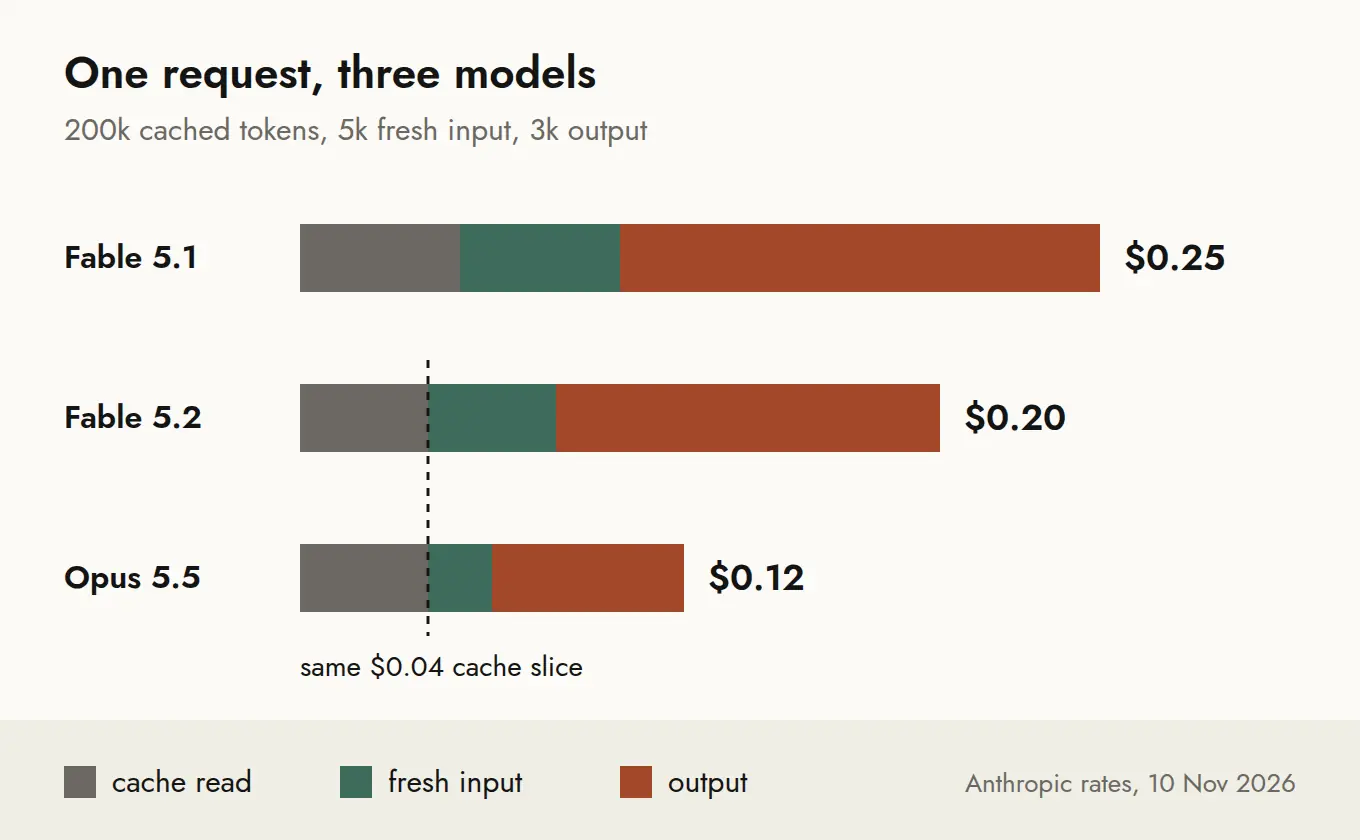
Take a typical agent turn: 200,000 tokens of system prompt, tools and history already cached, 5,000 fresh input tokens, and 3,000 output tokens. At list price, here is what that single request costs.
| Model | Cost of the request |
|---|---|
| Fable 5.1 | $0.25 |
| Fable 5.2 | $0.20 |
| Opus 5.5 | $0.12 |
| Fable 5.2, nothing cached | $1.76 |
| Opus 5.5, nothing cached | $0.88 |
With the cache warm, Fable 5.2 costs 1.67 times Opus 5.5 instead of twice. The $0.08 gap is the fresh input and output; the $0.04 cache slice is identical on both models.
How much cache it takes to close the gap
Because the dollar gap is fixed, caching only shrinks Fable’s premium as a ratio. Working from the grid, the thresholds for that turn shape are simple to state.
- Fable 5.2 drops to 1.5 times Opus 5.5 once cached reads reach 20 times your fresh input plus 100 times your output. On the turn above, that is 400,000 cached tokens.
- Getting down to 1.25 times would take 60 times fresh input plus 300 times output, or 1.2 million cached tokens on that turn. That does not fit in the 1M context window.
- At a full 1M context, the same turn still leaves Fable at about 1.29 times Opus.
My verdict: the cache never makes Fable 5.2 the cheaper model per token. It only makes it cheaper per task if Fable needs fewer turns or fewer output tokens to finish.
Anthropic claims exactly that in its Fable 5.2 launch post: at High effort it scores 45.3 percent on FrontierCode 2.0 against 45.5 percent for Opus 5.5 at Max effort, for “roughly half the cost per task”. That is Anthropic’s measurement, and it depends on effort settings you control.
When a cache write pays for itself on Fable
A five-minute write costs $2 more than base input per million tokens, and every later hit saves $7.80. One hit covers it.
The one-hour write is $8 above base input, so one hit leaves you 20 cents short per million tokens and the second puts you ahead. That matches Anthropic’s general rule (one read for the five-minute window, two for the hour), but on Fable the first read gets you within a rounding error.
If your agent comes back to the same context more than once an hour, the one-hour write is the safe default. The Claude cache pricing guide covers what breaks a cache before the timer does.
One-hour cache write on Fable 5.2: $16 per million tokens. Each hit saves $7.80, so it pays off on the second read.
Batch, fast mode and the other routes
The other ways to pay for Fable 5.2 shift the comparison with Opus 5.5 in ways the headline price hides.
Batch at $4 and $20
The Batch API halves both sides, to $4 input and $20 output. That is exactly the standard real-time price of Opus 5.5. Cache multipliers stack on top of the batch discount, which puts a batched Fable cache hit at $0.10 per million tokens.
Fast mode at $16 and $80
Fast mode doubles the standard price, to $16 and $80, for up to 2.5 times faster generation according to Anthropic. It is not available through the Batch API. Opus 5.5 in fast mode costs $8 and $40, the same as standard Fable 5.2, so you can trade speed for capability at the same price.
US-only inference and the 1M context
Pinning inference to the US with the inference_geo parameter multiplies every line by 1.1, which puts Fable 5.2 at $8.80 input and $44 output. The context window is 1M tokens, and Anthropic bills it at a flat rate for its recent models: a 900k-token prompt pays the same per-token price as a 9k one.
When Fable 5.2 is the right tier
At twice Opus 5.5, Fable 5.2 has to earn its place on each workload. Here is how I would split it.
- Use Fable 5.2 for long autonomous runs where a failed attempt costs more than the tokens: large migrations, multi-hour audits, hard debugging.
- Move any Fable 5.1 workload to 5.2 now. Same tier, 20 percent cheaper, and Anthropic says faster.
- Keep Opus 5.5 for interactive coding and everyday knowledge work, which is also Anthropic’s own recommendation.
- Try Fable 5.2 in batch before ruling it out: at $4 and $20 it costs what Opus 5.5 costs in real time.
What we verified and what we did not
Every price above was read in table form on the Anthropic pricing page on 10 November 2026: the main grid, the cache multiplier table, the fast mode table and the batch table. The launch date, the 30 percent speed claim, the fast mode speed-up and the FrontierCode figures come from Anthropic’s launch post of 9 November 2026.
The specs, the changes from Fable 5.1, the benchmark table and the limits come from that launch post, Anthropic’s models overview and its “What’s new in Claude Fable 5.2” page, all read on 11 November 2026, when the prices had not moved. Each X post quoted here was checked on X the same day.
The per-request costs and thresholds are my own arithmetic on those list prices. They leave out tool fees, US-only inference and any negotiated discount. The “half the cost per task” claim is Anthropic’s benchmark, not an independent measurement, and I have not reproduced it.