GPT-6 Cyber costs $20 per million input tokens and $100 per million output tokens on OpenAI’s API, with cached input at $2 and cache writes at $25 (30 minutes) or $50 (12 hours). That is exactly twice GPT-6 Astra and ten times GPT-6.1 Sol on input and output. The price is the easy part: you can only call the model if your organization holds Daybreak Red access plus a separate approval for GPT-6 Cyber, and OpenAI is opening it to a select group first.

What GPT-6 Cyber costs per million tokens
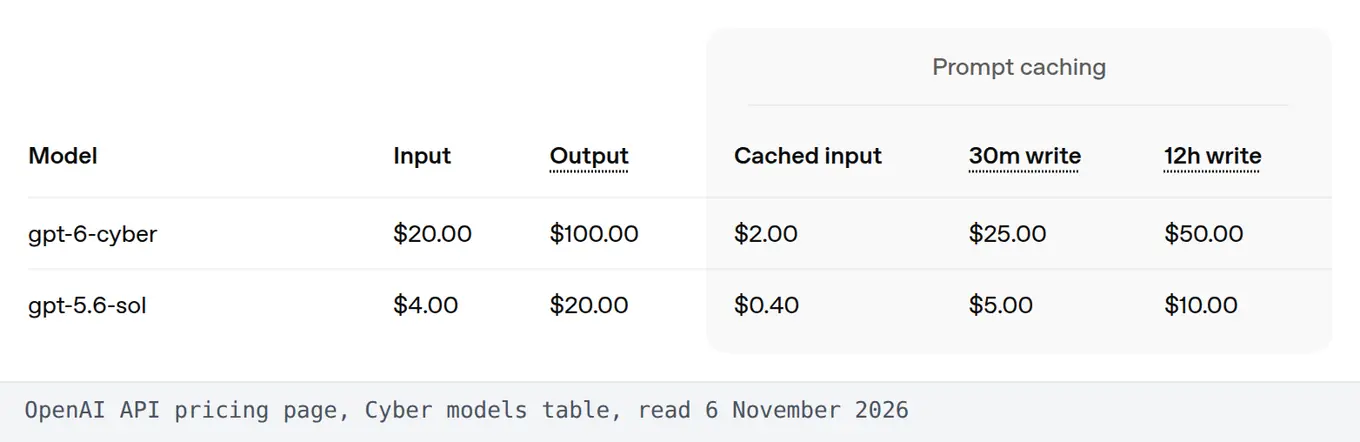
OpenAI launched GPT-6 Cyber on 5 November 2026 and listed it the same day in the “Cyber models” table of its API pricing page, below the mainline grid. As of 6 November 2026, the row reads as follows.
| GPT-6 Cyber, per 1M tokens | Price |
|---|---|
| Input | $20.00 |
| Cached input | $2.00 |
| Cache write, 30 minutes | $25.00 |
| Cache write, 12 hours | $50.00 |
| Output | $100.00 |
The GPT-6 Cyber model page on the same site confirms these figures and labels them “standard short-context prices”. It also lists a 1,050,000-token context window and 128,000 max output tokens, so a whole service plus its dependencies fits in one prompt.
The cache ratios follow the GPT-6 pattern
Cached input is a tenth of the input rate, a 30-minute cache write is 1.25 times input, and a 12-hour write is 2.5 times input. That is the same structure as GPT-6 Astra, not the 0.05x cache that GPT-6.1 Sol gets.
For exploit development this matters more than usual. An agent that keeps a 200K-token codebase in context and runs 40 turns against it pays $2 per million on the repeated part instead of $20, so caching is the single biggest lever on your bill.
Long-context pricing is not on the model page
The model page only states short-context rates. OpenAI’s pricing table has a short and long context switch, but the long-context row for GPT-6 Cyber is not spelled out on the model page the way it is for GPT-5.6 Cyber, where prompts over 272K input tokens are billed at 2x input and 1.5x output for the full request.
If your scans regularly push past 272K tokens, check the long-context tab on the pricing page before you budget. I would not assume the GPT-5.6 Cyber multipliers carry over until OpenAI writes them down for this model.
How it compares with GPT-5.6 Cyber, Astra and Sol
The interesting comparison is not with other labs. It is with the three OpenAI models a security team can already reach, two of them without any Daybreak approval at all.
Here is the input and output price of each, per million tokens, taken from the pricing page and the model pages on 6 November 2026.
| Model | Input / output per 1M |
|---|---|
| gpt-6-cyber | $20.00 / $100.00 |
| gpt-5.6-cyber | $12.50 / $75.00 |
| gpt-6-astra | $10.00 / $50.00 |
| gpt-6.1-sol | $2.00 / $10.00 |
Against GPT-5.6 Cyber, not quite double
GPT-6 Cyber is 1.6 times GPT-5.6 Cyber on input ($20 against $12.50) and on cached input ($2 against $1.25), but only 1.33 times on output ($100 against $75). Output-heavy jobs, such as writing proof-of-concept code and long reports, see the smallest increase.
GPT-5.6 Cyber has also left the main pricing table; it now lives on its own model page, which still shows $12.50 / $1.25 / $75. Our gpt-5.6 tier breakdown covers the rest of that family.
Against GPT-6 Astra, exactly twice
Every column of the GPT-6 Cyber row is twice the GPT-6 Astra row: $20 against $10 input, $100 against $50 output, $2 against $1 cached, $25 and $50 against $12.50 and $25 for cache writes. The full Astra grid is in our GPT-6 Astra pricing breakdown.
GPT-6 Cyber costs exactly 2x GPT-6 Astra on every column. On OpenAI's own web penetration test, it found 40.3% of vulnerabilities against 32.0% for Astra.
That benchmark comes from the GPT-6 Cyber announcement. On recall alone, you pay twice the price for about 1.26 times the findings, so Astra still wins on cost per bug for discovery work. Cyber earns its price where Astra simply refuses: on OpenAI’s RemoteExploitBench, Astra running with Daybreak Blue refused 100% of tasks and GPT-6 Cyber completed 95%.
Against GPT-6.1 Sol, ten times
GPT-6.1 Sol is $2 / $10, so Cyber costs ten times more on input and output, and twenty times more on cached reads ($2 against $0.10). For bulk secure code review, Sol stays the default, as I explain in our GPT-6.1 Sol cache rate analysis.
What a scan or an exploit job costs
Per-million prices are hard to feel, so I priced two typical security jobs on all four models. These are worked examples on OpenAI’s list prices, not measured runs, and every request is kept under the 272K short-context threshold.
A single-pass review of a code slice
Take a 150,000-token slice of a repository, sent once without cache, with 20,000 tokens of findings coming back.
- gpt-6-cyber: $3.00 input + $2.00 output = $5.00
- gpt-5.6-cyber: $1.875 + $1.50 = $3.38
- gpt-6-astra: $1.50 + $1.00 = $2.50
- gpt-6.1-sol: $0.30 + $0.20 = $0.50
An agentic exploit-development run
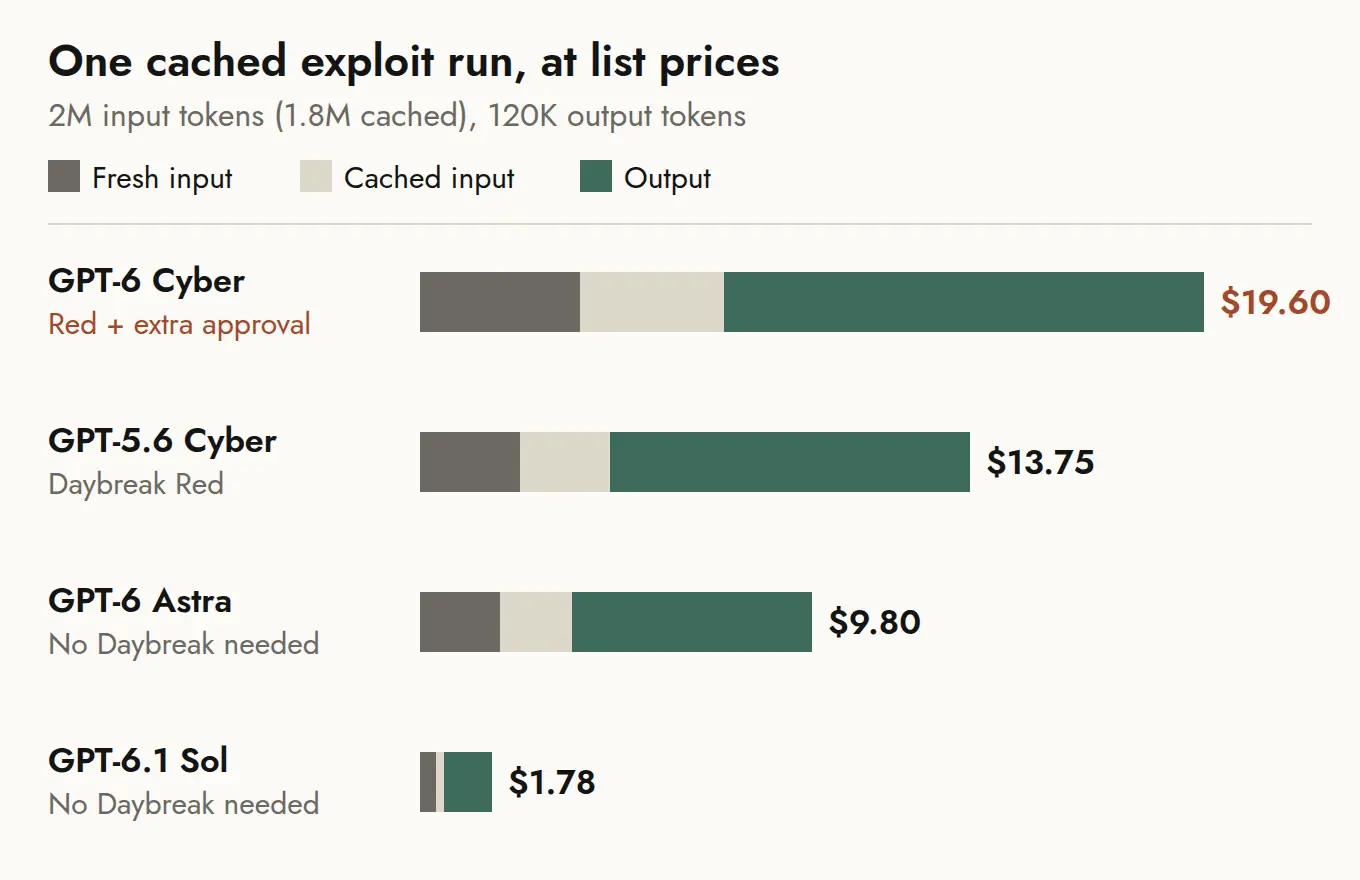
Now a long run: 2 million input tokens across many turns, of which 1.8 million are served from cache and 200,000 are fresh, plus 120,000 output tokens.
- gpt-6-cyber: $4.00 fresh + $3.60 cached + $12.00 output = $19.60
- gpt-5.6-cyber: $2.50 + $2.25 + $9.00 = $13.75
- gpt-6-astra: $2.00 + $1.80 + $6.00 = $9.80
- gpt-6.1-sol: $0.40 + $0.18 + $1.20 = $1.78
If the 200,000 fresh tokens are billed at the 30-minute cache-write rate instead of plain input, the GPT-6 Cyber run rises by $1.00, to $20.60. Output is 61% of the Cyber bill here, so capping report length saves more than trimming context.
A cached 2M-token exploit run costs about $19.60 on GPT-6 Cyber, against $9.80 on GPT-6 Astra and $1.78 on GPT-6.1 Sol.
Cost per exploit is not something OpenAI publishes
OpenAI says GPT-6 Cyber reproduced 1,724 Linux kernel vulnerabilities and developed working exploits for 948 of them, against 166 for GPT-5.6 Sol with the same harness. It has not published the tokens those campaigns used, so no honest cost per exploit can be derived from them yet.
Who can actually buy it
The Daybreak access overview spells out the gates. GPT-6 Cyber sits behind three of them, and the price only applies once you clear all three.
- Daybreak Red approval, which is currently available only to approved business and enterprise organizations, not to individuals.
- A separate GPT-6 Cyber approval on top of Red. Every Red organization gets GPT-5.6 Cyber; GPT-6 Cyber is reserved for those approved for it.
- Project enablement, since Daybreak is off by default. In the Responses API you set access_programs.cyber to daybreak_red on an enabled project.
OpenAI says GPT-6 Cyber is initially available through the API and Codex to a select group of approved Red customers, with access expanding to all Red customers “soon”. The launch post below is the official announcement, including the partner list.
Introducing GPT‑6 Cyber: a major advance in security research that pairs stronger capabilities with better model alignment. The model powered the Linux kernel research we announced yesterday, and security teams at companies like Mozilla, Palo Alto Networks, Calif, and https://t.co/34uAeNnhwP
@OpenAI
https://x.com/OpenAI/status/2118390190246879554
The operational strings attached
Approval comes with conditions that cost engineering time, not just money. Plan for these before you plan the budget.
- IP allowlisting is required for Daybreak Red API access by default, so calls only work from approved networks.
- Zero Data Retention customers generally must use Private Safety Processing, which keeps encrypted records in your own storage for 30 days.
- Daybreak may not power customer-facing features, resale, proxying or any third-party access.
- Rate limits for approved organizations are 5,000 requests and 1,000,000 tokens per minute on the Build tier, up to 15,000 requests and 40,000,000 tokens on Grow.
Who should not bother
My verdict is blunt: for most readers of this site, GPT-6 Cyber is a price to know, not a model to plan around. The cases where I would skip it are clear.
- Individual researchers. Red is organization-only, so the model is out of reach whatever you are willing to pay.
- Teams doing secure code review and triage. Daybreak Blue gives reduced refusals on GPT-6 Sol and GPT-6 Luna, and GPT-6.1 Sol does a single-pass review at a tenth of the price.
- Anyone building a product. The Daybreak terms forbid embedding the model in customer-facing traffic, so it cannot power a SaaS scanner.
- Red organizations without the extra approval. GPT-5.6 Cyber is already yours at $12.50 / $75, and it is the cheaper way to test whether exploit work justifies a cyber model at all.
Where GPT-6 Cyber is worth $100 per million output tokens is narrow: approved red teams running long exploit-validation work that Astra refuses. If your organization qualifies, OpenAI’s $1 billion Daybreak for Frontline Defenders grant program also subsidizes access for resource-constrained defenders such as government bodies and essential service providers.