Eleven v4 costs $0.08 per 1,000 characters on the ElevenLabs API and Eleven v4 Turbo costs $0.04, read on the ElevenLabs API pricing page on 20 October 2026. At a narration pace of 150 words a minute, an hour of audio is about 54,000 characters, so the ElevenLabs cost of a finished hour is $4.32 on v4 and $2.16 on Turbo. That is exactly what Multilingual v2 now costs per character, because ElevenLabs cut its older models from $0.10 on launch day, and the 72% launch discount on v4 ended on 12 October.

So the new flagship carries no premium over the model most narration pipelines already run on. What it does change is the reason to stay on v2, the size of each request, and the gap between buying through the API and buying through the web app, which is wider than the plan names suggest.
What Eleven v4 costs per character and per hour
ElevenLabs bills text to speech by the character you send, in US dollars rather than credits on the API side, and the price depends only on the model. Taxes come on top, which the page states under its grid.
The rate card as it stands
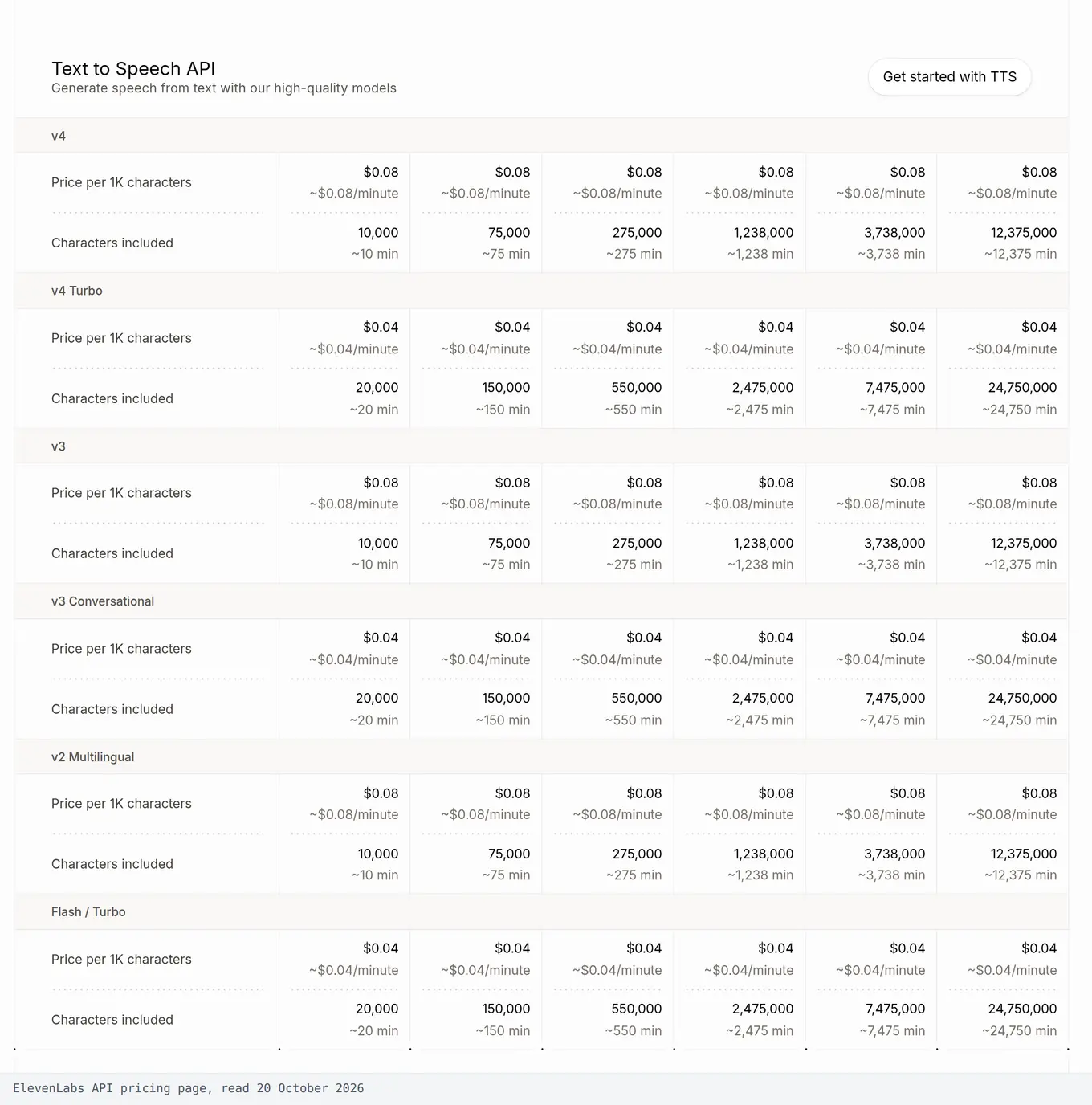
Six text to speech models sit on the ElevenLabs API pricing page, and they fall into exactly two price points. The second column converts each rate to an hour of narration at 54,000 characters.
| Model | Per 1,000 characters (per hour of narration) |
|---|---|
| Eleven v4 | $0.08 ($4.32) |
| Eleven v4 Turbo | $0.04 ($2.16) |
| Eleven v3 | $0.08 ($4.32) |
| Eleven v3 Conversational | $0.04 ($2.16) |
| Multilingual v2 | $0.08 ($4.32) |
| Flash / Turbo | $0.04 ($2.16) |
The expressive models cost $0.08 and the low-latency ones $0.04, whatever their generation. Picking v4 over v2 is a quality and language decision, not a budget one: v4 covers more than 90 languages against 29 for Multilingual v2.
One hour of narration on Eleven v4: 54,000 characters x $0.08 per 1,000 = $4.32. On v4 Turbo, $2.16.
How 1,000 characters becomes a minute
ElevenLabs prints “~$0.08/minute” next to the v4 rate, which treats 1,000 characters as one minute of speech. That implies a voice reading about 167 words a minute, counting six characters per word with the space. Audiobook narration usually runs closer to 150 words a minute, which is 900 characters a minute and puts the hour at $4.32 rather than the $4.80 the vendor minute suggests.
The rate is the easy part of the bill. Three things push the character count above the length of your script.
- Retakes. Each generation is a new request, so a line you regenerate because the delivery missed is billed a second time.
- Request size. The models documentation caps eleven_v4 at 10,000 characters per request, about ten minutes of audio, so an hour takes at least six requests that have to be stitched together.
- Audio tags. Directions such as [laughs] or [light rain] are written into the text, and on a per-character meter, text is what you pay for.
On a heavily directed audiobook I would budget a fifth more characters than the clean script. An eight-hour book is about 432,000 characters, $34.56 on v4 at the clean count and roughly $41.50 with that margin.
What changed on 28 September
ElevenLabs announced Eleven v4 and v4 Turbo on 28 September 2026. The launch post is short and carries no price, which is why the rate card above is the number to quote.
Introducing Eleven v4 and Eleven v4 Turbo, our fastest and most emotive voice models yet. Ranked #1 by Artificial Analysis.
@ElevenLabs
https://x.com/ElevenLabs/status/2104572127617994917
The launch discount ended on 12 October
For its first two weeks, v4 was listed at 72% off until Oct 12: $0.022 per 1,000 characters for v4 and $0.011 for v4 Turbo, against the same $0.08 and $0.04 list prices, as an archived copy of the pricing page from launch day shows. An hour of narration cost about $1.19 during that window. It does not any more, and the current page shows no discount at all.
Launch rate until 12 October 2026: $0.022 per 1,000 characters on v4. Rate since then: $0.08, about 3.6 times as much.
Any cost estimate written in the first fortnight of October around $0.022 describes a price that no longer exists. If you budgeted a production on it, multiply by 3.6.
Multilingual v2 and v3 got cheaper the same day
The less visible change sits one row lower. On the 30 August 2026 copy of the same page, Multilingual v2 and v3 cost $0.10 per 1,000 characters and Flash / Turbo $0.05. Since launch day they cost $0.08 and $0.04, a 20% cut on every existing model.
If you never touch v4, your bill still fell: an hour on Multilingual v2 went from $5.40 to $4.32. If you were holding off on v4 because a new flagship usually costs more, that objection is gone.
Subscriptions against pay as you go
The same six plans, from Starter at $6 a month to Business at $990, appear on both the API tab and the Creative tab of the pricing page. They do not buy the same thing.
On the API, a plan buys characters at list price
On the API tab, each plan converts its monthly price into characters at exactly $0.08 per 1,000 for v4. Starter’s $6 buys 75,000 v4 characters, Creator’s $22 buys 275,000, Pro’s $99 buys 1,238,000 and Business’s $990 buys 12,375,000, with twice as many on v4 Turbo.
That is no discount at any tier. In narration hours at 54,000 characters, Starter covers about 1.4 hours, Creator 5.1, Pro 22.9 and Business 229, and the price per hour stays $4.32 the whole way up. Only Enterprise mentions “significant discounts at scale”, without a figure.
The web app still bills in credits
The Creative tab, which prices the Studio and the web app, keeps the credit ladder covered in my breakdown of ElevenLabs plan credits: 30,000 credits on Starter, 121,000 on Creator, 600,000 on Pro. Its own table counts those as about 30, 121 and 600 minutes of text to speech, so a minute in the app costs $0.20 on Starter and about $0.165 on Pro. That is roughly double the API’s $0.08 minute for the same voice.
The Creative tab does not print a v4-specific credit rate, and its plan comparison still carries an Eleven v3 row and no v4 row. During launch, ElevenLabs waived credits on v4 generations for Creator plans and above, which ended on the same date as the API discount.
To celebrate the launch of Eleven v4, it’s free on ElevenCreative for the next 11 days. Until October 12, v4 generations on Creator plans and above don’t use your credits, up to 2x your monthly allowance.
@ElevenCreative
https://x.com/ElevenCreative/status/2105674217484374286
One line on the Creative tab is now beaten by the API. The Business plan advertises “Low-latency TTS as low as 5c/minute”, while v4 Turbo on pay as you go is about 4 cents a vendor minute with no plan at all.
Where Eleven v4 sits against OpenAI and Gemini voices
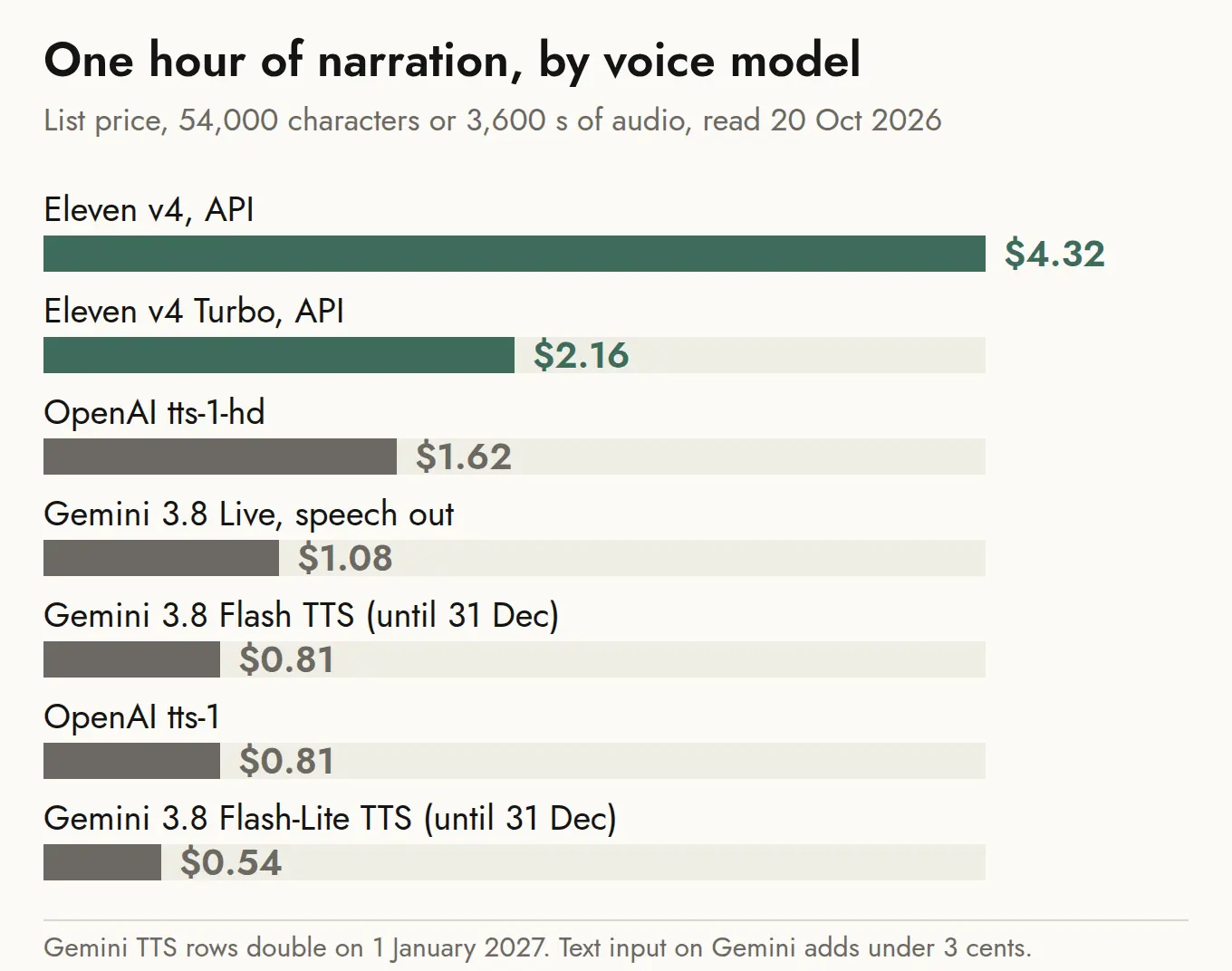
The cheaper voices are priced on different meters: OpenAI bills tts-1 by the character, and Google bills its TTS models by output audio token at 25 tokens a second. Similar to Mistral’s Voxtral 3 TTS pricing, the table converts each to one hour of narration, using 54,000 characters for the per-character models and 3,600 seconds of audio for Google’s, all read on 20 October 2026.
| Voice model | One hour of narration |
|---|---|
| Eleven v4 (API) | $4.32 |
| Eleven v4 Turbo (API) | $2.16 |
| OpenAI tts-1-hd, $30 per million characters | $1.62 |
| Gemini 3.8 Live, speech output at $0.018 a minute | $1.08 |
| Gemini 3.8 Flash TTS | $0.81 until 31 December 2026, then $1.62 |
| OpenAI tts-1, $15 per million characters | $0.81 |
| Gemini 3.8 Flash-Lite TTS | $0.54 until 31 December 2026, then $1.08 |
The Gemini rows come from the Gemini API pricing page, which prints them as $0.00225 and $0.0015 per 10 seconds of audio at the introductory rate. The text you send adds $0.50 per million tokens, under three cents an hour even if every character counted as a token. OpenAI also lists gpt-4o-mini-tts at $12 per million audio output tokens, but its pricing page gives no per-minute equivalent, so I left it out rather than guess a token rate.
What the gap pays for
At list price, Eleven v4 costs about five times Gemini 3.8 Flash TTS and almost three times OpenAI’s tts-1-hd for the same hour. Gemini 3.8 Live sits in the table for scale only: it is a conversation model, and an hour of it with a human on the line costs less than an hour of pure speech, as I worked through in an hour of Gemini 3.8 Live.
What ElevenLabs charges for is delivery: inline direction tags, multi-speaker dialogue that reacts to context, cloned voices that hold across a long production, and accent control across 90-plus languages. Its launch post cites first place on the Artificial Analysis voice leaderboard for September 2026, and about 75% listener preference in blind head-to-head tests against four rivals, two of them Gemini 3.8 Flash TTS and Flash-Lite TTS. If your listener will hear eight hours of one narrator, $4.32 an hour is small next to the cost of a voice that drifts.
Which model I would put on each job
The two-price structure makes the choice simpler than the model count suggests. Here is where I would route each kind of work at the rates above.
- Audiobooks and long narration: Eleven v4 through the API at $4.32 an hour, plus a retake margin. There is no cost reason left to stay on Multilingual v2.
- Voice agents: v4 Turbo at $0.04, the same price as Flash. Keep Flash only if you need its 40,000-character requests or its lower latency.
- Notifications, drafts and internal audio: Gemini 3.8 Flash-Lite TTS or OpenAI tts-1, both under a dollar an hour. Re-check the Gemini rows in January, when they double.
- Studio users on a Creative plan: move long renders to the API if you can script them, since the app minute costs about twice as much.
If the same pipeline also turns audio back into text, transcription is a separate meter, and Whisper’s price per transcribed hour runs on a different scale from speech output.