Gemini 3.8 Flash costs $0.75 per million input tokens and $3.75 per million output tokens, with cached input at $0.075, read from the Google AI pricing page on 5 September 2026. Those are promotional rates that Google publishes as applying through 31 December 2026, after which the same page lists $1.50, $7.50 and $0.15. Every line doubles on the same day.

The newest and, by Google’s own description, most intelligent Flash model is priced exactly like the two generations before it. The line that actually separates a cheap Gemini month from an expensive one is not on that headline grid. It is the cache line, priced in the section below.
What Gemini 3.8 Flash costs, on both grids
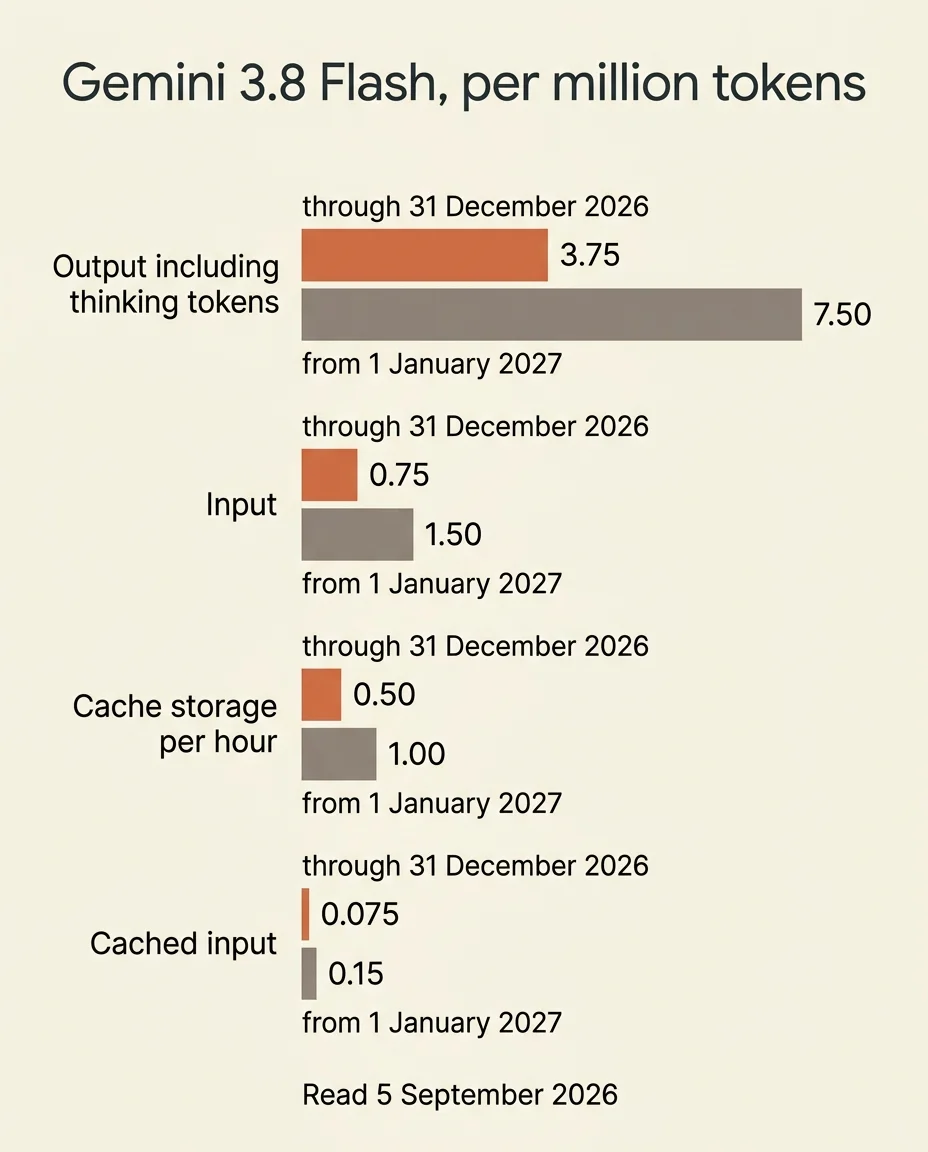
Google publishes the current rate and the one that replaces it on the same row, which is unusually candid and worth taking literally.
| Line, per million tokens | Through 31 Dec 2026 / from 1 Jan 2027 |
|---|---|
| Input | $0.75 / $1.50 |
| Cached input | $0.075 / $0.15 |
| Output, thinking tokens included | $3.75 / $7.50 |
| Cache storage, per hour | $0.50 / $1.00 |
Output includes thinking tokens, which matters on a model that supports low, medium and high thinking. The minimal setting is not supported on 3.8 Flash and returns an error, so there is no way to buy your way below the low tier.
Three generations at one price
Gemini 3.8 Flash, 3.7 Flash and 3.6 Flash carried an identical grid, promotional dates included. Gemini 3.7 Flash has since been retired: Google’s deprecations page, read on 3 November 2026, says its API calls are now routed to 3.8 Flash, and Gemini 3.5 Flash calls to 3.6 Flash. Google did not price the new generation above the old ones, and it did not cut the old ones either.
Three Flash generations, one price list, one expiry date. On price alone there is no reason to stay on an older one.
That makes the upgrade decision unusually simple, and it makes the comparison tables that rank Flash generations by price useless, because they are all the same number. We priced the previous generation line by line on our Gemini 3.7 Flash page.
The cache line nobody puts in a comparison table
Every provider we track charges a reduced rate to read cached input. Google is the one that also charges rent to keep the cache alive, at $0.50 per million tokens per hour through 31 December 2026, then $1.00.
What an hour of storage actually costs
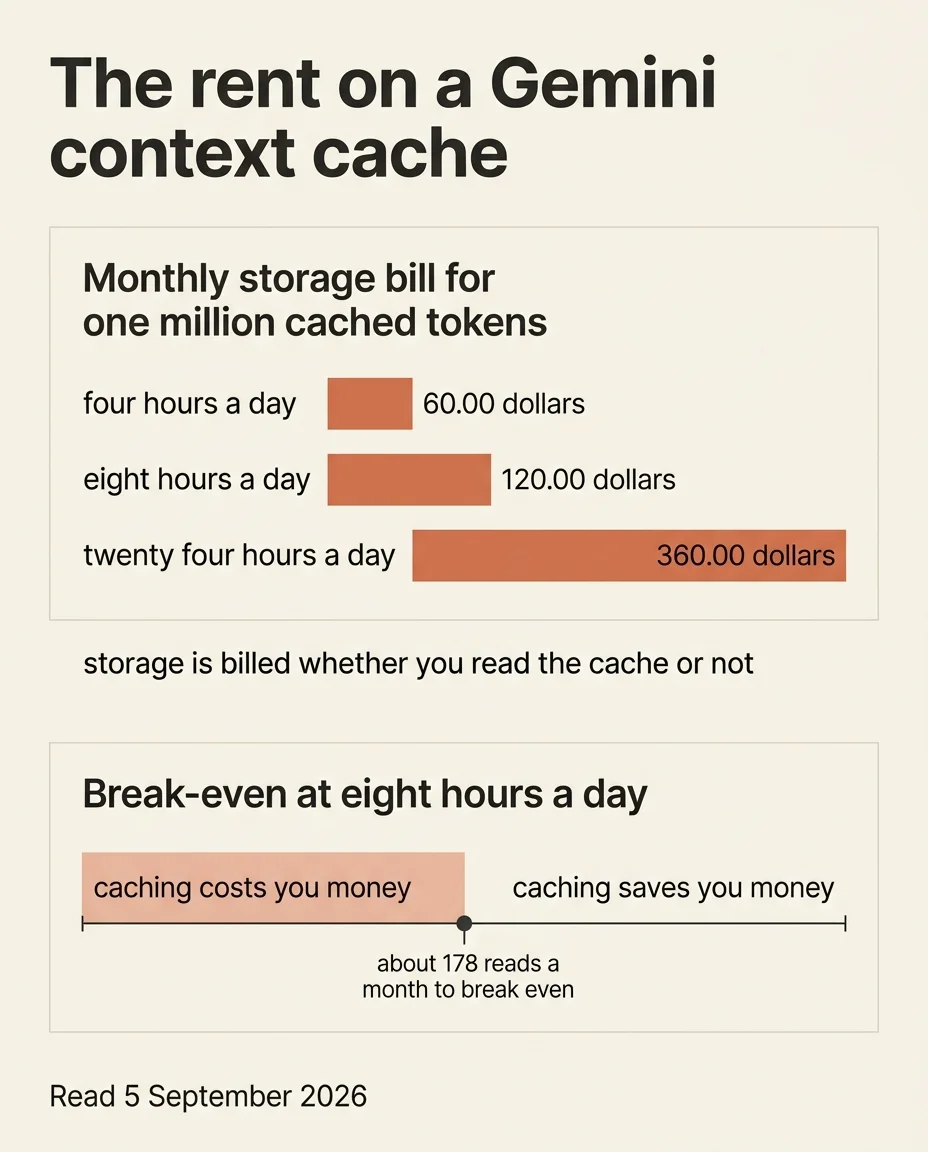
The arithmetic is brutal on a pinned context. Keeping one million tokens cached for eight hours a day, thirty days a month, costs $120 in storage before you read it once.
Keep the same context alive around the clock and it costs $360 a month. That is on a model whose entire headline appeal is being cheap, and the figure appears on no comparison table we have seen, ours included until we checked.
How many reads it takes to pay for itself
Each read of that million-token cache saves $0.675 against sending it fresh, so the storage bill needs about 178 reads a month to break even at eight hours a day, and about 533 reads at twenty-four hours.
Three things follow from that:
- A cache pinned overnight for a workload that only fires during office hours is paying rent for nothing.
- Below roughly six reads a day per pinned million tokens, caching costs you money rather than saving it.
- Above that, the saving grows fast, because reading is a tenth of fresh input and storage does not scale with reads.
Where 3.8 Flash sits in the Flash line
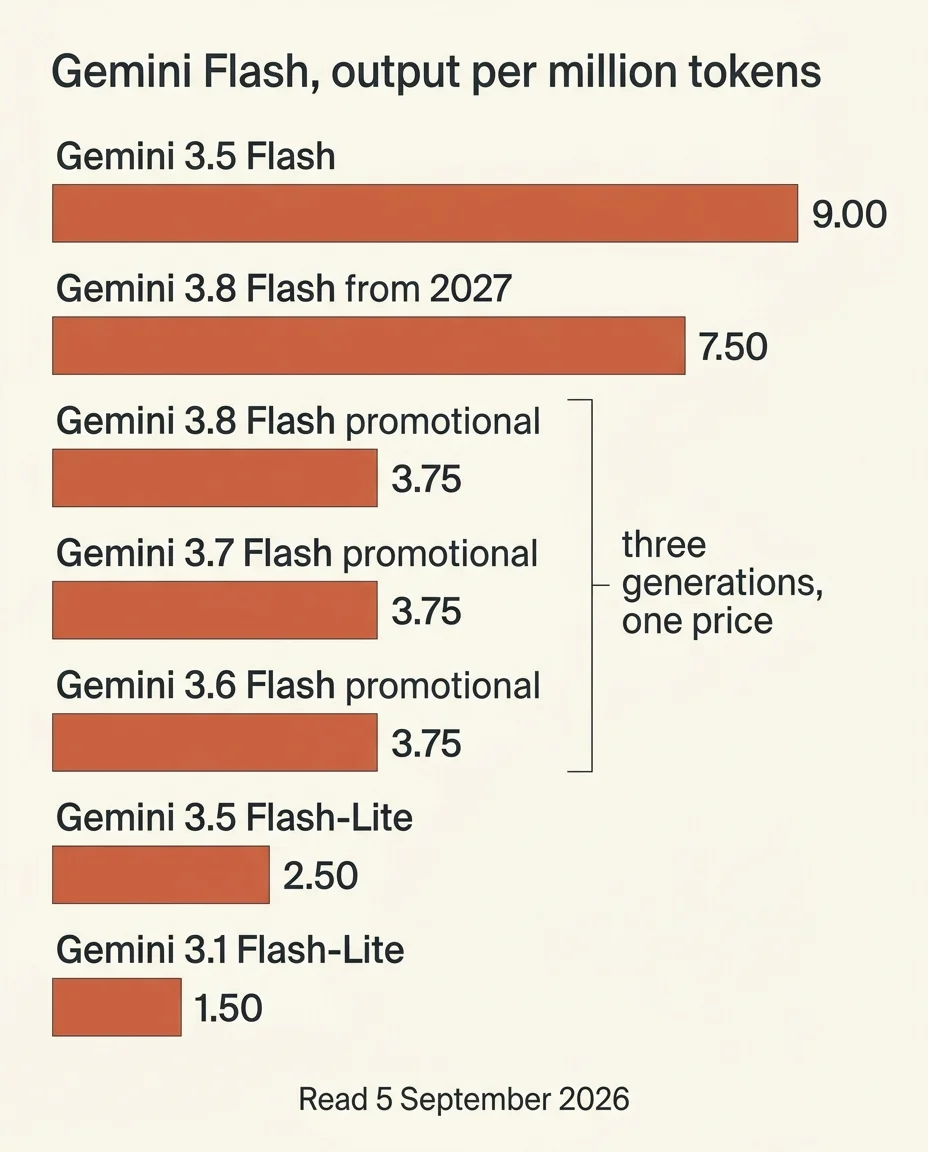
The Flash family now spans a factor of five on output, and the promotional rate is what puts the newest model at the bottom of it.
| Model | Input / cached / output, per million |
|---|---|
| Gemini 3.8 Flash, promotional | $0.75 / $0.075 / $3.75 |
| Gemini 3.7 Flash, promotional (retired, routes to 3.8 Flash) | $0.75 / $0.075 / $3.75 |
| Gemini 3.6 Flash, promotional | $0.75 / $0.075 / $3.75 |
| Gemini 3.8 Flash, from 2027 | $1.50 / $0.15 / $7.50 |
| Gemini 3.5 Flash (retired, routes to 3.6 Flash) | $1.50 / $0.15 / $9.00 |
| Gemini 3.5 Flash-Lite | $0.30 / $0.03 / $2.50 |
| Gemini 3.1 Flash-Lite | $0.25 / $0.025 / $1.50 |
Two readings come out of that. Even after the promotional rate ends, 3.8 Flash matches Gemini 3.5 Flash on input and undercuts it on output, at $7.50 against $9.00, so the newer model is never the expensive choice.
And the Flash-Lite models sit well below all of them. If the task is classification, extraction or routing, 3.1 Flash-Lite does it at a third of the promotional Flash price, and we mapped where the floor actually sits across every provider on our cheapest LLM APIs page.
What a month actually costs
Ten million input tokens and two million output tokens, no caching, which is the honest default for traffic that does not repeat.
| Grid | A month at that volume |
|---|---|
| Through 31 December 2026 | $15.00 |
| From 1 January 2027 | $30.00 |
Budgeting a year of Gemini 3.8 Flash at $0.75 assumes a discount you have been told will end. The sane position is to plan at $1.50 and treat the current rate as money you are saving until the date.
A scheduled increase is an announcement rather than a fact, and this market has seen one cancelled: Anthropic published that Claude Sonnet 5 would rise on 1 September 2026, then made the launch rates standard instead. Plan for the published date, and check the page again before you commit.
The free tier, and what it costs instead of money
Gemini 3.8 Flash has a free tier that is genuinely free of charge on input, output and caching. The price is paid in a different currency: on the free tier Google states that content is used to improve its products, and on the paid tier it states that it is not.
Two other lines belong in a real budget. Grounding with Google Search gives 5,000 free requests a month shared across all Gemini 3.x models, then costs $14 per 1,000 requests, and a single prompt can trigger more than one search. Batch processing takes fifty percent off, while Flex and Priority inference are both supported on this model.
Our LLM cost calculator runs the same volume across every provider we track.
Frequently asked questions
How much does Gemini 3.8 Flash cost per million tokens?
$0.75 for input and $3.75 for output, with cached input at $0.075, through 31 December 2026. From 1 January 2027 the published rates are $1.50, $7.50 and $0.15. Read from the Google AI pricing page on 5 September 2026.
Is Gemini 3.8 Flash more expensive than 3.7 Flash?
No. The two carry an identical grid, including the same promotional dates, as does 3.6 Flash. On price there was nothing to choose between the three generations, and the choice is now made for you: 3.7 Flash has been retired and its API calls route to 3.8 Flash.
Will the price really double in January 2027?
That is what Google publishes on the pricing page today. It is an announced date rather than a settled fact, and increases in this market have been cancelled before, so budget at the higher rate and treat the lower one as temporary.
What is the context cache storage price?
$0.50 per million tokens per hour through 31 December 2026, then $1.00. It is charged for keeping the cache alive, separately from the $0.075 you pay to read it, and it runs whether you read the cache or not.
Is there a free tier on Gemini 3.8 Flash?
Yes, free of charge on input, output and caching. Google states that free-tier content is used to improve its products and that paid-tier content is not, so it is a way to try the model rather than a way to run a product on it.
What we verified and what we did not
Verified: the input, cached input, output and cache storage rates for Gemini 3.8 Flash on both the promotional and the post-2026 grids, the identical grids on 3.7 Flash and 3.6 Flash, the rates for 3.5 Flash, 3.5 Flash-Lite and 3.1 Flash-Lite, the free-tier terms and the data-use difference between free and paid, the search grounding allowance of 5,000 free requests a month then $14 per 1,000, and the model card figures of a 1,048,576 token input limit, a 65,536 token output limit, text image video audio and PDF inputs, text-only output, and thinking supported at low, medium and high with minimal returning an error. All read from the Google AI pricing page and the gemini-3.8-flash model page on 5 September 2026.
Not verified, and therefore not asserted: any benchmark or capability claim, since this page prices a model rather than ranking it; the Batch, Flex and Priority rates line by line, which the page presents behind separate tabs we did not transcribe; and Vertex AI pricing, which Google publishes on its own grid.
Prices in this category move, and this one carries a published expiry date. Everything here is stamped with the day it was read.