gpt-6-astra costs $10 per million input tokens, $1 for cached input and $50 per million output tokens on the standard tier, read from the OpenAI pricing page on 5 September 2026. The unusual part is what that means for the tier below it. The top of the GPT-6 line is cheaper than the top of the 5.6 line, which still charges $12.50 and $75 on cyber.

Four service tiers sit on that grid and a long-context surcharge sits on top of them, so the same tokens can cost four times as much depending on how you send them.
What gpt-6-astra costs, tier by tier
OpenAI sells the same weights at four rates. Standard is what you get unless you ask for something else, and the other three move in fixed multiples of it.
| Tier | Input / cached / cache write / output |
|---|---|
| Standard | $10.00 / $1.00 / $12.50 / $50.00 |
| Batch | $5.00 / $0.50 / $6.25 / $25.00 |
| Flex | $5.00 / $0.50 / $6.25 / $25.00 |
| Fast mode | $20.00 / $2.00 / $25.00 / $100.00 |
Batch and Flex land on exactly the same numbers, half the standard grid, and they differ in what you give up rather than in what you pay. Batch runs asynchronously; Flex accepts slower scheduling on a synchronous call.
Fast mode is the tier OpenAI renamed from Priority on 30 July 2026, and it doubles every line. Cached input stays at a tenth of fresh input on all four tiers, so caching keeps its value whichever one you pick.
The new flagship undercuts the old one
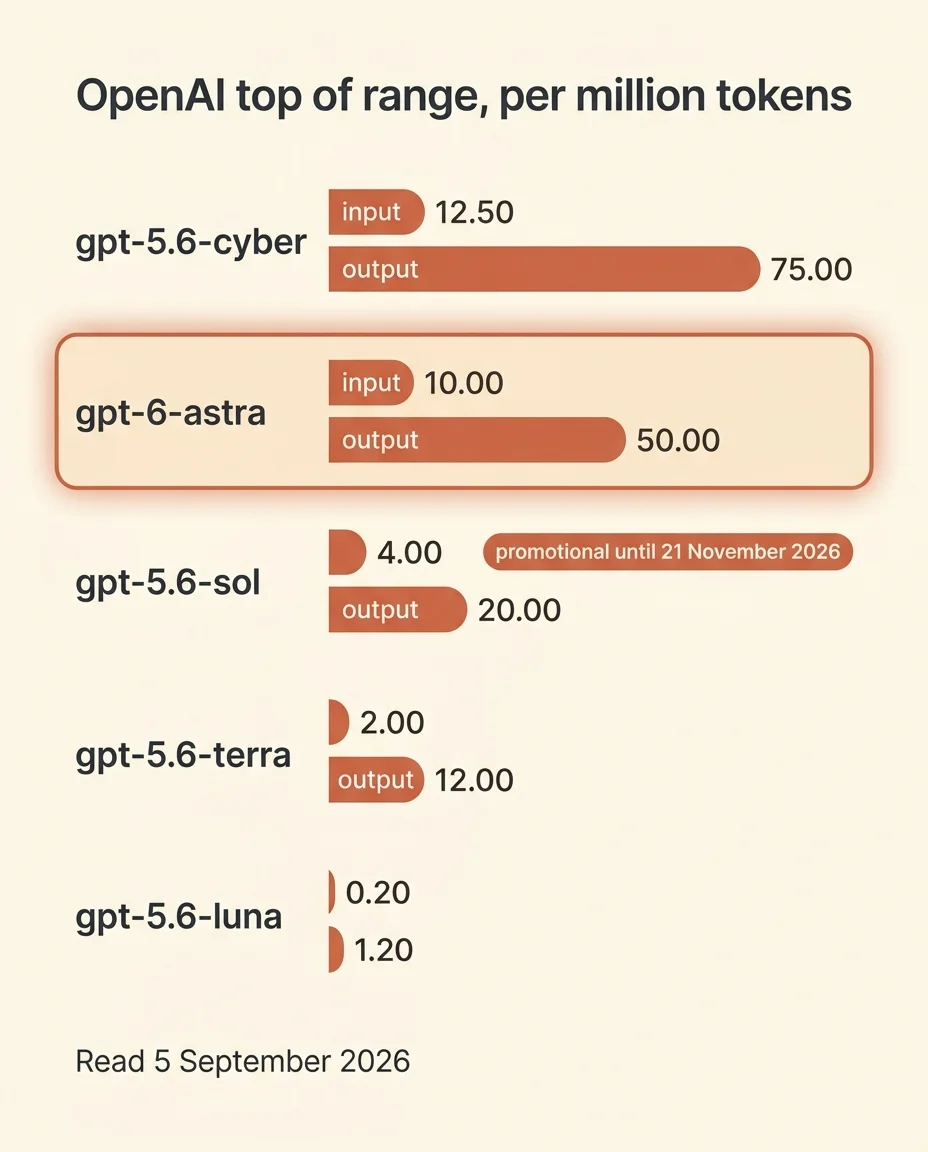
The interesting comparison is not against Anthropic or Google, it is against the model astra sits above in OpenAI’s own catalogue.
| Model | Input / cached / output, per million |
|---|---|
| gpt-5.6-cyber | $12.50 / $1.25 / $75.00 |
| gpt-6-astra | $10.00 / $1.00 / $50.00 |
| gpt-5.6-sol | $4.00 / $0.40 / $20.00 |
| gpt-5.6-terra | $2.00 / $0.20 / $12.00 |
| gpt-5.6-luna | $0.20 / $0.02 / $1.20 |
A newer generation, priced twenty percent under the older flagship on input and a third under it on output. That is not how model pricing usually moves.
Two caveats belong with that table. The sol rates are promotional and OpenAI now says they are available until 30 November 2026, so the gap between sol and astra is the one most likely to move. And astra is the only model in the group whose output multiplier is five times input rather than six, which shifts the arithmetic on generative work.
We take the four tiers of the previous generation apart on our gpt-5.6 pricing page.
Long prompts are billed on a second grid
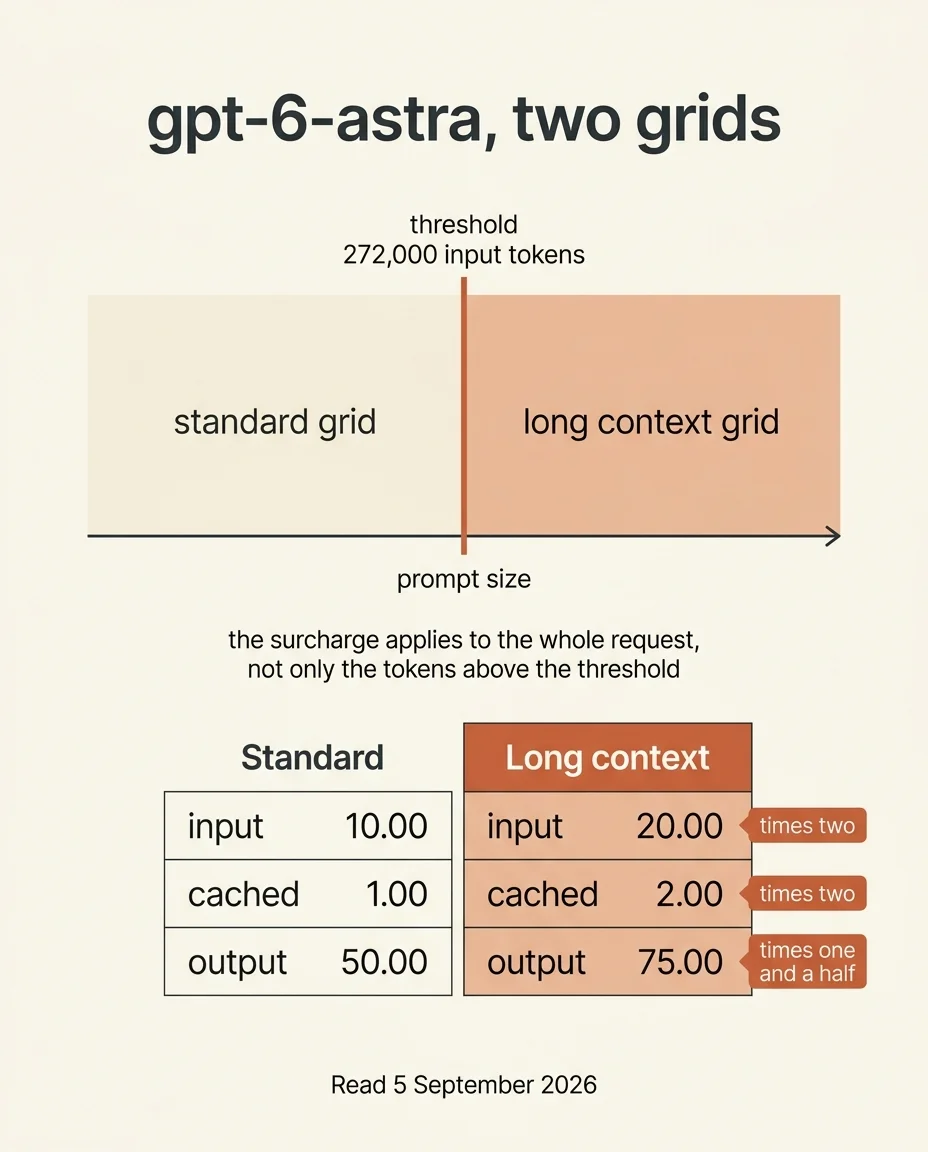
Past 272,000 input tokens, OpenAI doubles the input and cache rates and multiplies output by one and a half. The detail that costs money is that it applies the surcharge to the full request, not to the tokens above the threshold.
On astra that produces a second grid of $20.00 input, $2.00 cached and $75.00 output. A prompt of 273,000 tokens is therefore billed entirely at those rates, and a prompt of 271,000 tokens is not.
Three consequences worth designing around:
- Trimming a prompt from just over the threshold to just under it halves your input bill for that call.
- The 1,050,000 token context window is real, but the last three quarters of it are expensive.
- Output rises by half rather than doubling, so long prompts are relatively kinder to generative work than to retrieval.
The same $10 and $50 buys a different model at Anthropic
astra and Claude Fable 5.1 carry the identical headline rate of $10 input and $50 output per million. On the two visible columns they are indistinguishable, which makes the third column the whole comparison. Anthropic has since moved under that rate: Claude Fable 5.2, listed on 9 November 2026, costs $8 and $40, a fifth below both.
Anthropic reads a cache hit on Fable 5.1 at $0.25 per million, a fortieth of its input price. OpenAI reads one on astra at $1.00, a tenth. On a workload that resends a large context all day, that single line is worth $0.75 per million tokens read, and it goes to Anthropic.
The reverse holds on anything that does not repeat itself, where the two models cost the same to the cent and the choice comes down to everything except price.
What a month actually costs
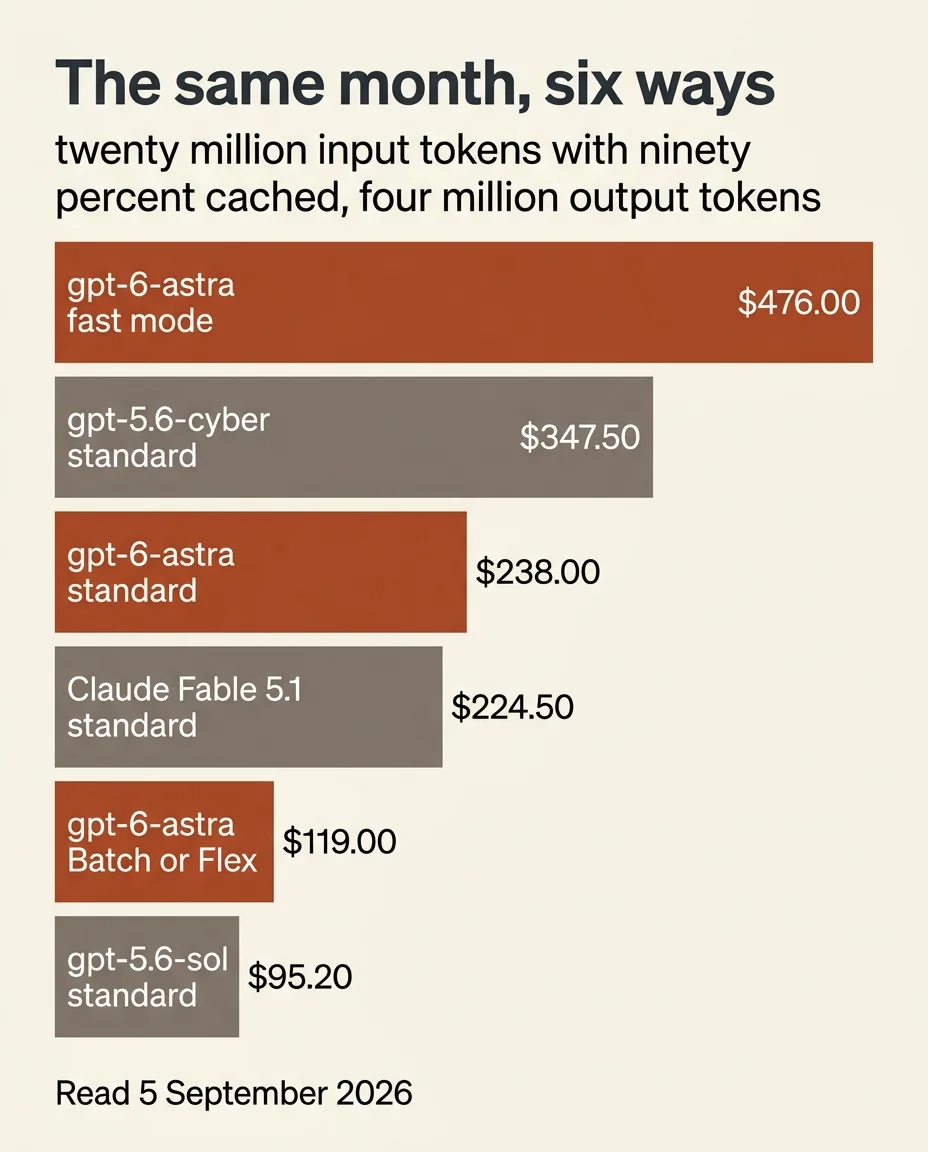
Twenty million input tokens with ninety percent served from cache, four million output tokens, priced on the 5 September 2026 grid. For comparison, GPT-6 Cyber at twice Astra’s price offers different cost parameters for users with higher budgets.
| Model or tier | A month at that volume |
|---|---|
| gpt-6-astra, fast mode | $476.00 |
| gpt-5.6-cyber, standard | $347.50 |
| gpt-6-astra, standard | $238.00 |
| Claude Fable 5.1, standard | $224.50 |
| gpt-6-astra, Batch or Flex | $119.00 |
| gpt-5.6-sol, standard | $95.20 |
Read that table twice. Moving from cyber to astra saves 31 percent for a newer model, and moving astra from standard to Batch saves another half on top, which is a larger lever than any model choice inside the OpenAI catalogue.
When astra is the right line
At $50 per million output tokens, Astra is the most expensive standard rate in OpenAI’s gpt-6 line, so the question is whether the work needs the top of that line at all, or if the cheaper GPT-6 Sol tier would suffice.
The grid points at three answers:
- If the task is genuinely hard and end to end, astra now costs less than the model it replaces at the top, so there is no longer a price argument for staying on cyber.
- If the task is ordinary and high volume, terra at $2.00 and $12.00 does it for a fifth of the price and luna for a fiftieth.
- If the work can wait, Batch halves whichever line you land on, and that beats moving down a tier on quality grounds.
Our LLM cost calculator runs the same volume across every provider we track.
Frequently asked questions
How much does gpt-6-astra cost per million tokens?
$10.00 input, $1.00 cached input and $50.00 output on the standard tier, with a cache write at $12.50. Read from the OpenAI pricing page on 5 September 2026.
Is gpt-6-astra more expensive than gpt-5.6-cyber?
No. astra is $10.00 and $50.00 against $12.50 and $75.00 on cyber, so the newer flagship is twenty percent cheaper on input and a third cheaper on output.
What is the cheapest way to run gpt-6-astra?
The Batch API or Flex, both at $5.00 input and $25.00 output, a flat fifty percent off the standard grid. Cached input still costs a tenth of fresh input on top of that.
When does the long-context rate kick in?
Past 272,000 input tokens. Input and cache rates double and output rises by half, applied to the full request rather than to the excess, so astra reads $20.00, $2.00 and $75.00 on that grid.
What is fast mode and what does it cost?
Fast mode is the tier OpenAI renamed from Priority on 30 July 2026. It doubles every line, putting astra at $20.00 input, $2.00 cached and $100.00 output.
What we verified and what we did not
Verified: the standard, Batch, Flex and fast mode rates for gpt-6-astra, the long-context rule of 2x on input and cache and 1.5x on output past 272,000 tokens applied to the full request, the standard rates for gpt-5.6-cyber, sol, terra and luna on the same page and the same day, the note that the sol rates are promotional at least through 21 November 2026 (re-read on 10 November 2026: now until 30 November 2026, rates unchanged), and the model card figures of a 1,050,000 token context window, 922,000 maximum input tokens, 128,000 maximum output tokens and a knowledge cutoff of 30 April 2026. All read from the OpenAI pricing page and the gpt-6-astra model page on 5 September 2026.
Not verified, and therefore not asserted: any benchmark or capability claim, since this page prices a model rather than ranking it; what regional data residency endpoints cost beyond the published ten percent uplift for models released on or after 5 March 2026; and the rates on Azure, which publishes its own grid and renders it in a way we could not read on the day.
Prices in this category move, and one line on this page carries an expiry date. Everything here is stamped with the day it was read.