ElevenLabs sells characters, and characters say nothing about what an hour of finished narration costs. Re-read on 24 October 2026 and unchanged since 15 August, the paid tiers run from $6 a month for 30,000 credits to $990 for 6 million, with one credit equal to one character on the standard voices.

Converted at a normal narration pace of 150 words a minute, that works out at $10.80 per hour of audio on Starter, $9.82 on Creator and $8.91 on Pro, after which the price per hour stops improving.
What ElevenLabs charges, re-read on 24 October 2026
Everything below comes from the Creative tab of elevenlabs.io/pricing, first read on 15 August 2026 and re-read on 24 October 2026, when the tier prices, credit allowances and extra-minute rates had not moved. Prices are in US dollars and exclude taxes, levies and duties, which the page states explicitly.

The six published tiers
| Plan | Monthly | Annual, per month | Credits per month |
|---|---|---|---|
| Free | $0 | n/a | 10,000 |
| Starter | $6 | $5 | 30,000 |
| Creator | $22 | $18.33 | 121,000 |
| Pro | $99 | $82.50 | 600,000 |
| Scale | $299 | $249.17 | 1,800,000 |
| Business | $990 | $825 | 6,000,000 |
The ElevenLabs plans, billed per character
Annual billing is described as two months free: you pay for ten months, so the equivalent monthly figures in the third column are the ones to compare against. Creator carries a first-month promotion at $11, and until 1 November 2026 Starter’s first month costs $1.

The plan comparison further down the page also prints an extra-minute rate, where one extra minute means 1,000 more credits: about $0.36 on Free, $0.20 on Starter, $0.18 on Creator and $0.17 from Pro upward. Buying those extra credits is itself listed as a Creator feature, so the first two rates describe a top-up a Free or Starter subscriber cannot actually purchase.
Above Business sits Enterprise, priced on request, with custom credit volumes, SSO, DPA and SLA terms, BAAs for HIPAA customers and elevated concurrency limits. There is also a startup grant program advertised at 33 million characters over twelve months for eligible companies building conversational agents.
The feature ladder matters as much as the credit ladder for small buyers, and it climbs in four steps.
- Starter opens the commercial license and instant voice cloning.
- Creator adds professional voice cloning and the right to buy top-up credits.
- Pro adds 44.1 kHz PCM output over the API and 192 kbps audio.
- Scale adds three workspace seats, Business ten.
What one credit buys
On the V2 Multilingual models, and on Eleven v4, which ElevenLabs says uses the same credit pricing as its other text to speech models, one text character equals one credit. On V2 Flash and Turbo in English, and V2.5 Flash and Turbo Multilingual, API usage is discounted to between 0.5 and 1 credit per character.
Every other product draws on the same monthly pool, at the rates the page publishes below its FAQ.
| Product | Credits it spends |
|---|---|
| Text to speech | 1 per character |
| Speech to text | 330 per minute |
| Eleven Music | 900 per minute |
| Voice changer | 1,000 per minute |
| Voice isolator | 1,000 per minute |
| Sound effects | 200 per generation |
| Automatic dubbing | 2,000 per minute, 3,000 without a watermark |
| Dubbing Studio | 5,000 per minute, 10,000 without a watermark |
That single shared pool is the part buyers underestimate. An hour of transcription costs 19,800 credits, which is two thirds of an entire Starter month, and it competes with your text to speech budget rather than sitting in a separate bucket.
From characters to hours, the conversion nobody prints
The thousand-character minute
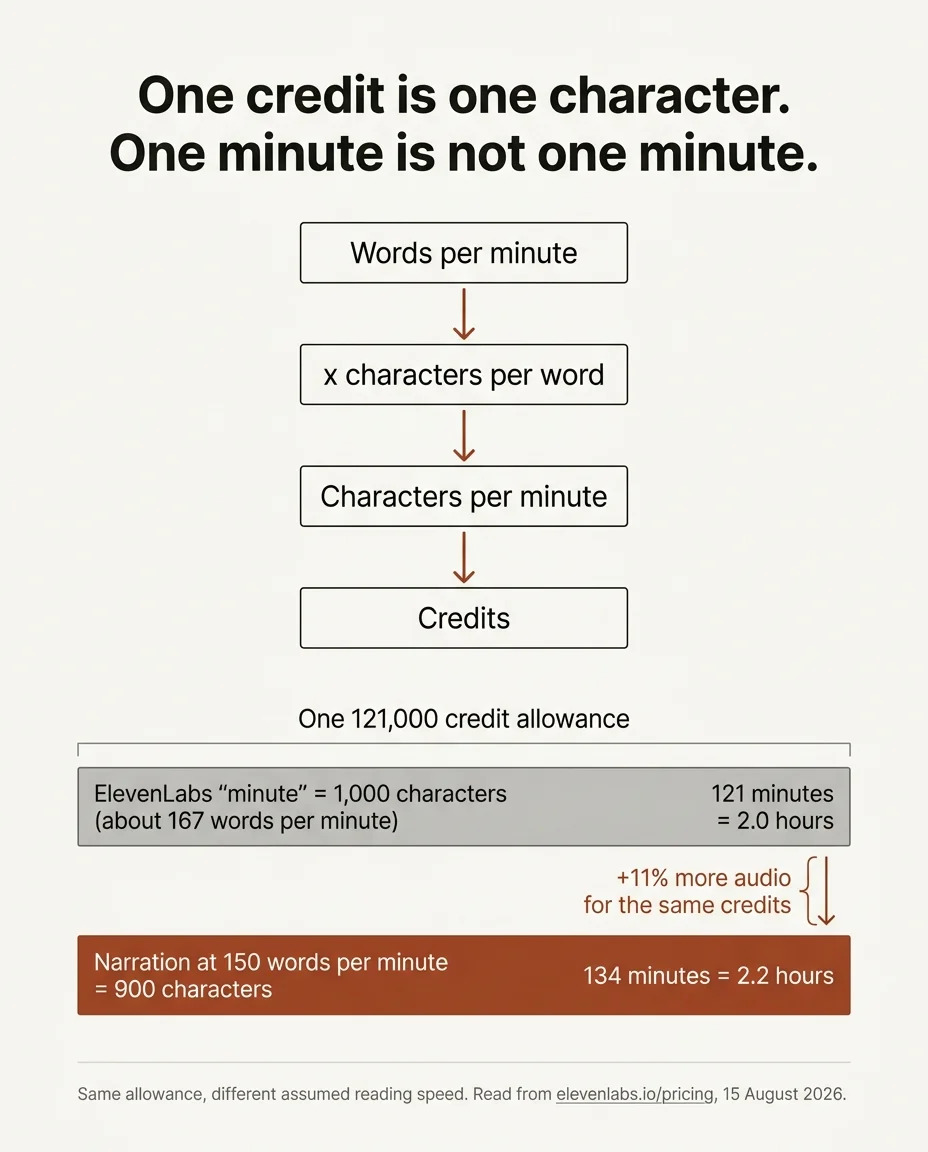
ElevenLabs does publish minutes, in the plan comparison table further down the pricing page: about 10 on Free, 30 on Starter, 121 on Creator, 600 on Pro, 1,800 on Scale and 6,000 on Business. Divide the credits by those minutes and the same number comes out every time. One ElevenLabs minute is exactly 1,000 characters.
At roughly six characters per word once you count the space, a thousand-character minute implies a voice reading about 167 words a minute. That is a brisk pace. Audiobook narration is usually delivered between 140 and 160 words a minute, explainer voiceover slower still, because the listener needs room to follow.
What a slower read does to your bill
Read at 150 words a minute and a minute of audio costs 900 characters instead of 1,000. An hour is then 54,000 credits rather than 60,000, and every allowance stretches about 11 percent further than the grid suggests. Pro stops being 10 hours and becomes 11.1. Go the other way, to a 170 word promo read, and the same allowance shrinks below the published figure.
This is the same translation problem that makes token grids unreadable, and it has the same fix: convert the vendor unit into the unit you buy in. We did it for Google in our breakdown of what a Gemini token actually costs, where the billable unit also hides a conversion the buyer has to make.
The real cost per hour, tier by tier
Above Creator the price per hour stops moving
Holding the pace at 150 words a minute and six characters a word, here is what each tier costs for one hour of finished standard-voice audio, if you use the full allowance.
| Plan | Hours included | Per hour, monthly | Per hour, annual |
|---|---|---|---|
| Starter | 0.6 | $10.80 | $9.00 |
| Creator | 2.2 | $9.82 | $8.18 |
| Pro | 11.1 | $8.91 | $7.43 |
| Scale | 33.3 | $8.97 | $7.48 |
| Business | 111.1 | $8.91 | $7.43 |
The spread from the cheapest tier to the most expensive is 21 percent. That is not a volume discount curve, it is a flat rate with a small entry penalty. Whatever you are optimizing when you move from Pro to Business, it is not the price of audio.
Scale costs more per credit than Pro
Restate those allowances as a price per million characters and an oddity surfaces. Pro sells credits at $165.00 per million, Business at exactly the same $165.00, and Scale, sitting between the two, at $166.11. Scale is the only tier on the ladder that costs more per credit than the tier below it. On annual billing the same inversion holds, $138.43 against $137.50.
It is a small premium, about seven tenths of a percent, and it is not a mistake on their side. Scale is sold on three workspace seats, team collaboration and three professional voice clones. You buy it for the seats. If you are a solo producer eyeing Scale purely for the credit volume, you are paying slightly above Pro rates for the privilege.
The tier gap is where the money goes
The list price per hour is not the price you pay. What you pay is the plan divided by the hours you actually made. Take a podcast producer needing 5 hours a month at 150 words a minute, which is 270,000 credits. Creator includes 121,000, so it is short. Pro includes 600,000, more than double the need, and $99 spread over 5 hours is $19.80 an hour.
Staying on Creator and buying the missing 149,000 credits as top-ups at the published $0.18 per thousand costs $26.82, for a total of $48.82, or $9.76 an hour. Same audio, same voices, half the bill. Run that comparison on the volume you actually produce, because that is the only version of this calculation that matters.
Three levers that move the bill more than the tier does
Flash, Turbo and v4 Turbo halve the character price on the API
The API tab of the pricing page, read on 24 October 2026, bills in dollars rather than credits and gives each text to speech model one of two prices. Eleven v4, the new flagship, costs $0.08 per 1,000 characters, like v3 and V2 Multilingual. Eleven v4 Turbo, its low-latency version, costs $0.04, like v3 Conversational and Flash/Turbo. In the web app, ElevenLabs states that v4 uses the same credit pricing as its other text to speech models, so the Creative grid and the per-hour table above apply to it unchanged.
| API model | Per 1,000 characters | Per hour at 150 words a minute | Per hour at the 1,000-character minute |
|---|---|---|---|
| Eleven v4 | $0.08 | $4.32 | $4.80 |
| Eleven v4 Turbo | $0.04 | $2.16 | $2.40 |
API subscriptions carry a dollar allowance rather than a credit pool. At the v4 rate, Starter includes 75,000 characters, Creator 275,000, Pro 1,238,000, Scale 3,738,000 and Business 12,375,000, each monthly price divided by $0.08, and v4 Turbo doubles every figure. At 150 words a minute, Pro buys about 22.9 hours of v4 audio over the API, against 11.1 hours of the same voice spent as credits in the web app.
The discount for Flash and Turbo models over the API is stated as 0.5 to 1 credit per character. At the bottom of that range, every number above halves. According to Eleven v4 API pricing per hour, Pro’s 600,000 credits become 22.2 hours of audio, about $4.46 an hour.
The same five-hour podcast month still misses Creator, but only just: 135,000 credits against the 121,000 included, a gap a $2.52 top-up closes for $24.52 all in, or $4.90 an hour. ElevenLabs publishes its own floor for this kind of work on the Business tier, low-latency text to speech advertised at as low as 5 cents a minute, which is $3.00 an hour.
The trade is model choice: Flash and Turbo are the latency-optimized voices, not the expressive flagship ones, so this lever costs you something audible on narrative work and nothing at all on notifications, IVR prompts and app readouts.
Top-up credits usually beat a tier jump
Additional credits appear as a Creator feature and carry upward. Because the published extra-minute rate on Creator, $0.18 per thousand credits, is essentially the same as the included rate on Pro, topping up a smaller plan is close to free compared with jumping a tier you cannot fill. The arithmetic only flips when the top-ups cost more than the upgrade itself, which for Creator against Pro happens at roughly 428,000 extra credits a month, a total need of about 549,000. Below that line Creator plus top-ups wins, above it Pro does.
Rollover, and what canceling costs you
Unused credits roll over for up to two months on a paid plan, so a balance can reach three times the monthly quota: this month’s allotment plus two months of carry. That is real money for anyone with lumpy production, a heavy launch month against three quiet ones. Two conditions attach. Rollover does not apply to the Free plan, and downgrading or canceling forfeits the unused balance at the end of the cycle, which turns a hoarded three-month buffer into nothing the moment you decide to leave. Pay-as-you-go top-up credits are excluded from that cap and treated separately.
One more line item worth knowing before you budget: credits are charged per generation request, not per download. Regenerate a take because you disliked the delivery and you have spent the characters twice, although a limited number of free regenerations is available as long as the content and certain settings do not change.
What we checked and what we did not
We read the Creative tab of the pricing page on 15 August 2026, re-read it on 24 October 2026, and every credit figure in this article comes from it: the six tier prices, the credit allowances, the annual equivalents, the published minutes and extra-minute rates, the credit costs per product, and the rollover and regeneration rules. The per-hour conversions are ours, built on a pace of 150 words a minute, and they change when the pace changes.
We read the API tab on 24 October 2026 for the Eleven v4 and v4 Turbo dollar rates quoted above. We did not read the Agents tab, so nothing here should be taken as the price of conversational agents.
Concurrency is now printed in the plan comparison: 2 simultaneous requests on Free, 3 on Starter, 5 on Creator, 10 on Pro, 15 on Scale and 25 on Business, with elevated limits on Enterprise. One ceiling stays unpublished. The page also states that a single generation request is capped in credits, and that the cap differs between the free tier and a paid subscription, without printing either number.
We did not audit the free plan against the paid ones for output quality, which is a separate question from cost, in the same way that what DeepSeek actually costs to use turns out to depend on which surface you are on rather than on the word free.
If ElevenLabs is one line in a wider AI bill, the text models sitting next to it are priced on the same read-and-date basis in our comparison of LLM API pricing per million tokens. Audio is the expensive one per unit of output, and it is the one most often bought on the wrong tier.
Frequently asked questions
How much does an hour of ElevenLabs audio cost?
Between $10.80 and $8.91 on the tiers re-read on 24 October 2026, if you read at 150 words a minute and use your whole allowance. Starter is the expensive end at $10.80, Pro and Business share the floor at $8.91, and annual billing takes a sixth off every one of those figures. Use less than your allowance and the real figure climbs.
How many characters is one ElevenLabs minute?
Exactly 1,000. Divide any plan’s credits by the minutes ElevenLabs advertises for it and you get the same 1,000 every time, which implies a voice reading about 167 words a minute. Most narration is slower than that, so a real minute of your audio usually costs nearer 900 credits and your allowance stretches about 11 percent further than the grid suggests.
Do ElevenLabs credits roll over?
Yes, for up to two months on a paid plan, so a balance can reach three times your monthly quota. Two limits apply: the Free plan is excluded, and downgrading or canceling forfeits whatever is unused at the end of the cycle. Pay-as-you-go top-up credits sit outside that cap and are treated separately.
Is the Scale plan worth it over Pro?
Not for the credits. Scale works out at $166.11 per million characters against $165.00 on Pro, making it the only tier on the ladder that costs more per credit than the one below it. What you are buying is three workspace seats, team collaboration and three professional voice clones, so it is worth it for a team and not for a solo producer chasing volume.
How often do we re-check these prices?
Every figure here was read from the Creative tab of elevenlabs.io/pricing on 15 August 2026 and checked again on 24 October 2026, after the Eleven v4 launch, and those dates are printed next to the numbers rather than buried. We re-read the grid when ElevenLabs changes a tier or a credit rate, and the date at the top of the page moves with it.