From 1 December 2026, every call to gemini-2.5-pro is served and billed as Gemini 3.8 Flash, so its output price drops from $10 to $3.75 per million tokens and its input from $1.25 to $0.75. That discount lasts one month: on 1 January 2027, 3.8 Flash doubles to $1.50 in and $7.50 out, which puts input above what 2.5 Pro costs today. Calls to gemini-2.5-flash go to Gemini 3.5 Flash-Lite at the same $0.30 and $2.50 text rate, with audio input 70% cheaper. The price is the easy part; the thinking settings, the grounding allowance and the model you actually get are what you should pin before the switch.

What gemini-2.5-pro costs from 1 December
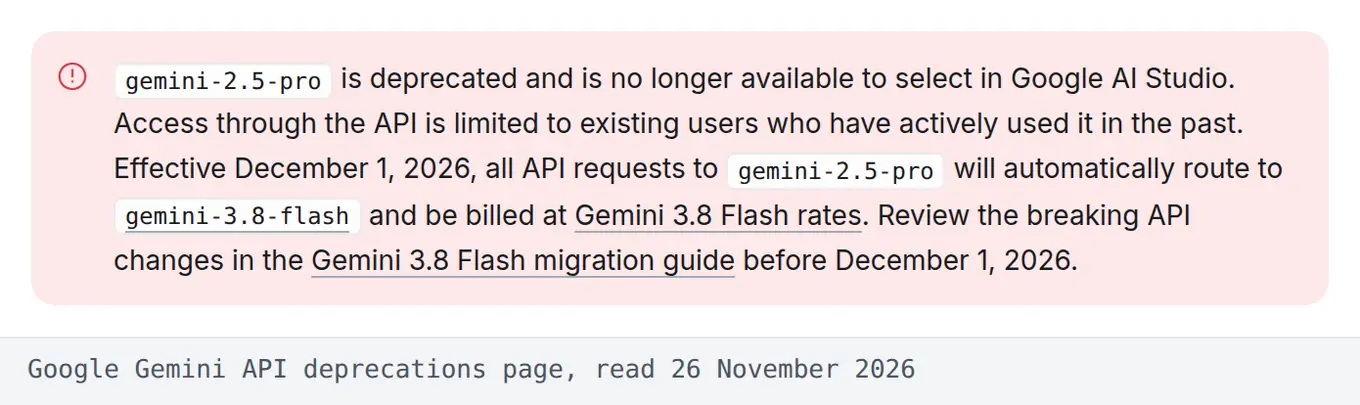
Google’s Gemini deprecations page and the caution notice on its pricing page say the same thing: from 1 December 2026, API requests to gemini-2.5-pro “automatically route” to gemini-3.8-flash and are billed at its rates. The calls keep succeeding; only the model and the invoice change. Here is what each line of a Standard-tier bill becomes, per million tokens, as listed on the Gemini API pricing page on 26 November 2026.
| Billing line (per 1M tokens) | 2.5 Pro today / December / from 1 Jan 2027 |
|---|---|
| Input, prompts up to 200k | $1.25 / $0.75 / $1.50 |
| Input, prompts over 200k | $2.50 / $0.75 / $1.50 |
| Output incl. thinking, up to 200k | $10.00 / $3.75 / $7.50 |
| Output incl. thinking, over 200k | $15.00 / $3.75 / $7.50 |
| Cached input, up to 200k | $0.125 / $0.075 / $0.15 |
| Cache storage, per 1M tokens per hour | $4.50 / $0.50 / $1.00 |
| Batch input / output, up to 200k | $0.625 / $5.00, then $0.375 / $1.875, then $0.75 / $3.75 |
| Priority input / output, up to 200k | $2.25 / $18.00, then $1.35 / $6.75, then $2.70 / $13.50 |
Gemini 3.8 Flash at $0.75 in and $3.75 out until 31 December 2026, read 26 November 2026
December is cheaper on every line
For one month, the reroute is a pure price cut. Input falls 40%, output falls 62.5%, and cache storage falls from $4.50 to $0.50 per million tokens per hour.
The catch is that the $0.75 and $3.75 rates are introductory. Google’s own wording is “through December 31, 2026”, and we already broke down the full Gemini 3.8 Flash grid on its own page.
In January, input overtakes what 2.5 Pro charges
From 1 January 2027, 3.8 Flash costs $1.50 in and $7.50 out. Against 2.5 Pro’s short-prompt rates, that is 20% more on input and 25% less on output, so the verdict depends on the shape of your traffic.
If you send more than 10 input tokens for every output token, the rerouted model costs more in January than 2.5 Pro does today, on identical tokens.
Cached reads follow input: $0.125 today, $0.15 in January. A retrieval pipeline that stuffs long contexts and returns short answers is exactly the workload that ends up paying more.
Long prompts and cache storage are the real winners
2.5 Pro bills prompts over 200,000 tokens at $2.50 and $15.00. 3.8 Flash has no long-context tier at all, so those calls drop to $0.75 and $3.75 in December and stay at $1.50 and $7.50 afterwards, still 40% and 50% below today.
Cache storage is the other line people forget. Holding a 300,000-token cache around the clock for a 720-hour month costs $972 on 2.5 Pro, $108 in December and $216 from January.
What gemini-2.5-flash costs on 3.5 Flash-Lite
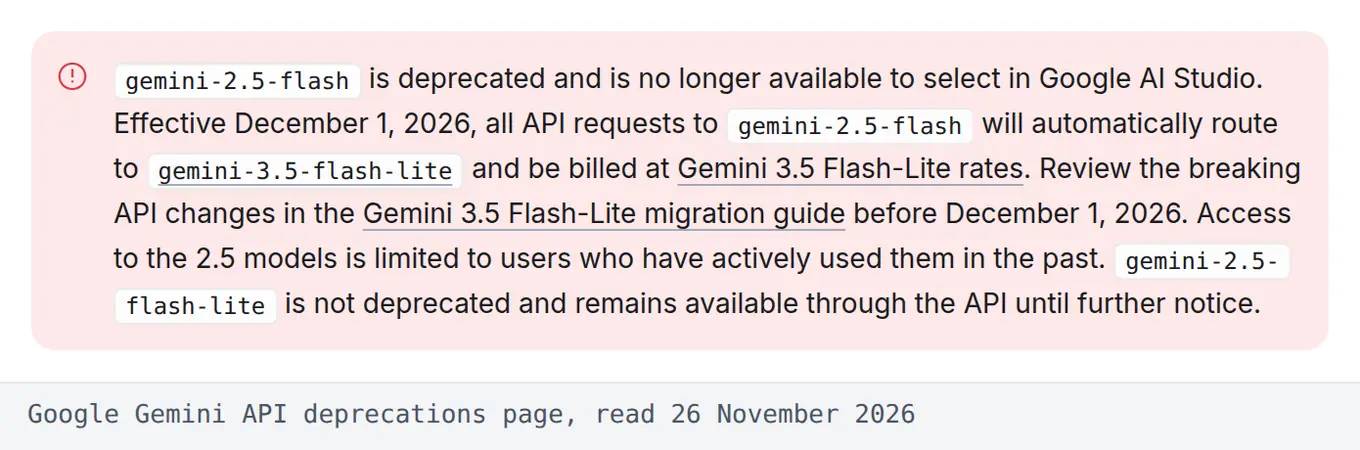
The second notice is quieter, because the price on the text line does not move. Requests to gemini-2.5-flash go to gemini-3.5-flash-lite on the same date and are billed at Flash-Lite rates, which carry no promotional end date.
| Billing line (per 1M tokens) | 2.5 Flash today / 3.5 Flash-Lite from 1 Dec |
|---|---|
| Input, text / image / video | $0.30 / $0.30 |
| Input, audio | $1.00 / $0.30 |
| Output incl. thinking | $2.50 / $2.50 |
| Cached input, text | $0.03 / $0.03 |
| Cached input, audio | $0.10 / $0.03 |
| Batch input / output, text | $0.15 / $1.25, unchanged |
| Batch cached input | $0.03 / $0.015 |
| Priority input / output, text | $0.54 / $4.50, unchanged |
Text is the same price for a different model
A text-only workload sees an identical invoice and a different model behind it. Google calls 3.5 Flash-Lite a “strong migration path from Gemini 2.5 Flash” and quotes 18.0% against 11.0% on HLE and 74.5% against 63.7% on CharXIV. Those scores are Google’s, not an independent test.
Audio input gets 70% cheaper
Flash-Lite charges one input rate for every modality, so audio drops from $1.00 to $0.30 per million tokens. A voice pipeline sending 200 million audio tokens and getting 10 million tokens back pays $225 a month today and $85 from December.
What a month costs before and after the switch
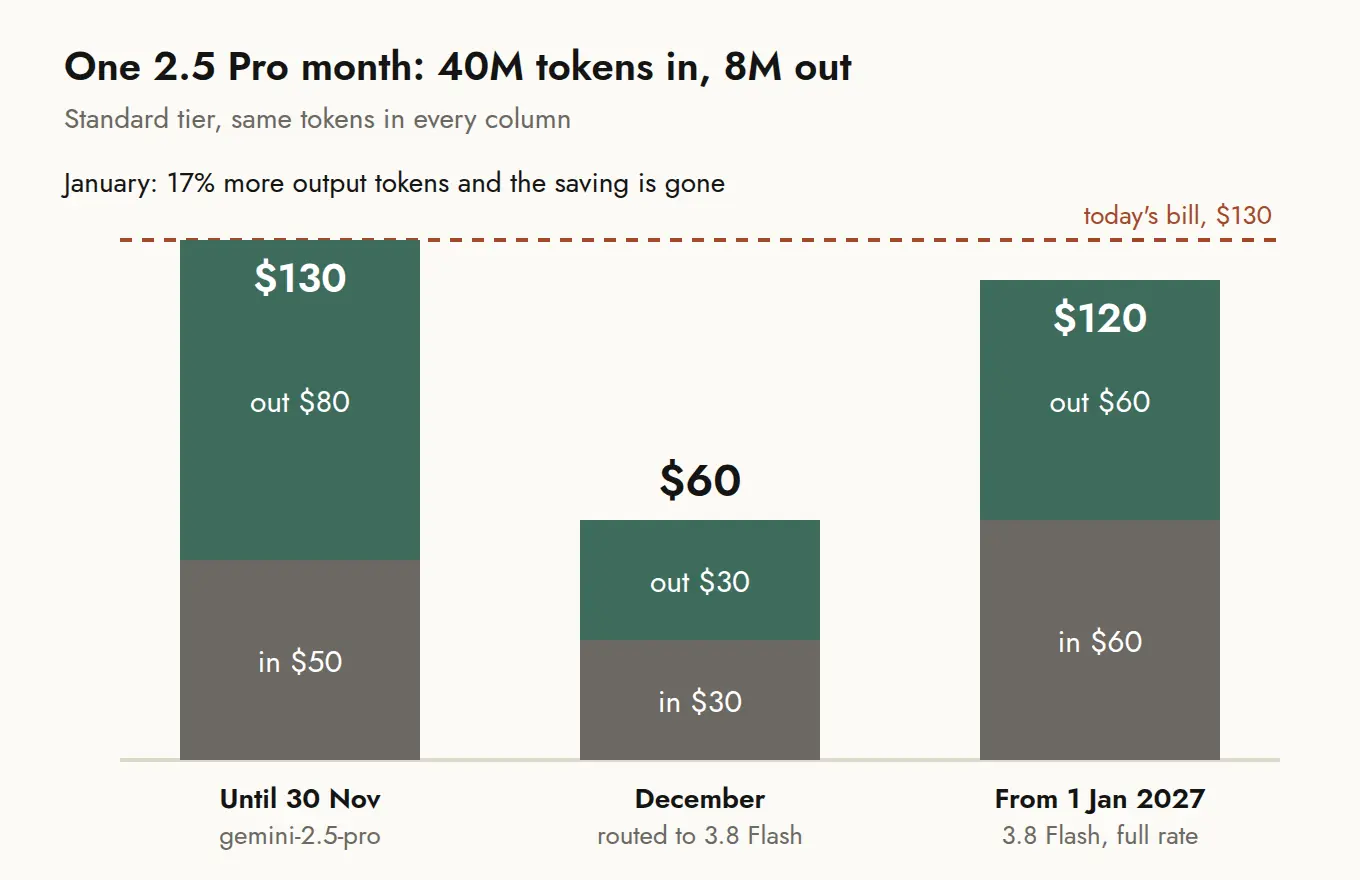
Three workloads, Standard tier, priced on Google’s listed rates with the same token counts in every column. That last assumption is the one to distrust, as the next section explains.
- Agent on 2.5 Pro, 40M tokens in and 8M out: $130 today, $60 in December, $120 from January.
- Long-document Q&A on 2.5 Pro, 2,000 calls of 300,000 tokens with 1,000-token answers: $1,530 today, $457.50 in December, $915 from January.
- Voice pipeline on 2.5 Flash, 200M audio tokens in, 10M out: $225 today, $85 from December.
The agent case is the one to watch. Its January bill sits only $10 under today’s, which leaves almost no room for a model that thinks longer.
What changes in behaviour besides the price
Same model string, different model, different defaults. Google lists the breaking changes in its Gemini 3.8 Flash migration guide and in the 3.5 Flash-Lite one, and three of them land on the bill.
Thinking budgets become thinking levels
2.5 models take a token thinking_budget. Both replacements take a thinking_level enum instead, with different floors and defaults:
- 3.8 Flash defaults to
medium, acceptslowandhigh, and returns an error onminimal. - 3.5 Flash-Lite defaults to
minimal; Google recommendsmediumorhighfor subagents that call tools, “to prevent premature tool termination”. - Thinking tokens are billed at the output rate on both.
Google also writes that 3.8 Flash “can use more tokens on longer running and complex tasks, by design”. On the agent workload above, about 17% more output tokens erases the January saving entirely; in December, output would have to more than triple before you lose money. Google does not document how a rerouted call that still sends thinking_budget is translated, so test it rather than assume.
Context window and output limit stay the same
All four model pages list a 1,048,576-token input limit and a 65,536-token output limit. Nothing gets truncated by the switch.
Sampling parameters and prefills
From the 3.6 and 3.5 generation on, temperature, top_p and top_k are ignored, candidate_count is unsupported, and a request that ends on a prefilled model turn returns a 400 error. If your 2.5 code forced JSON with a prefill, that call breaks on 1 December; structured output or a system instruction replaces it.
Grounding with Google Search changes allowance
This is the line I would check first. On 2.5 models, the paid tier gives 1,500 grounded prompts a day free, then $35 per 1,000. Gemini 3 and newer models get 5,000 free search requests a month, shared across all of them, then $14 per 1,000, with a default cap of 1,500 requests a day per project.
At 1,000 grounded calls a day, that is a $0 line today and roughly $350 a month after the switch, counting one search per call. Google warns that one request can trigger several searches, each billed.
What to pin before 1 December
Letting the reroute happen is cheap for December, but a deprecated string should not set your 2027 budget. My order of moves:
- Name the model you want. Replace
gemini-2.5-prowithgemini-3.8-flashandgemini-2.5-flashwithgemini-3.5-flash-litein code, so a future reroute cannot change your model silently. - Set the thinking level explicitly.
lowon 3.8 Flash for everyday calls,mediumon Flash-Lite for tool loops. The default is a cost decision Google made for you. - Move delay-tolerant work to Batch. On 3.8 Flash, the agent month above costs $60 on Batch from January instead of $120.
- Check 2.5 Flash-Lite if you only need cheap text. It is not deprecated, costs $0.10 in and $0.40 out, and stays available “until further notice”; Google limits access to users who have actively used 2.5 models.
- Budget grounding as its own line before the free daily pool disappears.
If what you valued in 2.5 Pro was the Pro tier itself, the obvious upgrade is not cheap: Gemini 4 Argon moves to $4 in and $20 out on 1 December, a rise we covered on the Gemini 4 Argon page. Gemini 3.6 Flash, at exactly the same two-step price as 3.8 Flash, is the alternative Google itself names for everyday tasks that do not need the extra reasoning.
We have seen this pattern before: when Gemini 3.7 Flash was retired, its calls went to 3.8 Flash too, and the code kept working on a model nobody had chosen. This time the jump is from a Pro model to a Flash one, with 31 days before the price doubles.