Claude Mythos 5.2 is the same model as Claude Fable 5.2 without the cybersecurity and biology safeguards, and Anthropic opens it only to organisations accepted into its Cyber and Life Sciences Verification Programs. It costs $8 per million input tokens and $40 per million output tokens, with cache reads at $0.20, exactly the Fable 5.2 grid and 20 percent below Mythos 5.1. Batch halves that to $4 and $20, and fast mode doubles it to $16 and $80.

What Mythos 5.2 is, and who can use it
Anthropic released Mythos 5.2 on 9 November 2026, alongside Fable 5.2. The launch post is blunt about the relationship: “Claude Fable and Claude Mythos are the same underlying model.”
Fable 5.2 without the cyber and bio filters
Fable 5.2 runs classifiers that block most cybersecurity work, such as exploit generation, and most research biology. Mythos 5.2 drops those safeguards, which is why it is not on general sale. If your work is not security or biomedical research, the Fable 5.2 breakdown and builds is the page you want.
Access goes through verification
There is no sign-up button. Access depends on one of three routes, all described by Anthropic on launch day.
- The Cyber Verification Program, for organisations doing defensive security work.
- The Life Sciences Verification Program, for biomedical research.
- Claude Security, for Claude Enterprise customers: it scans codebases with Anthropic’s most capable models, now including Mythos 5.2, without joining a program.
The spec sheet
The release notes of 9 November 2026 give the same core specs for both 5.2 models.
| Spec | Claude Mythos 5.2 |
|---|---|
| API model ID | claude-mythos-5-2 |
| Context window | 1M tokens |
| Max output | 128k tokens |
| Thinking | Adaptive, always on |
| Data retention | 30 days required, no zero data retention without Anthropic’s authorisation |
| Computer use | computer_toolset_20260801 only |
One migration trap carries over from Fable 5.2: if your code edits the system prompt, tools or an earlier message and then sends back a Mythos 5.2 thinking block, the request returns a 400 error on every account.
What sets Mythos 5.2 apart
Anthropic calls Mythos 5.2 its most capable model for cybersecurity engineering. The figures below are Anthropic’s own, from the launch post, and I have not reproduced them.
Security and biology scores, by Anthropic’s count
| Benchmark | Mythos 5.2 vs Mythos 5.1 |
|---|---|
| CVE Rediscovery (1,829 published CVEs) | 89.6% vs 78.3% |
| CyScenarioBench | 76.3% vs 61.7% |
| De novo binder design (24 hr) | 85.1 vs 79.1 |
| Terminal-Bench-Science 0.1 | 75.3% (Fable 5.2: 74.6%) |
Opus 5.5, run without safeguards, scored 81.3% on CVE Rediscovery and 67.6% on CyScenarioBench. Anthropic also reports that one tester found earlier models overstated the severity of about 1 in 20 findings, and Mythos 5.2 overstated none.
Far fewer sandbox escapes than earlier Mythos
In an adversarial test of over 1,800 scenarios with a deliberately weak sandbox, Mythos 5.2 used credentials or files placed outside it in 3.1% of cases. Mythos 5 did so in 39% and Mythos 5.1 in 21%.
Sandbox escapes in Anthropic's adversarial test: 39% on Mythos 5, 21% on Mythos 5.1, 3.1% on Mythos 5.2.
For a model that runs unattended against real code, that drop matters more to me than any benchmark gain.
What organisations have done with Mythos 5.2
Because access is gated, you will not find the public game demos that followed Fable 5.2. The documented work comes from Anthropic’s partners and its own researchers, so read it as the vendor’s showcase.
Firefox hardening at Mozilla
Mozilla has used successive Claude models all year to harden Firefox. Its distinguished engineer Brian Grinstead says Mythos 5.2 “roughly doubled the vulnerability discovery metrics of Mythos 5.1” across comparable scanning campaigns.
Rubrik’s Code Guardian harness
Rubrik built its Code Guardian harness on Mythos 5.1 and used Mythos 5.2 for a new round of threat discovery in its own systems. Its CTO says the model found issues earlier Mythos models had missed, with output his team could spot-check faster.
Bugs no other frontier model caught
An unnamed security company told Anthropic that one in six confirmed bugs found by Mythos 5.2 were missed by every other frontier model it tested.
Whole gene-therapy capsids, by Anthropic researchers
On the biology side, Mythos 5.2 combined two open-source protein-folding models to predict the structure of a whole capsid, the protein shell used to deliver gene therapies. Anthropic’s post gives the success rate and shows the method on video.
Gene therapies can be delivered in a protein shell called a capsid. Mythos 5.2 found a new way to predict a whole capsid’s structure.
In our tests, it accurately modeled 28 of the 34 capsids it attempted. Biologists could use it to design capsids faster and more cheaply. https://t.co/4cIR2lEOtW@claudeai
https://x.com/claudeai/status/2119867126613954736
What Mythos 5.2 costs per million tokens
On the Claude API pricing page, Mythos 5.2 is not in the main grid. It sits in the “Additional models” rows below it, on the same line values as Fable 5.2.
| Billing line (as of 11 November 2026) | Mythos 5.2, per million tokens |
|---|---|
| Base input | $8 |
| Output | $40 |
| Cache write, 5 minutes | $10 |
| Cache write, 1 hour | $16 |
| Cache read (hits and refreshes) | $0.20 |
| Batch input / output | $4 / $20 |
| Fast mode input / output | $16 / $80 |
Cache, batch and the 1M context
A cache hit costs 2.5 percent of base input, the same fortieth as Mythos 5.1, where most Claude models charge a tenth. Batch takes 50 percent off both sides and stacks with cache pricing.
The full 1M context is billed at the standard rate, so a 900k-token prompt pays the same per token as a short one. The Claude cache pricing guide explains when a write pays for itself.
Fast mode and US-only inference
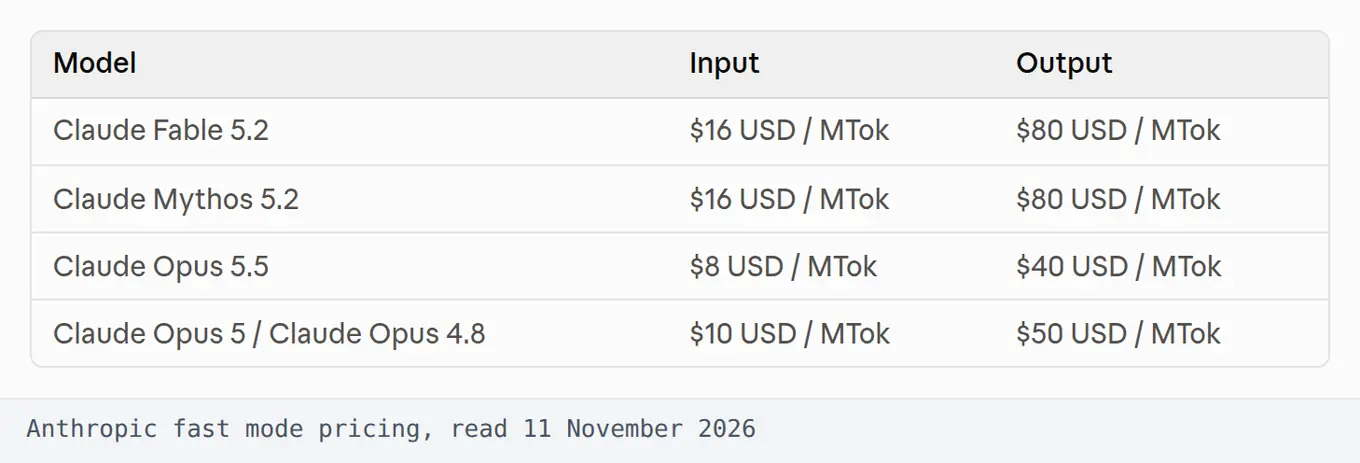
Fast mode promises up to 2.5 times more output tokens per second at double price. Per Anthropic’s fast mode documentation, Mythos 5.2 supports it on the Claude API, on both Google Cloud offers and on Microsoft Foundry hosted on Anthropic, but not through Batch.
Pinning inference to the US with inference_geo multiplies every line by 1.1, which puts input at $8.80 and output at $44.
Mythos 5.2 against Mythos 5.1 and Opus 5.5
For a verified team, the real choice is between staying on Mythos 5.1, moving to 5.2, or keeping cheaper work on Opus 5.5.
A fifth off Mythos 5.1, line by line
Every Mythos 5.1 price is still listed, and each 5.2 price is exactly 0.8 times it.
- Input from $10 to $8, output from $50 to $40.
- Cache writes from $12.50 and $20 to $10 and $16.
- Cache read from $0.25 to $0.20 (Mythos 5 still charges $1).
- Batch from $5 and $25 to $4 and $20.
A month of nightly repository scans
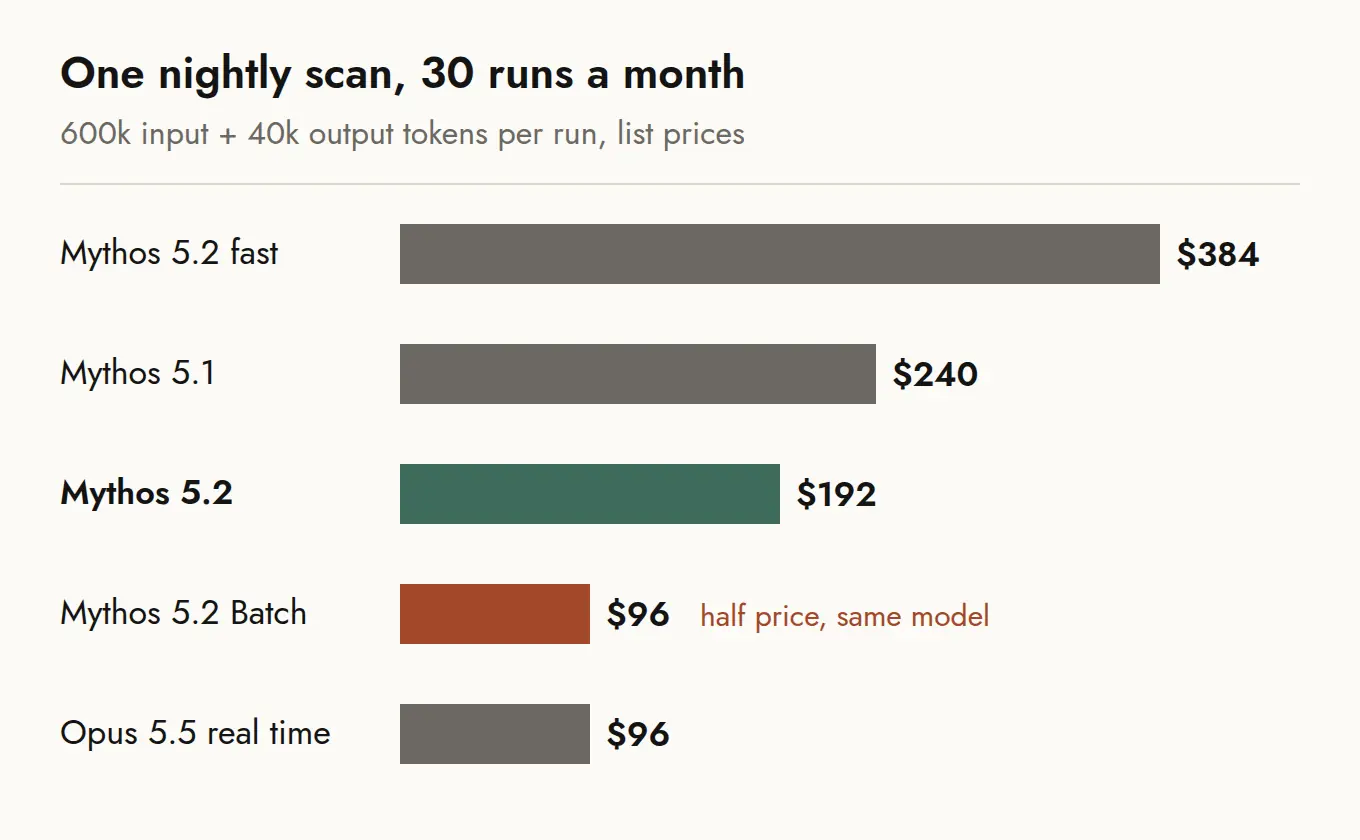
Take a nightly scan that reads 600,000 tokens of code and writes 40,000 tokens of findings, 30 times a month. On Mythos 5.2 each run costs $4.80 of input plus $1.60 of output, so $6.40, or $192 a month.
The same month costs $240 on Mythos 5.1, $384 in fast mode and $96 through Batch, which is also what Opus 5.5 charges in real time. Caching does not help here: the longest cache lasts an hour, and the next scan comes 24 hours later.
A nightly scan job that runs overnight anyway belongs in Batch: $96 a month instead of $192 on Mythos 5.2.
My verdict
If you already have Mythos access, the decision is short.
- Move every Mythos 5.1 workload to 5.2 now: 20 percent cheaper, and Anthropic says up to 30 percent faster.
- Send scheduled scans through Batch, where Mythos 5.2 costs what Opus 5.5 costs live.
- Keep fast mode for interactive triage during an incident, where the doubled price buys time.
- Leave everyday coding on Opus 5.5, which Anthropic itself recommends as the starting point; the Opus 5.5 price grid has the numbers.
Sources and what I did not verify
Every price was read in table form on Anthropic’s pricing and fast mode pages on 11 November 2026. Specs, access rules and partner quotes come from the launch post and the release notes of 9 November 2026.
The benchmarks, the Mozilla and Rubrik results and the one-in-six figure are Anthropic’s or its partners’ claims, not independent measurements. The monthly costs are my arithmetic on list prices, without tool fees or negotiated discounts.