Mercury 3 is listed at $0.20 per million input tokens and $0.70 per million output tokens, with cached input at $0.02. For launch, Inception cuts all three by half, to $0.10, $0.01 and $0.35, and it has not published an end date for that discount. At the launch rate, Mercury 3 matches GPT-6 Luna and Claude Haiku 5.5 on input and undercuts both on output; at the list rate, it costs more than either.

Mercury 3 price per million tokens
Inception announced Mercury 3 on 19 October 2026 as its new flagship diffusion model. A diffusion LLM drafts the whole answer and refines every position over several passes, instead of writing one token after another, which is where the speed comes from. The pricing itself is plain per-token billing, with three rates and a launch discount on top.
Inception’s own launch post sums up the claim the price is built on: GPT-6 Luna and Claude Haiku 5.5 quality at over 1,000 tokens per second.
Mercury 3 is live: the most capable diffusion LLM released to date. It outperforms GPT-6 Luna and Claude Haiku 5.5 across a range of benchmarks while running at over 1,000 tokens per second. More than 40x the size of Mercury 1, 3x more intelligent across standard benchmarks, https://t.co/imE2PIMhTU
@_inception_ai
https://x.com/_inception_ai/status/2112236719068369299
List price versus launch price
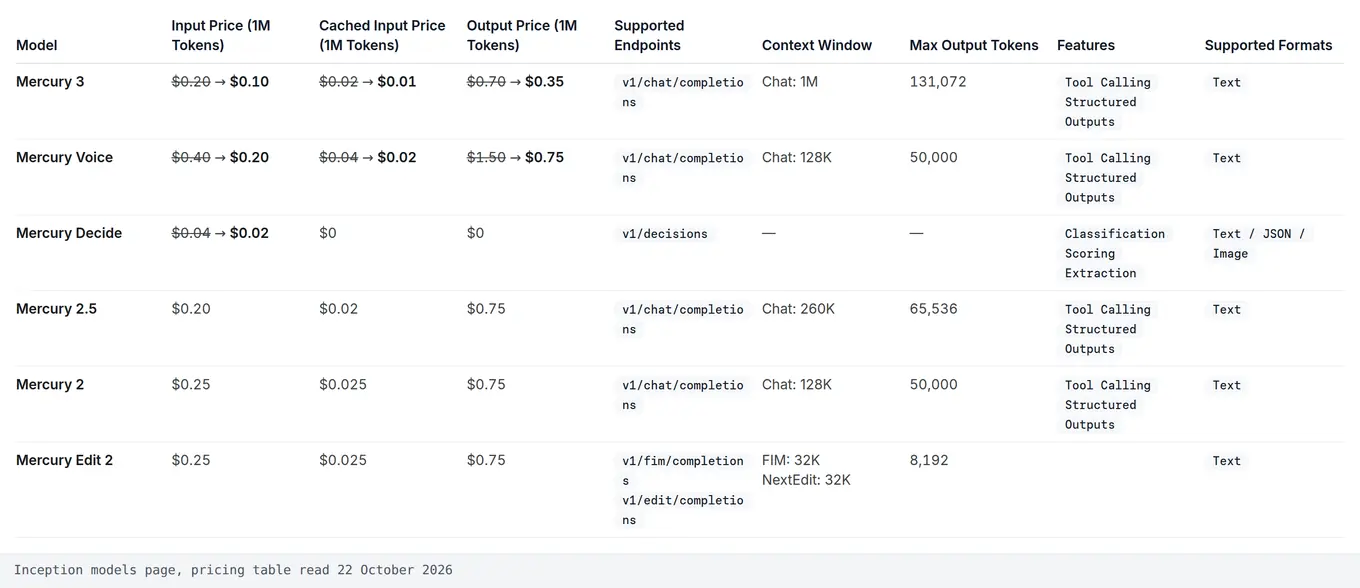
The Inception models page prints each Mercury 3 rate as an arrow, regular price first and launch price second. On 22 October 2026, the table reads as follows.
| Mercury 3 rate (per 1M tokens) | List price, then launch price |
|---|---|
| Input | $0.20, then $0.10 |
| Cached input | $0.02, then $0.01 |
| Output | $0.70, then $0.35 |
| Context window | 1M tokens |
| Max output | 131,072 tokens |
The list price is the number to budget on. The launch price is what your invoice shows today, and it is exactly 50% of every line, cached input included.
Against its predecessor, the list price barely moves. Mercury 2.5 sits in the same table at $0.20 input, $0.02 cached and $0.75 output with a 260K window, so Mercury 3 keeps the input rate, trims output by five cents and nearly quadruples the context.
The cached input rate
Inception’s Mercury 3 announcement says cached tokens are 90% off the input price. That gives $0.02 at list and $0.01 during the launch, which is what the docs table shows.
The docs table has no cache-write column. OpenAI and Anthropic both bill the first write of a cached prefix at 1.25x the input rate on their small models, so check your first Mercury invoice before assuming writes are free.
Mercury 3 cached input costs $0.02 per million tokens at list price and $0.01 during the launch discount: 90% off the input rate either way.
The discount has no end date
Neither the announcement nor the docs page says when the 50% launch price ends. Inception writes “at launch” and nothing more, so there is no minimum date to plan around either.
My advice is to run your cost model at the list price and treat the launch rate as a bonus. If Mercury 3 only wins your comparison at $0.10 and $0.35, it does not win it.
Mercury 3 against GPT-6 Luna and Claude Haiku 5.5
Inception picked its own comparison set: GPT-6 Luna and Claude Haiku 5.5, the two speed tiers it claims to beat on quality. Both are priced from their official grids, read on 22 October 2026.
Per-token rates side by side
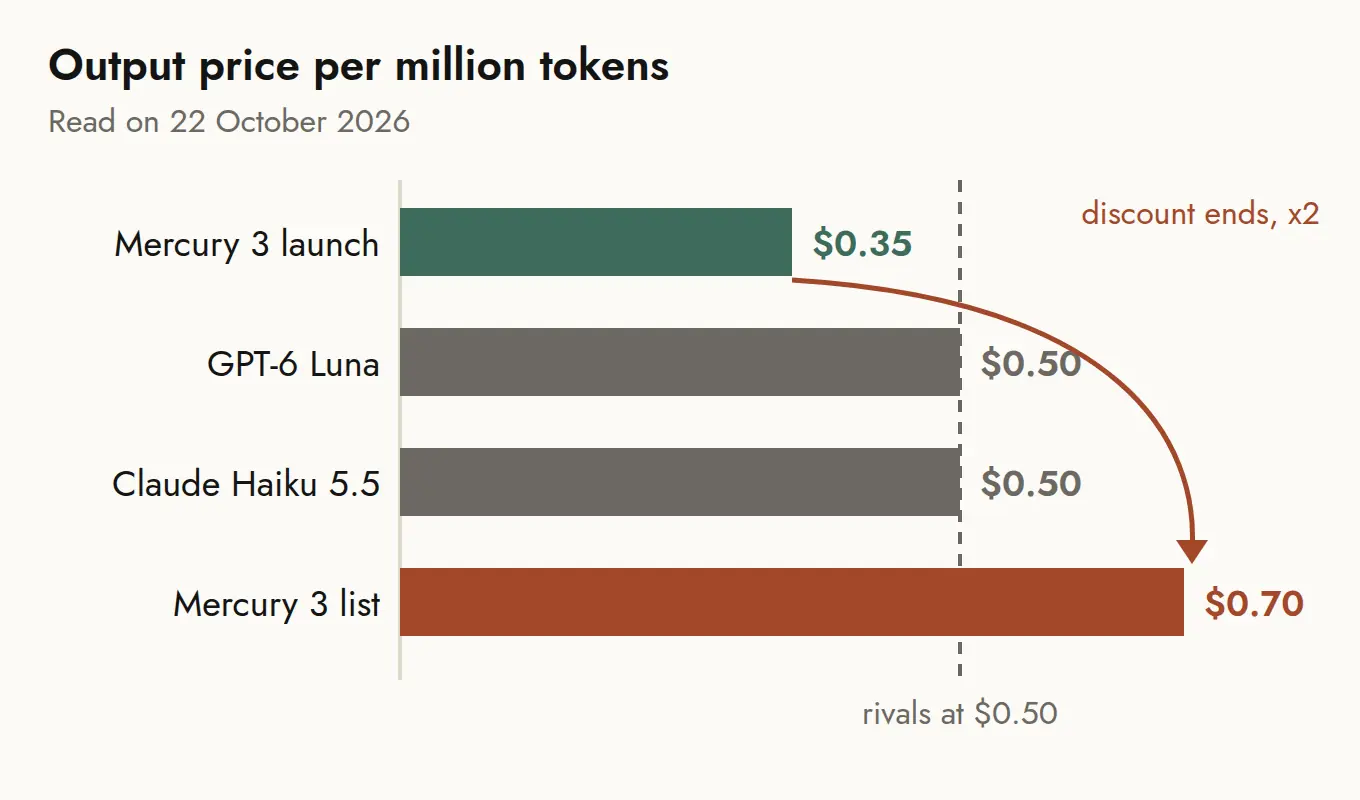
The three models land on almost the same input price. The gap is on output, and on what happens once the launch discount goes away.
| Model | Input / cached / output per 1M tokens |
|---|---|
| Mercury 3, launch price | $0.10 / $0.01 / $0.35 |
| Mercury 3, list price | $0.20 / $0.02 / $0.70 |
| GPT-6 Luna | $0.10 / $0.01 / $0.50 |
| Claude Haiku 5.5, prompts up to 100K tokens | $0.10 / $0.01 / $0.50 |
The Luna figures come from OpenAI’s GPT-6 Luna model page, and the Haiku 5.5 figures from Anthropic’s pricing grid. For the full detail of each, see my GPT-6 Luna pricing breakdown and the Claude Haiku 5.5 threshold analysis.
At the launch price, Mercury 3 output costs $0.35 per million tokens against $0.50 for GPT-6 Luna and Claude Haiku 5.5. At list price it costs $0.70, 40% more than both.
Where the long-prompt thresholds bite
The flat comparison above holds for short prompts only. Both rivals reprice long requests, and those surcharges change the ranking for retrieval and agent workloads.
Here is what each grid does past its threshold:
- Claude Haiku 5.5 moves to $0.50 input, $0.05 cached and $2.50 output once a prompt passes 100,000 tokens, for the whole request.
- GPT-6 Luna bills 2x input and cache and 1.5x output past 272K input tokens, so $0.20, $0.02 and $0.75.
- Mercury 3 shows one rate per column across its 1M-token window, with no long-context tier in the docs table.
On a 150K-token prompt, Mercury 3 at list price ($0.20 input, $0.70 output) is far cheaper than Haiku 5.5 ($0.50 and $2.50). Past 272K tokens it also matches Luna on input and edges it on output, $0.70 against $0.75: long prompts are where the list price already competes.
Speed, the part you are actually paying for
Inception rates Mercury 3 at 1,068 tokens per second on NVIDIA GPUs. That is the reason to look at this model at all, because on price alone it is a near tie with Luna.
Measured throughput through a router can be lower: on 22 October 2026, OpenRouter’s provider table for Mercury 3 showed 323 tokens per second. If latency is the whole point of your switch, measure it on your own prompts and your own route before signing up for volume.
OpenRouter’s launch post confirms the same launch rates and the 1M context on its side of the fence, which matters if you buy through the router.
Mercury 3 is live on OpenRouter! @_inception_ai’s new diffusion model generates 1,000+ tok/s with 1M context, 4x more than Mercury 2.5. Inception reports it beats GPT-6 Luna and Haiku 5.5 on IFBench, GPQA Diamond, and SWE-Bench Atlas. 50% off at launch: $0.10/M in, $0.35/M out https://t.co/QuHw9l3QYe
@OpenRouter
https://x.com/OpenRouter/status/2112225779782398131
What a month of traffic costs
To make the rates concrete, I use one fixed workload: a support assistant that sends 100 million input tokens and receives 20 million output tokens a month, with prompts under 100K tokens. The totals are straight multiplications of the grids above.
Without prompt caching
With no cache, every input token pays the full rate. The monthly bill for 100M in and 20M out comes out like this:
- Mercury 3 at launch price: $10.00 input plus $7.00 output, so $17.00.
- GPT-6 Luna: $10.00 plus $10.00, so $20.00.
- Claude Haiku 5.5: $10.00 plus $10.00, so $20.00.
- Mercury 3 at list price: $20.00 plus $14.00, so $34.00.
The launch discount saves you $3 against Luna on this workload. The list price costs you $14 more than Luna, which is 70% above it.
With a warm cache
Support assistants resend the same system prompt and knowledge base on every turn. Assume 80 million of the 100 million input tokens are cache reads and 20 million are fresh:
- Mercury 3 at launch price: $2.00 fresh input, $0.80 cache reads, $7.00 output, so $9.80.
- GPT-6 Luna: $2.00, $0.80 and $10.00, so $12.80, plus cache writes at $0.125 per million.
- Claude Haiku 5.5: $2.00, $0.80 and $10.00, so $12.80, plus cache writes at $0.125 per million for the 5-minute cache.
- Mercury 3 at list price: $4.00, $1.60 and $14.00, so $19.60.
Caching shrinks the input side so far that output decides the bill. That is good news for Mercury 3 at launch and bad news at list, where its output rate is the highest of the four lines.
Who should switch now, and who should wait
My verdict is simple: Mercury 3 is a speed purchase that happens to be cheap this month. Against the cheapest LLM APIs on a pure price ranking, it does not stay at the bottom once the discount ends.
It is worth moving traffic now in these cases:
- Voice, tutoring or browser agents where every second of latency loses the user, which is the use Inception’s early partners describe.
- Prompts between 100K and 1M tokens that would push Haiku 5.5 into its higher tier.
- Teams already on an OpenAI-compatible client, since the Mercury 3 API is a drop-in swap at the request level.
Hold off if your workload is output-heavy and latency-tolerant, such as batch summarisation. GPT-6 Luna and Haiku 5.5 both offer 50% Batch pricing, and Mercury 3 at list price would cost more per output token than either at standard rates.
Inception also gives 100 million free tokens to try the API, enough to replay a real slice of your traffic. Use them on your own prompts, and make the call at $0.20 and $0.70.