gpt-5.6-sol costs $4.00 per million input tokens, $0.40 cached and $20.00 output, a promotional rate that OpenAI says “is available until November 30, 2026” and not one day beyond, read on its pricing page on 12 October 2026, with the end date re-read on 10 November 2026. OpenAI has not published what sol will cost after that date, but the cut was measured against GPT-5.5’s $5.00 / $30.00, and budgeting at that line raises a typical sol bill by 25 to 50 percent. Before the date, the cheapest exit is not terra but gpt-6.1-sol at $2.00 / $10.00; terra only wins when you have to stay inside the 5.6 family.

What gpt-5.6-sol costs today, and until when
On the OpenAI API pricing page, sol no longer sits in the flagship table. It is listed in a second table labelled “Cyber models”, next to gpt-5.6-cyber, so a reader who only checks the top grid will not find it.
The promotional grid
The short-context row is the one most of your traffic pays. The long-context row applies to the whole request once a prompt passes 272K input tokens, not just to the tokens above the threshold.
Here is the sol row as published, alongside the two models I would compare it with before the date:
| Model and context | Input / cached / output per 1M tokens |
|---|---|
| gpt-5.6-sol, up to 272K | $4.00 / $0.40 / $20.00 (promotional) |
| gpt-5.6-sol, above 272K | $8.00 / $0.80 / $30.00 (promotional) |
| gpt-5.6-terra, up to 272K | $2.00 / $0.20 / $12.00 |
| gpt-6.1-sol, up to 272K | $2.00 / $0.10 / $10.00 |
| GPT-5.5, the reference | $5.00 / $0.50 / $30.00 |
Cache writes add a fourth line: sol bills them at $5.00, which is 1.25 times its uncached input rate. Terra applies the same 1.25x rule to its own $2.00.
Why “at least through” was not an end date
The gpt-5.6-sol model page words it the same way as the pricing page: the promotional pricing “is available until November 30, 2026”. That is now a firm end date, not a floor. Until 9 November 2026 both pages said “at least through November 21, 2026”, which only set a minimum; OpenAI then replaced it with a fixed end date nine days past that old floor.
OpenAI’s own announcement on 21 August framed the window as three months, which landed exactly on 21 November, the date the pages carried until OpenAI moved it to 30 November on 9 November 2026:
As we continue to push the frontier of capabilities while improving efficiency, we’re dropping API and credit pricing of GPT-5.6 Sol by over 20% for the next 3 months. https://t.co/UoTb3hcB2t
@OpenAI
https://x.com/OpenAI/status/2090885187634905500
OpenAI says $4.00 / $20.00 on gpt-5.6-sol "is available until November 30, 2026". It has published no rate for the day after.
What the bill looks like after 30 November
Nobody outside OpenAI knows the post-promotional price, and I will not pretend otherwise. What OpenAI did publish is the baseline it measured the discount against, and that is the number a budget should carry.
The reference OpenAI measured the cut against
The sol model page describes the promotion as “a 20% reduction in input pricing and a 33% reduction in output pricing”, and its comparison block sets sol against GPT-5.5. Run the arithmetic backwards and both percentages land on GPT-5.5’s grid: $4.00 is 20 percent under $5.00, and $20.00 is a third under $30.00.
GPT-5.5 still lists at $5.00 input, $0.50 cached and $30.00 output on its own model page. That is the most defensible “after” line: not a promise from OpenAI, but the price the promotion was cut from.
How much a real request moves
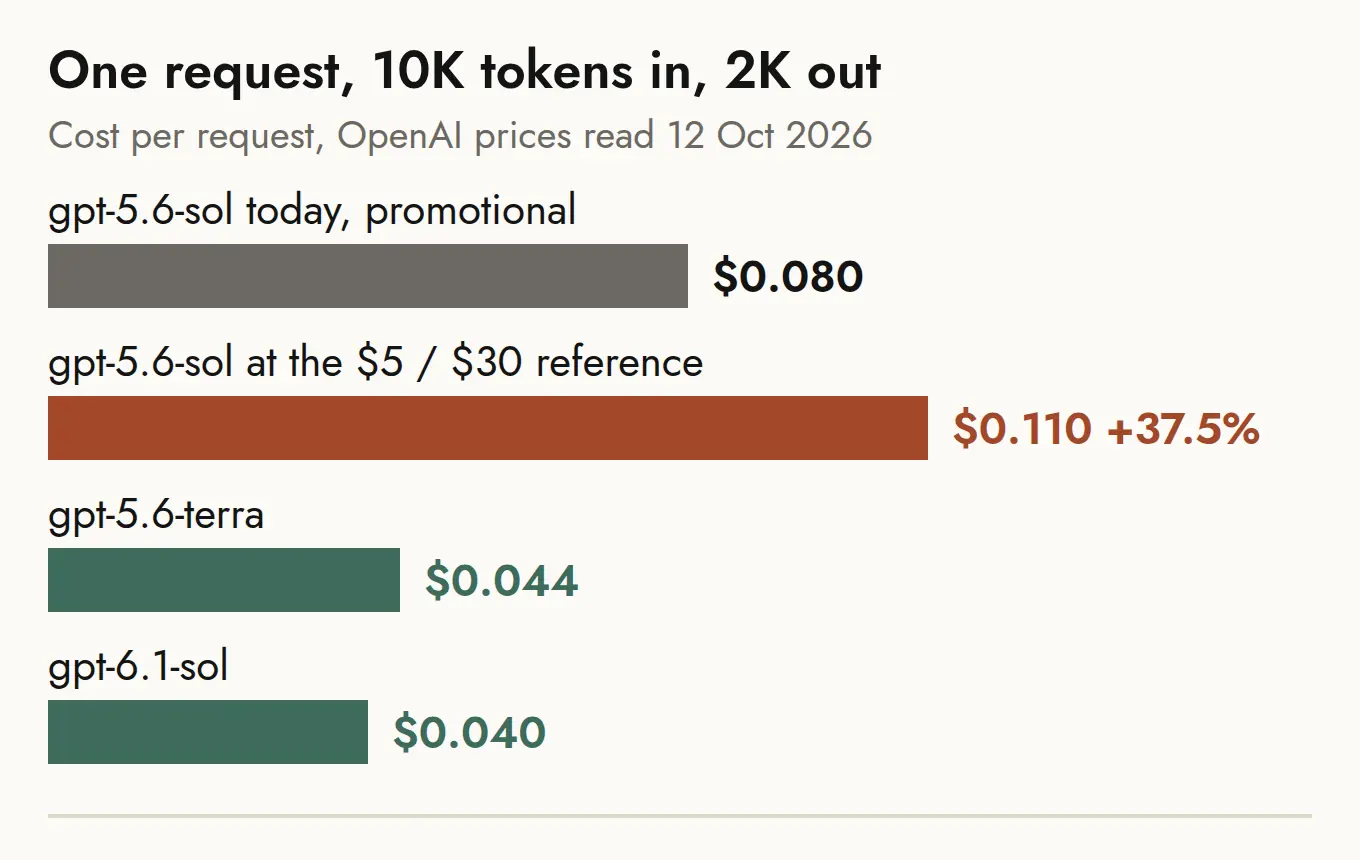
The increase depends on your output share, because the output rate moves by half and the input rate by a quarter. I priced two request shapes I see often, at sol’s current rate and at the GPT-5.5 reference:
| Request shape | Sol today, then at $5 / $30 |
|---|---|
| 10K in, 2K out (RAG answer, support reply) | $0.080, then $0.110 (+37.5%) |
| 2K in, 8K out (drafting, long reasoning) | $0.168, then $0.250 (+48.8%) |
| Same 10K in, 2K out on terra | $0.044 |
| Same 10K in, 2K out on gpt-6.1-sol | $0.040 |
At the GPT-5.5 reference, a sol bill rises by 25% on pure input and 50% on pure output. Every real workload lands between the two.
Long-context and cached traffic
Long prompts carry the sharpest jump. Sol’s long-context row today is $8.00 / $30.00; if sol went back to $5.00 / $30.00, the same 2x input and 1.5x output rule would put it at $10.00 / $45.00. A retrieval pipeline that routinely sends 300K-token prompts should model that line, not the short one.
Cached input is less exposed. Sol’s cached rate is $0.40 today against $0.50 on GPT-5.5, so a workload that hits the cache on most of its input sees its input line rise by a quarter on a small base. The output line still moves by half.
Which workloads should move before the date
Moving costs eval time, so move what is cheap to validate first. Terra shares sol’s 1,050,000-token context window, its 128,000-token output ceiling, its February 2026 knowledge cutoff and its tool list; the gpt-5.6-terra model page rates its reasoning “Higher” where sol gets “Highest”.
Workloads that belong on terra
Terra halves input and cuts output by 40 percent against today’s promotional sol. The tasks where that gap costs you nothing measurable are the ones with a checkable answer:
- extraction and classification against a fixed schema, where structured outputs catch most failures;
- summaries and RAG answers grounded in retrieved text, where the context does the heavy lifting;
- high-volume support replies with a human or a rule-based check downstream;
- first drafts that a person or a second model reviews anyway.
Run your own eval set on terra at the same reasoning effort before switching. OpenAI says terra “roughly corresponds to the mini model tier”, so expect to lose quality on the hardest prompts rather than everywhere.
Workloads to keep on a flagship
Some traffic pays for sol’s top reasoning tier, and dropping it to terra shows up in retries and human review, which cost more than tokens. These stay on a flagship model:
- multi-step agentic coding and tool chains where one wrong call wastes the whole run;
- long-document analysis above 272K tokens where the answer depends on cross-references;
- anything you currently run at high or max reasoning effort because medium failed.
The cheaper flagship nobody on sol is looking at
Here is my verdict: if you are leaving sol for cost, terra is the wrong destination unless you are pinned to the 5.6 family. gpt-6.1-sol lists at $2.00 input, $0.10 cached and $10.00 output, which beats terra on cached input and output and matches it on input. I covered the move from 5.6 to the 6 line in GPT-6 Sol and Luna pricing.
The independent benchmark I trust on this put gpt-6.1-sol one point under GPT-6 Astra on its Intelligence Index, at the same $2 / $10 as GPT-6 Sol:
GPT-6.1 Sol replaces GPT-6 Sol after just 7 days. It scores 1 point below GPT-6 Astra in the Intelligence Index at less than one quarter of the Cost per Task Pricing matches GPT-6 Sol at $2/$10 per million input/output tokens, except that the cache read discount rises from 90% https://t.co/LcuAxgLSBj
@ArtificialAnlys
https://x.com/ArtificialAnlys/status/2105025585332605357
A model change is still a migration: prompts tuned on 5.6 can behave differently on 6.1, so it needs the same eval pass as terra. The difference is that it ends with a lower bill and no step down in tier.
Why a dated rate is not a price
A price is what you can plan a year on. A promotional rate with an end date is a discount on a price that OpenAI has not restated, and the two belong on different lines of a budget.
Budget at the reference, bank the discount
The method I use on every promotional rate is short, and it keeps finance from being surprised in December:
- put sol in the budget at $5.00 / $30.00 from 1 December, with long context at $10.00 / $45.00;
- record the gap to $4.00 / $20.00 as a discount that ends on 30 November, not as a saving;
- move the checkable workloads to terra or gpt-6.1-sol before the last week of November, so the eval is done before the date rather than after the invoice;
- keep your per-model spend split, so the first post-promotion bill tells you which line moved.
If you need to rebuild the forecast, the invoice has three lines worth tracking separately: fresh input, cached input and output, reasoning tokens included.
What to watch on the pricing page
Three edits on OpenAI’s pages would change this plan; none had happened on 12 October 2026, and the first one happened on 9 November 2026:
- a new date replacing “at least through November 21, 2026”, which would extend the window (this is what happened on 9 November 2026: the pages now say “is available until November 30, 2026”);
- the word “promotional” disappearing from the sol note, which would make $4.00 / $20.00 the list price;
- a deprecation notice on the sol model page, which would turn the question from price into migration date.
For the full 5.6 line, from luna to cyber, see the four gpt-5.6 tiers compared. I will update this page the day the sol note changes.