Mistral Large 4 costs $0.70 per million input tokens, $0.07 cached and $2.10 output, the rate Mistral set on 29 October 2026 when it released the model’s weights. That is roughly half the $1.36 / $0.14 / $4.18 list price the pricing table showed on 27 October, and almost exactly the $0.68 / $0.07 / $2.09 launch sale rate. I re-read the pricing table, the model card and Mistral’s announcement on 3 November 2026: all three give $0.70 / $0.07 / $2.10.

What Mistral Large 4 costs now
The Mistral API pricing table, read on 3 November 2026, lists Large 4 at a single price with no promotion tag: $0.70 input, $0.07 cached input and $2.10 output per million tokens. Mistral’s 29 October announcement, which released the weights, states the same rate and says it applies “starting today”. This is no longer a sale: it is the list price.
Three prices in four weeks
Large 4 has carried three different rates since its 6 October launch. Same model ID (mistral-large-4), same 1M-token context window, same endpoints throughout.
| Period | Input | Cached input | Output |
|---|---|---|---|
| Launch sale, from 6 October 2026 | $0.68 | $0.07 | $2.09 |
| Full preview rate, read 27 October 2026 | $1.36 | $0.14 | $4.18 |
| Current rate, since 29 October 2026 | $0.70 | $0.07 | $2.10 |
The cached line is still a tenth of input, the same ratio Mistral applies across the rest of its catalog. If your prompts reuse a long system message or document, that ratio matters more than the headline rate.
How the launch sale ended and the cut followed
The Mistral changelog entry for 6 October announced “Launch pricing: 50% off for 2 weeks” without a closing date. When I re-read the Large 4 row on 27 October 2026, the sale tag was gone and the table showed $1.36 / $0.14 / $4.18 per million tokens.
The full rate lasted only a few days: on 29 October Mistral cut Large 4 to $0.70 / $2.10, two cents above the old sale price on input and one cent on output.
If you budgeted at $1.36 / $4.18 after the sale ended, your cost per token has roughly halved. If a page or a spreadsheet still quotes $1.36, it is quoting a rate that no longer exists.
What the open-weight release changes
The model card now lists Large 4 under the “Mistral Ecosystem Open Weight License”, still tagged “Public Preview”, version 26.10. Mistral’s announcement describes it as a modified MIT license: free to use, modify, fine-tune and commercialize, with one condition, that companies running a model-as-a-service offering need a separate commercial license.
Three practical consequences follow for anyone wiring it into production:
- The weights released on 29 October are an improved version of the 6 October preview, after further reinforcement learning, so evaluations run in early October may not reflect what the API serves now. Pin your evaluations to a date.
- Other providers can now host Large 4: Mistral itself names OpenRouter, and self-hosting with vLLM or SGLang is supported. Their prices will show whether $0.70 / $2.10 is competitive.
- Batching is listed on the model card, but Mistral has not said whether batch pricing applies a further discount to Large 4, so test batch billing on a small job before assuming one.
Large 4 against Large 3
Large 3 was on the table at $0.50 input, $0.05 cached and $1.50 output when we covered Mistral Large 3 pricing per million tokens in August. That comparison now comes with a deadline: Mistral’s models page lists Large 3 (mistral-large-2512) as deprecated on 31 October 2026, with retirement set for 30 April 2027 and Large 4 named as its replacement. Large 3 no longer appears on the pricing table.
The premium at today’s rates
Against Large 3’s last listed rate, Large 4 at $0.70 / $2.10 costs 1.4 times as much on input and 1.4 times on output. A pipeline that billed $100 a month on Large 3 would land around $140 on Large 4, whatever its input-to-output mix.
At the 27 October list price the premium was 2.7 to 2.8 times. The 29 October cut brings it back to 1.4 times.
That is the number to put in front of whoever approves your budget, with one difference from a month ago: staying on Large 3 is no longer an option past April 2027. The migration question is now when, not whether.
Large 4 against GLM 5.3 and Claude Haiku 5.5
Two comparisons say more than the Large 3 one. GLM 5.3 is the model Mistral itself benchmarks Large 4 against, and Haiku 5.5 is what a cost-driven team would pick instead.
GLM 5.3 on the same platform
Mistral hosts Z.ai’s GLM 5.3 as a third-party model at $1.40 input, $0.14 cached and $4.40 output, unchanged on the pricing table on 3 November 2026. Large 4 now costs half of GLM 5.3 on input and cached input, and 48% of it on output.
Mistral’s announcements compare Large 4 with GLM 5.3 repeatedly, on coding, cybersecurity and reasoning benchmarks. At the 27 October list price, Large 4 sat a few cents under its open-weight rival; at $0.70 / $2.10 it undercuts it by half on Mistral’s own platform.
Claude Haiku 5.5 at the bottom of the grid
Claude Haiku 5.5 sits on a different shelf: $0.10 input and $0.50 output for prompts up to 100,000 tokens, and $0.50 / $2.50 above that line, read on Anthropic’s pricing page on 9 October 2026. Our breakdown of the Haiku 5.5 100K-token threshold covers how that switch works.
On short prompts, Large 4 costs 7 times Haiku 5.5 on input and 4.2 times on output. Long prompts change the picture: above 100,000 tokens Haiku 5.5 bills $0.50 / $2.50, so Large 4 costs 1.4 times as much on input but is cheaper on output ($2.10 against $2.50).
One workload priced seven ways
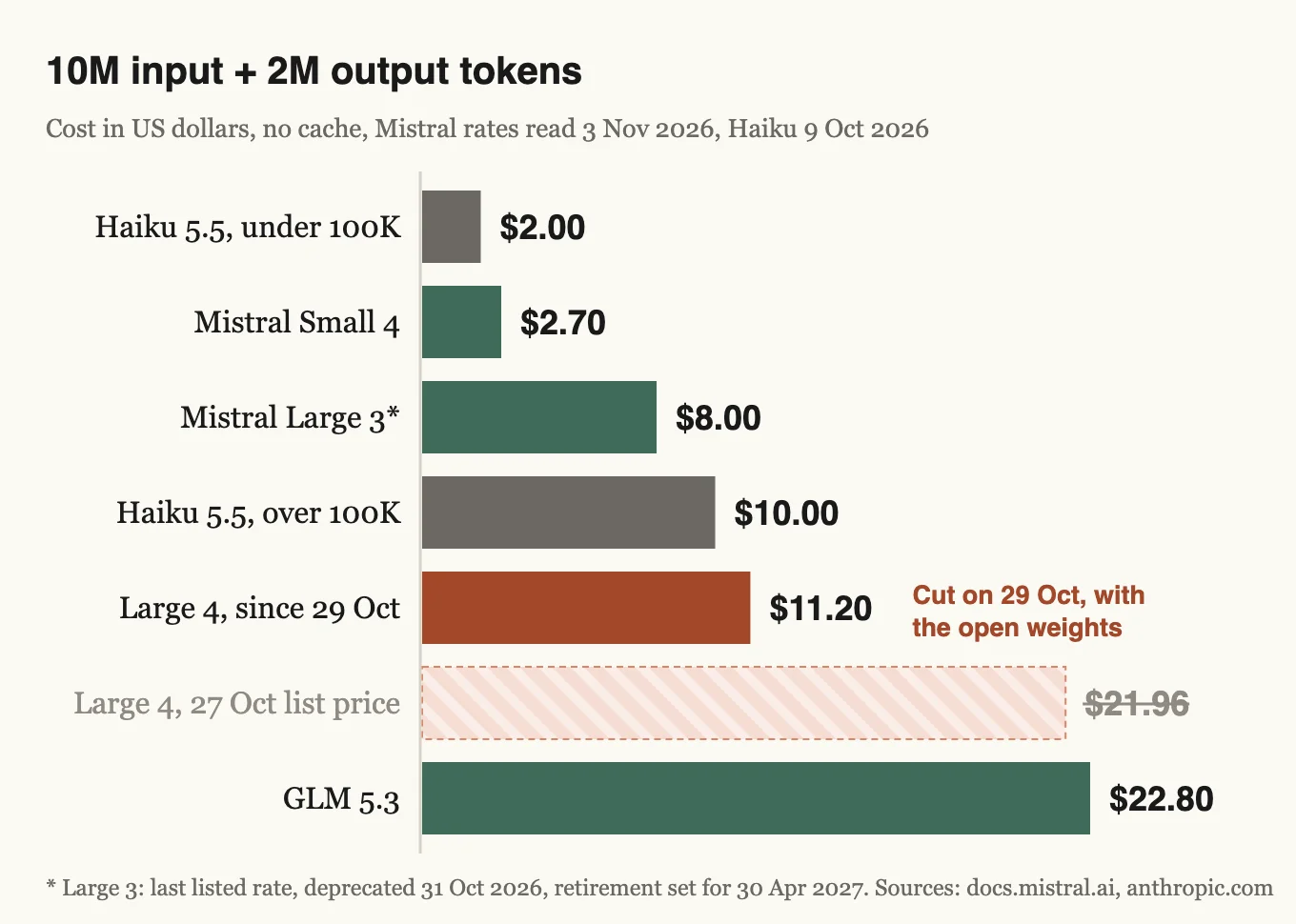
To make the gaps concrete, I priced a single workload of 10 million input tokens and 2 million output tokens, with no cache hits. The figures are straight multiplication of the published rates: Mistral’s read on 3 November 2026, Haiku’s on 9 October 2026, and Large 3 at its last listed rate.
| Model and rate | Cost for 10M in + 2M out |
|---|---|
| Claude Haiku 5.5 (prompts up to 100K) | $2.00 |
| Mistral Small 4 | $2.70 |
| Mistral Large 3 (deprecated, last listed rate) | $8.00 |
| Claude Haiku 5.5 (prompts over 100K) | $10.00 |
| Mistral Large 4, current rate since 29 October | $11.20 |
| Mistral Large 4, 27 October list price (replaced) | $21.96 |
| Z.ai GLM 5.3 on Mistral | $22.80 |
The cut moves Large 4 out of GLM 5.3’s bracket and into the same range as long-prompt Haiku and Large 3. For this workload it now costs $1.20 more than long-prompt Haiku and less than half of GLM 5.3.
Who should pay for Large 4 now
My verdict changes with the price: at $0.70 / $2.10, Large 4 is the default Mistral flagship to test, and the only one with a future on Mistral’s API once Large 3 retires. Measure it on a small slice of real traffic before you migrate anything.
Worth testing at the current rate
Some workloads justify running Large 4 against your current model now:
- Agentic coding and terminal work, where Mistral reports the lead among open-weight models on Terminal-Bench and Cognition’s FrontierCode 2.0 (19.7%) after the October reinforcement learning run.
- Document and image understanding, since Large 4 is natively multimodal with a 1M context window.
- Defensive security work, the use case Mistral’s launch and open-weight posts lean on hardest.
- Teams that need EU-hosted inference, or that want the option to self-host the same model later under the open-weight license.
Independent measurement arrived on day one. Artificial Analysis scored the preview at 38 on its Intelligence Index on launch day, which gives you a third-party reference point before you spend your own tokens.
Mistral has released Mistral Large 4, scoring 38 on the Artificial Analysis Intelligence Index; France is back to having the most intelligent model from outside the US and China @MistralAI has released Mistral Large 4 in Research Public Preview, with plans to release the weights
@ArtificialAnlys
https://x.com/ArtificialAnlys/status/2107467221421420919
Better left on a cheaper model
High-volume classification, extraction and routing do not need a trillion-parameter model. On those jobs Haiku 5.5 at $0.10 / $0.50 or Mistral Small 4 at $0.15 / $0.60 will beat Large 4 on cost by a wide margin.
If you run Large 3 today, plan the move before 30 April 2027: at 1.4 times the cost, Large 4 is the replacement Mistral names, and Small 4 is the fallback for jobs that never needed a flagship. Our wider look at Mistral API pricing against US models shows where the rest of the catalog sits.
From preview to open weights
Mistral’s Large 4 launch announcement on 6 October promised the weights “by the end of the month”. Mistral kept that date: the weights were released on 29 October 2026, on Hugging Face, together with the price cut.
A model with 52B active parameters out of 1.05T total, per the model card, still needs serious hardware to self-host, so most teams will keep paying per token. What open weights bring is competition from other inference providers, and Mistral answered it in advance by halving its own rate.
The one number for your spreadsheet is $0.70 / $2.10 per million tokens ($0.07 cached), the rate on Mistral’s pricing table on 3 November 2026. The model is still labeled a public preview, so watch the pricing page for any change at general availability.