Claude Haiku 5.5 costs $0.10 per million input tokens and $0.50 per million output tokens, but only on requests whose prompt stays at or under 100,000 tokens. Above that line, every token of the request moves to $0.50 input and $2.50 output, cache reads and cache writes included, read from the Anthropic pricing page on 9 October 2026. Short prompts therefore cost a tenth of Haiku 4.5 and the same as GPT-6 Luna. A request that crosses the line costs five times more than one just under it.

What Haiku 5.5 costs, line by line
Anthropic launched Haiku 5.5 on 7 October 2026 with two complete price sets instead of one. Which set applies depends only on the length of the prompt you send, so the same model can bill one request at $0.10 and the next at $0.50 per million input tokens.
Prompts up to 100,000 tokens
This is the headline price, and it covers most of what a small model does. Anthropic’s launch post says prompts of this size made up around 90% of requests to the previous Haiku. The table below gives both sets, as listed in the Claude API pricing table, in dollars per million tokens.
| Token line | Up to 100K / over 100K |
|---|---|
| Base input | $0.10 / $0.50 |
| Output | $0.50 / $2.50 |
| 5-minute cache write | $0.125 / $0.625 |
| 1-hour cache write | $0.20 / $1.00 |
| Cache read and refresh | $0.01 / $0.05 |
| Batch input | $0.05 / $0.25 |
| Batch output | $0.25 / $1.25 |
Prompts over 100,000 tokens
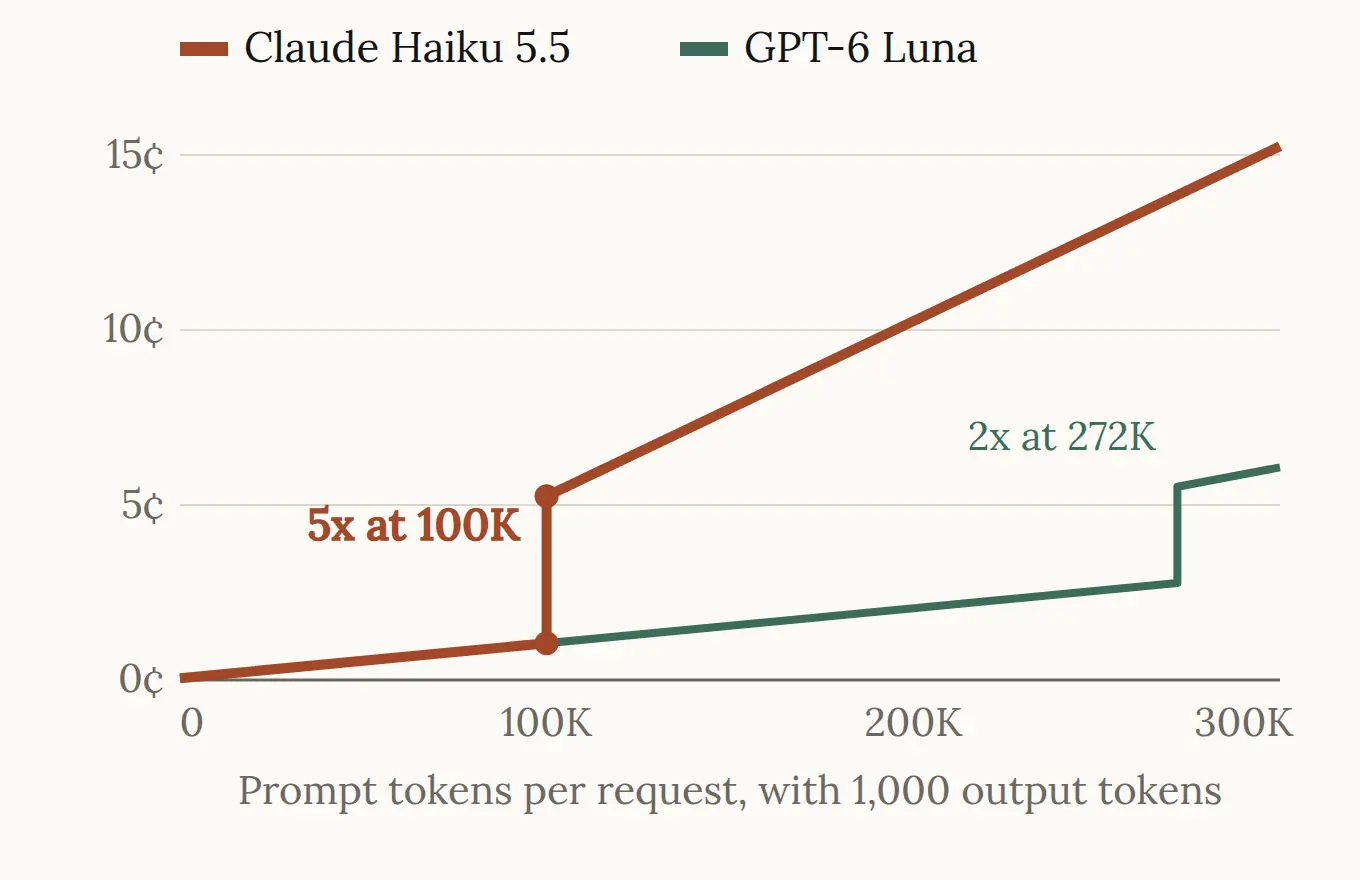
Every line of the grid is multiplied by five above the threshold, output included. The model still accepts up to 1 million tokens of context and returns up to 128,000 tokens of output, so nothing stops a long request: it is simply billed on the second grid.
A 100,000-token prompt with 1,000 tokens of output costs $0.0105 on Haiku 5.5. Add one token to the prompt and the same request costs $0.0525.
Batch keeps the same split
The Batch API halves both grids, as it does on every Claude model. The threshold survives the discount: a batched request over 100K tokens pays $0.25 input and $1.25 output, still five times the batched short-prompt rate.
How Anthropic counts the 100K tokens
The wording on the pricing page is short, and three details in it decide most bills. Read them before you estimate anything.
Cache reads count toward the prompt length
Anthropic counts all input tokens of a request, including cache reads and cache writes. A prompt made of 95,000 cached tokens and 6,000 new ones is a 101,000-token prompt, and the cached part is then billed at $0.05 instead of $0.01. Caching lowers the price per token, it does not move you back under the line.
Each request is priced on its own
There is no monthly tier or rolling average. A request over the threshold pays the higher prices even when part of its prompt is a cache hit, and earlier requests keep the prices they were billed at. One long request does not reprice the short ones around it.
Output follows the prompt, not its own length
The output rate jumps from $0.50 to $2.50 because of the prompt size, whatever the length of the answer. A 50-token classification label on a 120K-token document is billed at the higher output rate.
Where the threshold bites in real workloads
Whether you ever pay the second grid depends on the shape of your requests, not on your volume. Three patterns cover most Haiku use.
Anthropic gives the proportion itself: on its previous Haiku, around 90% of requests stayed under 100,000 tokens, which is the share the low grid was built for.
Haiku 5.5 is especially good value on tasks under 100,000 tokens, which make up around 90% of requests to our previous Haiku model.
@claudeai
https://x.com/claudeai/status/2107894052041490537
RAG and classification stay under the line
A retrieval call with 2,000 cached tokens of instructions, 18,000 tokens of retrieved chunks and a 500-token answer costs about $0.0021 on Haiku 5.5, against $0.0207 on Haiku 4.5. You would need five times more context per call to approach the threshold. For these workloads the 90% cut on the headline grid is the real price.
Agent loops cross it mid-session
Agents are different, because the context grows with every turn. Take a loop that starts with 10,000 tokens of system prompt and tools, then adds 6,000 tokens of tool results per turn, with 1,000 tokens of output and everything earlier read from cache. Its prompt reaches 100,000 tokens at turn 16 and 106,000 tokens at turn 17.
Here is what that loop costs per session on Haiku 5.5, assuming the new 6,000 tokens of each turn are billed as plain input:
- Turns 1 to 16 together cost about $0.025, the same as on GPT-6 Luna.
- Turn 16 alone costs $0.0020, and turn 17 costs $0.0105.
- A 30-turn session costs about $0.20, of which the last 14 turns account for $0.17.
- At the same token counts, the 30 turns cost about $0.06 on GPT-6 Luna and $0.60 on Haiku 4.5.
The tokenizer moves the line
Haiku 5.5 uses the newer tokenizer of Claude 4.7 and later models. Anthropic’s Haiku 5.5 migration notes say the same text counts as approximately 30% more tokens than on Haiku 4.5, with the exact increase depending on the content. A prompt you measured at 80,000 tokens on Haiku 4.5 can therefore land around 104,000 tokens on Haiku 5.5.
In Haiku 4.5 tokens, the threshold sits closer to 77,000 than to 100,000. Recount your prompts with the new model before you plan around the line.
Haiku 5.5 against Haiku 4.5 and GPT-6 Luna
The two natural comparisons are the model Haiku 5.5 replaces and the OpenAI model at the same headline price. The table lists input and output per million tokens on the standard tier.
| Model and prompt size | Input / output per MTok |
|---|---|
| Haiku 5.5, up to 100K | $0.10 / $0.50 |
| Haiku 5.5, over 100K | $0.50 / $2.50 |
| Haiku 4.5, any length | $1.00 / $5.00 |
| GPT-6 Luna, up to 272K | $0.10 / $0.50 |
| GPT-6 Luna, over 272K | $0.20 / $0.75 |
Against Haiku 4.5
Haiku 4.5 bills $1 input, $5 output and $0.10 cache reads at any prompt length. Haiku 5.5 is 90% cheaper per token under the threshold and still 50% cheaper above it. Anthropic puts the average saving at around 75%, a figure that already accounts for the extra tokens of the new tokenizer and for the 10% of requests above 100K.
Against GPT-6 Luna
On short prompts the two grids are identical, down to the cache: the GPT-6 Luna model page lists $0.10 input, $0.01 cached, $0.125 cache writes and $0.50 output. The difference is the long-context rule. Luna’s threshold sits at 272K input tokens and only doubles input and cache while multiplying output by 1.5, against a fivefold jump at 100K on Haiku 5.5. This pricing structure differs notably from competitors like Inception’s Mercury 3 pricing, which follows a flatter tier model.
Between 100K and 272K tokens, Luna is therefore five times cheaper on input and output alike. Above 272K, it costs $0.20 and $0.75 against $0.50 and $2.50. Anthropic’s own benchmark table puts Haiku 5.5 ahead of Luna on every test where both are listed, so the choice is between a better score on short tasks and a flatter bill on long ones. We have more on OpenAI’s side in our GPT-6 Sol and Luna pricing breakdown.
The extra-token caveat
A per-token price only tells half the story when the model uses more tokens for the same work. Haiku 5.5 adds two sources of consumption that Haiku 4.5 did not have.
The first is the tokenizer, already covered above: roughly 30% more tokens for the same text. The second is adaptive thinking, which is on by default and lets the model decide when and how much to think. Thinking tokens count toward max_tokens, so a small limit can stop a response after the thinking block and before any text.
Haiku 5.5 is the first Haiku with an effort setting. Anthropic names it as the way to trade response quality against speed and cost.
Independent testing reads the launch the same way. Artificial Analysis scored Haiku 5.5 at 43 on its Intelligence Index, 26 points above the previous Haiku, and flagged the tiered pricing above 100K tokens in the same post.
Anthropic has released Claude Haiku 5.5, scoring 43 on the Artificial Analysis Intelligence Index – up 26 points one year after the last Haiku release. Haiku 5.5 is the first Haiku model with Anthropic’s effort settings and adaptive thinking, and Anthropic has introduced tiered pricing.
@ArtificialAnlys
https://x.com/ArtificialAnlys/status/2107911905822351609
Both effects shrink the headline saving without erasing it. Even with 30% more tokens on every line, a short prompt on Haiku 5.5 costs well under a fifth of the same work on Haiku 4.5.
How to keep requests under 100K
The threshold rewards workloads that keep each prompt short, even if they send more requests. These habits keep most calls on the cheap grid:
- Compact agent context before it reaches about 90,000 tokens, instead of letting the history grow until the session ends.
- Hand long documents to subagents that each read one part, then pass only their summaries upward.
- Cap the number of retrieved chunks in RAG calls rather than sending everything that matches.
- Recount tokens with Haiku 5.5 itself, since counts measured on Haiku 4.5 run about 30% low.
- Route the requests that genuinely need 150K or more tokens to Sonnet 5.5, whose rate does not change with prompt length, or to GPT-6 Luna, whose surcharge only starts at 272K.
For the full mechanics of cache writes and reads across the Claude range, see our guide to Claude API pricing with cache. If raw price per token is what matters most, our list of the cheapest LLM APIs tracks the floor across providers.